On this page
Quick Reference
Overview and Recommendations
Background
- •Ulcerative colitis (UC) is a chronic relapsing-remitting IBD characterized by continuous mucosal inflammation starting at the anal verge and extending proximally to a variable extent, confined to the colon and rectum. It affects approximately 5 million people worldwide, with highest incidence in Europe (24.3 per 100,000 person-years) and North America (19.2 per 100,000).
- •Pathogenesis involves a primary defect in the mucus barrier (reduced MUC2), microbial dysbiosis (decreased butyrate producers, increased adherent-invasive E. coli and Candida), and immune activation via the IL-23/Th17 pathway, TNF-α, and α4β7 integrin-mediated lymphocyte trafficking. These mechanisms provide multiple therapeutic targets.
- •Disease classification by extent (Montreal E1 proctitis ≤15 cm, E2 left-sided up to splenic flexure, E3 extensive/pancolitis) guides treatment and prognosis. Acute severe UC (ASUC) is defined by Truelove and Witts criteria (≥6 bloody stools/day plus systemic toxicity) and requires urgent hospitalization.
- •The modern treat-to-target paradigm aims for clinical and endoscopic remission (Mayo endoscopic subscore 0-1). Colectomy risk has declined from ~13% to ~7% at 5 years with biologics (infliximab, vedolizumab, ustekinumab) and small molecules (tofacitinib, upadacitinib, ozanimod, etrasimod), driven by landmark trials such as ACT 1/2, GEMINI 1, UNIFI, OCTAVE, and U-ACHIEVE.
Evaluation
- •Suspect UC in patients with bloody diarrhea, urgency, tenesmus, and abdominal pain. Exclude infectious colitis with stool culture, Clostridioides difficile toxin, and ova/parasite exam.
- •Assess inflammation: fecal calprotectin <150 μg/g effectively rules out active endoscopic inflammation (negative LR ~0.28); CRP has modest sensitivity (49%) but high specificity (92%). Perform ileocolonoscopy with segmental biopsies as the gold standard to confirm diagnosis.
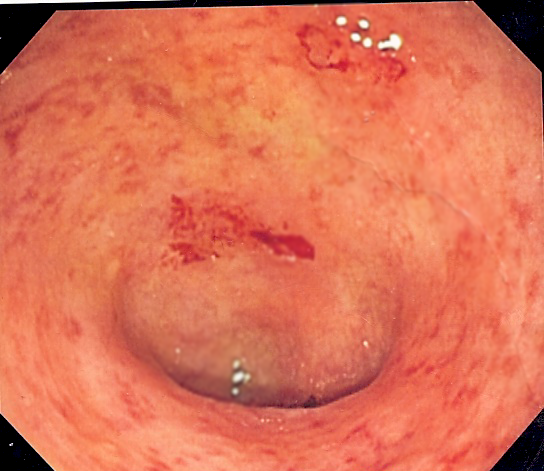
- •Document continuous inflammation starting at the anal verge using the Mayo Endoscopic Subscore (0-3) or UCEIS (0-8). Classify extent by Montreal (E1/E2/E3), this determines treatment approach and prognostic counseling.
- •Obtain baseline labs: CBC, CRP, albumin, ferritin. Check pANCA if diagnostic uncertainty exists (specificity 89%, sensitivity 55%). Consider intestinal ultrasound: bowel wall thickness >2.8 mm predicts remission (AUC 0.87).
- •In ASUC, apply Truelove and Witts criteria (≥6 bloody stools/day plus pulse >90, temp >37.8°C, Hb <10.5 g/dL, or ESR >30 mm/h). Obtain abdominal X-ray for toxic megacolon (dilation >5.5 cm).
- •Assess steroid response at day 3 using Oxford criteria: persistent stool frequency >8/day or CRP >45 mg/L predicts steroid failure with ~85% sensitivity and mandates rescue therapy.
- •Biopsy for histology using the Nancy Index (grades 0-4) or Robarts score; histologic activity independently predicts relapse. Test for CMV by immunohistochemistry or PCR in steroid-refractory severe colitis.
- •For long-standing disease (>8 years), perform surveillance colonoscopy with dye-based chromoendoscopy and targeted biopsies, random biopsies have negligible yield. In pregnancy, continue anti-TNF therapy; disease activity is more harmful than medication.
Management
- •For mild-to-moderate active UC, begin mesalazine (5-ASA) 2.4-4.8 g/day oral plus topical enema or suppository. Alternatively, budesonide MMX 9 mg once daily for 8 weeks (combined clinical/endoscopic remission 17.4% vs 4.5% placebo). Reserve prednisone 40 mg/day for 5-ASA failures.
- •For ASUC: hospitalize, start IV methylprednisolone 60 mg daily or hydrocortisone 100 mg q6h, plus VTE prophylaxis with enoxaparin 40 mg SC daily. Assess day 3 using Oxford criteria; continue IV steroids for up to 7 days.
- •Steroid-refractory ASUC: initiate rescue therapy with infliximab 5 mg/kg IV at weeks 0, 2, 6 (then q8wk), ciclosporin 2 mg/kg/day continuous IV, or tofacitinib 10 mg BID. If no response in 48-72 hours, consult colorectal surgery for subtotal colectomy.
- •After achieving remission, maintain with the same advanced therapy. In biologic-naïve patients, preferred higher-efficacy options (per 2024 AGA): infliximab, vedolizumab, ozanimod, etrasimod, upadacitinib, risankizumab, guselkumab.
- •For prior anti-TNF failure, rank tofacitinib, upadacitinib, and ustekinumab highest. Combine anti-TNF with azathioprine 2-2.5 mg/kg/day to improve outcomes. Maintenance dosing: vedolizumab 300 mg IV q8wk or 108 mg SC q2wk; ustekinumab 90 mg SC q8-12wk; upadacitinib 15-30 mg daily; tofacitinib 5-10 mg BID.
- •Taper corticosteroids over at least 10 weeks (6-week taper is inferior for steroid-free remission, RR 2.19). Use treat-to-target monitoring: clinical symptoms, fecal calprotectin <150 μg/g, colonoscopy every 1-3 years target Mayo 0-1.
- •What NOT to do: methotrexate monotherapy for maintenance (no benefit); thiopurine monotherapy for induction; probiotics for remission; antidiarrheals, anticholinergics, or opioids in ASUC.
- •Screen for latent infections (TB, hepatitis) before advanced therapy. Vaccinate against influenza, pneumococcus, and herpes zoster (especially before JAK inhibitors, HZ risk RR ~7).
- •CRC surveillance: start colonoscopy 8-10 years after diagnosis, repeat every 1-3 years based on risk (PSC, prior dysplasia). Use chromoendoscopy. Recommend Mediterranean diet, regular physical activity; low-FODMAP for functional symptoms.
- •Special populations: in pregnancy, continue anti-TNF; in elderly, assess frailty and consider vedolizumab for safety; in children, use weight-based 5-ASA (30-40 mg/kg/day).
Board Review — High Yield
- •Montreal E1 (proctitis), Inflammation ≤15 cm from anal verge; often responds to topical 5-ASA alone.
- •Truelove and Witts criteria, ≥6 bloody stools/day plus systemic toxicity defines acute severe UC; prompts hospitalisation and IV steroids.
- •Oxford criteria, At day 3 of IV steroids, stool frequency >8/day or CRP >45 mg/L predicts need for rescue therapy (85% sensitivity).
- •Fecal calprotectin <150 μg/g, Effectively rules out active endoscopic inflammation; normal CRP does not.
- •Mayo Endoscopic Subscore 0, Normal mucosa; target of treat-to-target strategies. MES 0-1 is endoscopic remission.
- •Vedolizumab, Gut-selective α4β7 integrin inhibitor; superior to adalimumab in head-to-head VARSITY trial; low infection risk.
- •JAK inhibitors and herpes zoster, Tofacitinib and upadacitinib increase HZ risk (RR ~7); vaccinate before initiation.
- •Dye-based chromoendoscopy, Preferred surveillance technique for dysplasia detection; random biopsies have negligible yield.
- •Colectomy risk decline, 5-year risk ~7% in modern era (down from ~13% historically) due to biologics and small molecules.
- •Anti-TNF continuation in pregnancy, Not associated with increased adverse outcomes; disease activity is more harmful than medication.
Deep Dive — Evidence Details
Definition, Classification & Nomenclature
- ▸UC is a principal IBD diagnostic category distinguished clinically from CD, but the distinction can remain uncertain in a subset of patients.[619][621][624]
- ▸IBDU or indeterminate colitis should be used when available evidence does not support confident classification as UC or CD; classification may change during follow-up.[624]
- ▸Disease identity should be separated from activity, endoscopic severity, treatment response, D2T status, and associated extraintestinal or hepatobiliary disease.[616][617][620][625][626]
- ▸FOCUS provides a three-tier chromoendoscopic nomenclature for suspected flat-type UC-associated dysplasia: Type I, Type II, and Type III.[618]
- ▸Biomarkers, microbiome findings, immune pathways, and genetic associations are adjunctive descriptors or research findings, not standalone definitions of UC.[60][615][619][628][629][630][631]
Definition and diagnostic position
Ulcerative colitis (UC) is used in the cited literature as a principal diagnostic category within inflammatory bowel disease (IBD), alongside Crohn’s disease (CD). The distinction is clinically consequential because UC and CD may require different diagnostic interpretation, prognostic assessment, and therapeutic planning.[619][621]C[624] The available evidence does not provide a new universally accepted disease definition or replace established clinicopathological criteria; instead, it refines how UC is identified, classified, and separated from overlapping or indeterminate phenotypes.
UC is treated as a heterogeneous disorder rather than a single uniform phenotype. Contemporary studies describe variation in clinical activity, endoscopic severity, inflammatory biology, microbiota, extraintestinal manifestations, and treatment trajectory among patients assigned a UC diagnosis.[615][617]C[620][625][626][628][630] This heterogeneity supports retaining descriptive qualifiers—such as activity, extent, endoscopic severity, treatment response, and disease complexity—rather than using “UC” alone as a complete phenotype label.[617]C[620][626]
Classification by certainty of IBD diagnosis
Patients who cannot be confidently classified as having either CD or UC may be labelled inflammatory bowel disease unclassified (IBDU); “indeterminate colitis” is also used in the cited registry study.[624] IBDU represented approximately 10% of patients in the background description of that study, although the precise proportion depends on the population and classification approach.[624] IBDU is therefore a provisional or uncertainty category, not a third biologically uniform form of IBD.[624]
Longitudinal reassessment is important because some patients initially classified as IBDU may subsequently be reclassified as UC or CD. The Spanish ENEIDA multicentre study specifically evaluated diagnostic changes during follow-up and compared IBDU with matched UC, demonstrating that diagnostic classification may evolve over time.[624] Accordingly, nomenclature should record the current level of diagnostic certainty and should be revised when accumulated clinical, endoscopic, histological, radiological, or molecular evidence supports a more specific classification.[624]
Classification by disease relationship and associated conditions
UC may coexist with or be associated with conditions that should be documented separately rather than incorporated into the primary intestinal diagnosis. Primary sclerosing cholangitis (PSC) is described as closely associated with IBD and is evaluated both in general populations and in IBD populations; PSC should therefore be recorded as an associated hepatobiliary disease or phenotype modifier when present.[616] Extraintestinal manifestations and concurrent immune-mediated inflammatory diseases are also common enough to warrant explicit classification alongside the intestinal diagnosis, rather than being treated as synonyms for UC activity.[625]
Population-based coding and informatics studies may identify UC using multiple coding systems, including ICD-9, ICD-10, and SNOMED CT; such coding labels are operational definitions for cohort ascertainment and should not be mistaken for full clinical diagnostic criteria.[623] Similarly, studies enrolling adults and children may use the same UC label across age groups, but age category remains an important descriptor because pediatric and adult cohorts can differ in presentation, monitoring, and treatment context.[620]
Phenotypic and activity descriptors
Disease activity should be specified independently from disease identity. Patient-reported symptom activity may be summarized using PRO-2 instruments, whereas endoscopic activity may be graded with the Mayo Endoscopic Score (MES).[617]C[620] The cited AI study evaluated automated MES prediction across adult and pediatric cohorts, confirming the continuing use of MES as an endoscopic classification framework, but it did not redefine UC itself.[620] Chromoendoscopic nomenclature may additionally describe suspected UC-associated neoplasia: the FOCUS classification categorizes flat lesions as Type I (suggestive of non-dysplasia), Type II (suggestive of dysplasia with low confidence), or Type III (suggestive of dysplasia with high confidence).[618]
A diagnosis of UC should not be inferred from a single biomarker or biological pathway. Anti-integrin αvβ6 autoantibodies are being evaluated as a discriminator between UC and CD and were compared with ANCA and ASCA, but they are diagnostic aids rather than replacements for integrated assessment.[619] Likewise, differences in mycobiome composition, IgG-targeted bacterial signatures, mucus-related gene expression, macrophage signalling, cortisol dynamics, or CCR5 genotype describe biological features or research associations, not standalone nomenclature categories.[60]D5[615][628][629][630][631]
Distinguishing UC from Crohn’s disease
The UC–CD distinction remains imperfect in a minority of patients. Granulomas are discussed as a histological feature occurring in a subset of patients with CD and as one characteristic that helps separate CD from UC, but their presence or absence should not be treated as the sole determinant of diagnosis.[621]C When evidence remains conflicting, the appropriate terminology is IBDU or indeterminate colitis, followed by periodic reassessment rather than forced assignment to UC or CD.[624]
Terminology for disease course and severity
The cited literature uses additional descriptors including active disease, clinical remission, endoscopic activity, difficult-to-treat (D2T) disease, treatment intolerance, and response or nonresponse.[617]C[620][626] These terms describe current state or course and are not interchangeable with the diagnostic label UC. In particular, progression to D2T disease is an outcome classification studied in relation to 5-aminosalicylate intolerance and subsequent treatment requirements; it should not be used as a synonym for severe UC at diagnosis.[626] Frailty, quality-of-life impairment, microbiome alterations, and extraintestinal disease are clinically relevant modifiers, but none independently establishes or redefines UC.[445]C4[615][625][627]C[632]
| Term | Meaning in the cited evidence | Classification role |
|---|---|---|
| UC | Principal IBD diagnostic category evaluated against CD | Primary diagnosis |
| CD | Alternative major IBD diagnostic category | Differential diagnosis |
| IBDU / indeterminate colitis | IBD not confidently classifiable as UC or CD | Uncertainty category; reassess longitudinally |
| MES | Mayo Endoscopic Score for endoscopic activity | Activity/severity descriptor |
| PRO-2 | Patient-reported symptom activity measure | Clinical activity descriptor |
| D2T disease | Difficult-to-treat disease-course classification | Prognostic/course descriptor |
| FOCUS Type I–III | Chromoendoscopic assessment of suspected flat-type dysplasia | Neoplasia descriptor |
Pathophysiology & Mechanism
- ▸UC pathophysiology reflects interaction among epithelial-barrier dysfunction, dysregulated innate and adaptive immunity, microbiota disturbance, and metabolic or cellular stress. [641][642][643][644][651]
- ▸Enterocyte differentiation defects may reduce absorptive ion transport and increase epithelial leak, contributing to inflammatory diarrhea. [637]
- ▸Etrasimod alters circulating and mucosal immune-cell signatures, including selective partial reductions in circulating T-cell populations. [634]
- ▸Selective systemic IgG responses to bacterial taxa and Ruminococcus gnavus-associated inflammation support antigen-specific microbiota–immune interactions. [628][647]
- ▸Difficult-to-treat IBD in trials is defined by active disease despite advanced therapies with **≥2 different mechanisms of action**. [633]
Overview
Ulcerative colitis (UC) is a chronic inflammatory bowel disease in which genetically susceptible hosts develop dysregulated mucosal immune responses, epithelial-barrier injury, and gut-microbiota disturbance. These processes are interdependent rather than isolated: barrier failure increases exposure to luminal antigens, microbial imbalance modifies immune activation, and inflammation further damages epithelial integrity. [641]D[642]D[643]D[644]D[651]D
Epithelial barrier dysfunction and diarrhea
The colonic epithelium normally coordinates tight-junction permeability, mucus protection, epithelial differentiation, and absorption of water and electrolytes. In inflammatory bowel disease, including UC, aberrant enterocyte differentiation is associated with reduced expression of absorptive ion-transport proteins and increased expression of proteins linked to epithelial leak, providing a mechanistic basis for chronic inflammatory diarrhea. These abnormalities were assessed across biopsies from the terminal ileum to the rectum and were related to disease activity, diarrhea severity, and proinflammatory cytokine expression. [637]
Mucus and tight-junction disruption are also implicated in experimental colitis. In a dextran-sulfate-sodium model, increased occludin and MUC2 expression accompanied attenuation of colitis after Myrica rubra juice treatment, together with taxon-specific changes in the microbiota and alterations in serum and fecal metabolomic profiles. These findings support a microbiota–metabolite–epithelium interaction, but they do not establish that the intervention or individual metabolites cause equivalent effects in human UC. [650]D
RhoA/ROCK signaling is another candidate regulator of epithelial-barrier integrity. In rats with DSS-induced colitis, electroacupuncture was specifically investigated for barrier protection through this pathway, indicating that altered cytoskeletal and junctional signaling may participate in experimental barrier injury; animal findings should not be equated with proven human treatment mechanisms. [639]
Immune dysregulation
UC involves abnormal innate and adaptive immune activity. Phase 3 ELEVATE UC analyses showed that etrasimod treatment changed circulating immune-cell populations and mucosal cellular and molecular signatures; the study evaluated blood from 525 etrasimod-treated and 257 placebo-treated patients and mucosal biopsies from 411 and 200 patients, respectively. The reported effects included selective and partial reduction of circulating T-cell populations and changes in mucosal immune, innate, and non-immune cell signatures, with analyses stratified by clinical remission status. [634]
T-helper-cell plasticity may connect metabolic signals with mucosal inflammation. In experimental colitis, physiologically tolerable cholic acid reduced disease activity and histologic inflammation, downregulated RORγt, promoted conversion of RORγt-positive Th17 cells toward IL-10-producing phenotypes, and reduced IFN-γ and IL-17 production. This supports bile-acid-dependent immune modulation as a mechanistic hypothesis, although the evidence is preclinical. [648]D
Toll-like receptor 3 (TLR3) is overexpressed in inflamed intestinal epithelium and represents a pathway linking epithelial sensing of nucleic-acid-associated signals with inflammation. PRV-300, an anti-TLR3 IgG4κ monoclonal antibody, was evaluated in a randomized phase 1b study in adults with moderate-to-severe UC defined by a Mayo Clinical Score of 6–12; participants received 7 intravenous doses during a 12-week treatment period followed by 8 weeks of follow-up. The trial primarily assessed safety and tolerability, with pharmacodynamic, pharmacokinetic, immunogenicity, and endoscopic outcomes as secondary measures; therefore, this study identifies a therapeutic target but does not by itself prove that TLR3 blockade modifies disease pathogenesis. [638]C
Microbiota, antigens, and metabolites
UC is associated with dysbiosis and an abnormal immune response to commensal organisms. Systemic IgG responses are not uniformly directed against the entire microbiota: profiling of patients with UC identified selective targeting of particular bacterial taxa, and IgG-targeted bacterial signatures were associated with active disease and increased systemic inflammatory markers. [628]
Ruminococcus gnavus has been identified in clinical microbiome profiling and causal animal studies as a UC-associated pathobiont whose abundance correlates positively with oxidative stress and inflammatory measures. In mice, a microbiota-directed mucosal immunotherapy was designed to enhance antigen presentation, stimulate T-follicular-helper-cell and germinal-center B-cell responses, and induce R. gnavus-specific secretory IgA; these findings support selective pathobiont control as an experimental strategy rather than established clinical therapy. [647]D
Microbial short-chain fatty acids—including acetate, propionate, and butyrate—are proposed mediators of the gut–immune axis. They may influence immune regulation, microbial metabolism, and epithelial-barrier maintenance, but the cited evidence is a mechanistic review and does not define a single causal SCFA defect or a validated replacement regimen for UC. [642]D
FMT aims to restore microbial balance. Placebo-controlled randomized trials and meta-analyses summarized in the cited review indicate that multi-donor FMT can produce clinical and endoscopic remission in some patients with mild-to-moderate UC, although donor composition, preparation, delivery, and durability remain important determinants. [641]D Microbial ecology also differs by intestinal context: analyses of ileal pouches compared normally functioning pouches, chronic pouchitis, UC, and healthy intact-colon microbiomes, while repeated antibiotic exposure was examined for bacterial antimicrobial-resistance signatures. These findings caution against assuming that a healthy-colon microbiome is an appropriate universal target for pouch or UC-associated disorders. [645]D
Molecular stress and therapeutic complexity
Experimental UC models demonstrate altered transcriptional programs involving inflammation, epithelial-barrier integrity, autophagy, and endoplasmic-reticulum stress; STAT6 knockout and Corylus avellana treatment were used to investigate these pathways in experimental and human UC profiling. [643]D Ethanol exacerbation of DSS colitis produced extensive epithelial-cell mRNA and microRNA changes, including increased oxidative-stress pathways, supporting oxidative injury as a potential amplifier of inflammation rather than a standalone cause of UC. [649]D
Emerging delivery approaches reflect the multifactorial nature of UC. Engineered exosomes have been developed to localize PD-L1-Fc assembly to diseased mucosa, while nanomedicine systems seek to improve intestinal targeting and reduce the poor solubility, instability, nonspecific distribution, and off-target toxicity associated with conventional therapies. These are investigational platforms, not established mechanisms of routine care. [644]D[651]D
Clinical heterogeneity and evidence limits
Mechanistic heterogeneity is mirrored by therapeutic heterogeneity. A systematic review of 179 advanced-therapy randomized trials found that inclusion and representation of difficult-to-treat IBD were heterogeneous; difficult-to-treat disease was defined as active disease despite exposure to advanced therapies with ≥2 different mechanisms of action. Consequently, trial-derived mechanisms and efficacy estimates may not fully represent treatment-refractory UC. [633] A separate cohort study used electronic health records to examine hidradenitis suppurativa across UC and other spondyloarthritis-related diseases, reflecting investigation of shared inflammatory comorbidity rather than proof of a UC-specific causal pathway. [635] Finally, a scoping review of active-UC trials examined registered studies to characterize trial design and outcome measures, underscoring that endpoint selection influences how biological activity is translated into clinical evidence. [646]D
Practical synthesis
The current model is a self-reinforcing loop: epithelial differentiation and barrier defects increase luminal exposure; dysbiosis and pathobionts alter antigenic and metabolic signals; innate and adaptive immune pathways sustain inflammation; and oxidative, endoplasmic-reticulum, and tissue-repair stress perpetuate mucosal injury. [628][637][642]D[643]D[647]D[649]D The most persuasive human evidence currently demonstrates cellular and mucosal immune modulation, disease-associated microbial immune targeting, and epithelial transport abnormalities, whereas many specific interventions—including bile-acid manipulation, acupuncture-mediated RhoA/ROCK regulation, engineered exosomes, and nanomedicine—remain preclinical or investigational. [634][637][638]C[639][644]D[648]D[651]D
| Domain | Evidence-supported mechanism | Evidence context |
|---|---|---|
| Epithelial barrier | Abnormal enterocyte differentiation, reduced absorptive transport, increased leak, and altered mucus or tight-junction markers | Human IBD biopsies and experimental models [637][639][650]D |
| Immune regulation | Altered circulating and mucosal lymphocyte signatures; Th17-to-IL-10 plasticity; TLR3 as an epithelial target | Human clinical data plus preclinical studies [634][638]C[648]D |
| Microbiota and metabolites | Selective IgG targeting, pathobiont enrichment, SCFA signaling, and microbiome-dependent therapeutic effects | Human profiling, reviews, and animal studies [628][641]D[642]D[647]D |
| Cellular stress | Oxidative-stress, autophagy, endoplasmic-reticulum-stress, and inflammation-related transcriptional changes | Human profiling and experimental colitis [643]D[649]D |
Epidemiology, Etiology & Risk Factors
- ▸UC etiology is best approached as multifactorial, involving environmental exposures, mucosal immunity, epithelial-barrier function, and microbial ecosystems [615,653,659].
- ▸PFOA exposure, gut mycobiome dysbiosis, intestinal permeability, socioeconomic conditions, and physical activity are active research areas, but the cited studies do not establish universal causal relationships [615,653,656,659,660].
- ▸Objective prospective assessment of physical activity included **95,197** UK Biobank participants; the study defined an active-weekend-warrior exposure as **≥231.5 minutes/week** of MVPA with **≥50%** on 1–2 days [660].
- ▸MMP-10 and routinely collected clinical data are being investigated for pre-diagnostic IBD or UC risk prediction, but prediction is distinct from causation and requires validation [655,663].
- ▸Associations between UC and other immune-mediated conditions, including eosinophilic esophagitis and hidradenitis suppurativa, may reflect shared inflammatory susceptibility rather than direct etiologic relationships [623,635].
Epidemiology
Ulcerative colitis (UC) is a chronic, relapsing inflammatory disorder of the colonic mucosa. Contemporary literature continues to describe inflammatory bowel disease (IBD) incidence as increasing, particularly in middle-income countries, although the cited global biomarker study addresses IBD overall rather than providing UC-specific incidence estimates [655]C. The available 2026 evidence base is dominated by prospective cohorts, retrospective electronic-health-record analyses, case-control studies, systematic reviews, and mechanistic investigations; therefore, associations should not automatically be interpreted as causal relationships [615][656][660][663].
UC is clinically heterogeneous, and current research increasingly focuses on identifying biological and environmental subgroups. A retrospective cohort of 346 patients with UC evaluated clinical indicators and peripheral-blood T-cell subsets to develop models for therapeutic-response prediction; patients were divided into training (n=242) and validation (n=104) cohorts [652]. This study informs disease stratification and treatment response rather than population incidence or primary disease causation [652]. Similarly, a full-thickness spatial-transcriptomics study examined medically refractory UC in 3 patients and 3 controls, identifying tissue-level immune and stromal niches associated with biologic non-response; the very small sample limits epidemiologic inference [658]C.
Etiology and host–environment interactions
Current evidence supports a multifactorial model in which environmental exposures interact with mucosal immunity, epithelial-barrier function, and the intestinal microbial ecosystem. A systematic review and meta-analysis specifically evaluated gut fungal diversity, taxonomic composition, and relative abundance in IBD, including UC, compared with individuals without IBD, and assessed relationships with phenotype and inflammatory activity [615]. These data support investigation of mycobiome dysbiosis as a potential contributor to immune dysregulation, but do not establish that fungal alterations initiate UC [615].
Intestinal permeability is another candidate intermediary. In a prospective pediatric IBD program, plasma lipopolysaccharide-binding protein (LBP) was measured in 1,083 longitudinal samples from newly diagnosed children, including 61 with UC and 115 with Crohn disease, to examine relationships between permeability-related endotoxin exposure, clinicopathological activity, and immunological disease activity [659]. LBP is an indirect marker rather than a direct measurement of epithelial permeability; consequently, the findings should be interpreted as evidence of a possible barrier–inflammation relationship, not proof that increased permeability is a primary cause of UC [659].
Environmental chemical exposure is also being investigated. A 2026 meta-analysis examined the association between perfluorooctanoic acid (PFOA), a persistent organic pollutant, and UC onset, while integrated network toxicology, cross-species transcriptomics, protein–protein interaction analysis, weighted gene-coexpression analysis, and single-cell approaches were used to explore mechanisms [653]. This work supports PFOA as a hypothesis-generating environmental exposure, but mechanistic signatures and epidemiologic associations do not by themselves prove that PFOA causes UC in individuals [653].
Lifestyle and socioeconomic factors
Socioeconomic conditions may influence IBD risk through correlated lifestyle and environmental exposures. A prospective cohort study classified socioeconomic status using household income, education, and employment, grouped participants into high-, medium-, and low-SES profiles, and assessed smoking, alcohol consumption, diet, physical activity, body mass index, and sleep duration as components of a healthy-lifestyle mediator [656]. Because the reported framework concerns incident IBD overall, its applicability to UC specifically requires disease-specific analysis [656].
Physical activity has been examined using objective rather than self-reported measurements. A population-based prospective UK Biobank study included 95,197 participants without baseline IBD and used accelerometers to quantify sedentary behavior, light physical activity, and moderate-to-vigorous physical activity (MVPA) in relation to incident UC [660]. MVPA patterns included an active-weekend-warrior category defined as at least 231.5 minutes/week, with at least 50% of activity occurring on 1–2 days, and an active-regular category [660]. These thresholds describe the study exposure definitions; they should not yet be presented as proven preventive prescriptions without the study’s fully reported effect estimates [660].
Biomarkers and associated conditions
Pre-diagnostic biomarkers may help identify people at increased risk but are not established causes. The PURE biomarker substudy evaluated serum proteins, including matrix metalloproteinase-10 (MMP-10), in a globally recruited population for prediction of incident IBD, with UC and Crohn disease assessed as secondary outcomes [655]C. A separate nationwide electronic-health-record study used longitudinal laboratory results, body mass index, demographics, and comorbidities in 81,960 individuals to develop interpretable models predicting UC and Crohn disease years before diagnosis [663]. These studies indicate the potential value of routinely collected data and circulating biomarkers for risk prediction, while requiring external validation before clinical use [655]C[663].
Several immune-mediated or inflammatory conditions may coexist with UC. A national real-world cohort characterized adults with overlapping eosinophilic esophagitis and IBD using repeated diagnosis dates, including UC and Crohn disease [623]. A large electronic-health-record study also examined hidradenitis suppurativa across spondyloarthritis-related diseases, including UC, with comparisons matched for age, sex, body mass index, and comorbidities [635]. These studies address epidemiologic overlap and shared inflammatory susceptibility, not direct causation [623][635]. Pediatric case-control research additionally compared serum vitamin profiles and immune-cell characteristics in 46 children with IBD and 46 age- and sex-matched controls; because deficiencies may result from inflammation, diet, or treatment, vitamin abnormalities should not automatically be regarded as initiating risk factors [662].
| Domain | Evidence | Interpretation |
|---|---|---|
| Microbiome | Systematic review/meta-analysis of intestinal mycobiome alterations in IBD, including UC [615] | Supports investigation of fungal dysbiosis; causality remains unproven [615] |
| Environmental exposure | Meta-analysis and mechanistic investigation of PFOA and UC onset [653] | Hypothesis-generating evidence for pollutant exposure [653] |
| Barrier function | Longitudinal pediatric LBP analysis including 61 children with UC [659] | Supports a possible permeability–inflammation relationship [659] |
| Lifestyle/SES | Prospective cohort examining SES and lifestyle mediation in incident IBD [656] | Relevant to risk disparities; UC-specific effects require confirmation [656] |
| Physical activity | Prospective accelerometer-based study of 95,197 participants [660] | Objective evaluation of activity and incident UC risk [660] |
| Biomarkers | PURE MMP-10 analysis and nationwide clinical prediction modeling [655]C[663] | Potential risk-prediction tools, not established etiologic factors [655]C[663] |
Clinical Presentation
- ▸UC presentation should be assessed across intestinal symptoms, inflammatory activity, extent, complications, and extraintestinal manifestations [667][679].
- ▸EIMs occurred in 15.4% of UC patients in a large Chinese inpatient study, and 22.6% of patients with timing data developed an EIM before intestinal symptoms [669].
- ▸Perianal disease is uncommon in UC but may precede diagnosis; fissures were the most frequent presenting lesion [670].
- ▸Amebic colitis, focal active colitis, lymphoma, hematologic ulceration, and other conditions can mimic UC [673][672][668][204].
- ▸PSC, pancreatitis, sarcopenia/myosteatosis, and opportunistic infections may identify clinically important associated or complicated disease states [248][676][666][250].
Core intestinal presentation
The supplied evidence describes ulcerative colitis (UC) primarily within cohorts of inflammatory bowel disease (IBD), pediatric colonic IBD, hospitalized IBD, and studies evaluating active disease. Clinical assessment should therefore document the intestinal symptom pattern, disease extent, inflammatory activity, complications, and extraintestinal manifestations rather than relying on symptoms alone [667][679]. In pediatric colonic IBD, UC is evaluated alongside IBD-unclassified and colonic Crohn disease, and treatment response or primary nonresponse may be clinically defined by subsequent biologic discontinuation, drug switching, or surgery [667]. A phase 1 trial specifically enrolled patients with active UC, confirming that “active disease” is a clinically identifiable presentation suitable for symptom, endoscopic, biomarker, and biological-response assessment [240]A1b.
Abdominal pain and diarrhea are important presenting symptoms in the differential diagnosis of colitis, although they are not specific for UC. In a Beijing series of amebic colitis, 83.3% of patients presented with abdominal pain and/or diarrhea; endoscopy showed segmental erosions or ulcerations involving the ileocecal region, rectum, or entire colon [673]. These findings emphasize that infectious colitis can clinically and endoscopically mimic UC, particularly when ulceration is present [673]. Focal active colitis on biopsy is likewise not synonymous with UC: among 419 adults with isolated focal active colitis, abdominal pain was reported in 57.5%, colonoscopy was normal in 73%, and only 2.15% developed IBD during a mean 26-month follow-up [672]C.
Severity markers and complicated presentations
Hospitalized patients with IBD may have reduced muscle quantity or quality. CT-based sarcopenia and myosteatosis were evaluated at the third lumbar vertebral level in 308 hospitalized patients, including 251 with UC; these measures were studied as predictors of later treatment escalation, defined as biologic therapy, cyclosporine, or surgery after relapse [666]. Thus, low muscle reserves may accompany a clinically consequential phenotype, although the cited abstract does not establish sarcopenia or myosteatosis as presenting symptoms [666].
A particularly concerning presentation is intestinal ulceration accompanied by pancytopenia. A pooled individual-patient systematic review evaluated cases occurring in patients with IBD or intestinal Behçet disease together with myelodysplastic syndrome or aplastic anemia, highlighting the need to distinguish severe inflammatory disease from hematologic causes of ulceration and cytopenias [204]B2a. Colorectal lymphoma is another rare alternative diagnosis in children; pediatric colorectal lymphoma may be primary or secondary, can resemble inflammatory disease, and creates diagnostic and surgical challenges [668].
Extraintestinal and perianal manifestations
Extraintestinal manifestations (EIMs) may precede bowel symptoms. In a nationwide Chinese inpatient study, 17.1% of 2,252 adults with IBD reported at least one EIM; among patients with available timing data, 22.6% developed their first EIM before intestinal symptoms. EIMs were less frequent in UC than Crohn disease but still occurred in 15.4% of UC patients [669]. The study therefore supports asking about musculoskeletal, skin, eye, hepatobiliary, and other systemic symptoms even when bowel symptoms are absent or recent [669].
Ear, nose, and throat involvement is an underrecognized component of IBD. A systematic review of 23 studies evaluated ENT manifestations in UC and Crohn disease, including their clinical spectrum, diagnostic approaches, and outcomes [249]B2a. ENT complaints should consequently be actively elicited when evaluating a patient with suspected or established UC, while recognizing that the cited abstract does not provide UC-specific prevalence estimates [249]B2a.
Perianal disease can occur in UC, although it is uncommon and may raise diagnostic questions about Crohn disease or an alternative phenotype. In the ENEIDA registry, 411 of 9,884 patients with UC developed perianal disease, corresponding to an incidence of 0.5 cases per 100 person-years; 22% developed perianal disease before the UC diagnosis. The most common presenting lesion was an anal fissure (52%), followed by fistula [670]C. Obstetric assessment is also relevant: among primiparous women with IBD but without active perianal disease, a cohort study evaluated perineal injury during vaginal birth, indicating that reproductive and perineal history should be incorporated into clinical assessment [671].
Associated hepatobiliary, pancreatic, and systemic findings
Primary sclerosing cholangitis (PSC) is an important hepatobiliary association. In a Greek multicenter PSC cohort, 62.5% of patients with PSC-IBD had UC, and 76% of those with UC had pancolitis; PSC was diagnosed at a younger age in PSC-IBD than in PSC without IBD [248]B2b. Abnormal liver tests or cholestatic symptoms should therefore prompt evaluation for associated PSC [248]B2b.
Acute pancreatitis may complicate pediatric IBD. In a single-center cohort of 395 children with IBD, 4.1% developed acute pancreatitis; four cases were attributed to azathioprine, and the remaining cases were classified as idiopathic after exclusion of drug-induced, metabolic, infectious, genetic, and structural causes [676]C.
Diagnostic context and mimics
Amebic colitis, focal active colitis, colorectal lymphoma, hematologic ulceration, pelvic radiation-related bowel dysfunction, and opportunistic infections can produce symptoms or mucosal findings that overlap with UC [673][672]C[668][204]B2a[677]C. In Mediterranean endemic regions, symptomatic leishmaniasis is also a relevant consideration in biologic-treated IBD patients [250]B3b. Gut microbiome metagenomic profiles are being investigated as noninvasive diagnostic or treatment-response markers in therapy-naive pediatric IBD, but they should not replace clinical, endoscopic, histologic, and laboratory assessment [678]. Autoimmune liver disease cohorts and axial spondyloarthritis studies provide additional systemic-disease context but do not define UC-specific presenting symptoms [622]C[675].
| Finding or context | Reported evidence |
|---|---|
| EIMs in UC | 15.4% in a Chinese multicenter IBD inpatient cohort [669] |
| EIM before intestinal symptoms | 22.6% among patients with available timing data [669] |
| Perianal disease in UC | 411/9,884; incidence 0.5 cases per 100 person-years [670]C |
| Perianal fissures | 52% of perianal lesions at presentation [670]C |
| PSC-IBD with UC | 62.5%; pancolitis in 76% of UC cases [248]B2b |
| Pediatric IBD with acute pancreatitis | 4.1% overall; four cases were azathioprine-related [676]C |
| Amebic colitis symptoms | Abdominal pain and/or diarrhea in 83.3% [673] |
| Isolated focal active colitis progressing to IBD | 2.15% during mean 26-month follow-up [672]C |
Diagnosis & Workup (Endoscopy, Imaging & Severity Labs)
- ▸Endoscopy remains central for documenting UC mucosal activity, treatment response, and UC-associated neoplasia; histopathology remains the reference for evaluating dysplasia [618][680].
- ▸Chromoendoscopic FOCUS classification uses Type I, II, and III patterns for flat-type dysplasia assessment and was compared with histopathology across 230 biopsy sites [618].
- ▸AI tools can standardize Mayo Endoscopic Score assessment, while QUAD adds inflammatory extent using a 0–3 score for each image quadrant; both remain adjunctive technologies [620][682].
- ▸CRP and fecal calprotectin are established monitoring biomarkers in the cited studies; exploratory wearable thresholds corresponded to CRP 5 mg/L and fecal calprotectin 250 µg/g [654].
- ▸RDW should not be used alone for diagnosis or activity grading because a systematic review and meta-analysis questioned its clinical utility [684].
- ▸Intestinal ultrasound evaluates bowel-wall thickness and color Doppler signal, whereas MRE may identify nutritional consequences such as reduced muscle mass in pediatric UC [636][689].
- ▸For acute severe UC, Day 1 scores such as ADMIT-ASC, ACE, and ROR, together with early pediatric PUCAI assessment, are intended to identify steroid non-response and support timely escalation [665][688].
Diagnostic framework
Ulcerative colitis (UC) assessment should integrate symptoms, endoscopic findings, histopathology, laboratory inflammation, and—when clinically appropriate—intestinal imaging. The cited 2026 evidence supports endoscopy as the principal method for documenting mucosal activity and dysplasia, while biomarkers and imaging provide complementary information about inflammatory burden, transmural features, complications, and disease activity between procedures [618][620][682][636][686]C. The studies supplied do not establish a single diagnostic test or replace clinicopathologic assessment with any emerging biomarker.
Endoscopy and tissue assessment
Endoscopic examination is central to assessing UC activity and treatment response. The phase 2 trial of oral icotrokinra used clinical response, clinical remission, symptom remission, and endoscopic improvement at week 12 as outcomes, illustrating the continuing role of endoscopic assessment in therapeutic evaluation [680]. Mayo Endoscopic Score (MES) is an established target for automated assessment; a multicohort deep-learning study trained models to predict MES using adult and pediatric images from Turkey, China, and the United States, addressing interobserver variability across geographically and demographically diverse datasets [620]. AI-derived MES should currently be regarded as an adjunct to expert endoscopic interpretation rather than an autonomous diagnostic substitute because the cited study evaluated model performance, not replacement of clinical oversight [620].
Chromoendoscopy is particularly relevant when evaluating suspected UC-associated neoplasia (UCAN), including lesions with a flat appearance. The FOCUS classification categorizes chromoendoscopic patterns as Type I, suggestive of non-dysplasia; Type II, suggestive of dysplasia with low confidence; or Type III, suggestive of dysplasia with high confidence [618]. In the supporting study, prospectively recorded classifications from 230 biopsy sites involving 33 UCAN lesions in 26 patients were compared with histopathology [618]. Histologic examination therefore remains the reference against which chromoendoscopic characterization is assessed [618].
Endoscopic severity should consider not only the worst-appearing segment but also the spatial extent of inflammation. The QUAD system assigns a score of 0–3 to each image quadrant and was developed to quantify inflammatory extent; in a prospective cohort of patients in clinical remission, its purpose was to evaluate whether extent-informed assessment improves prediction of relapse over 24 months [682]. This approach complements, rather than invalidates, conventional peak-severity indices [682].
Noninvasive biomarkers and severity laboratories
Serum C-reactive protein (CRP) and fecal calprotectin remain the biomarkers specifically used in the cited work to monitor IBD between endoscopies [654]C. In a feasibility study of a wearable perspiration sensor, exploratory ROC thresholds were aligned with serum CRP 5 mg/L and fecal calprotectin 250 µg/g; however, the sensor evidence was based on only 27 patients with UC within a mixed IBD cohort and was explicitly exploratory [654]C. Continuous perspiration monitoring should therefore not be treated as a validated replacement for conventional blood or stool sampling [654]C.
Routine inflammatory and hematologic testing may include red-cell indices, but RDW should be interpreted cautiously. A systematic review and meta-analysis specifically challenged the utility of red cell distribution width (RDW) for detecting IBD or reliably reflecting disease activity [684]. RDW should not be used in isolation to diagnose UC, grade severity, or determine treatment response [684].
Serological markers may correlate with endoscopic or histologic activity, but their performance is not sufficient to replace direct disease assessment. A retrospective study of 267 IBD patients evaluated serological markers against endoscopic, pathologic, or imaging classifications and explored their predictive value for UC and Crohn’s disease activity [686]C. These findings support serology as an adjunct rather than a standalone diagnostic strategy [686]C.
Anti-integrin αvβ6 autoantibodies are a promising disease-discrimination biomarker. In a prospective cross-sectional study of 224 patients with UC or Crohn’s disease, their ability to distinguish UC from Crohn’s disease was compared directly with ANCA and ASCA; the study was designed because reliable serologic differentiation remains limited [619]. Anti-integrin αvβ6 testing may be considered investigational or supplementary until performance is confirmed across broader settings [619].
Imaging and bowel-wall assessment
Intestinal ultrasound can complement endoscopy by assessing bowel-wall and vascular features. In a prospective study of 59 UC patients, transabdominal and transperineal ultrasound measured bowel-wall thickness, individual bowel-wall layers, and color Doppler signal in the sigmoid colon and rectum, with comparison against endoscopic activity and biomarkers [636]. These parameters were also studied in relation to bowel urgency and possible transmural inflammatory features, recognizing that symptoms may not be explained solely by mucosal appearance [636].
Magnetic resonance enterography (MRE) may provide additional information in selected diagnostic workups, particularly in children or when broader intestinal assessment is needed. In a pediatric exploratory study, MRE-derived total psoas muscle area at the L3 vertebral level was evaluated as an opportunistic marker of sarcopenia in 20 children newly diagnosed with UC and was compared with clinical, laboratory, and endoscopic activity [689]. MRE-derived muscle measures are therefore potentially useful for identifying nutritional or systemic consequences of disease, but the small retrospective sample does not establish a diagnostic threshold for UC or sarcopenia [689].
Acute severe disease
Patients hospitalized with acute severe UC require rapid, repeated clinical and laboratory assessment, with early evaluation of likely corticosteroid response. A contemporary multicenter validation study compared Day 1 prognostic tools, including the Admission Model for Intensification of Therapy in Acute Severe Colitis (ADMIT-ASC), the Albumin–CRP–Endoscopy (ACE) index, and the Risk of Rescue (ROR) score [665]. These tools were developed to identify patients at risk of steroid non-response and support timely escalation, but the cited evidence is observational validation rather than proof that any single score should replace bedside judgment [665]. Pediatric evidence similarly evaluated clinical, laboratory, and treatment variables at admission and during hospitalization, including whether day 3 PUCAI could help identify intravenous corticosteroid failure earlier than day 5 [688]C.
Practical interpretation
Use endoscopy with biopsies to establish and characterize mucosal disease, assess dysplasia, and document response; combine this with CRP, fecal calprotectin, hematologic testing, and clinical assessment. Use ultrasound or MRE selectively for bowel-wall, extra-mucosal, nutritional, or transmural information. Treat AI scores, anti-integrin αvβ6 antibodies, wearable biomarkers, RDW, and opportunistic MRE muscle measurements as emerging or adjunctive tools rather than replacements for integrated clinicopathologic evaluation [618][619][620][636][654]C[684][686]C[689].
| Component | What the cited evidence supports | Important limitation |
|---|---|---|
| Ileocolonoscopy, chromoendoscopy, and biopsy | Mucosal activity assessment, endoscopic improvement, and dysplasia characterization; FOCUS Type I–III classification for flat-type UCAN lesions [618][680] | Histopathology remains necessary for confirmation of dysplasia [618] |
| AI endoscopic scoring | Automated MES prediction and QUAD quantification of inflammatory extent [620][682] | Requires validation and expert oversight; not a replacement for clinical interpretation [620][682] |
| Blood and stool biomarkers | CRP and fecal calprotectin for interval monitoring; exploratory thresholds of 5 mg/L and 250 µg/g, respectively [654]C | Wearable perspiration monitoring remains feasibility-stage evidence [654]C |
| Serology | Anti-integrin αvβ6 may help distinguish UC from Crohn’s disease; serological markers may correlate with activity [619][686]C | Not a standalone diagnostic substitute [619][686]C |
| Intestinal ultrasound | Bowel-wall thickness, bowel-wall layers, and color Doppler assessment, including evaluation of urgency-related features [636] | Evidence is prospective but single-center [636] |
| MRE | Opportunistic assessment of psoas muscle area and sarcopenia-related consequences in pediatric UC [689] | Small retrospective exploratory cohort; no diagnostic threshold established [689] |
| ASUC prognostic assessment | ADMIT-ASC, ACE, ROR, and pediatric day 3 PUCAI can support early steroid-response assessment [665][688]C | Scores supplement, rather than replace, bedside assessment [665][688]C |
Severity, Staging & Risk Stratification (GI Scores)
- ▸ASUC risk assessment should prioritize early identification of corticosteroid non-response and timely rescue or surgical planning. [665][691]
- ▸Contemporary day-1 tools include ADMIT-ASC, the ACE index, and the ROR score; the supplied evidence does not provide their numerical cut-offs. [665]
- ▸Endoscopic severity, especially MES, remains a core objective domain; AI-based MES prediction may improve consistency but is not a replacement for clinical judgment. [620]
- ▸Biomarkers, intestinal ultrasound, PRO-2, LRG, and machine-learning models are adjunctive or emerging tools and should not replace integrated clinical, laboratory, and endoscopic assessment. [617][636][652][686][696]
- ▸Baseline molecular inflammatory scores may be prognostic without reliably modifying relative treatment benefit. [694]
Scope and clinical framework
Ulcerative colitis (UC) severity should be assessed multidimensionally rather than inferred from symptoms alone. Relevant domains include stool frequency and rectal bleeding, systemic toxicity, inflammatory biomarkers, serum albumin, endoscopic activity, disease extent, nutritional status, comorbidity, and early treatment response. The supplied contemporary evidence does not provide a replacement for established clinical or endoscopic indices; instead, it supports integrating validated scores with objective reassessment and emerging prediction tools. [665][686]C
Disease severity and endoscopic staging
Endoscopic severity remains central to risk assessment because mucosal inflammatory burden informs treatment decisions and prognosis. The Mayo Endoscopic Score (MES) is being evaluated for more reproducible application: an artificial-intelligence model was developed across adult and pediatric cohorts and externally assessed in datasets from Turkey, China, and the United States. [620] This technology may reduce interobserver variability, but it is an assessment aid rather than an independently validated clinical staging system. [620]
A baseline 200-gene mucosal inflammatory-response score was examined across randomized biologic datasets and treated cohorts. The analysis distinguished prognostic association from treatment-effect modification, indicating that a baseline inflammatory score may correlate with outcomes without reliably identifying patients who derive greater relative benefit from a particular biologic. [694] Tissue-level transcriptomic work in medically refractory UC identified spatial immune-stromal niches associated with biologic non-response, but the evidence was generated from a very small surgical series and is not ready for routine risk stratification. [658]C
Acute severe ulcerative colitis (ASUC)
ASUC is a medical emergency requiring inpatient assessment, exclusion of complications and infection, venous-thromboembolism prevention, close monitoring, and early multidisciplinary decision-making. [691][661] Day-1 risk stratification is intended to identify likely corticosteroid non-response early enough to support timely rescue therapy or surgical consultation. A contemporary multicentre validation study directly compared the Admission Model for Intensification of Therapy in Acute Severe Colitis (ADMIT-ASC), the Albumin–C-reactive protein–Endoscopy (ACE) index, and the Risk of Rescue (ROR) score. [665] The available abstract identifies these tools and their comparative validation objective but does not report their numerical cut-offs or discrimination estimates; those values should therefore not be reproduced without the full publication. [665]
Clinical reassessment should be serial rather than based on admission values alone. In a double-blind pilot randomized trial of 72 adults with ASUC, tofacitinib was administered with intravenous hydrocortisone and compared at 20 mg/day versus 30 mg/day; the primary endpoint was clinical response by day 7, with medical rescue, post-discharge escalation, or colectomy assessed through 90 days. [691] These treatment outcomes illustrate the importance of rapid early response assessment, but they do not establish a new severity score or validate tofacitinib as a universal first-line ASUC strategy. [691]
Biomarkers and non-invasive monitoring
C-reactive protein, albumin, hemoglobin, fecal inflammatory markers, and other routine laboratory variables remain useful adjuncts to clinical and endoscopic assessment, but no single serum marker should replace objective disease evaluation. A retrospective study correlated serological markers with endoscopic and histological healing in 141 patients with UC, exploring both individual and combined markers for non-invasive activity assessment. [686]C Intestinal ultrasound provides another non-invasive option: bowel-wall thickness and colour Doppler signal were evaluated against urgency, endoscopic activity, and biomarkers in a prospective cohort of 59 UC patients. [636] These findings support ultrasound as a potential monitoring adjunct, particularly when symptoms may not accurately reflect inflammatory burden, but the cited evidence does not define universal severity thresholds. [636]
Leucine-rich alpha-2 glycoprotein (LRG) has been investigated as a predictive rather than purely descriptive biomarker. In a prospective cohort of biologic-naive Egyptian patients with IBD, pretreatment serum LRG was assessed for primary non-response to anti-TNF therapy at week 24, including a UC subgroup. [696] LRG should therefore be viewed as a candidate treatment-response predictor requiring contextual interpretation, not as a standalone staging score. [696]
Patient-reported outcomes remain important for symptom severity and longitudinal monitoring. A rapid Patient-Reported Outcome-2 approach using a combination of retrospective and prospective symptom recording was compared with the conventional 4-day PRO-2 in a large IBD cohort that included 548 UC patients. [617]C Such measures can improve feasibility of repeated assessment, but symptom scores should be interpreted alongside objective inflammation because urgency and other symptoms may persist despite changing inflammatory activity. [617]C[636]
Emerging prediction models and limitations
A retrospective cohort of 346 UC patients used clinical indicators and peripheral-blood T-cell subsets to construct machine-learning and logistic-regression models for therapeutic response, with separate training and validation cohorts. [652] These models are promising for individualized prediction but require external validation, calibration assessment, and demonstration of clinical benefit before routine use. [652] Other cited studies address incident IBD prediction years before diagnosis using routinely collected health-record data, serum MMP-10 and incident IBD risk, PFOA exposure, vitamin profiles in children, and demographic or treatment patterns in older adults; these findings do not constitute validated tools for grading established UC severity or ASUC risk. [663][655]C[653][662][695]
Treatment efficacy studies of upadacitinib, vedolizumab, and icotrokinra inform management of moderately to severely active UC but do not redefine severity-stage categories. [692][693][680] Likewise, an exploratory case series of biologic-refractory, surgery-intended ASUC patients receiving adjunctive traditional Chinese medicine cannot establish a generalizable prognostic score. [661]
Practical interpretation
Use clinical assessment, objective biomarkers, endoscopy, and—where available—intestinal ultrasound together. In ASUC, apply a validated day-1 score such as ADMIT-ASC, ACE, or ROR according to its published protocol, repeat clinical and laboratory assessment promptly, and escalate multidisciplinary planning when response is inadequate. [665][636] Emerging molecular, machine-learning, AI-endoscopy, and biomarker approaches should be considered investigational or adjunctive until prospectively validated and shown to improve decisions. [620][652][694][658]C[696]
| Domain | Practical role | Evidence and limitation |
|---|---|---|
| Clinical status and early trajectory | Detect systemic severity and inadequate response, particularly in ASUC | Day-1 scores support early risk estimation; serial reassessment remains necessary. [665][691] |
| Endoscopy | Quantify mucosal inflammatory activity and support objective staging | MES is central; AI prediction may improve reproducibility but remains an adjunct. [620] |
| Laboratory biomarkers | Support assessment of inflammatory burden and healing | CRP, albumin, and combined serological approaches are useful adjuncts; universal thresholds are not established in the supplied evidence. [686]C[665] |
| Intestinal ultrasound | Non-invasive assessment of bowel-wall inflammation and Doppler activity | Associated with urgency and inflammatory assessment, but standardized severity cut-offs are not provided. [636] |
| Patient-reported outcomes | Quantify bleeding, stool frequency, urgency, and symptom response | Rapid PRO-2 may improve monitoring feasibility; symptoms should be paired with objective measures. [617]C[636] |
| Emerging prediction tools | Estimate therapeutic response or non-response | T-cell models, LRG, mucosal gene scores, and spatial signatures require further validation before routine use. [652][694][658]C[696] |
Acute Management
- ▸The supplied ASUC trials evaluate adjunctive tofacitinib alongside IV corticosteroids, including hydrocortisone 100 mg IV every 6 hours in one trial [691].
- ▸Trial-defined day-6 treatment failure included a less-than-3-point Lichtiger reduction, total Lichtiger score ≥10, or colectomy [697].
- ▸Tofacitinib regimens studied in ASUC were 10 mg three times daily for 3 days followed by twice daily, or 20 mg/day versus 30 mg/day with IV corticosteroids [697][691].
- ▸The supplied abstracts do not provide enough comparative outcome data to establish superiority of adjunctive tofacitinib or the higher tofacitinib dose [697][691].
- ▸A 10-week corticosteroid taper outperformed a 6-week taper for steroid-free clinical remission at 6 months in steroid-responsive active UC [397].
- ▸Colectomy and early surgical involvement remain integral to ASUC management because colectomy was included in treatment-failure and 90-day escalation outcomes [697][691].
Initial assessment and treatment setting
Acute severe ulcerative colitis (ASUC) should be managed as a high-risk, time-critical presentation requiring coordinated gastroenterology, colorectal-surgical, nursing, nutrition, and thrombosis-risk assessment. The supplied contemporary randomized evidence evaluates treatment in adults with ASUC receiving intravenous corticosteroids (IVCS), confirming IVCS as the background treatment against which rapid medical rescue strategies are being tested [697][691]. The references provided do not report a new diagnostic scoring algorithm, infection-exclusion protocol, or surgical-monitoring pathway; these elements should therefore remain governed by the institution’s validated ASUC protocol rather than inferred from these trials [697][691].
Intravenous corticosteroids and early response assessment
IVCS remain the immediate pharmacological treatment evaluated in the ASUC trials. In the tofacitinib dose-comparison trial, patients received hydrocortisone 100 mg intravenously every 6 hours alongside either tofacitinib 20 mg/day or 30 mg/day [691]. The adjunctive tofacitinib trial also evaluated tofacitinib in combination with corticosteroids for the first 5 days, with treatment failure assessed at day 6 [697]. These studies reinforce the need for early, predefined response assessment rather than prolonged corticosteroid monotherapy when clinical improvement is inadequate [697][691].
The day-6 treatment-failure definition used in the placebo-controlled trial was a less-than-3-point reduction in the Lichtiger score, a total Lichtiger score of at least 10, or colectomy [697]. This endpoint provides a trial-based threshold for identifying inadequate early response, but it should not replace daily bedside assessment, laboratory monitoring, abdominal examination, or early surgical review [697]. The supplied abstract does not provide sufficient outcome data to calculate the magnitude of benefit from adjunctive tofacitinib; treatment decisions should therefore not be based on an assumed effect size [697].
Tofacitinib as an adjunctive rescue strategy
A single-center, double-blind, placebo-controlled randomized trial enrolled adults with ASUC to receive tofacitinib plus corticosteroids or placebo plus corticosteroids. The tofacitinib regimen was 10 mg three times daily for 3 days, followed by 10 mg twice daily, and the primary endpoint was treatment failure at day 6 [697]. Secondary outcomes included relapse, rescue therapy, and colectomy through 90 days [697]. This regimen should be regarded as trial-specific and used only within specialist-led care, with attention to contraindications, infection risk, thrombosis risk, and local regulatory status [697].
A separate double-blind pilot randomized trial compared tofacitinib 20 mg/day with 30 mg/day, both combined with IVCS, in adults with ASUC. The primary endpoint was clinical response by day 7; the composite 90-day outcome included medical rescue therapy, post-discharge treatment escalation, or colectomy [691]. Because the supplied abstract identifies this as a pilot study and does not provide the comparative response or safety results, it does not establish that either dose is superior [691]. The higher dose should not be selected solely on the basis of presumed faster efficacy [691].
Corticosteroid taper after response
When active UC responds to corticosteroids, tapering remains part of acute-to-maintenance transition planning. A randomized trial compared a 6-week short taper with a 10-week long taper in steroid-responsive active UC, with randomization stratified for ASUC [397]A1b. The primary outcome was steroid-free clinical remission at 6 months; secondary outcomes included symptomatic remission, relapse, endoscopic and histological outcomes, and safety [397]A1b. The reported result was that the short taper was inferior to the long taper for 6-month clinical remission, with RR 2.19, 95% CI 1.08–4.46; p=0.02 [397]A1b. A longer taper may therefore be considered in patients who respond initially, while balancing cumulative corticosteroid toxicity and arranging steroid-sparing maintenance therapy [397]A1b.
Therapies not established for immediate ASUC rescue in the supplied evidence
Upadacitinib, mirikizumab, etrasimod, filgotinib, guselkumab, and infliximab strategies are represented in the supplied references primarily by induction, maintenance, post hoc, or long-term studies in moderately to severely active UC rather than randomized emergency ASUC rescue protocols [692][197]B2b[118]A1b[402]B2c[703][560]A1b[349]B2b[399]B2b. These data may inform subsequent steroid-sparing treatment selection, but they do not establish immediate rescue efficacy for an unstable patient with ASUC [692][197]B2b[118]A1b[402]B2c[703][560]A1b.
Surgical escalation and follow-up
Colectomy was incorporated as a treatment-failure or 90-day outcome in the ASUC tofacitinib trials, emphasizing that medical rescue should occur alongside—not instead of—early colorectal-surgical involvement [697][691]. Patients treated medically require reassessment for relapse, rescue therapy, escalation, and colectomy through at least 90 days, consistent with the outcome windows used in both randomized trials [697][691].
| Evidence source | Population and intervention | Acute-management endpoint | Practical interpretation |
|---|---|---|---|
| Arora et al. [697] | Adults with ASUC; tofacitinib 10 mg three times daily for 3 days, then twice daily, plus corticosteroids versus placebo plus corticosteroids | Day-6 treatment failure; relapse, rescue therapy, and colectomy through 90 days | Specialist-led adjunctive strategy; supplied abstract does not provide an effect estimate |
| Singh et al. [691] | Adults with ASUC; tofacitinib 20 mg/day versus 30 mg/day, both with hydrocortisone 100 mg IV every 6 hours | Clinical response by day 7; rescue, escalation, or colectomy through 90 days | Pilot dose-comparison evidence; superiority of 30 mg/day is not established from the supplied abstract |
| Kumar et al. [397]A1b | Steroid-responsive active UC, including stratification for ASUC; 6-week versus 10-week taper | Steroid-free clinical remission at 6 months | Short taper was inferior to long taper: RR 2.19, 95% CI 1.08–4.46; p=0.02 |
Long-term & Definitive Medical Management
- ▸Use objective disease activity, symptoms, endoscopy, biomarkers, and treatment safety to individualize long-term management; molecular signatures remain investigational [694][690][708].
- ▸Targeted options supported by the supplied evidence include etrasimod, risankizumab, vedolizumab-based strategies, icotrokinra, and JAK inhibitors, but comparative decisions must account for indirect evidence and patient-specific risks [634][706][693][680][625].
- ▸In ASUC, corticosteroid-refractory disease requires prompt rescue-treatment and surgical planning; tofacitinib, infliximab, and tacrolimus have been studied in this setting [697][691][707].
- ▸Probiotics, polyphenols, berry-based interventions, and other microbiome approaches should be regarded as adjunctive or investigational rather than replacements for anti-inflammatory therapy [681][632][709][615].
- ▸Subcutaneous infliximab maintenance in children is supported mainly by observational evidence, and older adults require individualized assessment of frailty and treatment risk [705][695].
Treatment goals and strategy
Long-term management should prioritize sustained clinical remission, objective control of inflammation, prevention of relapse, avoidance of corticosteroid dependence, and minimization of treatment toxicity. The available evidence supports an individualized, treat-to-target approach, although the supplied studies differ substantially in design, population, and endpoint definitions. Baseline mucosal inflammatory-response scores may be prognostic, but analyses across three randomized active-versus-placebo datasets did not establish that the score reliably modifies treatment benefit; therefore, such molecular scores should not be used alone to select a biologic therapy [694]. A biopsy-based molecular signature involving stromal and immune remodeling has been described among infliximab non-responders, but this remains biomarker research rather than a validated treatment-selection test [690].
Targeted maintenance therapies
Etrasimod, an oral sphingosine-1-phosphate receptor modulator, produced selective and partial reductions in circulating immune-cell populations and altered mucosal immune, innate, and non-immune cellular signatures in the phase 3 ELEVATE UC program; these findings provide biological support for its therapeutic activity but do not establish that cellular changes should guide routine maintenance decisions [634].
Risankizumab, a selective interleukin-23 inhibitor, has been evaluated for induction and maintenance in UC and Crohn disease. A systematic review of randomized, clinical, and observational studies concluded that it is an important emerging option, while emphasizing that treatment failure remains clinically relevant and that efficacy and safety must be interpreted across heterogeneous evidence sources [706]. Oral icotrokinra, an interleukin-23-receptor-blocking peptide, was assessed in a phase 2b randomized trial in adults with moderately to severely active UC. Doses of 100 mg, 200 mg, or 400 mg once daily were compared with placebo, with clinical response, clinical remission, symptom remission, and endoscopic improvement assessed at week 12; the supplied abstract identifies the trial design and endpoints but does not provide the numerical results [680].
A network meta-analysis of 29 randomized controlled trials compared subcutaneous vedolizumab with other targeted inflammatory bowel therapies in moderate-to-severe UC using Bayesian methods and design adjustments intended to improve indirect comparability. Because network estimates are indirect and depend on cross-trial assumptions, treatment choice should also consider prior exposure, comorbidities, route of administration, safety, and patient preference [693].
JAK inhibitors and acute severe UC
Tofacitinib has a rapid onset and is being evaluated particularly in acute severe UC (ASUC), rather than as an automatically preferred long-term therapy for all patients. In a single-center, double-blind randomized trial, adults with ASUC received tofacitinib 10 mg three times daily for 3 days, then twice daily, or placebo, alongside corticosteroids for 5 days. Treatment failure was assessed at day 6, using a less-than-3-point Lichtiger-score reduction, a total score of 10 or higher, or colectomy; relapse, rescue therapy, and colectomy were assessed through 90 days [697]. A separate double-blind pilot trial compared tofacitinib 20 mg/day versus 30 mg/day with intravenous hydrocortisone 100 mg every 6 hours, evaluating clinical response by day 7 and rescue therapy, escalation, or colectomy within 90 days; the supplied abstract does not provide the comparative numerical outcomes [691].
Real-world data also suggest potential benefit of JAK inhibitors for extraintestinal manifestations and concurrent immune-mediated inflammatory diseases. A multicenter retrospective study evaluated tofacitinib, upadacitinib, and filgotinib in adults with IBD and at least one such condition, assessing both IBD and extraintestinal disease activity at fixed time points; observational response rates should not be interpreted as equivalent to randomized maintenance efficacy [625].
Rescue treatment and definitive surgery
For intravenous-corticosteroid-refractory ASUC, tacrolimus and infliximab are established comparator rescue strategies in clinical practice. A multicenter Japanese retrospective cohort from 34 institutions compared these treatments using day-14 clinical remission as the primary outcome, with day-3 and day-7 response, colectomy, and adverse events through 56 days as secondary outcomes; retrospective confounding limits definitive comparative conclusions [707]. Patients with biologic-refractory, surgery-intended ASUC may require colectomy. In a small retrospective series, adjunctive individualized traditional Chinese medicine was associated with remission and cancellation of surgery in 5 of 11 treated patients, whereas 6 underwent surgery; these exploratory, nonrandomized findings cannot establish TCM as a substitute for timely surgical assessment [661].
Adjunctive and supportive measures
Probiotics may assist microbiome recovery after colonoscopy bowel preparation. In a single-center open-label trial involving 39 patients with UC, participants were randomized to probiotics or no probiotics for 28 days; microbiota and predicted metabolic pathways were assessed at baseline and days 2, 14, and 28 [681]. This evidence concerns post-procedure microbiome recovery, not replacement of anti-inflammatory maintenance therapy. A systematic review and meta-analysis of randomized trials evaluated dietary polyphenols as adjunctive therapy in UC and Crohn disease, separating diseases and synthesizing clinical efficacy and safety where studies were sufficiently comparable [632]. Berry-derived interventions have also been reviewed, but the evidence includes both preclinical and clinical studies and is insufficient to define a standard maintenance regimen [709]. Mycobiome alterations are associated with IBD, but systematic-review evidence remains primarily descriptive and does not support routine antifungal or microbiome-directed treatment [615].
Monitoring and safety
Patient-reported outcomes remain important for longitudinal monitoring. A rapid PRO-2 approach using retrospective and prospective symptom recording over a single day was compared with the conventional 4-day assessment in a cohort including 548 patients with UC; it may reduce assessment burden, but it should be interpreted within validated clinical and objective disease-monitoring frameworks [617]C. Plasma oncostatin M, fecal calprotectin, C-reactive protein, fibrinogen, endoscopic activity, and histological activity were evaluated over 12 months in UC, supporting investigation of oncostatin M as a complementary, non-invasive activity marker rather than a stand-alone treatment target [708]. Pediatric subcutaneous infliximab maintenance evidence remains limited to pooled observational cohorts involving 162 children with IBD, including 45 with UC, and largely reflects switching from intravenous therapy or selected de novo use; pediatric conclusions therefore remain less certain than adult evidence [705]. Older adults may require particular attention to frailty and treatment selection, as a Brazilian cross-sectional study compared biologic use and clinical characteristics in adults aged 60 years or older with those of younger adults [695].
| Clinical context | Evidence-supported considerations |
|---|---|
| Moderate-to-severe UC | Etrasimod, risankizumab, vedolizumab-based strategies, and investigational oral icotrokinra have been evaluated in phase 3, systematic-review, network-analysis, or phase 2b evidence [634][706][693][680] |
| ASUC with inadequate corticosteroid response | Tofacitinib has been tested with corticosteroids; infliximab and tacrolimus have been compared as rescue therapies [697][691][707] |
| Extraintestinal manifestations or concurrent IMIDs | JAK inhibitors have retrospective real-world evidence for disease activity improvement [625] |
| Pediatric maintenance | Subcutaneous infliximab evidence is based mainly on small observational cohorts [705] |
| Adjunctive care | Probiotics, polyphenols, and berry-derived interventions remain adjunctive and heterogeneous in evidence [681][632][709] |
Endoscopic & Procedural Management
- ▸Use endoscopy for objective assessment of activity, treatment response, and dysplasia risk, while interpreting findings alongside symptoms and quality of life. [257,455]
- ▸Optimize bowel preparation; adequacy was defined as a Boston Bowel Preparation Scale score of **≥6** in an IBD randomized trial. [486]
- ▸Reduced-volume **1-L** polyethylene glycol plus ascorbic acid was specifically studied in patients with quiescent UC against a **2-L** regimen. [710]
- ▸Enhanced imaging, structured lesion classification, and expert histology are important for UC-associated neoplasia surveillance. [307,618,614]
- ▸Endoscopic resection may be appropriate for selected visible lesions, but UC-associated neoplasia requires careful assessment for incomplete resection and metachronous disease. [72,711]
- ▸AI-based endoscopic and endo-histologic tools are emerging adjuncts, not replacements for expert clinical and pathologic judgment. [257,485,620,682]
Role of endoscopy
Endoscopy remains central to diagnosing ulcerative colitis (UC), characterizing disease activity and extent, evaluating treatment response, and performing colorectal neoplasia surveillance; the AGA’s 2026 Clinical Practice Update specifically addresses when advanced therapeutic endoscopic procedures should or should not be considered in inflammatory bowel disease (IBD). [455]A1c Endoscopic assessment should be interpreted alongside symptoms and quality of life because clinical and mucosal activity may disagree. [257]A1b Endoscopic healing is an established treatment target, although intestinal-ultrasound evidence suggests that assessment of bowel-wall healing may provide additional prognostic information beyond endoscopic healing alone. [714]C
For patients with moderately to severely active UC, endoscopic outcomes are important endpoints when evaluating medical therapy. In the phase 3 LUCENT program, mirikizumab induction and maintenance efficacy was analyzed according to the number and mechanism of prior advanced-therapy failures, including patients with 0, 1, or ≥2 prior failures. [118]A1b These data support continuing objective endoscopic assessment when selecting or evaluating advanced medical treatment, including in patients with previous biologic or targeted-therapy failure. [118]A1b
Bowel preparation and procedural quality
Adequate preparation is necessary for complete mucosal inspection and dysplasia detection. [486]A1b In a randomized, assessor-blinded IBD trial, a brief educational video was evaluated in addition to standard written preparation instructions, with preparation adequacy defined as a Boston Bowel Preparation Scale score of ≥6. [486]A1b In patients with inactive UC, a multicenter randomized non-inferiority trial compared 1 L versus 2 L polyethylene glycol plus ascorbic acid, assessing cleansing quality, safety, and acceptability. [710] These findings support individualized, patient-centered preparation strategies, while recognizing that the evidence for reduced-volume preparation in active disease or outside quiescent UC is not established by that study. [710]
Bowel preparation may transiently alter the intestinal microbiome in UC. A randomized open-label study of 79 participants, including 39 patients with UC, evaluated probiotics for 28 days after polyethylene-glycol preparation, with microbiome assessments at baseline and on days 2, 14, and 28. [681] Probiotic supplementation was investigated specifically for microbiota and metabolic-pathway recovery; the study does not establish probiotics as a standard component of colonoscopy preparation or post-procedure care. [681]
Dysplasia surveillance and lesion characterization
High-definition surveillance colonoscopy should use enhanced mucosal visualization when evaluating long-standing colonic IBD. Dye-based chromoendoscopy with methylene blue and Fujifilm virtual chromoendoscopy using blue-light imaging and linked-color imaging were compared prospectively in a randomized single-center study of 300 adults with UC or Crohn’s colitis. [307]A1b A separate retrospective surveillance cohort compared linked-color imaging with methylene-blue dye chromoendoscopy for detection of colonic neoplastic lesions. [614]B3b Because these studies evaluate different platforms and designs, their findings should not be generalized as proof that one enhancement technique is universally superior. [307]A1b[614]B3b
For flat lesions, the FOCUS classification was developed to categorize chromoendoscopic appearances as type I (suggestive of non-dysplasia), type II (suggestive of dysplasia with low confidence), or type III (suggestive of dysplasia with high confidence). [618] The classification was assessed against histopathology at 230 biopsy sites involving 33 UC-associated neoplasia lesions from 26 patients; it remains a developing, single-center diagnostic framework rather than a replacement for expert endoscopic and histologic assessment. [618]
CV-SCAN, an investigational crystal-violet staining method, was evaluated in 131 patients with UC undergoing surveillance colonoscopy. [712] The technique used an ultra-dilute 0.006% crystal-violet solution sprayed from the descending colon to the rectum to identify areas of Paneth-cell metaplasia and explore their relationship with UC-associated neoplasia. [712] It should be regarded as investigational pending external validation and evidence that its use improves clinically meaningful neoplasia outcomes. [712]
Endoscopic resection
Endoscopic resection (ER) is an important option for selected visible colorectal neoplasia when complete removal is technically feasible and the lesion can be appropriately characterized. [455]A1c Long-term outcomes after ER were explored retrospectively in 102 patients with UC treated between 2004 and 2024; lesions were categorized as confirmed UC-associated neoplasia, probable UC-associated neoplasia, or sporadic neoplasia according to location, morphology, and p53/Ki-67 patterns. [72]B3b Because UC-associated neoplasia carries a risk of metachronous neoplasia, ER requires structured post-resection surveillance and multidisciplinary review when complete excision, lesion origin, or invasive features are uncertain. [72]B3b
A separate retrospective study evaluated ER for serrated lesions in 127 patients with UC, including sessile serrated lesions, traditional serrated adenomas, and unclassified serrated adenomas, examining en-bloc and R0 resection as well as subsequent UC-associated neoplasia risk. [711]C These data expand the evidence base for resection of serrated lesions in UC but remain retrospective and exploratory. [711]C
Artificial intelligence and emerging procedural tools
AI-assisted endoscopic assessment may reduce interobserver variability and improve objective disease quantification. A phase 3-trial analysis found that an AI-derived cumulative disease score was compared with the conventional Mayo Endoscopic Score for agreement with symptoms and health-related quality of life. [257]A1b A separate multi-institutional model was developed to predict Mayo Endoscopic Score across adult and pediatric cohorts from diverse regions, with external validation datasets from China and the United States. [620]
The QUAD deep-learning score assigns inflammatory-extent scores from 0–3 per image quadrant and was prospectively evaluated for relapse prediction over 24 months in patients in clinical remission. [682] A multimodal endo-histo model combining endoscopic video and histologic whole-slide images was developed to assess histologic remission and treatment response in a mirikizumab clinical-trial dataset. [485]B2b These systems are promising adjuncts, but they should not replace expert review, validated histopathology, or clinical judgment until prospective implementation and outcome studies establish their clinical utility. [257]A1b[485]B2b[620][682]
Practical thresholds and follow-up
Surveillance intensity should account for disease duration and neoplasia risk rather than relying only on a single duration threshold. A retrospective study examined whether intervals shorter than those conventionally applied after 8 years of disease could improve detection in patients with prolonged UC duration. [716] Surveillance planning should therefore incorporate cumulative inflammatory burden, extent, prior dysplasia, lesion characteristics, family history, and quality of prior examinations, with interval decisions individualized according to the patient’s risk profile. [716]
| Area | Evidence and thresholds | Clinical implication |
|---|---|---|
| Preparation | Boston score ≥6; video education studied in IBD | Improve preparation quality and patient understanding. [486]A1b |
| Low-volume preparation | 1 L versus 2 L PEG plus ascorbic acid in inactive UC | Consider patient-centered volume reduction only within the studied population. [710] |
| Chromoendoscopy | Methylene blue, BLI, and LCI compared in prospective randomized or retrospective surveillance studies | Use validated enhanced imaging according to local expertise and equipment. [307]A1b[614]B3b |
| Flat dysplasia | FOCUS types I–III; evaluated at 230 biopsy sites | Use structured characterization as an adjunct to histology. [618] |
| AI assessment | QUAD score 0–3 per quadrant; relapse follow-up 24 months | Potentially improve reproducibility and risk prediction; requires validation. [682] |
History and Evolution of Treatment
- ▸The current evolution of UC treatment is defined by targeted oral small molecules, biologics, mechanism-specific investigational agents, and individualized sequencing rather than symptom control alone.[717]
- ▸JAK inhibitors are being studied in both routine-care IBD populations and acute severe UC, including combination treatment with intravenous corticosteroids and dose-comparison strategies.[691,697]
- ▸Etrasimod, icotrokinra, and PRV-300 illustrate continuing expansion of therapeutic mechanisms involving lymphocyte trafficking, IL-23-receptor blockade, and toll-like receptor 3 inhibition.[634,638,680]
- ▸Treatment optimization increasingly includes biomarker-informed sequencing, advanced combination therapy, therapeutic drug monitoring, and subcutaneous reformulation of established biologics.[720,722,727]
- ▸Modern UC management incorporates postoperative pouchitis, infection risk, extraintestinal manifestations, malignancy surveillance, reproductive health monitoring, microbiome recovery, healthcare utilization, and patient-reported psychosocial burden.[621,625,681,721,723,724,725,726,729]
From symptom control to mechanism-directed therapy
The contemporary treatment history of ulcerative colitis (UC) reflects a shift from largely symptom-directed management toward mechanism-directed, treat-to-target care using biologics, small molecules, and increasingly individualized treatment sequences. The supplied evidence is concentrated in 2026 and therefore documents the current phase of this evolution rather than the early historical development of corticosteroids, 5-aminosalicylates, immunomodulators, and anti-TNF therapy. Current research focuses on achieving clinical, biochemical, endoscopic, and steroid-free remission while reducing colectomy, treatment toxicity, and cumulative healthcare use.[717]
Expansion of advanced therapies
Janus kinase (JAK) inhibitors—particularly tofacitinib, upadacitinib, and filgotinib—represent an important evolution toward rapidly acting oral targeted therapy. A systematic review of 63 real-world studies involving 8,130 patients with IBD, identified through searches conducted to August 11, 2025, evaluated clinical response, clinical remission, steroid-free remission, endoscopic and biochemical outcomes, and safety.[717] The evidence base has consequently expanded beyond pivotal randomized trials to routine-care populations, where treatment persistence, comorbidity, prior biologic exposure, and adverse events influence effectiveness.[717]
JAK inhibition is also being explored in acute severe ulcerative colitis (ASUC), a setting in which approximately one-third of patients fail intravenous corticosteroids.[697] In a randomized, double-blind, placebo-controlled trial, tofacitinib was added to corticosteroids for five days, with treatment failure assessed at day 6 and relapse, rescue therapy, and colectomy evaluated through 90 days.[697] A separate double-blind pilot trial compared 20 mg/day versus 30 mg/day of tofacitinib alongside intravenous corticosteroids, using day-7 clinical response and 90-day rescue, escalation, or colectomy as outcomes.[691] These studies illustrate the movement from chronic maintenance use toward protocolized, rapid rescue strategies in hospitalized patients.[691][697]
Sphingosine-1-phosphate receptor modulation has added another oral, gut-relevant approach. Phase 3 ELEVATE UC data showed that etrasimod was associated with selective and partial reductions in circulating T-cell populations and changes in mucosal immune, innate, and nonimmune-cell signatures; these findings linked clinical treatment to measurable immunologic remodeling in the intestinal mucosa.[634] This mechanism-based approach differs from broad immunosuppression by targeting lymphocyte trafficking and provides pharmacodynamic evidence to complement clinical endpoints.[634]
The therapeutic pipeline has continued to diversify. Icotrokinra is an oral peptide that blocks the interleukin-23 receptor, potentially addressing the practical limitation that established IL-23 monoclonal antibodies require intravenous or subcutaneous administration.[680] In a phase 2b randomized trial, adults with moderately to severely active UC received 400 mg, 200 mg, or 100 mg once daily, or placebo, with clinical response, clinical remission, symptom remission, and endoscopic improvement assessed at week 12.[680] PRV-300, an anti-toll-like receptor 3 monoclonal antibody, was evaluated in a phase 1b randomized trial involving patients with moderate-to-severe UC; the study prioritized safety, tolerability, pharmacokinetics, pharmacodynamics, immunogenicity, and endoscopic activity after seven intravenous doses over 12 weeks.[638]C
Sequencing, optimization, and combination treatment
As the number of advanced therapies has increased, treatment selection has evolved from choosing a single agent to optimizing sequencing. In a multicenter retrospective cohort of 102 patients, prior vedolizumab exposure was examined as a potential predictor of ustekinumab nonresponse, while fibroblast-derived MMP13 was investigated as a molecular correlate of resistance.[722] These findings reflect the emerging emphasis on predictive biomarkers and individualized sequencing rather than a uniform treatment ladder.[722]
For refractory disease, advanced combination treatment (ACT) pairs two advanced therapies with different mechanisms. A tertiary-center real-world study recorded ACT courses from June 2021 through May 2026 and assessed clinical, biochemical, endoscopic, and therapeutic-drug-monitoring data, using composite clinical and biochemical remission as the primary outcome.[720]C Although such treatment remains an escalation strategy for patients who have not responded to single agents, its use demonstrates the movement toward mechanism-complementary combinations.[720]C
Therapeutic optimization also includes formulation and pharmacokinetic changes. In the prospective ISLASIS study, patients with IBD receiving intravenous infliximab were transitioned to subcutaneous infliximab, with subsequent assessment of trough concentrations, biomarkers, and clinical outcomes.[727]C This reflects an evolution toward maintenance regimens that may improve convenience and sustain drug exposure without abandoning an established biologic mechanism.[727]C
Surgery, postoperative disease, and treatment consequences
Surgery remains an essential endpoint and treatment pathway for refractory UC. Pediatric patients undergoing restorative proctocolectomy with ileal pouch-anal anastomosis remain at risk for pouchitis, the most common postoperative complication; a retrospective cohort of 105 patients aged 2.5–20.8 years examined incidence, natural history, and predictors of postoperative advanced-therapy use.[723] The continuing need for advanced therapy after surgery demonstrates that colectomy does not eliminate all chronic inflammatory-management requirements.[723]
Treatment evolution also increasingly incorporates infection prevention and competing risks. A retrospective study of hospitalized IBD flares evaluated enteric infections, including Clostridioides difficile, because CDI is associated with worse outcomes and increased subsequent treatment needs.[725] Conversely, clinicians must avoid inappropriate immune targeting: a systematic review evaluated whether IL-17 inhibitors used for hidradenitis suppurativa are associated with incident IBD or instead unmask pre-existing disease.[718]
Finally, modern UC care extends beyond luminal activity. JAK inhibitors have been evaluated for extraintestinal manifestations and concurrent immune-mediated inflammatory diseases in real-world practice.[625] Treatment planning also considers colorectal-cancer risk and family history in IBD surveillance populations,[724] cervical cytology monitoring in women with IBD,[721] healthcare-resource use after ustekinumab initiation,[726] microbiome recovery after bowel preparation and probiotic supplementation,[681] and the clinical and psychosocial burden of IBD among transgender and gender-nonconforming individuals.[729] Together, these developments mark a transition from isolated control of colonic inflammation to longitudinal, personalized management of disease, comorbidity, safety, quality of life, and healthcare utilization.
| Treatment direction | Current evidence and significance |
|---|---|
| Oral targeted therapy | Real-world evidence evaluates tofacitinib, upadacitinib, and filgotinib for response, remission, steroid-free remission, endoscopic outcomes, and safety.[717] |
| Rapid rescue in ASUC | Randomized studies evaluate tofacitinib with intravenous corticosteroids and compare 20 mg/day versus 30 mg/day dosing.[691][697] |
| New mechanisms | Etrasimod alters immune-cell trafficking/signatures; icotrokinra targets the IL-23 receptor orally; PRV-300 targets toll-like receptor 3.[634][638]C[680] |
| Personalized optimization | Sequencing after vedolizumab, MMP13-associated resistance, ACT, therapeutic drug monitoring, and subcutaneous infliximab are being investigated.[720]C[722][727]C |
| Whole-patient care | Management increasingly addresses pouchitis, CDI, extraintestinal disease, cancer risk, cervical screening, microbiome recovery, costs, and psychosocial burden.[625][681][721][723][724][725][726][729] |
Complications
- ▸Bowel urgency may remain clinically important even when bleeding and stool frequency improve and may be associated with subsequent treatment escalation. [736]
- ▸ASUC can require rescue therapy, colectomy assessment, and prolonged follow-up; upadacitinib has been evaluated after intravenous corticosteroid and infliximab failure. [735]
- ▸PARP occurs in up to **17%** of UC patients and should be interpreted in clinical and endoscopic context. [731]
- ▸Long-term surveillance should account for CRC, PSC, malignancy, surgery, and hematologic comorbidity. [733][737]
- ▸FMT, combination immunosuppression, topical tacrolimus, biologics, and small molecules require treatment-specific adverse-event monitoring. [309][348][197][306][730]
- ▸Clinical remission on 5-ASA does not necessarily imply endoscopic or biomarker remission. [732]
Disease-related complications
Ulcerative colitis (UC) complications include persistent inflammatory activity, acute severe ulcerative colitis (ASUC), colectomy, colorectal cancer (CRC), hepatobiliary disease, thrombo-inflammatory comorbidity, and extraintestinal or overlapping immune-mediated conditions. The updated evidence base also emphasizes that clinically important morbidity may persist despite apparent control of bleeding and stool frequency, particularly bowel urgency. In a real-world cohort, urgency was specifically evaluated as an outcome associated with subsequent UC-related events, including escalation to advanced treatment. [736]C
ASUC remains a major short-term complication requiring hospitalization and timely medical or surgical escalation. A multicenter cohort evaluated upadacitinib as rescue therapy after failure of intravenous corticosteroids and infliximab, with outcomes including clinical remission, clinical response, treatment persistence, and colectomy through 48 weeks. [735] These data concern a highly treatment-refractory population and do not eliminate the need for early surgical assessment when medical rescue fails. [735] Hyperbaric oxygen therapy was also studied in biologic-experienced patients with refractory moderate-to-severe UC who had failed at least 2 advanced therapies; the prospective pilot assessed combined clinical and endoscopic response at 12 weeks while background therapy continued. [305]C4
An isolated periappendiceal red patch (PARP), reported in up to 17% of patients with UC, is an endoscopic complication or atypical distribution pattern that may complicate disease interpretation. A systematic review and meta-analysis evaluated whether PARP predicts more severe disease or worse long-term outcomes, indicating that its clinical significance should be assessed rather than assumed from its appearance alone. [731]
Colorectal and hepatobiliary complications
CRC remains a key long-term concern in chronic colitis, and recent evidence examined CRC outcomes in the context of myeloproliferative neoplasms (MPNs). A multicenter matched analysis used the TriNetX database to assess incident MPN risk in UC and Crohn disease, then compared five-year outcomes—including IBD-related complications, surgery, CRC, and primary sclerosing cholangitis (PSC)—among patients with and without coexisting MPNs. [737] The study supports considering hematologic comorbidity when assessing long-term UC risk, although the abstract does not establish a causal medication-specific relationship. [737]
PSC is an important hepatobiliary complication associated with IBD. A systematic review and meta-analysis compared mortality, liver transplantation, malignancy, graft survival, and recurrent PSC in patients with PSC with versus without concomitant IBD. [733] Mechanistic work further characterized interleukin-8-driven monocyte activation in PSC using single-cell profiling and humanized immune-system mice, with UC patients included as a comparator group; these findings are investigational and do not yet define a UC-specific clinical intervention. [740]
Treatment-related complications and safety
Treatment escalation introduces infection, immunologic, procedural, and systemic safety considerations. Updated randomized evidence evaluated donor-derived fecal microbiota transplantation (FMT) versus placebo, sham, or autologous FMT, with adverse events as a prespecified secondary outcome and subgroup analyses by delivery route, including colonoscopy, rectal enema, combined colonoscopy plus enema, and nasoduodenal administration. [309]A1a FMT should therefore be considered a route-dependent intervention requiring structured donor screening and monitoring for adverse events. [309]A1a
A phase II randomized trial evaluated tacrolimus lipid-suspension enemas in adults with mild-to-moderate, mesalamine-refractory UC. The study assessed clinical activity, remission, rectal-bleeding resolution, relapse, quality of life, and clinical safety through four weeks after treatment. [348]A1b Novel local immunosuppression may reduce systemic exposure, but local and systemic safety surveillance remains necessary. [348]A1b
Mirikizumab safety was assessed in Chinese participants from the phase III LUCENT-1 and LUCENT-2 trials and in two Italian real-world cohorts. The controlled program evaluated induction over 12 weeks and maintenance over 40 weeks in induction responders, whereas real-world studies assessed clinical, biochemical, ultrasound, endoscopic, urgency, and adverse-event outcomes through at least 24 weeks when available. [197]B2b[738][739]C Ravagalimab, an anti-CD40 antibody, was studied in an open-label phase IIa trial of patients with moderate-to-severe UC and prior inadequate response, loss of response, or intolerance to therapy, with induction followed by maintenance dosing and safety evaluation. [306]C4
In pediatric IBD, a systematic review and meta-analysis evaluated combined biologic and/or small-molecule therapy, including tofacitinib or upadacitinib, focusing on both efficacy and safety. Such combinations may be considered only in carefully selected, treatment-refractory patients because cumulative immunosuppression can complicate infection and other adverse-event monitoring. [730] Antifungal therapy is another emerging safety issue: in patients with mild-to-moderate UC or Crohn disease and oral thrush, gastrointestinal fluconazole reduced intestinal Candida burden and altered the gut fungal community, whereas swish-and-spit nystatin did not show the same intestinal effect. [734]C
Extraintestinal and overlapping conditions
Prospective assessment of symptomatic fertile patients with IBD found clinically relevant overlap with pelvic endometriosis; dyspareunia and heavy menstrual bleeding were evaluated as predictors of concomitant disease. [687] A national real-world cohort also characterized adults with overlapping eosinophilic esophagitis and IBD, demonstrating that immune-mediated disease may extend beyond the colon and require multidisciplinary evaluation. [623] Rare colorectal lymphoma is a separate diagnostic consideration in children because pediatric colorectal lymphoma can mimic other gastrointestinal disease and may require distinct surgical management. [668]
Finally, evidence on 5-aminosalicylate-treated patients in clinical remission shows that symptom control does not necessarily equal complete remission: the CARUC-ASA study assessed steroid-free clinical remission, endoscopic remission, urgency, and biomarker normalization. [732] Physical activity was studied prospectively in relation to incident IBD rather than established UC complications, so it should not be interpreted as evidence that activity prevents UC complications. [217]B2b
| Domain | Updated evidence and clinical relevance |
|---|---|
| Acute severe disease | Rescue upadacitinib after steroid and infliximab failure; colectomy assessed through 48 weeks. [735] |
| Endoscopic phenotype | PARP reported in up to 17%; prognostic significance remains under evaluation. [731] |
| Malignancy and hematology | CRC and surgery evaluated in UC with coexisting MPN; colorectal lymphoma is a rare pediatric differential. [737][668] |
| Hepatobiliary disease | PSC outcomes and malignancy assessed in patients with and without IBD. [733] |
| Treatment toxicity | Safety evaluated for FMT, tacrolimus enemas, biologics, rescue therapies, and combination regimens. [309]A1a[348]A1b[197]B2b[306]C4[730] |
| Extraintestinal disease | Endometriosis and eosinophilic esophagitis may coexist with IBD and require multidisciplinary assessment. [687][623] |
Prognosis & Natural History
- ▸ASUC is life-threatening, and approximately **one-third** of patients may fail intravenous corticosteroids; early prognostic assessment is essential. [661][697]
- ▸Exposure to advanced therapies with **at least two different mechanisms of action** defines a difficult-to-treat population that is inconsistently represented in randomized trials. [633]
- ▸Biologic non-response remains common in medically refractory UC, with one exploratory study citing approximately **30–50%** biologic failure. [658]
- ▸Early response, rescue therapy, and colectomy within **90 days** are clinically important endpoints in ASUC trials. [691][697]
- ▸Symptoms, biomarkers, transcriptomic scores, immune-cell profiles, permeability markers, and microbiome features may refine prognostication, but most remain investigational or insufficiently validated for routine individual prediction. [615][617][652][659][694][741]
- ▸Colectomy and ileal pouch–anal anastomosis remain central options for medically refractory UC; robotic and laparoscopic approaches primarily have perioperative, not disease-modifying, evidence. [664][742]
Overview
Ulcerative colitis (UC) has a heterogeneous course, ranging from sustained remission to persistent, medically refractory inflammation requiring colectomy. Contemporary prognosis is increasingly determined by objective inflammatory control, treatment history, disease severity, and the ability to achieve durable clinical and endoscopic improvement. In medically refractory disease, biologic failure remains clinically important; one spatial-transcriptomic study describes biologic non-response as affecting approximately 30–50% of patients, although its tissue-level analysis was exploratory and based on only three UC resections and three controls. [658]C
Acute severe ulcerative colitis
Acute severe ulcerative colitis (ASUC) is a life-threatening manifestation in which early recognition of corticosteroid non-response is essential because delayed rescue treatment increases the risk of deterioration and surgery. [661] Approximately one-third of patients with ASUC fail intravenous corticosteroids, according to the rationale for a randomized trial of adjunctive tofacitinib. [697] Contemporary prognostic tools assessed on day 1—including ADMIT-ASC, the ACE index, and the ROR score—are being compared in multicentre cohorts to improve early identification of patients likely to require intensified therapy; the available abstract establishes the validation objective but does not provide comparative performance estimates. [665]
Randomized evidence suggests that rapid-acting targeted therapy may influence short-term ASUC trajectories. In a double-blind trial, tofacitinib was administered with intravenous corticosteroids and treatment failure was assessed by day 6 using a composite of inadequate Lichtiger-score improvement or a high total score, with colectomy also included; relapse, rescue therapy, and colectomy were assessed through 90 days. [697] A separate double-blind pilot trial compared tofacitinib 20 mg/day versus 30 mg/day with intravenous corticosteroids, evaluating clinical response by day 7 and cumulative medical rescue, post-discharge escalation, or colectomy through 90 days. [691] These studies support early-response and early-rescue endpoints as clinically meaningful prognostic markers, but their abstracts do not provide sufficient results to establish a preferred dose or quantify long-term colectomy risk. [691][697]
Biologic-refractory, surgery-intended ASUC represents a particularly high-risk subgroup. In a small retrospective case series of 39 patients, some patients receiving individualized treatment that included traditional Chinese medicine entered remission and avoided surgery, whereas others underwent colectomy; the exploratory, non-randomized design and baseline imbalance prevent causal conclusions about the intervention or the underlying prognosis. [661]
Chronic disease, treatment failure, and difficult-to-treat UC
Treatment resistance is not equivalent to an intrinsically fixed prognosis because outcomes depend on prior mechanisms of action, disease activity, adherence, therapeutic exposure, and access to effective rescue strategies. A systematic review of 179 randomized controlled trials examined the inclusion and representation of difficult-to-treat inflammatory bowel disease, defined as active disease despite exposure to advanced therapies with at least two different mechanisms of action. The review also examined populations exposed to at least one or at least two advanced therapies irrespective of mechanism, highlighting that trial populations may not reflect patients encountered after multiple treatment failures. [633]
Longitudinal comparative data can inform expectations after initial advanced-therapy selection. A Swedish nationwide cohort compared biologic-naive patients starting infliximab, adalimumab, or vedolizumab and followed them through 2023, with median follow-up reported between 4.3 and 5.4 years; the study was specifically designed to compare long-term clinical outcomes of TNF-antagonist-first versus vedolizumab-first strategies. [685] A network meta-analysis of 29 randomized trials compared subcutaneous vedolizumab with other targeted therapies in moderate-to-severe UC, while acknowledging the limited availability of head-to-head trials and the need for indirect comparisons. [693] These data can refine treatment expectations but do not imply that one strategy determines the prognosis of every individual patient. [685][693]
Novel and mechanism-based therapies may alter future disease trajectories. A phase 2b randomized trial evaluated oral icotrokinra, an interleukin-23-receptor peptide, in moderately to severely active UC, measuring clinical response, clinical remission, symptom remission, and endoscopic improvement at week 12. [680] Systematic review evidence has also evaluated risankizumab induction, maintenance, safety, and outcomes in UC and Crohn disease, although the included evidence comprised randomized, clinical, and retrospective studies and therefore has heterogeneous prognostic certainty. [706]
Objective monitoring and emerging prognostic markers
Clinical symptoms alone may not fully capture future risk. A rapid Patient-Reported Outcome 2 assessment was compared with the conventional four-day instrument in a longitudinal cohort including 548 patients with UC; assessment occurred at baseline and 14 weeks after therapy to classify activity, response, and remission. [617]C This supports pragmatic repeated symptom monitoring, although the abstract does not establish that rapid PRO-2 predicts colectomy or other long-term outcomes. [617]C
A 200-gene baseline mucosal inflammatory-response score was evaluated across randomized and treated UC cohorts to distinguish prognostic association from treatment-effect modification. The randomized branch included 681 participants, and the reported treatment-by-score interaction estimates had 95% confidence intervals that require interpretation in the full report; the study’s central implication is that a marker associated with outcome should not automatically be assumed to identify differential treatment benefit. [694] Peripheral blood T-cell subsets and clinical indicators were also incorporated into machine-learning models in a retrospective cohort of 346 UC patients, but external validation and prospective effects on prognosis remain uncertain. [652]
Barrier and microbial measures are promising but not established prognostic standards. Longitudinal pediatric data assessed plasma lipopolysaccharide-binding protein as an indirect marker of intestinal permeability in newly diagnosed UC and Crohn disease, linking permeability with clinicopathological and immunological activity during follow-up. [659] Systematic-review evidence indicates that gut mycobiome dysbiosis is associated with altered fungal diversity and composition in IBD, but its ability to predict individual UC outcomes remains unresolved. [615] Sodium butyrate has been investigated for anti-inflammatory, barrier-protective, and immunomodulatory effects, yet the available systematic review includes preclinical and clinical evidence and does not establish its effect on long-term UC natural history. [741]
Surgery and long-term consequences
Colectomy remains an important definitive treatment for medically refractory UC, and ileal pouch–anal anastomosis is described as the standard surgical reconstruction in patients refractory to medical therapy. [664] Robotic surgery is increasingly evaluated as an alternative minimally invasive approach, but systematic-review evidence remains focused on feasibility, safety, and perioperative outcomes rather than alteration of the underlying UC prognosis. [742] A retrospective comparison of robotic versus laparoscopic pouch surgery likewise addresses short-term postoperative outcomes and cannot establish superiority for long-term disease-related outcomes. [664]
In children and adolescents with IBD, pooled observational evidence on subcutaneous infliximab maintenance included 162 patients, of whom 45 had UC; the evidence primarily concerns effectiveness, pharmacokinetics, immunogenicity, and safety after switching or initiating therapy, rather than lifetime prognosis. [705] Finally, a multicentre study of hemorrhoidal surgery in IBD evaluated postoperative complications, flares, new perianal disease, and continence through 12 months, providing procedure-specific outcome information but not evidence that hemorrhoidal surgery changes the natural history of UC. [657]C
Practical prognostic principles
Prognosis should therefore be reassessed dynamically: identify ASUC early, evaluate response within the first several days, avoid extrapolating trial results from biologic-naive populations to difficult-to-treat disease, and pursue objective inflammatory and endoscopic control rather than symptom improvement alone. [633][665][694][685]
| Domain | Current evidence and clinically relevant threshold | Prognostic limitation |
|---|---|---|
| ASUC | Steroid failure affects approximately one-third; response, rescue, and colectomy are assessed within days to 90 days. [697] | Comparative score performance and long-term estimates remain incompletely reported. [665] |
| Difficult-to-treat disease | Active disease despite advanced therapies with ≥2 mechanisms of action. [633] | Such patients are heterogeneously included in RCTs. [633] |
| Biologic non-response | Approximately 30–50% cited in medically refractory UC. [658]C | Based on an exploratory small tissue study. [658]C |
| Surgery | Colectomy and IPAA remain options after medical refractoriness. [664] | Surgical approach studies mainly address perioperative outcomes. [664][742] |
| Emerging biomarkers | Mucosal gene scores, T-cell subsets, permeability, mycobiome, and PRO-2 may support monitoring. [615][617]C[652][659][694] | Prospective individual-level validation is limited. [615][617]C[652][659][694] |
Special Populations & Pregnancy
- ▸No supplied reference provides pregnancy, fetal, neonatal, or breastfeeding outcomes for UC therapies.[697][691][693][680][638]
- ▸Adult ASUC trials evaluated adjunctive tofacitinib with intravenous corticosteroids using day-6 or day-7 response and treatment-failure endpoints.[697][691]
- ▸The pediatric evidence is limited to a retrospective vitamin-profile study in 46 children with IBD and 46 matched controls; it does not establish supplementation or treatment recommendations.[662]
- ▸Adult evidence on hemorrhoidal surgery in IBD includes follow-up for complications, flares, perianal disease, and continence, but the supplied abstract does not define a preferred technique.[657]
- ▸Pregnancy and lactation decisions require individualized multidisciplinary assessment because pregnancy-specific evidence is absent from the supplied references.[697][691][680]
Scope of the available evidence
The supplied 2026 evidence base provides limited information specifically applicable to pregnancy, breastfeeding, older adults, or patients with major comorbidity. Most therapeutic studies enrolled adults with moderate-to-severe UC or acute severe UC (ASUC), and the available abstracts do not report pregnancy-specific outcomes, fetal safety, breastfeeding exposure, or neonatal outcomes.[697][691][693][680][638]C Accordingly, treatment decisions during pregnancy cannot be derived from these studies alone and should be individualized with gastroenterology, obstetric, and, when appropriate, maternal–fetal medicine input.[697][691][680]
Pregnancy and breastfeeding
No supplied reference evaluates UC treatment efficacy or safety in pregnant or breastfeeding patients. The ASUC randomized trials evaluated adult patients receiving intravenous corticosteroids with tofacitinib, but their reported designs do not establish maternal, fetal, or neonatal safety.[697][691] The tofacitinib regimens studied were 10 mg three times daily for 3 days followed by twice daily in one trial and 20 or 30 mg/day with intravenous corticosteroids in another; these findings should not be extrapolated to pregnancy without independent pregnancy-safety evidence.[697][691]
Similarly, the available studies of subcutaneous vedolizumab, oral icotrokinra, and PRV-300 were conducted in adults with moderate-to-severe UC and do not provide pregnancy-specific evidence.[693][680][638]C The phase 2b icotrokinra study assessed once-daily oral doses of 100 mg, 200 mg, or 400 mg against placebo, with clinical response as the week-12 primary endpoint, but did not address pregnancy or lactation.[680] The PRV-300 phase 1b trial primarily assessed safety and tolerability over a 12-week treatment period plus follow-up, without reported pregnancy outcomes in the supplied abstract.[638]C
For pregnant patients, the priority remains control of maternal intestinal inflammation while minimizing avoidable medication and disease-related risks; however, the references supplied here do not quantify those risks or identify a preferred drug during pregnancy.[697][691][693][680][638]C Decisions about continuing, initiating, holding, or switching advanced therapy should therefore be based on the individual disease trajectory and established pregnancy-specific guidance not included in this evidence set.[697][691]
Children and adolescents
The only pediatric UC-relevant study supplied was a retrospective case-control investigation of serum vitamins in 46 children with IBD and 46 age- and sex-matched healthy controls.[662] The study examined vitamin profiles and associations with immune-cell characteristics, but its design does not establish whether vitamin abnormalities cause disease, predict relapse, or improve with supplementation.[662] Vitamin assessment may be clinically relevant when nutritional deficiency is suspected, but the supplied evidence does not support routine supplementation protocols or vitamin-based treatment selection in pediatric UC.[662]
The therapeutic randomized trials of tofacitinib, vedolizumab, icotrokinra, and PRV-300 were adult studies and should not be assumed to establish pediatric dosing, efficacy, or safety.[697][691][693][680][638]C
Acute severe UC and high-risk adult populations
In adults with ASUC, tofacitinib was investigated as an adjunct to intravenous corticosteroids in randomized, double-blind trials.[697][691] One trial used a day-6 treatment-failure threshold defined by less than a 3-point Lichtiger reduction, a total Lichtiger score of ≥10, or colectomy; relapse, rescue therapy, and colectomy through 90 days were secondary outcomes.[697] A separate pilot trial compared tofacitinib 20 mg/day versus 30 mg/day, with clinical response by day 7 as the primary endpoint and medical rescue, post-discharge escalation, or colectomy through 90 days as a secondary outcome.[691] These studies may inform rapid inpatient treatment research, but they do not provide pregnancy-specific or pediatric evidence.[697][691]
Surgery and comorbidity considerations
The multicenter HEAD-IBD retrospective cohort evaluated hemorrhoidal surgery in adults with established UC or Crohn’s disease treated between 2004 and 2024, including postoperative complications, IBD flares at 6 months, new perianal disease, and continence outcomes through 12 months.[657]C The supplied abstract does not provide outcome values sufficient to define a universally safe surgical technique or to determine pregnancy-related surgical risk.[657]C
Socioeconomic status may influence long-term health outcomes: a prospective cohort study categorized participants by income, education, and employment and examined lifestyle factors as potential mediators of incident IBD risk.[656] These findings concern disease development rather than treatment selection in established UC and should not be used as a substitute for individualized assessment of medication access, nutrition, adherence, or social support.[656]
Evidence limitations
The remaining supplied references concern comparative treatment efficacy, molecular biomarkers, experimental therapies, dietary polyphenols, animal models, laboratory signatures, or symptom measurement and do not provide direct pregnancy-specific recommendations.[693][694][632][638]C[690][640][643]D[744][745][746]D[747]D[617]C No reference supplied here establishes fetal safety, breastfeeding compatibility, pediatric dosing, or special-population treatment thresholds for UC.[697][691][662][680][693]
| Population or setting | Evidence available | Clinical implication |
|---|---|---|
| Pregnancy or breastfeeding | No pregnancy-specific outcomes reported in the supplied therapeutic studies.[697][691][693][680][638]C | Do not infer fetal or lactation safety from these studies.[697][691] |
| Children | Retrospective study of 46 children with IBD and 46 matched controls assessed serum vitamins.[662] | Associations do not establish causality or supplementation benefit.[662] |
| Adult ASUC | Randomized trials evaluated tofacitinib with intravenous corticosteroids; endpoints included response, treatment failure, rescue therapy, and colectomy.[697][691] | Relevant to adult inpatient care, not pediatric or pregnancy-specific practice.[697][691] |
| IBD patients undergoing hemorrhoidal surgery | Retrospective multicenter cohort assessed complications and IBD outcomes through 12 months.[657]C | Surgical risk assessment remains individualized.[657]C |
Prevention, Screening & Surveillance
- ▸Document vaccination status and coordinate preventive care through the gastroenterology team, particularly because more than **70%** of patients with IBD may receive immune-modifying therapy. [404]
- ▸Give recombinant herpes zoster vaccine to eligible patients with IBD and plan vaccination timing around immune-modifying therapy. [404,754]
- ▸Maintain structured colorectal dysplasia surveillance using high-quality colonoscopy; dye and virtual chromoendoscopy are being compared as detection strategies. [307,614]
- ▸Interpret dysplasia by grade, morphology, location, and pathology subtype because metachronous neoplasia and non-conventional dysplasia occur after endoscopic resection. [72,711,749,750]
- ▸Include osteoporosis, cervical cancer, melanoma, non-melanoma skin cancer, depression, anxiety, and smoking cessation in routine preventive care. [404]
- ▸Use fecal calprotectin and assessment of histologic healing as complementary tools for disease monitoring, not substitutes for indicated dysplasia surveillance. [751,755]
- ▸Remain alert to PSC and inflammatory spondyloarthritis as clinically important IBD-associated conditions. [616,756]
Preventive care framework
Preventive care should be incorporated into routine ulcerative colitis (UC) management, with the gastroenterology team documenting vaccinations and coordinating screening for infection, malignancy, bone disease, mental health, and tobacco use. This is particularly important because more than 70% of patients with inflammatory bowel disease (IBD) receive immune-modifying therapy at some point, increasing susceptibility to potentially vaccine-preventable infections. [404]A1c The 2025 ACG preventive-care guideline specifically addresses vaccination safety and timing, osteoporosis, cervical cancer, melanoma, non-melanoma skin cancer, depression, anxiety, and smoking cessation. [404]A1c
Vaccination and infection prevention
Vaccination status should be reviewed before and during immune-modifying treatment, with attention to the safety and timing of live and non-live vaccines in relation to immunosuppression. [404]A1c Patients with IBD have increased herpes zoster risk and should receive recombinant herpes zoster vaccine (RZV). [754]C In a prospective study of patients receiving vedolizumab or anti-tumor necrosis factor (TNF) monotherapy, RZV immunogenicity, sustained immunity, and safety were assessed through 425 days after vaccination; the study specifically evaluated cellular and humoral responses and monitored adverse events and IBD flares. [754]C
Infections should be assessed proactively rather than focusing only on severe events. A prospective multicenter cohort using the validated Patient-Reported Infections Questionnaire evaluated 15 infection categories over a 3-month recall period in IBD patients receiving contemporary therapies. [748] Real-world pharmacovigilance remains important because biologic therapy may produce expected or unexpected adverse events; a one-year observational study in Calabria monitored patients treated with biologics during 2023–2024, recording adverse events and treatment switches. [757]C
Colorectal neoplasia surveillance
Long-standing colonic IBD requires structured colorectal cancer surveillance because surveillance colonoscopy programs are associated with reduced colorectal cancer incidence. [614]B3b Dye-based chromoendoscopy remains an established approach for dysplasia detection, while virtual chromoendoscopy is increasingly evaluated as a practical alternative. [307]A1b A prospective randomized study of 300 adults with UC or Crohn’s colitis compared methylene-blue chromoendoscopy with Fujifilm blue-light imaging/linked-color imaging during surveillance colonoscopy. [307]A1b A separate retrospective study compared linked-color imaging with methylene-blue dye chromoendoscopy in long-standing colonic IBD, using neoplastic-lesion detection as the principal outcome. [614]B3b
Surveillance findings should be interpreted according to dysplasia grade and morphology. In a nationwide Swedish cohort including IBD diagnosed from 1969–2023, patients were categorized by their first episode of no dysplasia, indefinite dysplasia, low-grade dysplasia, or high-grade dysplasia, and subsequent advanced colorectal neoplasia was evaluated. [750] UC-associated neoplasia may develop metachronously after endoscopic resection; an exploratory cohort of 102 patients evaluated long-term outcomes according to whether lesions arose in colitis-affected or unaffected areas. [72]B3b Serrated lesions also require careful management: a retrospective study of 127 UC patients assessed resection outcomes and subsequent UC-associated neoplasia after removal of sessile serrated lesions, traditional serrated adenomas, or unclassified serrated adenomas. [711]C
Pathology review is important because IBD-associated dysplasia is heterogeneous. In a single-center reclassification study, conventional dysplasia accounted for 74% of affected patients and non-conventional dysplasia for 28%, with some patients demonstrating both patterns. [749] Novel methods remain investigational: CV-SCAN, using 0.006% crystal violet sprayed from the descending colon to the rectum, was evaluated for detection of Paneth-cell metaplasia and UC-associated neoplasia in 131 patients undergoing surveillance colonoscopy. [712] Computed tomography colonography should not replace colonoscopic surveillance routinely; current European guidance limits its use in UC largely to selected situations such as strictures, and a retrospective study evaluated its detectability of UC-associated neoplasia in 50 patients scheduled for colectomy. [752]
Diagnostic and surveillance colonoscopy appears to require risk-aware but not excessive avoidance. A 2025 systematic review and meta-analysis examined perforation during diagnostic, screening, or surveillance colonoscopy in IBD compared with non-IBD populations across eight retrospective cohort studies. [610]A1a
Disease, hepatobiliary, and extraintestinal monitoring
Fecal calprotectin is a useful noninvasive marker for monitoring UC activity and may help identify patients who require endoscopic reassessment. A prospective study evaluated calprotectin against Mayo endoscopic and Geboes histologic activity in patients in clinical remission or relapse, including those undergoing dysplasia surveillance. [755]C Histologic healing is increasingly used as a sensitive remission marker; paired biopsy research demonstrated that cellular and cytokine profiles, including CD4+, CD8+, and interleukin-6 measures, change between active inflammation and histologic healing. [751]
Primary sclerosing cholangitis (PSC) is closely associated with IBD and carries substantial hepatobiliary morbidity, including increased cholangiocarcinoma risk. [616] A systematic review and meta-analysis of 74 studies updated estimates of PSC prevalence in the general population and among patients with IBD, supporting clinical awareness and appropriate hepatobiliary evaluation when clinically indicated. [616]
Extraintestinal disease should also be screened clinically. In a prospective multidisciplinary study of early IBD, rheumatologists assessed musculoskeletal symptoms and used imaging when required to identify IBD-associated spondyloarthritis; 63 of 85 participants had UC. [756]C
Lifestyle and general health
No established strategy currently prevents incident UC, but physical activity is being investigated as a modifiable factor. A prospective UK Biobank study used accelerometer data from 95,197 participants without baseline IBD and followed them from 2013–2015 through 2023 to evaluate sedentary behavior, light activity, and moderate-to-vigorous activity in relation to incident UC. [660] Statins should be prescribed according to cardiovascular indications rather than for IBD prevention; nevertheless, a Danish nationwide new-user cohort of adults aged ≥40 years eligible for primary cardiovascular prevention evaluated whether statin use was associated with lower incident IBD risk. [609]B2b These observational findings do not establish statins or exercise as UC-specific preventive treatments. [609]B2b[660]
| Domain | Evidence-informed action |
|---|---|
| Vaccination | Review and document vaccines; address timing and safety with immune-modifying therapy. [404]A1c |
| Herpes zoster | Use recombinant herpes zoster vaccine in patients with IBD; immunogenicity and safety have been studied during vedolizumab and anti-TNF therapy. [754]C |
| Colorectal neoplasia | Perform structured surveillance colonoscopy with careful dysplasia detection and pathology review. [307]A1b[614]B3b[750] |
| Dysplasia management | Consider lesion morphology, colitis-affected location, dysplasia grade, serrated subtype, and metachronous risk after resection. [72]B3b[711]C[749][750] |
| General health | Screen for osteoporosis, cervical cancer, melanoma, non-melanoma skin cancer, depression, anxiety, and smoking. [404]A1c |
| Disease monitoring | Use fecal calprotectin and assessment of endoscopic/histologic activity to support monitoring. [751][755]C |
| Associated disease | Maintain awareness of PSC, cholangiocarcinoma risk, and IBD-associated spondyloarthritis. [616][756]C |
References
- [1]
Bressler B, Marshall JK, Bernstein CN et al.. “Clinical practice guidelines for the medical management of nonhospitalized ulcerative colitis: the Toronto consensus.” Gastroenterology (2015). PMID: 25747596 ↗
L1GUIDELINECited in: Definition, Classification & Nomenclature - [2]
Moran GW, Gordon M, Sinopolou V et al.. “British Society of Gastroenterology guidelines on inflammatory bowel disease in adults: 2025.” Gut (2025). PMID: 40550582 ↗
L1GUIDELINECited in: Definition, Classification & Nomenclature, Diagnosis & Workup (Endoscopy, Imaging & Severity Labs), Long-term & Definitive Medical Management, History and Evolution of Treatment, Prognosis & Natural History - [3]
Mowat C, Cole A, Windsor A et al.. “Guidelines for the management of inflammatory bowel disease in adults.” Gut (2011). PMID: 21464096 ↗
L5GUIDELINECited in: Definition, Classification & Nomenclature, History and Evolution of Treatment, Prevention, Screening & Surveillance - [4]
Rubin DT, Ananthakrishnan AN, Siegel CA et al.. “ACG Clinical Guideline: Ulcerative Colitis in Adults.” The American journal of gastroenterology (2019). PMID: 30840605 ↗
L1GUIDELINECited in: Definition, Classification & Nomenclature, Diagnosis & Workup (Endoscopy, Imaging & Severity Labs), Severity, Staging & Risk Stratification (GI Scores), Long-term & Definitive Medical Management, History and Evolution of Treatment, Prognosis & Natural History, Prevention, Screening & Surveillance - [5]
Rubin DT, Ananthakrishnan AN, Siegel CA et al.. “ACG Clinical Guideline Update: Ulcerative Colitis in Adults.” The American journal of gastroenterology (2025). PMID: 40701556 ↗
L1GUIDELINECited in: Definition, Classification & Nomenclature, Epidemiology, Etiology & Risk Factors, History and Evolution of Treatment - [6]
Turner D, Travis SP, Griffiths AM et al.. “Consensus for managing acute severe ulcerative colitis in children: a systematic review and joint statement from ECCO, ESPGHAN, and the Porto IBD Working Group of ESPGHAN.” The American journal of gastroenterology (2011). PMID: 21224839 ↗
L1GUIDELINECited in: Definition, Classification & Nomenclature, Diagnosis & Workup (Endoscopy, Imaging & Severity Labs) - [7]
Kornbluth A, Sachar DB. “Ulcerative colitis practice guidelines in adults: American College Of Gastroenterology, Practice Parameters Committee.” The American journal of gastroenterology (2010). PMID: 20068560 ↗
L5GUIDELINECited in: Definition, Classification & Nomenclature, Severity, Staging & Risk Stratification (GI Scores), History and Evolution of Treatment - [8]
Ma C, Hanzel J, Panaccione R et al.. “CORE-IBD: A Multidisciplinary International Consensus Initiative to Develop a Core Outcome Set for Randomized Controlled Trials in Inflammatory Bowel Disease.” Gastroenterology (2022). PMID: 35788348 ↗
L5RCTCited in: Definition, Classification & Nomenclature - [9]
Hanžel J, Solitano V, Vuyyuru SK et al.. “An International Consensus on Appropriate Management of Corticosteroids in Clinical Trials in Inflammatory Bowel Disease.” Gastroenterology (2025). PMID: 40446946 ↗
L5TRIAL_NONRANDOMCited in: Definition, Classification & Nomenclature - [10]
Ma C, Sedano R, Almradi A et al.. “An International Consensus to Standardize Integration of Histopathology in Ulcerative Colitis Clinical Trials.” Gastroenterology (2021). PMID: 33610533 ↗
L5TRIAL_NONRANDOMCited in: Definition, Classification & Nomenclature - [11]
Stidham RW, Ghanem LR, Fletcher JG et al.. “Artificial Intelligence-Enabled Clinical Trials in Inflammatory Bowel Disease: Automating and Enhancing Disease Assessment and Study Management.” Gastroenterology (2025). PMID: 40158739 ↗
L5TRIAL_NONRANDOMCited in: Definition, Classification & Nomenclature - [12]
Turner D, Ricciuto A, Lewis A et al.. “STRIDE-II: An Update on the Selecting Therapeutic Targets in Inflammatory Bowel Disease (STRIDE) Initiative of the International Organization for the Study of IBD (IOIBD): Determining Therapeutic Goals for Treat-to-Target strategies in IBD.” Gastroenterology (2021). PMID: 33359090 ↗
L1SR_OBSCited in: Definition, Classification & Nomenclature, Long-term & Definitive Medical Management, Prognosis & Natural History, Special Populations & Pregnancy - [13]
Le Berre C, Peyrin-Biroulet L. “Selecting End Points for Disease-Modification Trials in Inflammatory Bowel Disease: the SPIRIT Consensus From the IOIBD.” Gastroenterology (2021). PMID: 33421515 ↗
L5SR_OBSCited in: Definition, Classification & Nomenclature, Severity, Staging & Risk Stratification (GI Scores), Complications - [14]
Orlanski-Meyer E, Aardoom M, Ricciuto A et al.. “Predicting Outcomes in Pediatric Ulcerative Colitis for Management Optimization: Systematic Review and Consensus Statements From the Pediatric Inflammatory Bowel Disease-Ahead Program.” Gastroenterology (2020). PMID: 32976826 ↗
L2SR_OBSCited in: Definition, Classification & Nomenclature, Complications - [15]
Ruemmele FM, Hyams JS, Otley A et al.. “Outcome measures for clinical trials in paediatric IBD: an evidence-based, expert-driven practical statement paper of the paediatric ECCO committee.” Gut (2014). PMID: 24821616 ↗
L5TRIAL_NONRANDOMCited in: Definition, Classification & Nomenclature, Diagnosis & Workup (Endoscopy, Imaging & Severity Labs) - [16]
Carballal S, Maisterra S, López-Serrano A et al.. “Real-life chromoendoscopy for neoplasia detection and characterisation in long-standing IBD.” Gut (2016). PMID: 27612488 ↗
L2TRIAL_NONRANDOMCited in: Definition, Classification & Nomenclature, Endoscopic & Procedural Management, Prevention, Screening & Surveillance - [17]
Waljee A, Waljee J, Morris AM et al.. “Threefold increased risk of infertility: a meta-analysis of infertility after ileal pouch anal anastomosis in ulcerative colitis.” Gut (2006). PMID: 16772310 ↗
L2SR_OBSCited in: Definition, Classification & Nomenclature, Severity, Staging & Risk Stratification (GI Scores) - [18]
Peyrin-Biroulet L, Sandborn W, Sands BE et al.. “Selecting Therapeutic Targets in Inflammatory Bowel Disease (STRIDE): Determining Therapeutic Goals for Treat-to-Target.” The American journal of gastroenterology (2015). PMID: 26303131 ↗
L1SR_OBSCited in: Definition, Classification & Nomenclature, Long-term & Definitive Medical Management, Complications, Prognosis & Natural History - [19]
van den Broek FJ, Fockens P, van Eeden S et al.. “Narrow-band imaging versus high-definition endoscopy for the diagnosis of neoplasia in ulcerative colitis.” Endoscopy (2010). PMID: 21165822 ↗
L1RCTCited in: Definition, Classification & Nomenclature, Diagnosis & Workup (Endoscopy, Imaging & Severity Labs), Acute Management, Long-term & Definitive Medical Management, Endoscopic & Procedural Management, History and Evolution of Treatment, Special Populations & Pregnancy - [20]
Park Y, Park JH, Leem GH et al.. “Periodontitis and the Incidence of Inflammatory Bowel Diseases: A Nationwide Population-Based Cohort Study.” The American journal of gastroenterology (2025). PMID: 39819636 ↗
L2COHORTCited in: Definition, Classification & Nomenclature, Epidemiology, Etiology & Risk Factors - [21]
Honap S, Jairath V, Sands BE et al.. “Acute Severe Ulcerative Colitis: An International Delphi Consensus on Clinical Trial Design and Endpoints.” Clinical gastroenterology and hepatology : the official clinical practice journal of the American Gastroenterological Association (2024). PMID: 39681225 ↗
L5TRIAL_NONRANDOMCited in: Definition, Classification & Nomenclature, Severity, Staging & Risk Stratification (GI Scores) - [22]
Caron B, Abreu MT, Siegel CA et al.. “IOIBD Recommendations for Clinical Trials in Ulcerative Proctitis: The PROCTRIAL Consensus.” Clinical gastroenterology and hepatology : the official clinical practice journal of the American Gastroenterological Association (2022). PMID: 35189386 ↗
L5TRIAL_NONRANDOMCited in: Definition, Classification & Nomenclature, Diagnosis & Workup (Endoscopy, Imaging & Severity Labs) - [23]
Iannone A, Ruospo M, Wong G et al.. “Chromoendoscopy for Surveillance in Ulcerative Colitis and Crohn's Disease: A Systematic Review of Randomized Trials.” Clinical gastroenterology and hepatology : the official clinical practice journal of the American Gastroenterological Association (2016). PMID: 27890853 ↗
L1SR_OBSCited in: Definition, Classification & Nomenclature, Diagnosis & Workup (Endoscopy, Imaging & Severity Labs), Prevention, Screening & Surveillance - [24]
Shi HY, Levy AN, Trivedi HD et al.. “Ethnicity Influences Phenotype and Outcomes in Inflammatory Bowel Disease: A Systematic Review and Meta-analysis of Population-based Studies.” Clinical gastroenterology and hepatology : the official clinical practice journal of the American Gastroenterological Association (2017). PMID: 28603049 ↗
L2SR_OBSCited in: Definition, Classification & Nomenclature, Clinical Presentation - [25]
Kotze PG, Underwood FE, Damião AOMC et al.. “Progression of Inflammatory Bowel Diseases Throughout Latin America and the Caribbean: A Systematic Review.” Clinical gastroenterology and hepatology : the official clinical practice journal of the American Gastroenterological Association (2019). PMID: 31252191 ↗
L2SR_OBSCited in: Definition, Classification & Nomenclature - [26]
Flores BM, O'Connor A, Moss AC. “Impact of mucosal inflammation on risk of colorectal neoplasia in patients with ulcerative colitis: a systematic review and meta-analysis.” Gastrointestinal endoscopy (2017). PMID: 28750838 ↗
L2SR_OBSCited in: Definition, Classification & Nomenclature, Epidemiology, Etiology & Risk Factors, Diagnosis & Workup (Endoscopy, Imaging & Severity Labs), Severity, Staging & Risk Stratification (GI Scores), Prevention, Screening & Surveillance - [27]
Feuerstein JD, Rakowsky S, Sattler L et al.. “Meta-analysis of dye-based chromoendoscopy compared with standard- and high-definition white-light endoscopy in patients with inflammatory bowel disease at increased risk of colon cancer.” Gastrointestinal endoscopy (2019). PMID: 31009609 ↗
L2SR_OBSCited in: Definition, Classification & Nomenclature, Severity, Staging & Risk Stratification (GI Scores), Endoscopic & Procedural Management - [28]
Olén O, Erichsen R, Sachs MC et al.. “Colorectal cancer in ulcerative colitis: a Scandinavian population-based cohort study.” Lancet (London, England) (2020). PMID: 31929014 ↗
L2COHORTCited in: Definition, Classification & Nomenclature, Epidemiology, Etiology & Risk Factors, Diagnosis & Workup (Endoscopy, Imaging & Severity Labs), Prevention, Screening & Surveillance - [29]
Vuitton L, Peyrin-Biroulet L, Colombel JF et al.. “Defining endoscopic response and remission in ulcerative colitis clinical trials: an international consensus.” Alimentary pharmacology & therapeutics (2017). PMID: 28112419 ↗
L5TRIAL_NONRANDOMCited in: Definition, Classification & Nomenclature, Diagnosis & Workup (Endoscopy, Imaging & Severity Labs), Severity, Staging & Risk Stratification (GI Scores) - [30]
Ten Hove JR, Mooiweer E, van der Meulen de Jong AE et al.. “Clinical implications of low grade dysplasia found during inflammatory bowel disease surveillance: a retrospective study comparing chromoendoscopy and white-light endoscopy.” Endoscopy (2016). PMID: 27951611 ↗
L3COHORTCited in: Definition, Classification & Nomenclature, Epidemiology, Etiology & Risk Factors, Severity, Staging & Risk Stratification (GI Scores), Prognosis & Natural History, Prevention, Screening & Surveillance - [31]
Chen JH, Andrews JM, Kariyawasam V et al.. “Review article: acute severe ulcerative colitis - evidence-based consensus statements.” Alimentary pharmacology & therapeutics (2016). PMID: 27226344 ↗
L1SR_OBSCited in: Definition, Classification & Nomenclature - [32]
D'Amico F, Bonovas S, Danese S et al.. “Review article: faecal calprotectin and histologic remission in ulcerative colitis.” Alimentary pharmacology & therapeutics (2020). PMID: 32048751 ↗
L2SR_OBSCited in: Definition, Classification & Nomenclature, Long-term & Definitive Medical Management, Prognosis & Natural History - [33]
Ma C, MacDonald JK, Nguyen TM et al.. “Systematic review: disease activity indices for immune checkpoint inhibitor-associated enterocolitis.” Alimentary pharmacology & therapeutics (2021). PMID: 34821404 ↗
L2SR_OBSCited in: Definition, Classification & Nomenclature, Severity, Staging & Risk Stratification (GI Scores) - [34]
Lu C, Verstockt B, Winter MW et al.. “Review Article: Extending the Frontiers of Intestinal Ultrasound Knowledge, Performance and Expansion.” Alimentary pharmacology & therapeutics (2025). PMID: 41235810 ↗
L5SR_OBSCited in: Definition, Classification & Nomenclature - [35]
Jayasooriya N, Baillie S, Blackwell J et al.. “Systematic review with meta-analysis: Time to diagnosis and the impact of delayed diagnosis on clinical outcomes in inflammatory bowel disease.” Alimentary pharmacology & therapeutics (2023). PMID: 36627691 ↗
L2SR_OBSCited in: Definition, Classification & Nomenclature, Complications - [36]
Desai A, Sehgal P, Khataniar H et al.. “Obesity Is Associated With Worsened Outcomes in Patients With Ulcerative Colitis on Advanced Therapies: A Propensity Matched Cohort Study From the U.S.” Alimentary pharmacology & therapeutics (2025). PMID: 39844347 ↗
L3COHORTCited in: Definition, Classification & Nomenclature - [37]
Lamb CA, Kennedy NA, Raine T et al.. “British Society of Gastroenterology consensus guidelines on the management of inflammatory bowel disease in adults.” Gut (2019). PMID: 31562236 ↗
L5OTHERCited in: Definition, Classification & Nomenclature, Complications, Prevention, Screening & Surveillance - [38]
Rieder F, Mukherjee PK, Massey WJ et al.. “Fibrosis in IBD: from pathogenesis to therapeutic targets.” Gut (2024). PMID: 38233198 ↗
L5REVIEW_NARRATIVECited in: Definition, Classification & Nomenclature, Pathophysiology & Mechanism, Complications - [39]
Marchal-Bressenot A, Salleron J, Boulagnon-Rombi C et al.. “Development and validation of the Nancy histological index for UC.” Gut (2015). PMID: 26464414 ↗
L4OTHERCited in: Definition, Classification & Nomenclature, Severity, Staging & Risk Stratification (GI Scores) - [40]
Mahadevan U, Seow CH, Barnes EL et al.. “Global Consensus Statement on the Management of Pregnancy in Inflammatory Bowel Disease.” The American journal of gastroenterology (2025). PMID: 40862489 ↗
L5OTHERCited in: Definition, Classification & Nomenclature, Special Populations & Pregnancy - [41]
Santiago P, Barnes EL, Raffals LE. “Classification and Management of Disorders of the J Pouch.” The American journal of gastroenterology (2023). PMID: 37252759 ↗
L5REVIEW_NARRATIVECited in: Definition, Classification & Nomenclature, Endoscopic & Procedural Management - [42]
Adamina M, Kienle P, Chaparro M et al.. “ECCO Guidelines on Therapeutics in Ulcerative Colitis: Surgical Treatment.” Journal of Crohn's & colitis (2026). PMID: 42381162 ↗
L1GUIDELINECited in: Definition, Classification & Nomenclature, History and Evolution of Treatment - [43]
Ooi CJ, Ling KL, Limsrivilai J et al.. “Asian Pacific Association of Gastroenterology (APAGE) Clinical Practice Guidelines on the Use of Small Molecules and IL-23 p19 Inhibitors in Ulcerative Colitis and Crohn's Disease.” Journal of gastroenterology and hepatology (2026). PMID: 42117726 ↗
L5GUIDELINECited in: Definition, Classification & Nomenclature, Long-term & Definitive Medical Management, History and Evolution of Treatment, Prevention, Screening & Surveillance - [44]
Mahadevan U, Seow CH, Barnes EL et al.. “Global Consensus Statement on the Management of Pregnancy in Inflammatory Bowel Disease.” Clinical gastroenterology and hepatology : the official clinical practice journal of the American Gastroenterological Association (2025). PMID: 40874901 ↗
L5OTHERCited in: Definition, Classification & Nomenclature - [45]
Münch A, Langner C. “Microscopic colitis: clinical and pathologic perspectives.” Clinical gastroenterology and hepatology : the official clinical practice journal of the American Gastroenterological Association (2014). PMID: 24407107 ↗
L5REVIEW_NARRATIVECited in: Definition, Classification & Nomenclature, Pathophysiology & Mechanism, Clinical Presentation - [46]
Reinisch W, Gottlieb K, Colombel JF et al.. “Comparison of the EMA and FDA Guidelines on Ulcerative Colitis Drug Development.” Clinical gastroenterology and hepatology : the official clinical practice journal of the American Gastroenterological Association (2018). PMID: 31352970 ↗
L5REVIEW_NARRATIVECited in: Definition, Classification & Nomenclature - [47]
Cleynen I, Boucher G, Jostins L et al.. “Inherited determinants of Crohn's disease and ulcerative colitis phenotypes: a genetic association study.” Lancet (London, England) (2015). PMID: 26490195 ↗
L3OTHERCited in: Definition, Classification & Nomenclature, Severity, Staging & Risk Stratification (GI Scores) - [48]
Pai RK, Jairath V, Vande Casteele N et al.. “The emerging role of histologic disease activity assessment in ulcerative colitis.” Gastrointestinal endoscopy (2018). PMID: 30142351 ↗
L5REVIEW_NARRATIVECited in: Definition, Classification & Nomenclature, Diagnosis & Workup (Endoscopy, Imaging & Severity Labs), Severity, Staging & Risk Stratification (GI Scores), Long-term & Definitive Medical Management, Prognosis & Natural History, Special Populations & Pregnancy - [49]
Yan B, Feagan B, Teriaky A et al.. “Reliability of EUS indices to detect inflammation in ulcerative colitis.” Gastrointestinal endoscopy (2017). PMID: 28760533 ↗
L4OTHERCited in: Definition, Classification & Nomenclature, Severity, Staging & Risk Stratification (GI Scores), Special Populations & Pregnancy - [50]
Sugimoto S, Naganuma M, Iwao Y et al.. “Endoscopic morphologic features of ulcerative colitis-associated dysplasia classified according to the SCENIC consensus statement.” Gastrointestinal endoscopy (2016). PMID: 27884517 ↗
L4OTHERCited in: Definition, Classification & Nomenclature - [51]
Karstensen JG, Săftoiu A, Brynskov J et al.. “Confocal laser endomicroscopy in ulcerative colitis: a longitudinal study of endomicroscopic changes and response to medical therapy (with videos).” Gastrointestinal endoscopy (2016). PMID: 26945556 ↗
L4OTHERCited in: Definition, Classification & Nomenclature, Long-term & Definitive Medical Management, Prognosis & Natural History - [52]
Bisschops R, Bessissow T, Dekker E et al.. “Pit pattern analysis with high-definition chromoendoscopy and narrow-band imaging for optical diagnosis of dysplasia in patients with ulcerative colitis.” Gastrointestinal endoscopy (2017). PMID: 28986266 ↗
L4OTHERCited in: Definition, Classification & Nomenclature - [53]
Trivedi PJ, Kiesslich R, Hodson J et al.. “The Paddington International Virtual Chromoendoscopy Score in ulcerative colitis exhibits very good inter-rater agreement after computerized module training: a multicenter study across academic and community practice (with video).” Gastrointestinal endoscopy (2018). PMID: 29548940 ↗
L4OTHERCited in: Definition, Classification & Nomenclature, Complications - [54]
van den Broek FJ, van Es JA, van Eeden S et al.. “Pilot study of probe-based confocal laser endomicroscopy during colonoscopic surveillance of patients with longstanding ulcerative colitis.” Endoscopy (2010). PMID: 21165821 ↗
L4OTHERCited in: Definition, Classification & Nomenclature, Prevention, Screening & Surveillance - [55]
Bourreille A, Ignjatovic A, Aabakken L et al.. “Role of small-bowel endoscopy in the management of patients with inflammatory bowel disease: an international OMED-ECCO consensus.” Endoscopy (2009). PMID: 19588292 ↗
L1REVIEW_NARRATIVECited in: Definition, Classification & Nomenclature, Diagnosis & Workup (Endoscopy, Imaging & Severity Labs), Special Populations & Pregnancy - [56]
Hurlstone DP, Sanders DS, McAlindon ME et al.. “High-magnification chromoscopic colonoscopy in ulcerative colitis: a valid tool for in vivo optical biopsy and assessment of disease extent.” Endoscopy (2006). PMID: 17163321 ↗
L4OTHERCited in: Definition, Classification & Nomenclature, Endoscopic & Procedural Management, Prognosis & Natural History - [57]
Iacucci M, Fort Gasia M, Hassan C et al.. “Complete mucosal healing defined by endoscopic Mayo subscore still demonstrates abnormalities by novel high definition colonoscopy and refined histological gradings.” Endoscopy (2015). PMID: 25826276 ↗
L4OTHERCited in: Definition, Classification & Nomenclature, Severity, Staging & Risk Stratification (GI Scores), Endoscopic & Procedural Management - [58]
Pedersen L, Valori R, Bernstein I et al.. “Risk of post-colonoscopy colorectal cancer in Denmark: time trends and comparison with Sweden and the English National Health Service.” Endoscopy (2019). PMID: 31174223 ↗
L2OTHERCited in: Definition, Classification & Nomenclature - [59]
Dignass A, Narula N, Pratap K et al.. “IOlBD evidence-based consensus on the use of artificial intelligence for assessment of endoscopic and histologic endpoints in clinical trials of inflammatory bowel disease.” Journal of Crohn's & colitis (2026). PMID: 41802119 ↗
L1TRIAL_NONRANDOMCited in: Definition, Classification & Nomenclature, Diagnosis & Workup (Endoscopy, Imaging & Severity Labs), Endoscopic & Procedural Management - [60]
Xhumari J, Ojeda A, Akinsuyi OS et al.. “Cross-species systems analysis distinguishes inflammatory remodeling from primary mucus secretory failure in inflammatory bowel disease.” Frontiers in immunology (2026). PMID: 42344920 ↗
L5SR_OBSCited in: Definition, Classification & Nomenclature, Epidemiology, Etiology & Risk Factors - [61]
Moraes BF, Leite GAPD, Visentini LM et al.. “Safety of advanced therapies in pregnant women with inflammatory bowel disease: a systematic review and Meta-Analysis.” Journal of Crohn's & colitis (2026). PMID: 41874976 ↗
L1SR_OBSCited in: Definition, Classification & Nomenclature - [62]
Das P, Sakhuja P, Singh A et al.. “Histological interpretation and reporting of intestinal mucosal biopsies in suspected cases of inflammatory bowel disease: Joint IAPM-ISG-CCFI Working Group Recommendations.” Indian journal of gastroenterology : official journal of the Indian Society of Gastroenterology (2026). PMID: 41673255 ↗
L1GUIDELINECited in: Definition, Classification & Nomenclature - [63]
Swaminathan A, Day AS, Sparrow MP et al.. “Review article: Measuring disease severity in inflammatory bowel disease - Beyond treat to target.” Alimentary pharmacology & therapeutics (2024). PMID: 39403053 ↗
L5REVIEW_NARRATIVECited in: Definition, Classification & Nomenclature, Severity, Staging & Risk Stratification (GI Scores), History and Evolution of Treatment - [64]
Hasskamp J, Meinhardt C, Patton PH et al.. “Azathioprine and 6-mercaptopurine for maintenance of remission in ulcerative colitis.” The Cochrane database of systematic reviews (2025). PMID: 40013523 ↗
L1SR_OBSCited in: Definition, Classification & Nomenclature, Long-term & Definitive Medical Management, Prognosis & Natural History, Special Populations & Pregnancy - [65]
Timmer A, Patton PH, Chande N et al.. “Azathioprine and 6-mercaptopurine for maintenance of remission in ulcerative colitis.” The Cochrane database of systematic reviews (2016). PMID: 27192092 ↗
L1SR_OBSCited in: Definition, Classification & Nomenclature, Epidemiology, Etiology & Risk Factors, Long-term & Definitive Medical Management, Prognosis & Natural History, Special Populations & Pregnancy - [66]
Sinopoulou V, Gordon M, Gregory V et al.. “Prebiotics for induction and maintenance of remission in ulcerative colitis.” The Cochrane database of systematic reviews (2024). PMID: 38501688 ↗
L1SR_OBSCited in: Definition, Classification & Nomenclature, Severity, Staging & Risk Stratification (GI Scores), Special Populations & Pregnancy - [67]
Timmer A, McDonald JW, Tsoulis DJ et al.. “Azathioprine and 6-mercaptopurine for maintenance of remission in ulcerative colitis.” The Cochrane database of systematic reviews (2012). PMID: 22972046 ↗
L1SR_OBSCited in: Definition, Classification & Nomenclature, Epidemiology, Etiology & Risk Factors, Long-term & Definitive Medical Management, Special Populations & Pregnancy - [68]
Farrell D, Artom M, Czuber-Dochan W et al.. “Interventions for fatigue in inflammatory bowel disease.” The Cochrane database of systematic reviews (2020). PMID: 32297974 ↗
L1SR_OBSCited in: Definition, Classification & Nomenclature - [69]
Chande N, McDonald JW, Macdonald JK et al.. “Unfractionated or low-molecular weight heparin for induction of remission in ulcerative colitis.” The Cochrane database of systematic reviews (2010). PMID: 20927749 ↗
L1SR_OBSCited in: Definition, Classification & Nomenclature, Complications - [70]
Kafil TS, Nguyen TM, MacDonald JK et al.. “Cannabis for the treatment of ulcerative colitis.” The Cochrane database of systematic reviews (2018). PMID: 30406638 ↗
L1SR_OBSCited in: Definition, Classification & Nomenclature - [71]
Belling R, McLaren S, Woods L. “Specialist nursing interventions for inflammatory bowel disease.” The Cochrane database of systematic reviews (2009). PMID: 19821376 ↗
L1SR_OBSCited in: Definition, Classification & Nomenclature - [72]
Nishio M, Hirasawa K, Chiba S et al.. “Long-Term Outcomes After Endoscopic Resection for Strictly Defined Ulcerative Colitis-Associated Neoplasia: An Exploratory Retrospective Cohort Study.” Digestive endoscopy : official journal of the Japan Gastroenterological Endoscopy Society (2026). PMID: 42204839 ↗
L3COHORTCited in: Definition, Classification & Nomenclature, Diagnosis & Workup (Endoscopy, Imaging & Severity Labs), Severity, Staging & Risk Stratification (GI Scores), Endoscopic & Procedural Management, Prevention, Screening & Surveillance - [73]
Wang Y, Sun X, Chen J et al.. “Associations between oral health problems and inflammatory bowel disease: evidence from prospective cohort study.” Frontiers in immunology (2026). PMID: 41909690 ↗
L2COHORTCited in: Definition, Classification & Nomenclature - [74]
Cox SR, Lindsay JO, Fromentin S et al.. “Effects of Low FODMAP Diet on Symptoms, Fecal Microbiome, and Markers of Inflammation in Patients With Quiescent Inflammatory Bowel Disease in a Randomized Trial.” Gastroenterology (2019). PMID: 31586453 ↗
L1RCTCited in: Pathophysiology & Mechanism, Severity, Staging & Risk Stratification (GI Scores), Acute Management, Long-term & Definitive Medical Management, History and Evolution of Treatment, Prognosis & Natural History - [75]
Sandborn WJ, Ferrante M, Bhandari BR et al.. “Efficacy and Safety of Mirikizumab in a Randomized Phase 2 Study of Patients With Ulcerative Colitis.” Gastroenterology (2019). PMID: 31493397 ↗
L1RCTCited in: Pathophysiology & Mechanism, Complications - [76]
Kedia S, Virmani S, K Vuyyuru S et al.. “Faecal microbiota transplantation with anti-inflammatory diet (FMT-AID) followed by anti-inflammatory diet alone is effective in inducing and maintaining remission over 1 year in mild to moderate ulcerative colitis: a randomised controlled trial.” Gut (2022). PMID: 35973787 ↗
L1RCTCited in: Pathophysiology & Mechanism, Acute Management, Long-term & Definitive Medical Management, History and Evolution of Treatment, Prognosis & Natural History - [77]
Kao D, Wong K, Jijon H et al.. “Preliminary Results From a Multicenter, Randomized Trial Using Fecal Microbiota Transplantation to Induce Remission in Patients With Mild-to-Moderate Crohn's Disease.” The American journal of gastroenterology (2024). PMID: 39530534 ↗
L1RCTCited in: Pathophysiology & Mechanism, Diagnosis & Workup (Endoscopy, Imaging & Severity Labs), Severity, Staging & Risk Stratification (GI Scores), Acute Management, Long-term & Definitive Medical Management, History and Evolution of Treatment - [78]
Cheifetz AS, Allegretti JR, Quintas M et al.. “Small-Molecule Neutrophil Modulator ADS051 is Safe and Well-Tolerated in a Phase 1 Single Ascending Dose Study.” The American journal of gastroenterology (2024). PMID: 39588987 ↗
L4RCTCited in: Pathophysiology & Mechanism - [79]
Piovani D, Danese S, Peyrin-Biroulet L et al.. “Environmental Risk Factors for Inflammatory Bowel Diseases: An Umbrella Review of Meta-analyses.” Gastroenterology (2019). PMID: 31014995 ↗
L2SR_OBSCited in: Pathophysiology & Mechanism, Severity, Staging & Risk Stratification (GI Scores) - [80]
Pittayanon R, Lau JT, Leontiadis GI et al.. “Differences in Gut Microbiota in Patients With vs Without Inflammatory Bowel Diseases: A Systematic Review.” Gastroenterology (2019). PMID: 31812509 ↗
L3SR_OBSCited in: Pathophysiology & Mechanism - [81]
Allegretti JR, Kassam Z, Carrellas M et al.. “Fecal Microbiota Transplantation in Patients With Primary Sclerosing Cholangitis: A Pilot Clinical Trial.” The American journal of gastroenterology (2019). PMID: 30730351 ↗
L4TRIAL_NONRANDOMCited in: Pathophysiology & Mechanism, Diagnosis & Workup (Endoscopy, Imaging & Severity Labs), Severity, Staging & Risk Stratification (GI Scores), Endoscopic & Procedural Management, Prognosis & Natural History - [82]
Kedia S, Virmani S, Bajaj A et al.. “Coconut Water Induces Clinical Remission in Mild to Moderate Ulcerative Colitis: Double-blind Placebo-controlled Trial.” Clinical gastroenterology and hepatology : the official clinical practice journal of the American Gastroenterological Association (2024). PMID: 38278200 ↗
L1RCTCited in: Pathophysiology & Mechanism, Severity, Staging & Risk Stratification (GI Scores), Acute Management, Long-term & Definitive Medical Management, History and Evolution of Treatment, Prognosis & Natural History - [83]
Fritsch J, Garces L, Quintero MA et al.. “Low-Fat, High-Fiber Diet Reduces Markers of Inflammation and Dysbiosis and Improves Quality of Life in Patients With Ulcerative Colitis.” Clinical gastroenterology and hepatology : the official clinical practice journal of the American Gastroenterological Association (2020). PMID: 32445952 ↗
L1RCTCited in: Pathophysiology & Mechanism, Severity, Staging & Risk Stratification (GI Scores), Acute Management, Long-term & Definitive Medical Management, History and Evolution of Treatment - [84]
Paramsothy S, Kamm MA, Kaakoush NO et al.. “Multidonor intensive faecal microbiota transplantation for active ulcerative colitis: a randomised placebo-controlled trial.” Lancet (London, England) (2017). PMID: 28214091 ↗
L1RCTCited in: Pathophysiology & Mechanism, Diagnosis & Workup (Endoscopy, Imaging & Severity Labs), Severity, Staging & Risk Stratification (GI Scores), Acute Management, Long-term & Definitive Medical Management, History and Evolution of Treatment, Prognosis & Natural History - [85]
Bolte LA, Vich Vila A, Imhann F et al.. “Long-term dietary patterns are associated with pro-inflammatory and anti-inflammatory features of the gut microbiome.” Gut (2021). PMID: 33811041 ↗
L2SR_OBSCited in: Pathophysiology & Mechanism, Epidemiology, Etiology & Risk Factors - [86]
Lee HH, Solitano V, Singh S et al.. “Differential Efficacy of Advanced Therapies in Inducing Remission in Ulcerative Colitis Based on Prior Exposure to TNF Antagonists.” Clinical gastroenterology and hepatology : the official clinical practice journal of the American Gastroenterological Association (2024). PMID: 39732355 ↗
L1SR_OBSCited in: Pathophysiology & Mechanism, Long-term & Definitive Medical Management, Prognosis & Natural History - [87]
Bénard MV, de Goffau MC, Blonk J et al.. “Gut Microbiota Features in Relation to Fecal Microbiota Transplantation Outcome in Ulcerative Colitis: A Systematic Review and Meta-Analysis.” Clinical gastroenterology and hepatology : the official clinical practice journal of the American Gastroenterological Association (2024). PMID: 39442743 ↗
L2SR_OBSCited in: Pathophysiology & Mechanism - [88]
Faye AS, Axelrad JE, Sun J et al.. “Atherosclerosis as a Risk Factor of Inflammatory Bowel Disease: A Population-Based Case-Control Study.” The American journal of gastroenterology (2023). PMID: 37721310 ↗
L3CASE_CONTROLCited in: Pathophysiology & Mechanism - [89]
Pavlidis P, Powell N, Vincent RP et al.. “Systematic review: bile acids and intestinal inflammation-luminal aggressors or regulators of mucosal defence?” Alimentary pharmacology & therapeutics (2015). PMID: 26223936 ↗
L5SR_OBSCited in: Pathophysiology & Mechanism - [90]
Rogler G, Singh A, Kavanaugh A et al.. “Extraintestinal Manifestations of Inflammatory Bowel Disease: Current Concepts, Treatment, and Implications for Disease Management.” Gastroenterology (2021). PMID: 34358489 ↗
L5REVIEW_NARRATIVECited in: Pathophysiology & Mechanism, Epidemiology, Etiology & Risk Factors, Clinical Presentation, Severity, Staging & Risk Stratification (GI Scores) - [91]
Kaplan GG, Ng SC. “Understanding and Preventing the Global Increase of Inflammatory Bowel Disease.” Gastroenterology (2016). PMID: 27793607 ↗
L5REVIEW_NARRATIVECited in: Pathophysiology & Mechanism - [92]
Bourgonje AR, Ungaro RC, Mehandru S et al.. “Targeting the Interleukin 23 Pathway in Inflammatory Bowel Disease.” Gastroenterology (2024). PMID: 38945499 ↗
L5REVIEW_NARRATIVECited in: Pathophysiology & Mechanism, Long-term & Definitive Medical Management - [93]
Rieder F, Fiocchi C, Rogler G. “Mechanisms, Management, and Treatment of Fibrosis in Patients With Inflammatory Bowel Diseases.” Gastroenterology (2016). PMID: 27720839 ↗
L5REVIEW_NARRATIVECited in: Pathophysiology & Mechanism, Diagnosis & Workup (Endoscopy, Imaging & Severity Labs), Endoscopic & Procedural Management - [94]
Gilliland A, Chan JJ, De Wolfe TJ et al.. “Pathobionts in Inflammatory Bowel Disease: Origins, Underlying Mechanisms, and Implications for Clinical Care.” Gastroenterology (2023). PMID: 37734419 ↗
L5REVIEW_NARRATIVECited in: Pathophysiology & Mechanism, Clinical Presentation - [95]
Gobert AP, Latour YL, Asim M et al.. “Protective Role of Spermidine in Colitis and Colon Carcinogenesis.” Gastroenterology (2021). PMID: 34767785 ↗
L4OTHERCited in: Pathophysiology & Mechanism, Prevention, Screening & Surveillance - [96]
Bamias G, Menghini P, Pizarro TT et al.. “Targeting TL1A and DR3: the new frontier of anti-cytokine therapy in IBD.” Gut (2025). PMID: 39266053 ↗
L5REVIEW_NARRATIVECited in: Pathophysiology & Mechanism, Long-term & Definitive Medical Management, Special Populations & Pregnancy - [97]
Palmela C, Chevarin C, Xu Z et al.. “Adherent-invasive Escherichia coli in inflammatory bowel disease.” Gut (2017). PMID: 29141957 ↗
L5REVIEW_NARRATIVECited in: Pathophysiology & Mechanism, Epidemiology, Etiology & Risk Factors - [98]
Vich Vila A, Hu S, Andreu-Sánchez S et al.. “Faecal metabolome and its determinants in inflammatory bowel disease.” Gut (2023). PMID: 36958817 ↗
L3OTHERCited in: Pathophysiology & Mechanism - [99]
Vich Vila A, Zhang J, Liu M et al.. “Untargeted faecal metabolomics for the discovery of biomarkers and treatment targets for inflammatory bowel diseases.” Gut (2024). PMID: 39002973 ↗
L5REVIEW_NARRATIVECited in: Pathophysiology & Mechanism - [100]
Tan H, Huang L, Wang J et al.. “Parasutterella excrementihominis exacerbates experimental colitis and colitis-associated colorectal cancer via pathogenic NETosis activation.” Gut (2026). PMID: 41448880 ↗
L3OTHERCited in: Pathophysiology & Mechanism, Complications - [101]
Neurath MF, Vieth M. “Different levels of healing in inflammatory bowel diseases: mucosal, histological, transmural, barrier and complete healing.” Gut (2023). PMID: 37640443 ↗
L5REVIEW_NARRATIVECited in: Pathophysiology & Mechanism, Diagnosis & Workup (Endoscopy, Imaging & Severity Labs), Long-term & Definitive Medical Management, Special Populations & Pregnancy - [102]
van der Post S, Jabbar KS, Birchenough G et al.. “Structural weakening of the colonic mucus barrier is an early event in ulcerative colitis pathogenesis.” Gut (2019). PMID: 30914450 ↗
L3OTHERCited in: Pathophysiology & Mechanism, Diagnosis & Workup (Endoscopy, Imaging & Severity Labs), Long-term & Definitive Medical Management, Special Populations & Pregnancy - [103]
Dubinsky M, Bleakman AP, Panaccione R et al.. “Bowel Urgency in Ulcerative Colitis: Current Perspectives and Future Directions.” The American journal of gastroenterology (2023). PMID: 37436151 ↗
L5REVIEW_NARRATIVECited in: Pathophysiology & Mechanism - [104]
Coffey JC, Rowan F, Burke J et al.. “Pathogenesis of and unifying hypothesis for idiopathic pouchitis.” The American journal of gastroenterology (2009). PMID: 19259080 ↗
L5REVIEW_NARRATIVECited in: Pathophysiology & Mechanism - [105]
Brown SJ, Mayer L. “The immune response in inflammatory bowel disease.” The American journal of gastroenterology (2007). PMID: 17561966 ↗
L5REVIEW_NARRATIVECited in: Pathophysiology & Mechanism - [106]
Danese S, Papa A, Saibeni S et al.. “Inflammation and coagulation in inflammatory bowel disease: The clot thickens.” The American journal of gastroenterology (2006). PMID: 17100967 ↗
L5REVIEW_NARRATIVECited in: Pathophysiology & Mechanism, Clinical Presentation, Complications - [107]
Damman CJ, Miller SI, Surawicz CM et al.. “The microbiome and inflammatory bowel disease: is there a therapeutic role for fecal microbiota transplantation?” The American journal of gastroenterology (2012). PMID: 23034604 ↗
L5REVIEW_NARRATIVECited in: Pathophysiology & Mechanism - [108]
Navaneethan U, Shen B. “Secondary pouchitis: those with identifiable etiopathogenetic or triggering factors.” The American journal of gastroenterology (2009). PMID: 19755972 ↗
L5REVIEW_NARRATIVECited in: Pathophysiology & Mechanism - [109]
Khanna S, Allegretti JR, Hashash JG et al.. “AGA Clinical Practice Update on Management of Clostridioides difficile Infection in Inflammatory Bowel Disease: Expert Review.” Gastroenterology (2026). PMID: 42138670 ↗
L1GUIDELINECited in: Pathophysiology & Mechanism, History and Evolution of Treatment, Prognosis & Natural History - [110]
Levine A, Rhodes JM, Lindsay JO et al.. “Dietary Guidance From the International Organization for the Study of Inflammatory Bowel Diseases.” Clinical gastroenterology and hepatology : the official clinical practice journal of the American Gastroenterological Association (2020). PMID: 32068150 ↗
L1REVIEW_NARRATIVECited in: Pathophysiology & Mechanism, Long-term & Definitive Medical Management - [111]
Chen J, Dan L, Yuan S et al.. “Dietary Antioxidant Capacity, Genetic Susceptibility and Polymorphism, and Inflammatory Bowel Disease Risk in a Prospective Cohort.” Clinical gastroenterology and hepatology : the official clinical practice journal of the American Gastroenterological Association (2024). PMID: 39510220 ↗
L2OTHERCited in: Pathophysiology & Mechanism - [112]
Jangi S, Hsia K, Zhao N et al.. “Dynamics of the Gut Mycobiome in Patients With Ulcerative Colitis.” Clinical gastroenterology and hepatology : the official clinical practice journal of the American Gastroenterological Association (2023). PMID: 37802272 ↗
L2OTHERCited in: Pathophysiology & Mechanism - [113]
Sasson AN, Ananthakrishnan AN, Raman M. “Diet in Treatment of Inflammatory Bowel Diseases.” Clinical gastroenterology and hepatology : the official clinical practice journal of the American Gastroenterological Association (2019). PMID: 31812656 ↗
L5REVIEW_NARRATIVECited in: Pathophysiology & Mechanism - [114]
Caron B, Ghosh S, Danese S et al.. “Identifying, Understanding, and Managing Fecal Urgency in Inflammatory Bowel Diseases.” Clinical gastroenterology and hepatology : the official clinical practice journal of the American Gastroenterological Association (2023). PMID: 36906079 ↗
L5REVIEW_NARRATIVECited in: Pathophysiology & Mechanism - [115]
Ungaro R, Mehandru S, Allen PB et al.. “Ulcerative colitis.” Lancet (London, England) (2016). PMID: 27914657 ↗
L5REVIEW_NARRATIVECited in: Pathophysiology & Mechanism, Epidemiology, Etiology & Risk Factors, Diagnosis & Workup (Endoscopy, Imaging & Severity Labs), Long-term & Definitive Medical Management - [116]
Ordás I, Eckmann L, Talamini M et al.. “Ulcerative colitis.” Lancet (London, England) (2012). PMID: 22914296 ↗
L5REVIEW_NARRATIVECited in: Pathophysiology & Mechanism - [117]
Atreya R, Kühbacher T, Vieth M et al.. “Targeting the transcription factor GATA3 by the DNAzyme formulation SB012 in patients with moderately-to-severely active ulcerative colitis: a multicenter, randomized, placebo-controlled, phase 2a induction trial.” Inflammatory bowel diseases (2026). PMID: 42118952 ↗
L1RCTCited in: Pathophysiology & Mechanism, Severity, Staging & Risk Stratification (GI Scores), Acute Management, Long-term & Definitive Medical Management, History and Evolution of Treatment, Prognosis & Natural History - [118]
Hart A, Navabi S, D'Haens G et al.. “Effect of Mirikizumab on Clinical and Endoscopic Outcomes Based on Prior Advanced Therapy Failure in Patients With Moderately to Severely Active Ulcerative Colitis.” United European gastroenterology journal (2026). PMID: 42104877 ↗
L1RCTCited in: Pathophysiology & Mechanism, Diagnosis & Workup (Endoscopy, Imaging & Severity Labs), Severity, Staging & Risk Stratification (GI Scores), Acute Management, Long-term & Definitive Medical Management, Endoscopic & Procedural Management, Prognosis & Natural History - [119]
Tesoi DF, Trandafir LM, Bozomitu L et al.. “Molecular Mechanisms Underlying the Higher Prevalence of Anemia in Crohn's Disease Compared with Ulcerative Colitis: A Systematic Review.” International journal of molecular sciences (2026). PMID: 42353283 ↗
L5SR_OBSCited in: Pathophysiology & Mechanism, Epidemiology, Etiology & Risk Factors - [120]
Lunney PC, Leong RW. “Review article: Ulcerative colitis, smoking and nicotine therapy.” Alimentary pharmacology & therapeutics (2012). PMID: 23072629 ↗
L5REVIEW_NARRATIVECited in: Pathophysiology & Mechanism, Long-term & Definitive Medical Management - [121]
Schieffer KM, Williams ED, Yochum GS et al.. “Review article: the pathogenesis of pouchitis.” Alimentary pharmacology & therapeutics (2016). PMID: 27554912 ↗
L5REVIEW_NARRATIVECited in: Pathophysiology & Mechanism - [122]
Lam S, Zuo T, Ho M et al.. “Review article: fungal alterations in inflammatory bowel diseases.” Alimentary pharmacology & therapeutics (2019). PMID: 31648369 ↗
L5REVIEW_NARRATIVECited in: Pathophysiology & Mechanism - [123]
Lobatón T, Vermeire S, Van Assche G et al.. “Review article: anti-adhesion therapies for inflammatory bowel disease.” Alimentary pharmacology & therapeutics (2014). PMID: 24479980 ↗
L5REVIEW_NARRATIVECited in: Pathophysiology & Mechanism - [124]
Papoutsopoulou S, Satsangi J, Campbell BJ et al.. “Review article: impact of cigarette smoking on intestinal inflammation-direct and indirect mechanisms.” Alimentary pharmacology & therapeutics (2020). PMID: 32372449 ↗
L5REVIEW_NARRATIVECited in: Pathophysiology & Mechanism - [125]
Mogilevski T, Burgell R, Aziz Q et al.. “Review article: the role of the autonomic nervous system in the pathogenesis and therapy of IBD.” Alimentary pharmacology & therapeutics (2019). PMID: 31418887 ↗
L5REVIEW_NARRATIVECited in: Pathophysiology & Mechanism - [126]
McIlroy J, Ianiro G, Mukhopadhya I et al.. “Review article: the gut microbiome in inflammatory bowel disease-avenues for microbial management.” Alimentary pharmacology & therapeutics (2017). PMID: 29034981 ↗
L5REVIEW_NARRATIVECited in: Pathophysiology & Mechanism - [127]
Ashton JJ, Latham K, Beattie RM et al.. “Review article: the genetics of the human leucocyte antigen region in inflammatory bowel disease.” Alimentary pharmacology & therapeutics (2019). PMID: 31518029 ↗
L5REVIEW_NARRATIVECited in: Pathophysiology & Mechanism - [128]
Barré A, Colombel JF, Ungaro R. “Review article: predictors of response to vedolizumab and ustekinumab in inflammatory bowel disease.” Alimentary pharmacology & therapeutics (2018). PMID: 29430672 ↗
L5REVIEW_NARRATIVECited in: Pathophysiology & Mechanism - [129]
Bickston SJ, Behm BW, Tsoulis DJ et al.. “Vedolizumab for induction and maintenance of remission in ulcerative colitis.” The Cochrane database of systematic reviews (2014). PMID: 25105240 ↗
L1SR_OBSCited in: Pathophysiology & Mechanism - [130]
Carter F, Alsayb M, Marshall JK et al.. “Mesalamine (5-ASA) for the prevention of recurrent diverticulitis.” The Cochrane database of systematic reviews (2017). PMID: 28973845 ↗
L1SR_OBSCited in: Pathophysiology & Mechanism, Epidemiology, Etiology & Risk Factors, Diagnosis & Workup (Endoscopy, Imaging & Severity Labs) - [131]
Limketkai BN, Akobeng AK, Gordon M et al.. “Probiotics for induction of remission in Crohn's disease.” The Cochrane database of systematic reviews (2020). PMID: 32678465 ↗
L1SR_OBSCited in: Pathophysiology & Mechanism, Severity, Staging & Risk Stratification (GI Scores) - [132]
Rosenfeld G, Parker CE, MacDonald JK et al.. “Etrolizumab for induction of remission in ulcerative colitis.” The Cochrane database of systematic reviews (2015). PMID: 26630451 ↗
L1SR_OBSCited in: Pathophysiology & Mechanism, Long-term & Definitive Medical Management - [133]
Naidoo K, Gordon M, Fagbemi AO et al.. “Probiotics for maintenance of remission in ulcerative colitis.” The Cochrane database of systematic reviews (2011). PMID: 22161412 ↗
L1SR_OBSCited in: Pathophysiology & Mechanism, Epidemiology, Etiology & Risk Factors, Long-term & Definitive Medical Management - [134]
Wallace C, Gordon M, Sinopoulou V et al.. “Vitamin D for the treatment of inflammatory bowel disease.” The Cochrane database of systematic reviews (2023). PMID: 37781953 ↗
L1SR_OBSCited in: Pathophysiology & Mechanism - [135]
Imdad A, Nicholson MR, Tanner-Smith EE et al.. “Fecal transplantation for treatment of inflammatory bowel disease.” The Cochrane database of systematic reviews (2018). PMID: 30480772 ↗
L1SR_OBSCited in: Pathophysiology & Mechanism, Complications - [136]
Behm BW, Bickston SJ. “Humanized antibody to the alpha4beta7 integrin for induction of remission in ulcerative colitis.” The Cochrane database of systematic reviews (2009). PMID: 19160337 ↗
L1SR_OBSCited in: Pathophysiology & Mechanism - [137]
Davies SC, Hussein IM, Nguyen TM et al.. “Oral Janus kinase inhibitors for maintenance of remission in ulcerative colitis.” The Cochrane database of systematic reviews (2020). PMID: 31984480 ↗
L1SR_OBSCited in: Pathophysiology & Mechanism - [138]
Yang Q, Yan Y. “A meta-analysis of the efficacy and safety of Janus kinase inhibitors in patients with ulcerative colitis.” Medicine (2026). PMID: 42116395 ↗
L1SR_OBSCited in: Pathophysiology & Mechanism - [139]
Maragno P, Amoroso C, Conforti S et al.. “The Assessment of Multidimensional Clinical, Biological and Patient-Reported Outcomes to Evaluate the Efficacy of Add-On Lactobacillus rhamnosus GG Supplementation in Mild Ulcerative Colitis: A Randomized Pilot Trial.” Nutrients (2026). PMID: 42123931 ↗
L1RCTCited in: Pathophysiology & Mechanism - [140]
Bogdanova AA, Borbón-García A, Ley RE et al.. “Human gut flagellome profiling using FlaPro reveals TLR5-related phenotype-specific alterations in IBD.” Gut microbes (2026). PMID: 42424228 ↗
L3OTHERCited in: Pathophysiology & Mechanism - [141]
Wang Y, Tian Y, Cui H et al.. “Multi-Omics Framework Integrating Genetics, Microbiome, Metabolism, and Immunity for Deciphering Ulcerative Colitis Pathogenesis and Diagnostic Biomarker Discovery.” FASEB journal : official publication of the Federation of American Societies for Experimental Biology (2026). PMID: 42411190 ↗
L2OTHERCited in: Pathophysiology & Mechanism - [142]
Karaskova E, Friedecky D, Kleparnik D et al.. “Cardiovascular risk in inflammatory bowel disease: focus on lipids and visceral adipose tissue.” Frontiers in endocrinology (2026). PMID: 42404342 ↗
L5REVIEW_NARRATIVECited in: Pathophysiology & Mechanism - [143]
An N, Wang R, Jiao H et al.. “Lactylation-Related Genes in Ulcerative Colitis: A Multiomics Mendelian Randomization Study for Therapeutic Target Discovery.” Human mutation (2026). PMID: 42369205 ↗
L2OTHERCited in: Pathophysiology & Mechanism - [144]
Hashash JG, Elkins J, Lewis JD et al.. “AGA Clinical Practice Update on Diet and Nutritional Therapies in Patients With Inflammatory Bowel Disease: Expert Review.” Gastroenterology (2024). PMID: 38276922 ↗
L1GUIDELINECited in: Epidemiology, Etiology & Risk Factors, Clinical Presentation, Diagnosis & Workup (Endoscopy, Imaging & Severity Labs), Long-term & Definitive Medical Management, History and Evolution of Treatment, Prognosis & Natural History, Special Populations & Pregnancy - [145]
Sandborn WJ, Baert F, Danese S et al.. “Efficacy and Safety of Vedolizumab Subcutaneous Formulation in a Randomized Trial of Patients With Ulcerative Colitis.” Gastroenterology (2019). PMID: 31470005 ↗
L1RCTCited in: Epidemiology, Etiology & Risk Factors, Diagnosis & Workup (Endoscopy, Imaging & Severity Labs), Severity, Staging & Risk Stratification (GI Scores), Acute Management, Long-term & Definitive Medical Management, History and Evolution of Treatment, Prognosis & Natural History, Special Populations & Pregnancy - [146]
Sands BE, Peyrin-Biroulet L, Kierkus J et al.. “Efficacy and Safety of Mirikizumab in a Randomized Phase 2 Study of Patients With Crohn's Disease.” Gastroenterology (2021). PMID: 34748774 ↗
L1RCTCited in: Epidemiology, Etiology & Risk Factors, Diagnosis & Workup (Endoscopy, Imaging & Severity Labs) - [147]
Sands BE, Rubin DT, Loftus EV et al.. “Impact of Prior Biologic Exposure on Ozanimod Efficacy and Safety in the Phase 3 True North Clinical Trial.” The American journal of gastroenterology (2025). PMID: 39773524 ↗
L1RCTCited in: Epidemiology, Etiology & Risk Factors, Acute Management, Special Populations & Pregnancy - [148]
Feagan BG, Rutgeerts P, Sands BE et al.. “Vedolizumab as induction and maintenance therapy for ulcerative colitis.” The New England journal of medicine (2013). PMID: 23964932 ↗
L1RCTCited in: Epidemiology, Etiology & Risk Factors, Acute Management, Long-term & Definitive Medical Management, History and Evolution of Treatment, Complications, Prognosis & Natural History, Special Populations & Pregnancy - [149]
Sands BE, Peyrin-Biroulet L, Loftus EV et al.. “Vedolizumab versus Adalimumab for Moderate-to-Severe Ulcerative Colitis.” The New England journal of medicine (2019). PMID: 31553834 ↗
L1RCTCited in: Epidemiology, Etiology & Risk Factors, Acute Management, Long-term & Definitive Medical Management, History and Evolution of Treatment, Prognosis & Natural History, Special Populations & Pregnancy - [150]
Sands BE, Sandborn WJ, Panaccione R et al.. “Ustekinumab as Induction and Maintenance Therapy for Ulcerative Colitis.” The New England journal of medicine (2019). PMID: 31553833 ↗
L1RCTCited in: Epidemiology, Etiology & Risk Factors, Acute Management, Long-term & Definitive Medical Management, History and Evolution of Treatment, Prognosis & Natural History, Special Populations & Pregnancy - [151]
Sandborn WJ, Feagan BG, D'Haens G et al.. “Ozanimod as Induction and Maintenance Therapy for Ulcerative Colitis.” The New England journal of medicine (2021). PMID: 34587385 ↗
L1RCTCited in: Epidemiology, Etiology & Risk Factors, Severity, Staging & Risk Stratification (GI Scores), Acute Management, Long-term & Definitive Medical Management, History and Evolution of Treatment, Prognosis & Natural History, Special Populations & Pregnancy - [152]
Sands BE, Feagan BG, Peyrin-Biroulet L et al.. “Phase 2 Trial of Anti-TL1A Monoclonal Antibody Tulisokibart for Ulcerative Colitis.” The New England journal of medicine (2024). PMID: 39321363 ↗
L1RCTCited in: Epidemiology, Etiology & Risk Factors, Acute Management, Long-term & Definitive Medical Management, History and Evolution of Treatment, Prognosis & Natural History, Special Populations & Pregnancy - [153]
Travis S, Silverberg MS, Danese S et al.. “Vedolizumab for the Treatment of Chronic Pouchitis.” The New England journal of medicine (2023). PMID: 36988594 ↗
L1RCTCited in: Epidemiology, Etiology & Risk Factors, Acute Management, Long-term & Definitive Medical Management, History and Evolution of Treatment, Prognosis & Natural History, Special Populations & Pregnancy - [154]
Kuenzig ME, Fung SG, Marderfeld L et al.. “Twenty-first Century Trends in the Global Epidemiology of Pediatric-Onset Inflammatory Bowel Disease: Systematic Review.” Gastroenterology (2022). PMID: 34995526 ↗
L2SR_OBSCited in: Epidemiology, Etiology & Risk Factors, Special Populations & Pregnancy - [155]
Molodecky NA, Soon IS, Rabi DM et al.. “Increasing incidence and prevalence of the inflammatory bowel diseases with time, based on systematic review.” Gastroenterology (2011). PMID: 22001864 ↗
L2SR_OBSCited in: Epidemiology, Etiology & Risk Factors - [156]
Wijnands AM, de Jong ME, Lutgens MWMD et al.. “Prognostic Factors for Advanced Colorectal Neoplasia in Inflammatory Bowel Disease: Systematic Review and Meta-analysis.” Gastroenterology (2020). PMID: 33385426 ↗
L2SR_OBSCited in: Epidemiology, Etiology & Risk Factors, History and Evolution of Treatment, Prevention, Screening & Surveillance - [157]
Barberio B, Massimi D, Cazzagon N et al.. “Prevalence of Primary Sclerosing Cholangitis in Patients With Inflammatory Bowel Disease: A Systematic Review and Meta-analysis.” Gastroenterology (2021). PMID: 34425093 ↗
L2SR_OBSCited in: Epidemiology, Etiology & Risk Factors, Prevention, Screening & Surveillance - [158]
Ferrante M, D'Haens G, Jairath V et al.. “Efficacy and safety of mirikizumab in patients with moderately-to-severely active Crohn's disease: a phase 3, multicentre, randomised, double-blind, placebo-controlled and active-controlled, treat-through study.” Lancet (London, England) (2024). PMID: 39581202 ↗
L1RCTCited in: Epidemiology, Etiology & Risk Factors, Severity, Staging & Risk Stratification (GI Scores), Acute Management, Long-term & Definitive Medical Management, History and Evolution of Treatment, Prognosis & Natural History, Special Populations & Pregnancy - [159]
Feagan BG, Danese S, Loftus EV et al.. “Filgotinib as induction and maintenance therapy for ulcerative colitis (SELECTION): a phase 2b/3 double-blind, randomised, placebo-controlled trial.” Lancet (London, England) (2021). PMID: 34090625 ↗
L1RCTCited in: Epidemiology, Etiology & Risk Factors, Acute Management, Long-term & Definitive Medical Management, History and Evolution of Treatment, Complications, Prognosis & Natural History, Special Populations & Pregnancy - [160]
Estevinho MM, Midya V, Cohen-Mekelburg S et al.. “Emerging role of environmental pollutants in inflammatory bowel disease risk, outcomes and underlying mechanisms.” Gut (2025). PMID: 39179372 ↗
L5SR_OBSCited in: Epidemiology, Etiology & Risk Factors - [161]
Parian A, Limketkai B, Koh J et al.. “Appendectomy does not decrease the risk of future colectomy in UC: results from a large cohort and meta-analysis.” Gut (2016). PMID: 27196594 ↗
L2SR_OBSCited in: Epidemiology, Etiology & Risk Factors, Severity, Staging & Risk Stratification (GI Scores) - [162]
Mosli MH, Zou G, Garg SK et al.. “C-Reactive Protein, Fecal Calprotectin, and Stool Lactoferrin for Detection of Endoscopic Activity in Symptomatic Inflammatory Bowel Disease Patients: A Systematic Review and Meta-Analysis.” The American journal of gastroenterology (2015). PMID: 25964225 ↗
L2SR_OBSCited in: Epidemiology, Etiology & Risk Factors, Diagnosis & Workup (Endoscopy, Imaging & Severity Labs) - [163]
Jess T, Gamborg M, Munkholm P et al.. “Overall and cause-specific mortality in ulcerative colitis: meta-analysis of population-based inception cohort studies.” The American journal of gastroenterology (2007). PMID: 17156150 ↗
L2SR_OBSCited in: Epidemiology, Etiology & Risk Factors - [164]
Ungaro R, Bernstein CN, Gearry R et al.. “Antibiotics associated with increased risk of new-onset Crohn's disease but not ulcerative colitis: a meta-analysis.” The American journal of gastroenterology (2014). PMID: 25223575 ↗
L2SR_OBSCited in: Epidemiology, Etiology & Risk Factors - [165]
de Voogd F, van Wassenaer EA, Mookhoek A et al.. “Intestinal Ultrasound Is Accurate to Determine Endoscopic Response and Remission in Patients With Moderate to Severe Ulcerative Colitis: A Longitudinal Prospective Cohort Study.” Gastroenterology (2022). PMID: 36030056 ↗
L2COHORTCited in: Epidemiology, Etiology & Risk Factors, Diagnosis & Workup (Endoscopy, Imaging & Severity Labs) - [166]
Constantine-Cooke N, Gros B, Plevris N et al.. “Associations between demographic, clinical and dietary factors and flares in inflammatory bowel disease: the PRognostic effect of Environmental factors in Crohn's and Colitis (PREdiCCt) prospective cohort study.” Gut (2026). PMID: 41554630 ↗
L2COHORTCited in: Epidemiology, Etiology & Risk Factors, Long-term & Definitive Medical Management, Prognosis & Natural History - [167]
Bonfils L, Poulsen G, Agrawal M et al.. “Impact of prenatal and postnatal maternal IBD status on offspring's risk of IBD: a population-based cohort study.” Gut (2025). PMID: 39054059 ↗
L2COHORTCited in: Epidemiology, Etiology & Risk Factors - [168]
Sun Y, Yuan S, Chen X et al.. “The Contribution of Genetic Risk and Lifestyle Factors in the Development of Adult-Onset Inflammatory Bowel Disease: A Prospective Cohort Study.” The American journal of gastroenterology (2023). PMID: 36695739 ↗
L2COHORTCited in: Epidemiology, Etiology & Risk Factors - [169]
Agrawal M, Allin KH, Iversen AT et al.. “Early-Life Mebendazole Exposure Increases the Risk of Adult-Onset Ulcerative Colitis: A Population-Based Cohort Study.” The American journal of gastroenterology (2022). PMID: 36040420 ↗
L2COHORTCited in: Epidemiology, Etiology & Risk Factors - [170]
Mårild K, Söderling J, Stephansson O et al.. “Inflammatory Bowel Disease, Periconceptional Disease Activity, and Risk of Major Congenital Anomalies: A Nationwide Cohort Study.” The American journal of gastroenterology (2025). PMID: 39945675 ↗
L2COHORTCited in: Epidemiology, Etiology & Risk Factors - [171]
Danese S, Klopocka M, Scherl EJ et al.. “Anti-TL1A Antibody PF-06480605 Safety and Efficacy for Ulcerative Colitis: A Phase 2a Single-Arm Study.” Clinical gastroenterology and hepatology : the official clinical practice journal of the American Gastroenterological Association (2021). PMID: 34126262 ↗
L4TRIAL_NONRANDOMCited in: Epidemiology, Etiology & Risk Factors, Diagnosis & Workup (Endoscopy, Imaging & Severity Labs), Special Populations & Pregnancy - [172]
Sands BE, Schreiber S, Danese S et al.. “A Phase 2 Study of MORF-057, an Oral α4β7 Integrin Inhibitor in Moderately to Severely Active Ulcerative Colitis.” Clinical gastroenterology and hepatology : the official clinical practice journal of the American Gastroenterological Association (2025). PMID: 40769468 ↗
L4TRIAL_NONRANDOMCited in: Epidemiology, Etiology & Risk Factors, Severity, Staging & Risk Stratification (GI Scores) - [173]
Hyams JS, Davis Thomas S, Gotman N et al.. “Clinical and biological predictors of response to standardised paediatric colitis therapy (PROTECT): a multicentre inception cohort study.” Lancet (London, England) (2019). PMID: 30935734 ↗
L2TRIAL_NONRANDOMCited in: Epidemiology, Etiology & Risk Factors, Diagnosis & Workup (Endoscopy, Imaging & Severity Labs), Long-term & Definitive Medical Management, Special Populations & Pregnancy - [174]
O'Sullivan DE, Sutherland RL, Town S et al.. “Risk Factors for Early-Onset Colorectal Cancer: A Systematic Review and Meta-analysis.” Clinical gastroenterology and hepatology : the official clinical practice journal of the American Gastroenterological Association (2021). PMID: 33524598 ↗
L2SR_OBSCited in: Epidemiology, Etiology & Risk Factors, History and Evolution of Treatment - [175]
Buie MJ, Quan J, Windsor JW et al.. “Global Hospitalization Trends for Crohn's Disease and Ulcerative Colitis in the 21st Century: A Systematic Review With Temporal Analyses.” Clinical gastroenterology and hepatology : the official clinical practice journal of the American Gastroenterological Association (2022). PMID: 35863682 ↗
L2SR_OBSCited in: Epidemiology, Etiology & Risk Factors - [176]
Fumery M, Singh S, Dulai PS et al.. “Natural History of Adult Ulcerative Colitis in Population-based Cohorts: A Systematic Review.” Clinical gastroenterology and hepatology : the official clinical practice journal of the American Gastroenterological Association (2017). PMID: 28625817 ↗
L2SR_OBSCited in: Epidemiology, Etiology & Risk Factors, Long-term & Definitive Medical Management, History and Evolution of Treatment, Prognosis & Natural History, Special Populations & Pregnancy - [177]
Tsai L, Ma C, Dulai PS et al.. “Contemporary Risk of Surgery in Patients With Ulcerative Colitis and Crohn's Disease: A Meta-Analysis of Population-Based Cohorts.” Clinical gastroenterology and hepatology : the official clinical practice journal of the American Gastroenterological Association (2020). PMID: 33127595 ↗
L2SR_OBSCited in: Epidemiology, Etiology & Risk Factors, History and Evolution of Treatment, Prognosis & Natural History - [178]
Nielsen OH, Gubatan JM, Juhl CB et al.. “Biologics for Inflammatory Bowel Disease and Their Safety in Pregnancy: A Systematic Review and Meta-analysis.” Clinical gastroenterology and hepatology : the official clinical practice journal of the American Gastroenterological Association (2020). PMID: 32931960 ↗
L2SR_OBSCited in: Epidemiology, Etiology & Risk Factors, Prognosis & Natural History, Special Populations & Pregnancy - [179]
Vuyyuru SK, Shaban N, Yuan Y et al.. “Medical Therapy for Acute Severe Ulcerative Colitis: A Systematic Review With Meta-analysis.” Clinical gastroenterology and hepatology : the official clinical practice journal of the American Gastroenterological Association (2025). PMID: 40339949 ↗
L1SR_OBSCited in: Epidemiology, Etiology & Risk Factors, Prognosis & Natural History, Special Populations & Pregnancy - [180]
Ng SC, Shi HY, Hamidi N et al.. “Worldwide incidence and prevalence of inflammatory bowel disease in the 21st century: a systematic review of population-based studies.” Lancet (London, England) (2017). PMID: 29050646 ↗
L2SR_OBSCited in: Epidemiology, Etiology & Risk Factors - [181]
Iacopini F, Saito Y, Yamada M et al.. “Curative endoscopic submucosal dissection of large nonpolypoid superficial neoplasms in ulcerative colitis (with videos).” Gastrointestinal endoscopy (2015). PMID: 25982856 ↗
L4TRIAL_NONRANDOMCited in: Epidemiology, Etiology & Risk Factors, Endoscopic & Procedural Management, Special Populations & Pregnancy - [182]
Peyrin-Biroulet L, Rahier JF, Kirchgesner J et al.. “I-CARE, a European Prospective Cohort Study Assessing Safety and Effectiveness of Biologics in Inflammatory Bowel Disease.” Clinical gastroenterology and hepatology : the official clinical practice journal of the American Gastroenterological Association (2022). PMID: 36152897 ↗
L2COHORTCited in: Epidemiology, Etiology & Risk Factors - [183]
Beaugerie L, Brousse N, Bouvier AM et al.. “Lymphoproliferative disorders in patients receiving thiopurines for inflammatory bowel disease: a prospective observational cohort study.” Lancet (London, England) (2009). PMID: 19837455 ↗
L2COHORTCited in: Epidemiology, Etiology & Risk Factors, Long-term & Definitive Medical Management - [184]
Kuroki T, Maeda Y, Kudo SE et al.. “A novel artificial intelligence-assisted "vascular healing" diagnosis for prediction of future clinical relapse in patients with ulcerative colitis: a prospective cohort study (with video).” Gastrointestinal endoscopy (2024). PMID: 38215859 ↗
L2COHORTCited in: Epidemiology, Etiology & Risk Factors, Diagnosis & Workup (Endoscopy, Imaging & Severity Labs), Severity, Staging & Risk Stratification (GI Scores), Long-term & Definitive Medical Management, Endoscopic & Procedural Management, Prognosis & Natural History, Special Populations & Pregnancy - [185]
Maeda Y, Kudo SE, Ogata N et al.. “Evaluation in real-time use of artificial intelligence during colonoscopy to predict relapse of ulcerative colitis: a prospective study.” Gastrointestinal endoscopy (2021). PMID: 34695422 ↗
L2COHORTCited in: Epidemiology, Etiology & Risk Factors, Long-term & Definitive Medical Management, Prognosis & Natural History - [186]
Nardone OM, Noor NM, Prabhu A et al.. “The Effectiveness of Medical Therapies for Joint, Skin and Eye Extraintestinal Manifestations in IBD-An Umbrella Review.” Alimentary pharmacology & therapeutics (2025). PMID: 40329548 ↗
L2SR_OBSCited in: Epidemiology, Etiology & Risk Factors, Prognosis & Natural History - [187]
Taxonera C, Olivares D, López-García ON et al.. “Meta-analysis: Real-world effectiveness and safety of ustekinumab in patients with ulcerative colitis.” Alimentary pharmacology & therapeutics (2023). PMID: 36645145 ↗
L2SR_OBSCited in: Epidemiology, Etiology & Risk Factors - [188]
Peyrin-Biroulet L, Germain A, Patel AS et al.. “Systematic review: outcomes and post-operative complications following colectomy for ulcerative colitis.” Alimentary pharmacology & therapeutics (2016). PMID: 27534519 ↗
L2SR_OBSCited in: Epidemiology, Etiology & Risk Factors - [189]
Sehgal P, Colombel JF, Aboubakr A et al.. “Systematic review: safety of mesalazine in ulcerative colitis.” Alimentary pharmacology & therapeutics (2018). PMID: 29722441 ↗
L2SR_OBSCited in: Epidemiology, Etiology & Risk Factors - [190]
Giri S, Harindranath S, Chandnani S et al.. “Systematic Review: Stigma Associated With Inflammatory Bowel Disease.” Alimentary pharmacology & therapeutics (2025). PMID: 41186070 ↗
L2SR_OBSCited in: Epidemiology, Etiology & Risk Factors - [191]
Fu T, Chen H, Chen X et al.. “Sugar-sweetened beverages, artificially sweetened beverages and natural juices and risk of inflammatory bowel disease: a cohort study of 121,490 participants.” Alimentary pharmacology & therapeutics (2022). PMID: 35848057 ↗
L2COHORTCited in: Epidemiology, Etiology & Risk Factors - [192]
Jukic A, Bakiri L, Wagner EF et al.. “Calprotectin: from biomarker to biological function.” Gut (2021). PMID: 34145045 ↗
L5REVIEW_NARRATIVECited in: Epidemiology, Etiology & Risk Factors, History and Evolution of Treatment, Prognosis & Natural History - [193]
Colombel JF, Sands BE, Rutgeerts P et al.. “The safety of vedolizumab for ulcerative colitis and Crohn's disease.” Gut (2016). PMID: 26893500 ↗
L2OTHERCited in: Epidemiology, Etiology & Risk Factors, Long-term & Definitive Medical Management, Complications, Prognosis & Natural History, Special Populations & Pregnancy - [194]
Ma Y, Zhang X, Xuan B et al.. “Disruption of CerS6-mediated sphingolipid metabolism by FTO deficiency aggravates ulcerative colitis.” Gut (2024). PMID: 37734910 ↗
L5OTHERCited in: Epidemiology, Etiology & Risk Factors, Severity, Staging & Risk Stratification (GI Scores) - [195]
Gharahdaghi N, Yeh PJ, Ceron-Gutierrez L et al.. “Interleukin-10 Autoantibodies and HLA-DRB1*01:03 in Inflammatory Bowel Disease.” The New England journal of medicine (2026). PMID: 42269151 ↗
L3OTHERCited in: Epidemiology, Etiology & Risk Factors - [196]
Le Berre C, Honap S, Peyrin-Biroulet L. “Ulcerative colitis.” Lancet (London, England) (2023). PMID: 37573077 ↗
L5REVIEW_NARRATIVECited in: Epidemiology, Etiology & Risk Factors, Long-term & Definitive Medical Management - [197]
Ran Z, Chen Y, Miao Y et al.. “Mirikizumab as Induction and Maintenance Therapy in Chinese Patients with Ulcerative Colitis: A Subpopulation Analysis of the Randomized, Global Phase 3 LUCENT-1 and LUCENT-2 Trials.” BioDrugs : clinical immunotherapeutics, biopharmaceuticals and gene therapy (2026). PMID: 42120652 ↗
L2RCTCited in: Epidemiology, Etiology & Risk Factors, Acute Management, Long-term & Definitive Medical Management, History and Evolution of Treatment, Complications, Prognosis & Natural History - [198]
Kawabata Y, Kudo SE, Maeda Y et al.. “Clinical impact of combination of lesion-border findings and pit patterns for identifying invasive versus noninvasive neoplastic lesions in ulcerative colitis.” Gastrointestinal endoscopy (2025). PMID: 40780500 ↗
L3OTHERCited in: Epidemiology, Etiology & Risk Factors, Diagnosis & Workup (Endoscopy, Imaging & Severity Labs), Complications, Special Populations & Pregnancy - [199]
Hirai M, Yanai S, Kunisaki R et al.. “Effectiveness of endoscopic resection for colorectal neoplasms in ulcerative colitis: a multicenter registration study.” Gastrointestinal endoscopy (2023). PMID: 37263363 ↗
L2OTHERCited in: Epidemiology, Etiology & Risk Factors, Diagnosis & Workup (Endoscopy, Imaging & Severity Labs), Endoscopic & Procedural Management, Complications, Prognosis & Natural History, Special Populations & Pregnancy - [200]
Hayashi Y, Takabayashi K, Kato M et al.. “Usefulness of texture and color enhancement imaging in assessing mucosal healing in patients with ulcerative colitis.” Gastrointestinal endoscopy (2022). PMID: 36460084 ↗
L4OTHERCited in: Epidemiology, Etiology & Risk Factors, Long-term & Definitive Medical Management, Endoscopic & Procedural Management, Prognosis & Natural History - [201]
Akiyama S, Sakamoto T, Kobayashi M et al.. “Clinical usefulness of hypoxia imaging colonoscopy for the objective measurement of ulcerative colitis disease activity.” Gastrointestinal endoscopy (2024). PMID: 38184118 ↗
L3OTHERCited in: Epidemiology, Etiology & Risk Factors, Diagnosis & Workup (Endoscopy, Imaging & Severity Labs) - [202]
Parker B, Buchanan J, Wordsworth S et al.. “Surgery versus surveillance in ulcerative colitis patients with endoscopically invisible low-grade dysplasia: a cost-effectiveness analysis.” Gastrointestinal endoscopy (2017). PMID: 28882578 ↗
L2OTHERCited in: Epidemiology, Etiology & Risk Factors, Prevention, Screening & Surveillance - [203]
Ben-Horin S, Izhaki Z, Haj-Natur O et al.. “Rarity of adenomatous polyps in ulcerative colitis and its implications for colonic carcinogenesis.” Endoscopy (2015). PMID: 26427000 ↗
L3OTHERCited in: Epidemiology, Etiology & Risk Factors, Diagnosis & Workup (Endoscopy, Imaging & Severity Labs), Special Populations & Pregnancy - [204]
Su S, Zhou H, Wang Z et al.. “When intestinal ulceration meets hematologic malignancies: clinical features and mortality from a pooled individual-patient data systematic review.” Frontiers in immunology (2026). PMID: 42292435 ↗
L2SR_OBSCited in: Epidemiology, Etiology & Risk Factors, Clinical Presentation, History and Evolution of Treatment - [205]
Goyal MK, Dutta P, Choy MC et al.. “Rethinking the dose: A Bayesian meta-analysis of infliximab intensification in acute severe ulcerative colitis.” Inflammatory bowel diseases (2026). PMID: 42030468 ↗
L1SR_OBSCited in: Epidemiology, Etiology & Risk Factors, Severity, Staging & Risk Stratification (GI Scores), Long-term & Definitive Medical Management - [206]
Takagi Y, Sato T, Nishiguchi T et al.. “Real-World Effectiveness and Safety of Mirikizumab Induction Therapy in Patients With Ulcerative Colitis: A Multicentre Retrospective Observational Study.” Alimentary pharmacology & therapeutics (2025). PMID: 40205711 ↗
L3OTHERCited in: Epidemiology, Etiology & Risk Factors, Severity, Staging & Risk Stratification (GI Scores), Long-term & Definitive Medical Management, Prognosis & Natural History, Special Populations & Pregnancy - [207]
Osty M, Altwegg R, Serrero M et al.. “Effectiveness and Safety of a Second JAK Inhibitor in Ulcerative Colitis: The J2J Multicentre Study.” Alimentary pharmacology & therapeutics (2025). PMID: 40400411 ↗
L3OTHERCited in: Epidemiology, Etiology & Risk Factors, Severity, Staging & Risk Stratification (GI Scores), Long-term & Definitive Medical Management, Special Populations & Pregnancy - [208]
Zhao J, Xue E, Zhou S et al.. “Allostatic load increases the incidence and risk of adverse prognosis in inflammatory bowel disease.” Alimentary pharmacology & therapeutics (2024). PMID: 39166843 ↗
L2OTHERCited in: Epidemiology, Etiology & Risk Factors, Special Populations & Pregnancy - [209]
Murray A, Nguyen TM, Parker CE et al.. “Oral 5-aminosalicylic acid for maintenance of remission in ulcerative colitis.” The Cochrane database of systematic reviews (2020). PMID: 32856298 ↗
L1SR_OBSCited in: Epidemiology, Etiology & Risk Factors, Long-term & Definitive Medical Management, Prognosis & Natural History, Special Populations & Pregnancy - [210]
Iheozor-Ejiofor Z, Kaur L, Gordon M et al.. “Probiotics for maintenance of remission in ulcerative colitis.” The Cochrane database of systematic reviews (2020). PMID: 32128794 ↗
L1SR_OBSCited in: Epidemiology, Etiology & Risk Factors, Long-term & Definitive Medical Management, Prognosis & Natural History - [211]
Mallon P, McKay D, Kirk S et al.. “Probiotics for induction of remission in ulcerative colitis.” The Cochrane database of systematic reviews (2007). PMID: 17943867 ↗
L1SR_OBSCited in: Epidemiology, Etiology & Risk Factors - [212]
Mosli MH, Parker CE, Nelson SA et al.. “Histologic scoring indices for evaluation of disease activity in ulcerative colitis.” The Cochrane database of systematic reviews (2017). PMID: 28542712 ↗
L2SR_OBSCited in: Epidemiology, Etiology & Risk Factors, Severity, Staging & Risk Stratification (GI Scores) - [213]
Bye WA, Nguyen TM, Parker CE et al.. “Strategies for detecting colon cancer in patients with inflammatory bowel disease.” The Cochrane database of systematic reviews (2017). PMID: 28922695 ↗
L2SR_OBSCited in: Epidemiology, Etiology & Risk Factors, Diagnosis & Workup (Endoscopy, Imaging & Severity Labs), Prevention, Screening & Surveillance - [214]
Baekdal JA, Hansen ESH, Meteran H et al.. “Risk and outcome of interstitial lung disease in inflammatory bowel disease: evidence from a Danish nationwide population-based cohort study.” Journal of Crohn's & colitis (2026). PMID: 42378711 ↗
L3COHORTCited in: Epidemiology, Etiology & Risk Factors, Special Populations & Pregnancy - [215]
Green Z, Nicholas M, Vuijk S et al.. “Escalating anti-tumour necrosis factor exposure with reductions in surgical resection rates in paediatric inflammatory bowel disease: an 18-year real-world population-based cohort study.” BMJ open gastroenterology (2026). PMID: 42342332 ↗
L3COHORTCited in: Epidemiology, Etiology & Risk Factors, Special Populations & Pregnancy - [216]
Plovgaard J, Wewer MD, Bendtsen F et al.. “Medical and surgical therapies for patients with inflammatory bowel diseases and prior or coexisting cancer: a Danish nationwide cohort study.” Journal of Crohn's & colitis (2026). PMID: 42302199 ↗
L3COHORTCited in: Epidemiology, Etiology & Risk Factors, History and Evolution of Treatment, Special Populations & Pregnancy - [217]
Wei Y, He B, Zhang G et al.. “Association between physical activity and inflammatory bowel disease: a prospective cohort study.” Frontiers in public health (2026). PMID: 42221652 ↗
L2COHORTCited in: Epidemiology, Etiology & Risk Factors - [218]
Vande Casteele N, Ferrante M, Van Assche G et al.. “Trough concentrations of infliximab guide dosing for patients with inflammatory bowel disease.” Gastroenterology (2015). PMID: 25724455 ↗
L1RCTCited in: Clinical Presentation - [219]
Scherl EJ, Pruitt R, Gordon GL et al.. “Safety and efficacy of a new 3.3 g b.i.d. tablet formulation in patients with mild-to-moderately-active ulcerative colitis: a multicenter, randomized, double-blind, placebo-controlled study.” The American journal of gastroenterology (2009). PMID: 19491859 ↗
L1RCTCited in: Clinical Presentation - [220]
Šimurina M, de Haan N, Vučković F et al.. “Glycosylation of Immunoglobulin G Associates With Clinical Features of Inflammatory Bowel Diseases.” Gastroenterology (2018). PMID: 29309774 ↗
L4SR_OBSCited in: Clinical Presentation - [221]
Damas OM, Jahann DA, Reznik R et al.. “Phenotypic manifestations of inflammatory bowel disease differ between Hispanics and non-Hispanic whites: results of a large cohort study.” The American journal of gastroenterology (2012). PMID: 23247580 ↗
L3COHORTCited in: Clinical Presentation - [222]
Griffiths BJ, Desborough MJR, Duijvestein M et al.. “Hypercoagulation After Hospital Discharge in Acute Severe Ulcerative Colitis: A Prospective Study.” Clinical gastroenterology and hepatology : the official clinical practice journal of the American Gastroenterological Association (2024). PMID: 39694211 ↗
L2COHORTCited in: Clinical Presentation - [223]
Pardi DS, Sandborn WJ. “Systematic review: the management of pouchitis.” Alimentary pharmacology & therapeutics (2006). PMID: 16611268 ↗
L5SR_OBSCited in: Clinical Presentation, Diagnosis & Workup (Endoscopy, Imaging & Severity Labs) - [224]
Gisbert JP, Chaparro M. “Systematic review with meta-analysis: inflammatory bowel disease in the elderly.” Alimentary pharmacology & therapeutics (2014). PMID: 24405149 ↗
L2SR_OBSCited in: Clinical Presentation - [225]
Melmed GY, Elashoff R, Chen GC et al.. “Predicting a change in diagnosis from ulcerative colitis to Crohn's disease: a nested, case-control study.” Clinical gastroenterology and hepatology : the official clinical practice journal of the American Gastroenterological Association (2007). PMID: 17478347 ↗
L3CASE_CONTROLCited in: Clinical Presentation - [226]
Argmann C, Tokuyama M, Ungaro RC et al.. “Molecular Characterization of Limited Ulcerative Colitis Reveals Novel Biology and Predictors of Disease Extension.” Gastroenterology (2021). PMID: 34480882 ↗
L4OTHERCited in: Clinical Presentation - [227]
Verstockt B, Bressler B, Martinez-Lozano H et al.. “Time to Revisit Disease Classification in Inflammatory Bowel Disease: Is the Current Classification of Inflammatory Bowel Disease Good Enough for Optimal Clinical Management?” Gastroenterology (2022). PMID: 34995534 ↗
L5REVIEW_NARRATIVECited in: Clinical Presentation - [228]
Crowley E, Warner N, Pan J et al.. “Prevalence and Clinical Features of Inflammatory Bowel Diseases Associated With Monogenic Variants, Identified by Whole-Exome Sequencing in 1000 Children at a Single Center.” Gastroenterology (2020). PMID: 32084423 ↗
L2OTHERCited in: Clinical Presentation - [229]
Vermeire S, Van Assche G, Rutgeerts P. “Laboratory markers in IBD: useful, magic, or unnecessary toys?” Gut (2006). PMID: 16474109 ↗
L5REVIEW_NARRATIVECited in: Clinical Presentation - [230]
Chambers CD, Johnson DL, Luo Y et al.. “Birth Outcomes in Women Who Have Taken Vedolizumab in Pregnancy: Results From the Vedolizumab Pregnancy Exposure Registry.” The American journal of gastroenterology (2025). PMID: 40498121 ↗
L2OTHERCited in: Clinical Presentation - [231]
Jairath V. “Hyperbaric Oxygen for Hospitalized patients with Ulcerative Colitis.” The American journal of gastroenterology (2018). PMID: 30158711 ↗
L5OTHERCited in: Clinical Presentation - [232]
Maunder RG, Greenberg GR, Hunter JJ et al.. “Psychobiological subtypes of ulcerative colitis: pANCA status moderates the relationship between disease activity and psychological distress.” The American journal of gastroenterology (2006). PMID: 17029612 ↗
L2OTHERCited in: Clinical Presentation - [233]
Gupta N, Bostrom AG, Kirschner BS et al.. “Presentation and disease course in early- compared to later-onset pediatric Crohn's disease.” The American journal of gastroenterology (2008). PMID: 18796101 ↗
L2OTHERCited in: Clinical Presentation - [234]
Lakatos PL, Papp M, Rieder F. “Serologic antiglycan antibodies in inflammatory bowel disease.” The American journal of gastroenterology (2011). PMID: 21245832 ↗
L5REVIEW_NARRATIVECited in: Clinical Presentation - [235]
Lau A, Chande N, Ponich T et al.. “Predictive factors associated with immunosuppressive agent use in ulcerative colitis: a case-control study.” Alimentary pharmacology & therapeutics (2008). PMID: 18564323 ↗
L3CASE_CONTROLCited in: Clinical Presentation - [236]
Mathews SC, Izmailyan S, Brito FA et al.. “Prevalence and Financial Burden of Digestive Diseases in a Commercially Insured Population.” Clinical gastroenterology and hepatology : the official clinical practice journal of the American Gastroenterological Association (2021). PMID: 34217877 ↗
L2OTHERCited in: Clinical Presentation - [237]
Shirwaikar Thomas A, Hanauer S, Wang Y. “Immune Checkpoint Inhibitor Enterocolitis vs Idiopathic Inflammatory Bowel Disease.” Clinical gastroenterology and hepatology : the official clinical practice journal of the American Gastroenterological Association (2022). PMID: 36270617 ↗
L5REVIEW_NARRATIVECited in: Clinical Presentation, Prevention, Screening & Surveillance - [238]
Gargallo-Puyuelo CJ, Ricart E, Iglesias E et al.. “Sex-Related Differences in the Phenotype and Course of Inflammatory Bowel Disease: SEXEII Study of ENEIDA.” Clinical gastroenterology and hepatology : the official clinical practice journal of the American Gastroenterological Association (2024). PMID: 38782172 ↗
L2OTHERCited in: Clinical Presentation - [239]
Delaunoit T, Limburg PJ, Goldberg RM et al.. “Colorectal cancer prognosis among patients with inflammatory bowel disease.” Clinical gastroenterology and hepatology : the official clinical practice journal of the American Gastroenterological Association (2006). PMID: 16527697 ↗
L3OTHERCited in: Clinical Presentation - [240]
Jairath V, Danese S, D'Haens GR et al.. “Safety and pharmacokinetics of SOR102, an oral bispecific inhibitor of TNF and interleukin-23 in healthy participants and patients with ulcerative colitis: a first-in-human, double-blind, randomised, placebo-controlled, phase 1 trial.” The lancet. Gastroenterology & hepatology (2025). PMID: 41242336 ↗
L1RCTCited in: Clinical Presentation - [241]
Mehdizadeh S, Chen G, Enayati PJ et al.. “Diagnostic yield of capsule endoscopy in ulcerative colitis and inflammatory bowel disease of unclassified type (IBDU).” Endoscopy (2007). PMID: 18058654 ↗
L4OTHERCited in: Clinical Presentation, Diagnosis & Workup (Endoscopy, Imaging & Severity Labs), Severity, Staging & Risk Stratification (GI Scores), Endoscopic & Procedural Management, History and Evolution of Treatment, Special Populations & Pregnancy - [242]
Sung J, Ho KY, Chiu HM et al.. “The use of Pillcam Colon in assessing mucosal inflammation in ulcerative colitis: a multicenter study.” Endoscopy (2012). PMID: 22696193 ↗
L2OTHERCited in: Clinical Presentation, Endoscopic & Procedural Management - [243]
Sager K, Alam S, Bond A et al.. “Review article: cytomegalovirus and inflammatory bowel disease.” Alimentary pharmacology & therapeutics (2015). PMID: 25684400 ↗
L5REVIEW_NARRATIVECited in: Clinical Presentation - [244]
Rosen MJ, Minar P, Vinks AA. “Review article: applying pharmacokinetics to optimise dosing of anti-TNF biologics in acute severe ulcerative colitis.” Alimentary pharmacology & therapeutics (2015). PMID: 25809869 ↗
L5REVIEW_NARRATIVECited in: Clinical Presentation - [245]
Kohn A, Daperno M, Armuzzi A et al.. “Infliximab in severe ulcerative colitis: short-term results of different infusion regimens and long-term follow-up.” Alimentary pharmacology & therapeutics (2007). PMID: 17697208 ↗
L4OTHERCited in: Clinical Presentation - [246]
Walker GJ, Lin S, Chanchlani N et al.. “Quality improvement project identifies factors associated with delay in IBD diagnosis.” Alimentary pharmacology & therapeutics (2020). PMID: 32573819 ↗
L2OTHERCited in: Clinical Presentation - [247]
Moore L, Tang L, Lopez R et al.. “Clinical features of ileal pouch-anal anastomosis in African American patients with underlying ulcerative colitis.” Alimentary pharmacology & therapeutics (2009). PMID: 19485976 ↗
L3OTHERCited in: Clinical Presentation - [248]
Theodoros V, Fotios F, Konstantinos M et al.. “HERACLIS-PSC: Current characteristics of primary sclerosing cholangitis with or without inflammatory bowel disease in Greece-a national multicenter cohort study.” Digestive and liver disease : official journal of the Italian Society of Gastroenterology and the Italian Association for the Study of the Liver (2026). PMID: 41577581 ↗
L2COHORTCited in: Clinical Presentation - [249]
Litsou E, Psychogios G, Saridi M et al.. “Ear, Nose, and Throat Manifestations in Inflammatory Bowel Diseases: A Systematic Review of the Clinical Spectrum.” Medicina (Kaunas, Lithuania) (2026). PMID: 42195197 ↗
L2SR_OBSCited in: Clinical Presentation - [250]
Gimeno-Pitarch L, Iborra M, Crespo A et al.. “Risk of symptomatic leishmaniasis in patients with inflammatory bowel disease receiving biologic therapy in an endemic Mediterranean region: a population-based case-control study.” Journal of Crohn's & colitis (2026). PMID: 42257254 ↗
L3CASE_CONTROLCited in: Clinical Presentation, Special Populations & Pregnancy - [251]
Maillet F, Nguyen Y, Espitia O et al.. “Association between large vessel vasculitis and inflammatory bowel disease: a case-control study.” Rheumatology (Oxford, England) (2025). PMID: 39898825 ↗
L3CASE_CONTROLCited in: Clinical Presentation - [252]
Hütter G, Winkelhausen M, Tönges L et al.. “Severe cerebellitis as a manifestation of infliximab-associated overlap of neurosarcoidosis and myelin oligodendrocyte glycoprotein antibody-associated disease - case report.” Frontiers in immunology (2026). PMID: 42305552 ↗
L4CASE_REPORTCited in: Clinical Presentation, Diagnosis & Workup (Endoscopy, Imaging & Severity Labs) - [253]
Drago E, Carfora R, Cafferata B et al.. “Case Report: Severe kidney involvement in a case of very early onset inflammatory bowel disease.” Frontiers in immunology (2025). PMID: 41346608 ↗
L4CASE_REPORTCited in: Clinical Presentation - [254]
Singh S, Ananthakrishnan AN, Nguyen NH et al.. “AGA Clinical Practice Guideline on the Role of Biomarkers for the Management of Ulcerative Colitis.” Gastroenterology (2023). PMID: 36822736 ↗
L1GUIDELINECited in: Diagnosis & Workup (Endoscopy, Imaging & Severity Labs), Severity, Staging & Risk Stratification (GI Scores), History and Evolution of Treatment - [255]
Sandborn WJ, Peyrin-Biroulet L, Zhang J et al.. “Efficacy and Safety of Etrasimod in a Phase 2 Randomized Trial of Patients With Ulcerative Colitis.” Gastroenterology (2019). PMID: 31711921 ↗
L1RCTCited in: Diagnosis & Workup (Endoscopy, Imaging & Severity Labs), Acute Management, Complications - [256]
Li Wai Suen CFD, Choy MC, Con D et al.. “Early Infliximab Levels and Clearance Predict Outcomes After Infliximab Rescue in Acute Severe Ulcerative Colitis: Results From PREDICT-UC.” Gastroenterology (2025). PMID: 40701396 ↗
L1RCTCited in: Diagnosis & Workup (Endoscopy, Imaging & Severity Labs) - [257]
Stidham RW, Cai L, Wittrup E et al.. “Artificial Intelligence Analysis of Endoscopy Outperforms Conventional Endoscopic Scoring for Agreement With Symptoms and Quality of Life in a Phase 3 Ulcerative Colitis Trial.” The American journal of gastroenterology (2025). PMID: 41247057 ↗
L1RCTCited in: Diagnosis & Workup (Endoscopy, Imaging & Severity Labs), Acute Management, Endoscopic & Procedural Management - [258]
Chavannes M, Dolinger MT, Cohen-Mekelburg S et al.. “AGA Clinical Practice Update on the Role of Intestinal Ultrasound in Inflammatory Bowel Disease: Commentary.” Clinical gastroenterology and hepatology : the official clinical practice journal of the American Gastroenterological Association (2024). PMID: 39001773 ↗
L1GUIDELINECited in: Diagnosis & Workup (Endoscopy, Imaging & Severity Labs), History and Evolution of Treatment - [259]
Sandborn WJ, Ghosh S, Panes J et al.. “Tofacitinib, an oral Janus kinase inhibitor, in active ulcerative colitis.” The New England journal of medicine (2012). PMID: 22894574 ↗
L1RCTCited in: Diagnosis & Workup (Endoscopy, Imaging & Severity Labs), Severity, Staging & Risk Stratification (GI Scores), Acute Management, Long-term & Definitive Medical Management, Complications - [260]
Peter Rimmer, Zhang F, Scott G et al.. “The Gut Microbiome at the Onset of Inflammatory Bowel Disease: A Systematic Review and Unified Bioinformatic Synthesis.” Gastroenterology (2025). PMID: 41432650 ↗
L2SR_OBSCited in: Diagnosis & Workup (Endoscopy, Imaging & Severity Labs) - [261]
Danese S, Neurath MF, Kopoń A et al.. “Effects of Apremilast, an Oral Inhibitor of Phosphodiesterase 4, in a Randomized Trial of Patients With Active Ulcerative Colitis.” Clinical gastroenterology and hepatology : the official clinical practice journal of the American Gastroenterological Association (2020). PMID: 31926340 ↗
L1RCTCited in: Diagnosis & Workup (Endoscopy, Imaging & Severity Labs), Severity, Staging & Risk Stratification (GI Scores), Acute Management, Long-term & Definitive Medical Management, History and Evolution of Treatment, Complications - [262]
Lee MW, Pourmorady JS, Laine L. “Use of Fecal Occult Blood Testing as a Diagnostic Tool for Clinical Indications: A Systematic Review and Meta-Analysis.” The American journal of gastroenterology (2020). PMID: 31972617 ↗
L2SR_OBSCited in: Diagnosis & Workup (Endoscopy, Imaging & Severity Labs), Prevention, Screening & Surveillance - [263]
Reese GE, Constantinides VA, Simillis C et al.. “Diagnostic precision of anti-Saccharomyces cerevisiae antibodies and perinuclear antineutrophil cytoplasmic antibodies in inflammatory bowel disease.” The American journal of gastroenterology (2006). PMID: 16952282 ↗
L2SR_OBSCited in: Diagnosis & Workup (Endoscopy, Imaging & Severity Labs) - [264]
Oliva S, Di Nardo G, Hassan C et al.. “Second-generation colon capsule endoscopy vs. colonoscopy in pediatric ulcerative colitis: a pilot study.” Endoscopy (2014). PMID: 24777427 ↗
L2RCTCited in: Diagnosis & Workup (Endoscopy, Imaging & Severity Labs), Severity, Staging & Risk Stratification (GI Scores), Special Populations & Pregnancy - [265]
Dekker E, van den Broek FJ, Reitsma JB et al.. “Narrow-band imaging compared with conventional colonoscopy for the detection of dysplasia in patients with longstanding ulcerative colitis.” Endoscopy (2007). PMID: 17385106 ↗
L1RCTCited in: Diagnosis & Workup (Endoscopy, Imaging & Severity Labs), Acute Management, Long-term & Definitive Medical Management, History and Evolution of Treatment, Prevention, Screening & Surveillance - [266]
Kochhar GS, Khataniar H, Jairath V et al.. “Comparative Effectiveness of Upadacitinib and Tofacitinib in Ulcerative Colitis: A US Propensity-Matched Cohort Study.” The American journal of gastroenterology (2024). PMID: 38976357 ↗
L2COHORTCited in: Diagnosis & Workup (Endoscopy, Imaging & Severity Labs) - [267]
Narula N, Alshahrani AA, Yuan Y et al.. “Patient-Reported Outcomes and Endoscopic Appearance of Ulcerative Colitis: A Systematic Review and Meta-analysis.” Clinical gastroenterology and hepatology : the official clinical practice journal of the American Gastroenterological Association (2018). PMID: 29913273 ↗
L2SR_OBSCited in: Diagnosis & Workup (Endoscopy, Imaging & Severity Labs), Complications - [268]
Jahagirdar V, Bapaye J, Chandan S et al.. “Diagnostic accuracy of convolutional neural network-based machine learning algorithms in endoscopic severity prediction of ulcerative colitis: a systematic review and meta-analysis.” Gastrointestinal endoscopy (2023). PMID: 37094691 ↗
L2SR_OBSCited in: Diagnosis & Workup (Endoscopy, Imaging & Severity Labs), Severity, Staging & Risk Stratification (GI Scores), Endoscopic & Procedural Management - [269]
Tontini GE, Mudter J, Vieth M et al.. “Confocal laser endomicroscopy for the differential diagnosis of ulcerative colitis and Crohn's disease: a pilot study.” Endoscopy (2014). PMID: 25521573 ↗
L2TRIAL_NONRANDOMCited in: Diagnosis & Workup (Endoscopy, Imaging & Severity Labs), History and Evolution of Treatment, Special Populations & Pregnancy - [270]
Shen J, Ran ZH, Tong JL et al.. “Meta-analysis: The utility and safety of heparin in the treatment of active ulcerative colitis.” Alimentary pharmacology & therapeutics (2007). PMID: 17697199 ↗
L1SR_OBSCited in: Diagnosis & Workup (Endoscopy, Imaging & Severity Labs) - [271]
Chatu S, Subramanian V, Pollok RC. “Meta-analysis: diagnostic medical radiation exposure in inflammatory bowel disease.” Alimentary pharmacology & therapeutics (2012). PMID: 22239831 ↗
L2SR_OBSCited in: Diagnosis & Workup (Endoscopy, Imaging & Severity Labs) - [272]
Shehab M, Al-Hindawi A, Alrashed F et al.. “Network Meta-Analysis: Comparison of Endoscopic Dysplasia Detection Technologies in Inflammatory Bowel Disease.” Alimentary pharmacology & therapeutics (2025). PMID: 39825829 ↗
L1SR_OBSCited in: Diagnosis & Workup (Endoscopy, Imaging & Severity Labs), Endoscopic & Procedural Management, Prevention, Screening & Surveillance - [273]
Ma C, Guizzetti L, Panaccione R et al.. “Systematic review with meta-analysis: endoscopic and histologic placebo rates in induction and maintenance trials of ulcerative colitis.” Alimentary pharmacology & therapeutics (2018). PMID: 29696670 ↗
L1SR_OBSCited in: Diagnosis & Workup (Endoscopy, Imaging & Severity Labs) - [274]
Jandl B, Dighe S, Baumgartner M et al.. “Gastrointestinal Biofilms: Endoscopic Detection, Disease Relevance, and Therapeutic Strategies.” Gastroenterology (2024). PMID: 38876174 ↗
L5REVIEW_NARRATIVECited in: Diagnosis & Workup (Endoscopy, Imaging & Severity Labs) - [275]
Baumgartner M, Lang M, Holley H et al.. “Mucosal Biofilms Are an Endoscopic Feature of Irritable Bowel Syndrome and Ulcerative Colitis.” Gastroenterology (2021). PMID: 34146566 ↗
L2OTHERCited in: Diagnosis & Workup (Endoscopy, Imaging & Severity Labs) - [276]
Kuwada T, Shiokawa M, Kodama Y et al.. “Identification of an Anti-Integrin αvβ6 Autoantibody in Patients With Ulcerative Colitis.” Gastroenterology (2021). PMID: 33582126 ↗
L3OTHERCited in: Diagnosis & Workup (Endoscopy, Imaging & Severity Labs) - [277]
Kane SV, Reau N. “Clinical advances: pregnancy in gastroenterologic and hepatic conditions.” Gut (2023). PMID: 36759153 ↗
L5REVIEW_NARRATIVECited in: Diagnosis & Workup (Endoscopy, Imaging & Severity Labs) - [278]
Maaser C, Petersen F, Helwig U et al.. “Intestinal ultrasound for monitoring therapeutic response in patients with ulcerative colitis: results from the TRUST&UC study.” Gut (2019). PMID: 31862811 ↗
L2OTHERCited in: Diagnosis & Workup (Endoscopy, Imaging & Severity Labs) - [279]
Seyed Tabib NS, Madgwick M, Sudhakar P et al.. “Big data in IBD: big progress for clinical practice.” Gut (2020). PMID: 32111636 ↗
L5REVIEW_NARRATIVECited in: Diagnosis & Workup (Endoscopy, Imaging & Severity Labs), Severity, Staging & Risk Stratification (GI Scores), Complications - [280]
Biasci D, Lee JC, Noor NM et al.. “A blood-based prognostic biomarker in IBD.” Gut (2019). PMID: 31030191 ↗
L2OTHERCited in: Diagnosis & Workup (Endoscopy, Imaging & Severity Labs), Severity, Staging & Risk Stratification (GI Scores) - [281]
Johansson ME, Gustafsson JK, Holmén-Larsson J et al.. “Bacteria penetrate the normally impenetrable inner colon mucus layer in both murine colitis models and patients with ulcerative colitis.” Gut (2013). PMID: 23426893 ↗
L3OTHERCited in: Diagnosis & Workup (Endoscopy, Imaging & Severity Labs), Long-term & Definitive Medical Management - [282]
Bressenot A, Salleron J, Bastien C et al.. “Comparing histological activity indexes in UC.” Gut (2014). PMID: 25246423 ↗
L4OTHERCited in: Diagnosis & Workup (Endoscopy, Imaging & Severity Labs), Endoscopic & Procedural Management - [283]
Curtius K, Kabir M, Al Bakir I et al.. “Multicentre derivation and validation of a colitis-associated colorectal cancer risk prediction web tool.” Gut (2021). PMID: 33990383 ↗
L2OTHERCited in: Diagnosis & Workup (Endoscopy, Imaging & Severity Labs) - [284]
Turner D, Walsh CM, Benchimol EI et al.. “Severe paediatric ulcerative colitis: incidence, outcomes and optimal timing for second-line therapy.” Gut (2007). PMID: 17981888 ↗
L2OTHERCited in: Diagnosis & Workup (Endoscopy, Imaging & Severity Labs) - [285]
Gaidos JKJ, Hashash JG. “Monitoring Inflammatory Bowel Disease Activity: When, How, and Why.” The American journal of gastroenterology (2025). PMID: 40488637 ↗
L5REVIEW_NARRATIVECited in: Diagnosis & Workup (Endoscopy, Imaging & Severity Labs), Severity, Staging & Risk Stratification (GI Scores), Long-term & Definitive Medical Management, Prognosis & Natural History - [286]
Yantiss RK, Odze RD. “Pitfalls in the interpretation of nonneoplastic mucosal biopsies in inflammatory bowel disease.” The American journal of gastroenterology (2007). PMID: 17324129 ↗
L5REVIEW_NARRATIVECited in: Diagnosis & Workup (Endoscopy, Imaging & Severity Labs) - [287]
Kochhar GS, Dziegielewski C, Schairer JN et al.. “Role of Endoscopy in Inflammatory Bowel Disease: What Every Gastroenterologist Should Know.” The American journal of gastroenterology (2025). PMID: 40298226 ↗
L5REVIEW_NARRATIVECited in: Diagnosis & Workup (Endoscopy, Imaging & Severity Labs), Endoscopic & Procedural Management, Prevention, Screening & Surveillance - [288]
Loftus EV, Colombel JF, Takeuchi K et al.. “Upadacitinib Therapy Reduces Ulcerative Colitis Symptoms as Early as Day 1 of Induction Treatment.” Clinical gastroenterology and hepatology : the official clinical practice journal of the American Gastroenterological Association (2022). PMID: 36464141 ↗
L1OTHERCited in: Diagnosis & Workup (Endoscopy, Imaging & Severity Labs), Severity, Staging & Risk Stratification (GI Scores), Long-term & Definitive Medical Management, Complications - [289]
Wijnands AM, Penning de Vries BBL, Lutgens MWMD et al.. “Dynamic Prediction of Advanced Colorectal Neoplasia in Inflammatory Bowel Disease.” Clinical gastroenterology and hepatology : the official clinical practice journal of the American Gastroenterological Association (2024). PMID: 38431223 ↗
L2OTHERCited in: Diagnosis & Workup (Endoscopy, Imaging & Severity Labs), Prevention, Screening & Surveillance - [290]
Dulai PS, Singh S, Vande Casteele N et al.. “Development and Validation of Clinical Scoring Tool to Predict Outcomes of Treatment With Vedolizumab in Patients With Ulcerative Colitis.” Clinical gastroenterology and hepatology : the official clinical practice journal of the American Gastroenterological Association (2020). PMID: 32062041 ↗
L1OTHERCited in: Diagnosis & Workup (Endoscopy, Imaging & Severity Labs) - [291]
Kaur M, Dalal RL, Shaffer S et al.. “Inpatient Management of Inflammatory Bowel Disease-Related Complications.” Clinical gastroenterology and hepatology : the official clinical practice journal of the American Gastroenterological Association (2020). PMID: 31927105 ↗
L5REVIEW_NARRATIVECited in: Diagnosis & Workup (Endoscopy, Imaging & Severity Labs), Endoscopic & Procedural Management, Complications - [292]
Dulai PS, Jairath V. “How Do We Treat Inflammatory Bowel Diseases to Aim For Endoscopic Remission?” Clinical gastroenterology and hepatology : the official clinical practice journal of the American Gastroenterological Association (2019). PMID: 31887449 ↗
L5REVIEW_NARRATIVECited in: Diagnosis & Workup (Endoscopy, Imaging & Severity Labs) - [293]
Lamps LW, Knapple WL. “Diverticular disease-associated segmental colitis.” Clinical gastroenterology and hepatology : the official clinical practice journal of the American Gastroenterological Association (2007). PMID: 17234553 ↗
L5OTHERCited in: Diagnosis & Workup (Endoscopy, Imaging & Severity Labs) - [294]
Hart A, Sridhar S, Venkat S et al.. “Multiomic characterisation of the clinical efficacy of guselkumab induction therapy in ulcerative colitis.” BMJ open gastroenterology (2026). PMID: 41871904 ↗
L1RCTCited in: Diagnosis & Workup (Endoscopy, Imaging & Severity Labs), Acute Management - [295]
Kochhar GS, Pal P. “Endoscopy in inflammatory bowel disease: what every endoscopist should know.” Gastrointestinal endoscopy (2025). PMID: 40334796 ↗
L2REVIEW_NARRATIVECited in: Diagnosis & Workup (Endoscopy, Imaging & Severity Labs), Severity, Staging & Risk Stratification (GI Scores), Endoscopic & Procedural Management - [296]
Kiesslich R, Neurath MF. “Advanced endoscopy imaging in inflammatory bowel diseases.” Gastrointestinal endoscopy (2016). PMID: 27816496 ↗
L2REVIEW_NARRATIVECited in: Diagnosis & Workup (Endoscopy, Imaging & Severity Labs) - [297]
Paine E, Shen B. “Endoscopic therapy in inflammatory bowel diseases (with videos).” Gastrointestinal endoscopy (2013). PMID: 24139079 ↗
L5REVIEW_NARRATIVECited in: Diagnosis & Workup (Endoscopy, Imaging & Severity Labs), Endoscopic & Procedural Management, Complications - [298]
Fan Y, Mu R, Xu H et al.. “Novel deep learning-based computer-aided diagnosis system for predicting inflammatory activity in ulcerative colitis.” Gastrointestinal endoscopy (2022). PMID: 35985375 ↗
L4OTHERCited in: Diagnosis & Workup (Endoscopy, Imaging & Severity Labs), Complications - [299]
Rodriguez SA, Collins JM, Knigge KL et al.. “Surveillance and management of dysplasia in ulcerative colitis.” Gastrointestinal endoscopy (2007). PMID: 17321245 ↗
L4OTHERCited in: Diagnosis & Workup (Endoscopy, Imaging & Severity Labs), Prevention, Screening & Surveillance - [300]
Suzuki N, Toyonaga T, East JE. “Endoscopic submucosal dissection of colitis-related dysplasia.” Endoscopy (2017). PMID: 28806821 ↗
L4OTHERCited in: Diagnosis & Workup (Endoscopy, Imaging & Severity Labs), Endoscopic & Procedural Management, Complications, Special Populations & Pregnancy - [301]
Iacucci M, Cannatelli R, Parigi TL et al.. “A virtual chromoendoscopy artificial intelligence system to detect endoscopic and histologic activity/remission and predict clinical outcomes in ulcerative colitis.” Endoscopy (2022). PMID: 36228649 ↗
L5OTHERCited in: Diagnosis & Workup (Endoscopy, Imaging & Severity Labs), Severity, Staging & Risk Stratification (GI Scores), Long-term & Definitive Medical Management, Prognosis & Natural History - [302]
Schusselé Filliettaz S, Juillerat P, Burnand B et al.. “Appropriateness of colonoscopy in Europe (EPAGE II). Chronic diarrhea and known inflammatory bowel disease.” Endoscopy (2009). PMID: 19280533 ↗
L5REVIEW_NARRATIVECited in: Diagnosis & Workup (Endoscopy, Imaging & Severity Labs), History and Evolution of Treatment, Prevention, Screening & Surveillance - [303]
Pardi DS, Shen B. “Endoscopy in the management of patients after ileal pouch surgery for ulcerative colitis.” Endoscopy (2008). PMID: 18464195 ↗
L5REVIEW_NARRATIVECited in: Diagnosis & Workup (Endoscopy, Imaging & Severity Labs), Severity, Staging & Risk Stratification (GI Scores), Endoscopic & Procedural Management, Prognosis & Natural History - [304]
Maselli R, de Sire R, Barbaro F et al.. “Outcomes of endoscopic submucosal dissection for high-risk colorectal colitis-associated neoplasia in inflammatory bowel disease.” Endoscopy (2025). PMID: 39848273 ↗
L4OTHERCited in: Diagnosis & Workup (Endoscopy, Imaging & Severity Labs), Endoscopic & Procedural Management, Prognosis & Natural History, Special Populations & Pregnancy - [305]
Mulders L, Pruijt M, Van Oostrom J et al.. “Hyperbaric oxygen therapy alters bowel perfusion and improves outcomes in patients with treatment-refractory ulcerative colitis: a prospective pilot trial.” Journal of Crohn's & colitis (2026). PMID: 42136082 ↗
L4TRIAL_NONRANDOMCited in: Diagnosis & Workup (Endoscopy, Imaging & Severity Labs), Severity, Staging & Risk Stratification (GI Scores), Complications, Prognosis & Natural History - [306]
Peyrin-Biroulet L, Seenan JP, Armuzzi A et al.. “Efficacy and Safety of Ravagalimab in Patients with Moderate-to-Severe Ulcerative Colitis: Data from a Phase 2a Trial.” Advances in therapy (2026). PMID: 41920263 ↗
L4TRIAL_NONRANDOMCited in: Diagnosis & Workup (Endoscopy, Imaging & Severity Labs), Severity, Staging & Risk Stratification (GI Scores) - [307]
Alshatti Y, Alshammari S, Alenezi M et al.. “Comparison of methylene blue dye-based chromoendoscopy and Fujifilm virtual chromoendoscopy (blue light imaging and linked color imaging) for dysplasia detection in inflammatory bowel disease: a prospective single-center randomized study.” BMC gastroenterology (2026). PMID: 41981491 ↗
L1RCTCited in: Diagnosis & Workup (Endoscopy, Imaging & Severity Labs), Endoscopic & Procedural Management, Prevention, Screening & Surveillance - [308]
Vos JMBW, Teichert C, De Voogd FAE et al.. “The predictive value of intestinal ultrasound for treatment response in inflammatory bowel disease: a systematic review and pooled data analysis.” Journal of Crohn's & colitis (2026). PMID: 41983602 ↗
L2SR_OBSCited in: Diagnosis & Workup (Endoscopy, Imaging & Severity Labs) - [309]
Huang B, An H, Qiu Y et al.. “Comparative Effectiveness and Safety of Fecal Microbiota Transplantation in Ulcerative Colitis: An Updated Systematic Review and Meta-Analysis.” Advances in therapy (2026). PMID: 41945234 ↗
L1SR_OBSCited in: Diagnosis & Workup (Endoscopy, Imaging & Severity Labs) - [310]
Arena S, Loria G, Cassaro F et al.. “Laparoscopic versus open ileal Pouch-Anal anastomosis in paediatric patients: A systematic review and meta-analysis.” Journal of pediatric surgery (2026). PMID: 41759620 ↗
L2SR_OBSCited in: Diagnosis & Workup (Endoscopy, Imaging & Severity Labs) - [311]
Chen J, Ruan X, Yuan S et al.. “Antioxidants, minerals and vitamins in relation to Crohn's disease and ulcerative colitis: A Mendelian randomization study.” Alimentary pharmacology & therapeutics (2023). PMID: 36645152 ↗
L2OTHERCited in: Diagnosis & Workup (Endoscopy, Imaging & Severity Labs) - [312]
Ling Lundström M, Peterson C, Hedin CRH et al.. “Faecal biomarkers for diagnosis and prediction of disease course in treatment-naïve patients with IBD.” Alimentary pharmacology & therapeutics (2024). PMID: 38997818 ↗
L2OTHERCited in: Diagnosis & Workup (Endoscopy, Imaging & Severity Labs) - [313]
Travis SP, Higgins PD, Orchard T et al.. “Review article: defining remission in ulcerative colitis.” Alimentary pharmacology & therapeutics (2011). PMID: 21615435 ↗
L5REVIEW_NARRATIVECited in: Diagnosis & Workup (Endoscopy, Imaging & Severity Labs), Long-term & Definitive Medical Management - [314]
Sagami S, Kobayashi T, Aihara K et al.. “Transperineal ultrasound predicts endoscopic and histological healing in ulcerative colitis.” Alimentary pharmacology & therapeutics (2020). PMID: 32383166 ↗
L4OTHERCited in: Diagnosis & Workup (Endoscopy, Imaging & Severity Labs), Endoscopic & Procedural Management - [315]
Fukuda T, Yamazaki H, Miyatani Y et al.. “Recent steroid use and the relapse risk in ulcerative colitis patients with endoscopic healing.” Alimentary pharmacology & therapeutics (2024). PMID: 38651779 ↗
L2OTHERCited in: Diagnosis & Workup (Endoscopy, Imaging & Severity Labs) - [316]
Jangi S, Yoon H, Dulai PS et al.. “Predictors and outcomes of histological remission in ulcerative colitis treated to endoscopic healing.” Alimentary pharmacology & therapeutics (2020). PMID: 33119168 ↗
L2OTHERCited in: Diagnosis & Workup (Endoscopy, Imaging & Severity Labs) - [317]
Ahmed Ali U, Keus F, Heikens JT et al.. “Open versus laparoscopic (assisted) ileo pouch anal anastomosis for ulcerative colitis and familial adenomatous polyposis.” The Cochrane database of systematic reviews (2009). PMID: 19160273 ↗
L1SR_OBSCited in: Diagnosis & Workup (Endoscopy, Imaging & Severity Labs) - [318]
Mohammed Vashist N, Samaan M, Mosli MH et al.. “Endoscopic scoring indices for evaluation of disease activity in ulcerative colitis.” The Cochrane database of systematic reviews (2018). PMID: 29338066 ↗
L2SR_OBSCited in: Diagnosis & Workup (Endoscopy, Imaging & Severity Labs), Severity, Staging & Risk Stratification (GI Scores) - [319]
Turner D, Steinhart AH, Griffiths AM. “Omega 3 fatty acids (fish oil) for maintenance of remission in ulcerative colitis.” The Cochrane database of systematic reviews (2007). PMID: 17636844 ↗
L1SR_OBSCited in: Diagnosis & Workup (Endoscopy, Imaging & Severity Labs) - [320]
Collins PD, Mpofu C, Watson AJ et al.. “Strategies for detecting colon cancer and/or dysplasia in patients with inflammatory bowel disease.” The Cochrane database of systematic reviews (2006). PMID: 16625534 ↗
L2SR_OBSCited in: Diagnosis & Workup (Endoscopy, Imaging & Severity Labs), Prevention, Screening & Surveillance - [321]
Tang JT, Wang X, Chen H et al.. “The real diagnostic value of serum iron in iron deficiency anemia among patients with inflammatory bowel disease: A retrospective study.” The Journal of international medical research (2026). PMID: 42087743 ↗
L3COHORTCited in: Diagnosis & Workup (Endoscopy, Imaging & Severity Labs) - [322]
Singh S, Loftus EV, Limketkai BN et al.. “AGA Living Clinical Practice Guideline on Pharmacological Management of Moderate-to-Severe Ulcerative Colitis.” Gastroenterology (2024). PMID: 39572132 ↗
L1GUIDELINECited in: Severity, Staging & Risk Stratification (GI Scores), Long-term & Definitive Medical Management, History and Evolution of Treatment, Prognosis & Natural History, Special Populations & Pregnancy - [323]
Hart A, Panaccione R, Steinwurz F et al.. “Efficacy and Safety of Guselkumab Subcutaneous Induction and Maintenance in Participants With Moderately to Severely Active Crohn's Disease: Results From the Phase 3 GRAVITI Study.” Gastroenterology (2025). PMID: 40113101 ↗
L1RCTCited in: Severity, Staging & Risk Stratification (GI Scores), Acute Management, Long-term & Definitive Medical Management, History and Evolution of Treatment, Prognosis & Natural History, Special Populations & Pregnancy - [324]
Hanauer SB, Sands BE, Schreiber S et al.. “Subcutaneous Infliximab (CT-P13 SC) as Maintenance Therapy for Inflammatory Bowel Disease: Two Randomized Phase 3 Trials (LIBERTY).” Gastroenterology (2024). PMID: 38788861 ↗
L1RCTCited in: Severity, Staging & Risk Stratification (GI Scores), Acute Management, Long-term & Definitive Medical Management, History and Evolution of Treatment, Prognosis & Natural History, Special Populations & Pregnancy - [325]
Amiot A, Seksik P, Meyer A et al.. “Top-down infliximab plus azathioprine versus azathioprine alone in patients with acute severe ulcerative colitis responsive to intravenous steroids: a parallel, open-label randomised controlled trial, the ACTIVE trial.” Gut (2025). PMID: 39586616 ↗
L1RCTCited in: Severity, Staging & Risk Stratification (GI Scores), Acute Management, Long-term & Definitive Medical Management, History and Evolution of Treatment, Prognosis & Natural History, Special Populations & Pregnancy - [326]
Singh A, Goyal MK, Midha V et al.. “Tofacitinib in Acute Severe Ulcerative Colitis (TACOS): A Randomized Controlled Trial.” The American journal of gastroenterology (2023). PMID: 38131615 ↗
L1RCTCited in: Severity, Staging & Risk Stratification (GI Scores), Acute Management, Long-term & Definitive Medical Management, History and Evolution of Treatment, Prognosis & Natural History, Special Populations & Pregnancy - [327]
Ananthakrishnan AN, Murad MH, Scott FI et al.. “Comparative Efficacy of Advanced Therapies for Management of Moderate-to-Severe Ulcerative Colitis: 2024 American Gastroenterological Association Evidence Synthesis.” Gastroenterology (2024). PMID: 39425738 ↗
L1SR_OBSCited in: Severity, Staging & Risk Stratification (GI Scores), Long-term & Definitive Medical Management, Prognosis & Natural History, Special Populations & Pregnancy - [328]
Pudipeddi A, Paramsothy S, Kariyawasam V et al.. “Effects of Thiopurine Withdrawal on Vedolizumab-Treated Patients With Ulcerative Colitis: A Randomized Controlled Trial.” Clinical gastroenterology and hepatology : the official clinical practice journal of the American Gastroenterological Association (2024). PMID: 38729400 ↗
L1RCTCited in: Severity, Staging & Risk Stratification (GI Scores), Acute Management, History and Evolution of Treatment - [329]
Danese S, Vermeire S, Zhou W et al.. “Upadacitinib as induction and maintenance therapy for moderately to severely active ulcerative colitis: results from three phase 3, multicentre, double-blind, randomised trials.” Lancet (London, England) (2022). PMID: 35644166 ↗
L1RCTCited in: Severity, Staging & Risk Stratification (GI Scores), Acute Management, Long-term & Definitive Medical Management, History and Evolution of Treatment, Prognosis & Natural History, Special Populations & Pregnancy - [330]
Rubin DT, Allegretti JR, Panés J et al.. “Guselkumab in patients with moderately to severely active ulcerative colitis (QUASAR): phase 3 double-blind, randomised, placebo-controlled induction and maintenance studies.” Lancet (London, England) (2024). PMID: 39706209 ↗
L1RCTCited in: Severity, Staging & Risk Stratification (GI Scores), Acute Management, Long-term & Definitive Medical Management, History and Evolution of Treatment, Prognosis & Natural History, Special Populations & Pregnancy - [331]
Sandborn WJ, Vermeire S, Peyrin-Biroulet L et al.. “Etrasimod as induction and maintenance therapy for ulcerative colitis (ELEVATE): two randomised, double-blind, placebo-controlled, phase 3 studies.” Lancet (London, England) (2023). PMID: 36871574 ↗
L1RCTCited in: Severity, Staging & Risk Stratification (GI Scores), Acute Management, Long-term & Definitive Medical Management, History and Evolution of Treatment, Prognosis & Natural History, Special Populations & Pregnancy - [332]
Vermeire S, Sandborn WJ, Danese S et al.. “Anti-MAdCAM antibody (PF-00547659) for ulcerative colitis (TURANDOT): a phase 2, randomised, double-blind, placebo-controlled trial.” Lancet (London, England) (2017). PMID: 28527704 ↗
L1RCTCited in: Severity, Staging & Risk Stratification (GI Scores), Acute Management, Long-term & Definitive Medical Management, History and Evolution of Treatment, Complications, Prognosis & Natural History, Special Populations & Pregnancy - [333]
Jørgensen KK, Olsen IC, Goll GL et al.. “Switching from originator infliximab to biosimilar CT-P13 compared with maintained treatment with originator infliximab (NOR-SWITCH): a 52-week, randomised, double-blind, non-inferiority trial.” Lancet (London, England) (2017). PMID: 28502609 ↗
L1RCTCited in: Severity, Staging & Risk Stratification (GI Scores), Acute Management, Long-term & Definitive Medical Management, Prognosis & Natural History - [334]
Honap S, Jairath V, Sands BE et al.. “Acute severe ulcerative colitis trials: the past, the present and the future.” Gut (2024). PMID: 38834296 ↗
L5SR_OBSCited in: Severity, Staging & Risk Stratification (GI Scores), History and Evolution of Treatment, Prognosis & Natural History, Special Populations & Pregnancy - [335]
Ahuja D, Murad MH, Ma C et al.. “Comparative Speed of Early Symptomatic Remission With Advanced Therapies for Moderate-to-Severe Ulcerative Colitis: A Systematic Review and Network Meta-Analysis.” The American journal of gastroenterology (2023). PMID: 36976548 ↗
L1SR_OBSCited in: Severity, Staging & Risk Stratification (GI Scores), Long-term & Definitive Medical Management, Complications, Prognosis & Natural History, Special Populations & Pregnancy - [336]
Hou JK, Abraham B, El-Serag H. “Dietary intake and risk of developing inflammatory bowel disease: a systematic review of the literature.” The American journal of gastroenterology (2011). PMID: 21468064 ↗
L2SR_OBSCited in: Severity, Staging & Risk Stratification (GI Scores) - [337]
Khanna R, Ma C, Jairath V et al.. “Endoscopic Assessment of Inflammatory Bowel Disease Activity in Clinical Trials.” Clinical gastroenterology and hepatology : the official clinical practice journal of the American Gastroenterological Association (2020). PMID: 33338657 ↗
L5TRIAL_NONRANDOMCited in: Severity, Staging & Risk Stratification (GI Scores) - [338]
Duan R, Zhang C, Li G et al.. “Antibiotic Exposure and Risk of New-Onset Inflammatory Bowel Disease: A Systematic Review and Dose-Response Meta-Analysis.” Clinical gastroenterology and hepatology : the official clinical practice journal of the American Gastroenterological Association (2024). PMID: 38423349 ↗
L2SR_OBSCited in: Severity, Staging & Risk Stratification (GI Scores) - [339]
Restellini S, Chao CY, Martel M et al.. “Clinical Parameters Correlate With Endoscopic Activity of Ulcerative Colitis: A Systematic Review.” Clinical gastroenterology and hepatology : the official clinical practice journal of the American Gastroenterological Association (2018). PMID: 30583048 ↗
L2SR_OBSCited in: Severity, Staging & Risk Stratification (GI Scores), Endoscopic & Procedural Management, Complications - [340]
Feagan BG, Matsuoka K, Rogler G et al.. “Long-term safety and efficacy of filgotinib for the treatment of moderately to severely active ulcerative colitis: Interim analysis from up to 4 years of follow-up in the SELECTION open-label long-term extension study.” Alimentary pharmacology & therapeutics (2024). PMID: 39086130 ↗
L2RCTCited in: Severity, Staging & Risk Stratification (GI Scores), Acute Management, Long-term & Definitive Medical Management, History and Evolution of Treatment, Special Populations & Pregnancy - [341]
Danese S, Leong RW, Sands BE et al.. “Clinical Trial: Association Between Early Disease Clearance and Long-Term Outcomes-4-Year Results From the Phase 3 UNIFI Study of Ustekinumab in Ulcerative Colitis.” Alimentary pharmacology & therapeutics (2025). PMID: 40668079 ↗
L2RCTCited in: Severity, Staging & Risk Stratification (GI Scores), Acute Management, History and Evolution of Treatment, Complications - [342]
Akiyama S, Yokoyama K, Yagi S et al.. “Efficacy and safety of filgotinib for ulcerative colitis: A real-world multicenter retrospective study in Japan.” Alimentary pharmacology & therapeutics (2024). PMID: 38494867 ↗
L4COHORTCited in: Severity, Staging & Risk Stratification (GI Scores), Long-term & Definitive Medical Management, Complications, Prognosis & Natural History, Special Populations & Pregnancy - [343]
Fumery M, Nancey S, Filippi J et al.. “Effectiveness of golimumab intensification in ulcerative colitis: A multicentric prospective study.” Alimentary pharmacology & therapeutics (2023). PMID: 36849714 ↗
L2COHORTCited in: Severity, Staging & Risk Stratification (GI Scores) - [344]
Hsu NY, Nayar S, Gettler K et al.. “NOX1 is essential for TNFα-induced intestinal epithelial ROS secretion and inhibits M cell signatures.” Gut (2022). PMID: 36191961 ↗
L5OTHERCited in: Severity, Staging & Risk Stratification (GI Scores), Long-term & Definitive Medical Management - [345]
Machiels K, Joossens M, Sabino J et al.. “A decrease of the butyrate-producing species Roseburia hominis and Faecalibacterium prausnitzii defines dysbiosis in patients with ulcerative colitis.” Gut (2013). PMID: 24021287 ↗
L3OTHERCited in: Severity, Staging & Risk Stratification (GI Scores) - [346]
García MJ, Brenes Y, Vicuña M et al.. “Persistence, Effectiveness, and Safety of Upadacitinib in Crohn's Disease and Ulcerative Colitis in Real Life: Results From a Spanish Nationwide Study (Ureal Study).” The American journal of gastroenterology (2024). PMID: 39588977 ↗
L4OTHERCited in: Severity, Staging & Risk Stratification (GI Scores), Long-term & Definitive Medical Management - [347]
Sahami S, Kooij IA, Meijer SL et al.. “The Link between the Appendix and Ulcerative Colitis: Clinical Relevance and Potential Immunological Mechanisms.” The American journal of gastroenterology (2015). PMID: 26416189 ↗
L5REVIEW_NARRATIVECited in: Severity, Staging & Risk Stratification (GI Scores) - [348]
Ahmad I, Chaturvedi AR, Jain A et al.. “Efficacy and Safety of a Tacrolimus Lipid Suspension Enema in Mild-to-Moderate Ulcerative Colitis: A Multicenter, Prospective, Double-Blind, Phase II Randomized Controlled Trial.” Clinical therapeutics (2026). PMID: 42128775 ↗
L1RCTCited in: Severity, Staging & Risk Stratification (GI Scores), Acute Management, Long-term & Definitive Medical Management, History and Evolution of Treatment, Complications, Prognosis & Natural History - [349]
Colombel JF, Danese S, Schreiber S et al.. “Impact of Immunogenicity on Clinical Outcomes in Patients With Moderate-to-Severe Inflammatory Bowel Disease Receiving Subcutaneous Infliximab: A Post Hoc Analysis of the LIBERTY Trials.” United European gastroenterology journal (2026). PMID: 41986154 ↗
L2RCTCited in: Severity, Staging & Risk Stratification (GI Scores), Acute Management - [350]
Yao H, Najarian K, Gryak J et al.. “Fully automated endoscopic disease activity assessment in ulcerative colitis.” Gastrointestinal endoscopy (2020). PMID: 32810479 ↗
L4OTHERCited in: Severity, Staging & Risk Stratification (GI Scores), Long-term & Definitive Medical Management, Prognosis & Natural History - [351]
Samaan MA, Shen B, Mosli MH et al.. “Reliability among central readers in the evaluation of endoscopic disease activity in pouchitis.” Gastrointestinal endoscopy (2018). PMID: 29660321 ↗
L5OTHERCited in: Severity, Staging & Risk Stratification (GI Scores) - [352]
Limdi JK, Picco M, Farraye FA. “A review of endoscopic scoring systems and their importance in a treat-to-target approach in inflammatory bowel disease (with videos).” Gastrointestinal endoscopy (2019). PMID: 31786161 ↗
L5REVIEW_NARRATIVECited in: Severity, Staging & Risk Stratification (GI Scores), Long-term & Definitive Medical Management, Complications, Prognosis & Natural History - [353]
Nakazato Y, Naganuma M, Sugimoto S et al.. “Endocytoscopy can be used to assess histological healing in ulcerative colitis.” Endoscopy (2017). PMID: 28472831 ↗
L4OTHERCited in: Severity, Staging & Risk Stratification (GI Scores), Long-term & Definitive Medical Management, Endoscopic & Procedural Management, Prognosis & Natural History - [354]
Sinonquel P, Lenfant M, Eelbode T et al.. “Real-time automated assessment of histological disease activity in patients with ulcerative colitis using single-wavelength endoscopy technology.” Endoscopy (2025). PMID: 40074006 ↗
L4OTHERCited in: Severity, Staging & Risk Stratification (GI Scores), Long-term & Definitive Medical Management, Endoscopic & Procedural Management, Prognosis & Natural History - [355]
Iacucci M, Kiesslich R, Gui X et al.. “Beyond white light: optical enhancement in conjunction with magnification colonoscopy for the assessment of mucosal healing in ulcerative colitis.” Endoscopy (2017). PMID: 28315280 ↗
L4OTHERCited in: Severity, Staging & Risk Stratification (GI Scores), Endoscopic & Procedural Management - [356]
Danese S, Dignass A, Laharie D et al.. “Mirikizumab is associated with rapid and sustained improvements in novel measures of bowel urgency in moderately-to-severely active ulcerative colitis: 28-week results from the LUCENT-URGE trial.” Journal of Crohn's & colitis (2026). PMID: 42112567 ↗
L4TRIAL_NONRANDOMCited in: Severity, Staging & Risk Stratification (GI Scores), Long-term & Definitive Medical Management, Prognosis & Natural History - [357]
Bénard MV, Van Der Spek MJ, Davids M et al.. “Transfer of faeces in ulcerative colitis 2: improving efficacy - study protocol for a multicentre randomised controlled trial (TURN2 study).” BMJ open (2026). PMID: 42086265 ↗
L5TRIAL_NONRANDOMCited in: Severity, Staging & Risk Stratification (GI Scores), Long-term & Definitive Medical Management, Prognosis & Natural History - [358]
Singh A, Bhardwaj A, Sharma R et al.. “Azathioprine or Tofacitinib as Maintenance Therapy in Corticosteroid-Responsive Acute Severe Ulcerative Colitis.” Alimentary pharmacology & therapeutics (2025). PMID: 40538240 ↗
L2OTHERCited in: Severity, Staging & Risk Stratification (GI Scores), Long-term & Definitive Medical Management - [359]
Schreiber S, Ben-Horin S, Leszczyszyn J et al.. “Randomized Controlled Trial: Subcutaneous vs Intravenous Infliximab CT-P13 Maintenance in Inflammatory Bowel Disease.” Gastroenterology (2021). PMID: 33676969 ↗
L1RCTCited in: Acute Management, Long-term & Definitive Medical Management, History and Evolution of Treatment - [360]
Sandborn WJ, van Assche G, Reinisch W et al.. “Adalimumab induces and maintains clinical remission in patients with moderate-to-severe ulcerative colitis.” Gastroenterology (2011). PMID: 22062358 ↗
L1RCTCited in: Acute Management, Long-term & Definitive Medical Management, History and Evolution of Treatment - [361]
Sandborn WJ, Ghosh S, Panes J et al.. “Efficacy of Upadacitinib in a Randomized Trial of Patients With Active Ulcerative Colitis.” Gastroenterology (2020). PMID: 32092309 ↗
L1RCTCited in: Acute Management - [362]
Sandborn WJ, Feagan BG, Marano C et al.. “Subcutaneous golimumab induces clinical response and remission in patients with moderate-to-severe ulcerative colitis.” Gastroenterology (2013). PMID: 23735746 ↗
L1RCTCited in: Acute Management - [363]
Peyrin-Biroulet L, Allegretti JR, Rubin DT et al.. “Guselkumab in Patients With Moderately to Severely Active Ulcerative Colitis: QUASAR Phase 2b Induction Study.” Gastroenterology (2023). PMID: 37659673 ↗
L1RCTCited in: Acute Management, Complications - [364]
Gisbert JP, Donday MG, Riestra S et al.. “Withdrawal of antitumour necrosis factor in inflammatory bowel disease patients in remission: a randomised placebo-controlled clinical trial of GETECCU.” Gut (2025). PMID: 39794921 ↗
L1RCTCited in: Acute Management, Long-term & Definitive Medical Management, History and Evolution of Treatment, Prognosis & Natural History, Special Populations & Pregnancy - [365]
Wagner F, Mansfield JC, Lekkerkerker AN et al.. “Dose escalation randomised study of efmarodocokin alfa in healthy volunteers and patients with ulcerative colitis.” Gut (2023). PMID: 36732049 ↗
L1RCTCited in: Acute Management, History and Evolution of Treatment - [366]
Leiper K, Martin K, Ellis A et al.. “Randomised placebo-controlled trial of rituximab (anti-CD20) in active ulcerative colitis.” Gut (2011). PMID: 21471566 ↗
L1RCTCited in: Acute Management - [367]
James SL, Christophersen CT, Bird AR et al.. “Abnormal fibre usage in UC in remission.” Gut (2014). PMID: 25037189 ↗
L1RCTCited in: Acute Management - [368]
Kamm MA, Lichtenstein GR, Sandborn WJ et al.. “Randomised trial of once- or twice-daily MMX mesalazine for maintenance of remission in ulcerative colitis.” Gut (2008). PMID: 18272546 ↗
L1RCTCited in: Acute Management - [369]
Elkjaer M, Shuhaibar M, Burisch J et al.. “E-health empowers patients with ulcerative colitis: a randomised controlled trial of the web-guided 'Constant-care' approach.” Gut (2010). PMID: 21071584 ↗
L1RCTCited in: Acute Management - [370]
Travis SP, Danese S, Kupcinskas L et al.. “Once-daily budesonide MMX in active, mild-to-moderate ulcerative colitis: results from the randomised CORE II study.” Gut (2013). PMID: 23436336 ↗
L1RCTCited in: Acute Management, Complications - [371]
Ardizzone S, Maconi G, Russo A et al.. “Randomised controlled trial of azathioprine and 5-aminosalicylic acid for treatment of steroid dependent ulcerative colitis.” Gut (2005). PMID: 15972298 ↗
L1RCTCited in: Acute Management - [372]
Afif W, Arasaradnam RP, Abreu MT et al.. “Efficacy and Safety of Ustekinumab for Ulcerative Colitis Through 4 Years: Final Results of the UNIFI Long-Term Maintenance Study.” The American journal of gastroenterology (2023). PMID: 38095692 ↗
L1RCTCited in: Acute Management, Long-term & Definitive Medical Management, History and Evolution of Treatment, Prognosis & Natural History, Special Populations & Pregnancy - [373]
Naude C, Skvarc D, Maunick B et al.. “Acceptance and Commitment Therapy for Adults Living With Inflammatory Bowel Disease and Distress: A Randomized Controlled Trial.” The American journal of gastroenterology (2024). PMID: 39162706 ↗
L1RCTCited in: Acute Management, History and Evolution of Treatment, Prognosis & Natural History - [374]
Torres J, Panés J, Siegel CA et al.. “Symptom Resolution and Meaningful Improvement in Quality of Life With Risankizumab in Patients With Ulcerative Colitis: Post Hoc Analysis of the Randomized INSPIRE and COMMAND Studies.” The American journal of gastroenterology (2025). PMID: 40094309 ↗
L1RCTCited in: Acute Management - [375]
Lee SD, Ehrlich AC, Pellanda P et al.. “Long-Term Safety of Mirikizumab in Patients With Moderately to Severely Active Ulcerative Colitis: An Integrated 2-Year Safety Analysis.” The American journal of gastroenterology (2025). PMID: 40071779 ↗
L1RCTCited in: Acute Management - [376]
Kaplan HC, Opipari-Arrigan L, Yang J et al.. “Personalized Research on Diet in Ulcerative Colitis and Crohn's Disease: A Series of N-of-1 Diet Trials.” The American journal of gastroenterology (2022). PMID: 35442220 ↗
L2RCTCited in: Acute Management - [377]
Tse CS, Lewis JD, Horst SN et al.. “Inflammatory Bowel Diseases-Specific Cognitive Behavioral Therapy Delivered Through Telehealth Reduces Disability: Addressing Disability Effectively With Psychosocial Telemedicine Pragmatic Randomized Controlled Trial.” The American journal of gastroenterology (2025). PMID: 40736700 ↗
L1RCTCited in: Acute Management - [378]
D'Haens G, Dubinsky M, Kobayashi T et al.. “Mirikizumab as Induction and Maintenance Therapy for Ulcerative Colitis.” The New England journal of medicine (2023). PMID: 37379135 ↗
L1RCTCited in: Acute Management, Long-term & Definitive Medical Management, History and Evolution of Treatment, Prognosis & Natural History, Special Populations & Pregnancy - [379]
Sandborn WJ, Su C, Sands BE et al.. “Tofacitinib as Induction and Maintenance Therapy for Ulcerative Colitis.” The New England journal of medicine (2017). PMID: 28467869 ↗
L1RCTCited in: Acute Management, Long-term & Definitive Medical Management, History and Evolution of Treatment, Prognosis & Natural History, Special Populations & Pregnancy - [380]
Sandborn WJ, Feagan BG, Wolf DC et al.. “Ozanimod Induction and Maintenance Treatment for Ulcerative Colitis.” The New England journal of medicine (2016). PMID: 27144850 ↗
L1RCTCited in: Acute Management, Long-term & Definitive Medical Management, History and Evolution of Treatment, Complications, Prognosis & Natural History, Special Populations & Pregnancy - [381]
Ben-Horin S, Salomon N, Karampekos G et al.. “Curcumin-QingDai Combination for Patients With Active Ulcerative Colitis: A Randomized, Double-Blinded, Placebo-Controlled Trial.” Clinical gastroenterology and hepatology : the official clinical practice journal of the American Gastroenterological Association (2023). PMID: 37302449 ↗
L1RCTCited in: Acute Management, Long-term & Definitive Medical Management, History and Evolution of Treatment, Special Populations & Pregnancy - [382]
Jairath V, D'Haens G, Sands BE et al.. “Bowel Urgency in Crohn's Disease: Effects of Mirikizumab in a Randomized Controlled Phase 3 Study.” Clinical gastroenterology and hepatology : the official clinical practice journal of the American Gastroenterological Association (2025). PMID: 40669578 ↗
L1RCTCited in: Acute Management, History and Evolution of Treatment, Special Populations & Pregnancy - [383]
Sands BE, D'Haens G, Panaccione R et al.. “Ozanimod in Patients With Moderate to Severe Ulcerative Colitis Naive to Advanced Therapies.” Clinical gastroenterology and hepatology : the official clinical practice journal of the American Gastroenterological Association (2024). PMID: 38723981 ↗
L1RCTCited in: Acute Management, History and Evolution of Treatment - [384]
Armuzzi A, Cross RK, Lichtenstein GR et al.. “Cardiovascular Safety of Ozanimod in Patients With Ulcerative Colitis: True North and Open-Label Extension Analyses.” Clinical gastroenterology and hepatology : the official clinical practice journal of the American Gastroenterological Association (2023). PMID: 38040274 ↗
L2RCTCited in: Acute Management, History and Evolution of Treatment - [385]
Magro F, Peyrin-Biroulet L, Sands BE et al.. “Endoscopic, Histologic, and Composite Endpoints in Patients With Ulcerative Colitis Treated With Etrasimod.” Clinical gastroenterology and hepatology : the official clinical practice journal of the American Gastroenterological Association (2024). PMID: 39089519 ↗
L2RCTCited in: Acute Management - [386]
Jairath V, Feagan BG, Silverberg MS et al.. “Mucosal Healing With Vedolizumab in Patients With Chronic Pouchitis: EARNEST, a Randomized, Double-Blind, Placebo-Controlled Trial.” Clinical gastroenterology and hepatology : the official clinical practice journal of the American Gastroenterological Association (2024). PMID: 39025255 ↗
L1RCTCited in: Acute Management - [387]
Vermeire S, O'Byrne S, Keir M et al.. “Etrolizumab as induction therapy for ulcerative colitis: a randomised, controlled, phase 2 trial.” Lancet (London, England) (2014). PMID: 24814090 ↗
L1RCTCited in: Acute Management, Long-term & Definitive Medical Management, History and Evolution of Treatment, Prognosis & Natural History, Special Populations & Pregnancy - [388]
Laharie D, Bourreille A, Branche J et al.. “Ciclosporin versus infliximab in patients with severe ulcerative colitis refractory to intravenous steroids: a parallel, open-label randomised controlled trial.” Lancet (London, England) (2012). PMID: 23063316 ↗
L1RCTCited in: Acute Management, Long-term & Definitive Medical Management, Special Populations & Pregnancy - [389]
de Lange T, Svensen AM, Larsen S et al.. “The functionality and reliability of an Internet interface for assessments of endoscopic still images and video clips: distributed research in gastroenterology.” Gastrointestinal endoscopy (2006). PMID: 16500394 ↗
L4RCTCited in: Acute Management, Long-term & Definitive Medical Management, History and Evolution of Treatment - [390]
Karstensen JG, Săftoiu A, Brynskov J et al.. “Confocal laser endomicroscopy: a novel method for prediction of relapse in Crohn's disease.” Endoscopy (2015). PMID: 26583952 ↗
L2RCTCited in: Acute Management, Long-term & Definitive Medical Management, Endoscopic & Procedural Management, History and Evolution of Treatment, Prognosis & Natural History, Special Populations & Pregnancy - [391]
Nordestgaard RLM, Lo B, Bergstrøm R et al.. “Clinical Trial: Evaluating a Single 1600 mg Tablet Regimen of 5-Aminosalicylate for Ulcerative Colitis-The EASI Trial.” Alimentary pharmacology & therapeutics (2025). PMID: 40955556 ↗
L1RCTCited in: Acute Management, History and Evolution of Treatment - [392]
Neelam PB, Mekala D, Patel R et al.. “Efficacy and Safety of Vedolizumab and Tofacitinib (VETO) Combination Therapy in Refractory Ulcerative Colitis Unresponsive to Anti-TNF and a Second-Line Advanced Therapy: A Prospective Cohort Nested Within a Randomised Trial.” Alimentary pharmacology & therapeutics (2025). PMID: 40755085 ↗
L1RCTCited in: Acute Management - [393]
Danese S, Levesque BG, Feagan BG et al.. “Randomised clinical trial: a phase 1b study of GB004, an oral HIF-1α stabiliser, for treatment of ulcerative colitis.” Alimentary pharmacology & therapeutics (2022). PMID: 35014040 ↗
L1RCTCited in: Acute Management - [394]
Panaccione R, Danese S, Sandborn WJ et al.. “Ustekinumab is effective and safe for ulcerative colitis through 2 years of maintenance therapy.” Alimentary pharmacology & therapeutics (2020). PMID: 33086438 ↗
L1RCTCited in: Acute Management, Complications - [395]
Casanova MJ, Rubín de Célix C, Riestra S et al.. “Long-Term Outcomes Following Withdrawal of Anti-Tumour Necrosis Factor Treatment in Inflammatory Bowel Disease Patients in Remission: The Exit Long-Term Study of GETECCU.” Alimentary pharmacology & therapeutics (2025). PMID: 40317957 ↗
L1RCTCited in: Acute Management - [396]
Osterman MT, Rosario M, Lasch K et al.. “Vedolizumab exposure levels and clinical outcomes in ulcerative colitis: determining the potential for dose optimisation.” Alimentary pharmacology & therapeutics (2019). PMID: 30663076 ↗
L2RCTCited in: Acute Management - [397]
Kumar A, Patil AN, Grewal J et al.. “Clinical Trial: Long Versus Short Tapering of Steroids in Steroid Responsive Moderate to Severely Active Ulcerative Colitis-A Randomised Controlled Trial.” Alimentary pharmacology & therapeutics (2026). PMID: 41482657 ↗
L1RCTCited in: Acute Management - [398]
Ikegami S, Nakamura M, Honda T et al.. “Efficacy of 1-kestose supplementation in patients with mild to moderate ulcerative colitis: A randomised, double-blind, placebo-controlled pilot study.” Alimentary pharmacology & therapeutics (2023). PMID: 36644995 ↗
L1RCTCited in: Acute Management - [399]
Dubinsky MC, Schreiber S, Yarur AJ et al.. “Recovery of response and long-term outcomes following loss of response and dose escalation of subcutaneous infliximab: a post hoc analysis of the LIBERTY-CD & LIBERTY-UC trials.” Inflammatory bowel diseases (2026). PMID: 41849243 ↗
L2RCTCited in: Acute Management - [400]
Peters L, Matysiak A, Hübener S et al.. “Course and predictors of somatic symptom disorder in irritable bowel syndrome and ulcerative colitis: A longitudinal analysis from the SOMA.GUT-RCT.” General hospital psychiatry (2026). PMID: 41833154 ↗
L2RCTCited in: Acute Management - [401]
Sands BE, Clemow DB, D'Haens G et al.. “Mirikizumab four-year sustained and durable efficacy and safety in ulcerative colitis: Final findings from the LUCENT-3 open-label extension study.” Inflammatory bowel diseases (2026). PMID: 41777218 ↗
L2RCTCited in: Acute Management, Complications - [402]
Dubinsky MC, Chaparro M, Irving PM et al.. “Rapid symptomatic improvement with etrasimod in ulcerative colitis: a post-hoc analysis of the ELEVATE UC program.” Inflammatory bowel diseases (2026). PMID: 41655066 ↗
L2RCTCited in: Acute Management, Complications - [403]
Ben-Horin S, Novack L, Mao R et al.. “Efficacy of Biologic Drugs in Short-Duration Versus Long-Duration Inflammatory Bowel Disease: A Systematic Review and an Individual-Patient Data Meta-Analysis of Randomized Controlled Trials.” Gastroenterology (2021). PMID: 34757139 ↗
L1SR_MA_RCTCited in: Long-term & Definitive Medical Management - [404]
Farraye FA, Melmed GY, Lichtenstein GR et al.. “ACG Clinical Guideline Update: Preventive Care in Inflammatory Bowel Disease.” The American journal of gastroenterology (2025). PMID: 40701559 ↗
L1GUIDELINECited in: Long-term & Definitive Medical Management, History and Evolution of Treatment, Prevention, Screening & Surveillance - [405]
Little DHW, Tabatabavakili S, Shaffer SR et al.. “Effectiveness of Dose De-escalation of Biologic Therapy in Inflammatory Bowel Disease: A Systematic Review.” The American journal of gastroenterology (2020). PMID: 33156094 ↗
L2SR_OBSCited in: Long-term & Definitive Medical Management - [406]
Chateau T, Feakins R, Marchal-Bressenot A et al.. “Histological Remission in Ulcerative Colitis: Under the Microscope Is the Cure.” The American journal of gastroenterology (2020). PMID: 31809296 ↗
L5SR_OBSCited in: Long-term & Definitive Medical Management, History and Evolution of Treatment, Prognosis & Natural History, Special Populations & Pregnancy - [407]
Shehab M, Alrashed F, Alsayegh A et al.. “Comparative Efficacy of Biologics and Small Molecule in Ulcerative Colitis: A Systematic Review and Network Meta-analysis.” Clinical gastroenterology and hepatology : the official clinical practice journal of the American Gastroenterological Association (2024). PMID: 39182898 ↗
L1SR_OBSCited in: Long-term & Definitive Medical Management, Prognosis & Natural History, Special Populations & Pregnancy - [408]
Singh S, Murad MH, Fumery M et al.. “First- and Second-Line Pharmacotherapies for Patients With Moderate to Severely Active Ulcerative Colitis: An Updated Network Meta-Analysis.” Clinical gastroenterology and hepatology : the official clinical practice journal of the American Gastroenterological Association (2020). PMID: 31945470 ↗
L1SR_OBSCited in: Long-term & Definitive Medical Management, Prognosis & Natural History, Special Populations & Pregnancy - [409]
Limketkai BN, Godoy-Brewer G, Parian AM et al.. “Dietary Interventions for the Treatment of Inflammatory Bowel Diseases: An Updated Systematic Review and Meta-analysis.” Clinical gastroenterology and hepatology : the official clinical practice journal of the American Gastroenterological Association (2022). PMID: 36470529 ↗
L2SR_OBSCited in: Long-term & Definitive Medical Management, Prognosis & Natural History - [410]
Loftus EV, Feagan BG, Panaccione R et al.. “Long-term safety of vedolizumab for inflammatory bowel disease.” Alimentary pharmacology & therapeutics (2020). PMID: 32876349 ↗
L2TRIAL_NONRANDOMCited in: Long-term & Definitive Medical Management, Prognosis & Natural History, Special Populations & Pregnancy - [411]
Barberio B, Gracie DJ, Black CJ et al.. “Network Meta-Analysis: Efficacy of Biological Therapies and Small Molecules as Maintenance Therapy in Ulcerative Colitis.” Alimentary pharmacology & therapeutics (2025). PMID: 40407729 ↗
L1SR_OBSCited in: Long-term & Definitive Medical Management, Prognosis & Natural History, Special Populations & Pregnancy - [412]
Aruljothy A, Singh S, Narula N et al.. “Systematic review with meta-analysis: Medical therapies for treatment of ulcerative proctitis.” Alimentary pharmacology & therapeutics (2023). PMID: 37589498 ↗
L1SR_OBSCited in: Long-term & Definitive Medical Management, Prognosis & Natural History - [413]
Estevinho MM, Sousa-Pinto B, Moreira PL et al.. “Network Meta-Analysis: Histologic and Histo-Endoscopic Improvement and Remission With Advanced Therapy in Ulcerative Colitis.” Alimentary pharmacology & therapeutics (2024). PMID: 39367678 ↗
L1SR_OBSCited in: Long-term & Definitive Medical Management, Prognosis & Natural History, Special Populations & Pregnancy - [414]
Gisbert JP, González-Lama Y, Maté J. “Systematic review: Infliximab therapy in ulcerative colitis.” Alimentary pharmacology & therapeutics (2007). PMID: 17229218 ↗
L1SR_OBSCited in: Long-term & Definitive Medical Management, Special Populations & Pregnancy - [415]
Chetwood JD, Arzivian A, Tran Y et al.. “Meta-Analysis: Intravenous Versus Subcutaneous Infliximab in Inflammatory Bowel Disease.” Alimentary pharmacology & therapeutics (2025). PMID: 40641122 ↗
L1SR_OBSCited in: Long-term & Definitive Medical Management - [416]
Krugliak Cleveland N, Torres J, Rubin DT. “What Does Disease Progression Look Like in Ulcerative Colitis, and How Might It Be Prevented?” Gastroenterology (2022). PMID: 35101421 ↗
L5REVIEW_NARRATIVECited in: Long-term & Definitive Medical Management, Complications - [417]
Hirten RP, Danieletto M, Sanchez-Mayor M et al.. “Physiological Data Collected From Wearable Devices Identify and Predict Inflammatory Bowel Disease Flares.” Gastroenterology (2025). PMID: 39826619 ↗
L2OTHERCited in: Long-term & Definitive Medical Management - [418]
Herrlinger KR, Fellermann K, Stange EF. “Tacrolimus--finally!” Gut (2006). PMID: 16905691 ↗
L5OTHERCited in: Long-term & Definitive Medical Management - [419]
Ochsenkühn T, D'Haens G. “Current misunderstandings in the management of ulcerative colitis.” Gut (2011). PMID: 21504997 ↗
L5REVIEW_NARRATIVECited in: Long-term & Definitive Medical Management - [420]
Van Assche G, Vermeire S, Rutgeerts P. “Management of acute severe ulcerative colitis.” Gut (2010). PMID: 21030524 ↗
L5REVIEW_NARRATIVECited in: Long-term & Definitive Medical Management - [421]
Rozich JJ, Holmer A, Singh S. “Effect of Lifestyle Factors on Outcomes in Patients With Inflammatory Bowel Diseases.” The American journal of gastroenterology (2020). PMID: 32224703 ↗
L5REVIEW_NARRATIVECited in: Long-term & Definitive Medical Management, Complications - [422]
Long MD, Rubin DT. “Histologic Remission in Ulcerative Colitis: Are We There Yet?” The American journal of gastroenterology (2019). PMID: 31021831 ↗
L5OTHERCited in: Long-term & Definitive Medical Management - [423]
Solitano V, Ogunsakin RE, Yuan Y et al.. “Effectiveness and Safety of Advanced Combination Treatment in Patients With Refractory Inflammatory Bowel Disease or Concomitant Immune-Mediated Disease or Extraintestinal Manifestations: A Multicenter Canadian Study.” The American journal of gastroenterology (2025). PMID: 40471825 ↗
L2OTHERCited in: Long-term & Definitive Medical Management - [424]
Qureshi W, Hoang S, Frye J et al.. “AGA Clinical Practice Update on Diagnosis and Treatment of Hemorrhoids: Expert Review.” Clinical gastroenterology and hepatology : the official clinical practice journal of the American Gastroenterological Association (2026). PMID: 42067175 ↗
L1GUIDELINECited in: Long-term & Definitive Medical Management, Endoscopic & Procedural Management, Complications - [425]
Battat R, Chang JT, Loftus EV et al.. “IBD Matchmaking: Rational Combination Therapy.” Clinical gastroenterology and hepatology : the official clinical practice journal of the American Gastroenterological Association (2024). PMID: 39025253 ↗
L5REVIEW_NARRATIVECited in: Long-term & Definitive Medical Management - [426]
Friedberg S, Choi D, Hunold T et al.. “Upadacitinib Is Effective and Safe in Both Ulcerative Colitis and Crohn's Disease: Prospective Real-World Experience.” Clinical gastroenterology and hepatology : the official clinical practice journal of the American Gastroenterological Association (2023). PMID: 36898598 ↗
L4OTHERCited in: Long-term & Definitive Medical Management - [427]
Ho AHY, Choi D, Mathew AJ et al.. “Real-world Experience of Upadacitinib Reinduction and High-dose Maintenance Therapy in Inflammatory Bowel Disease.” Clinical gastroenterology and hepatology : the official clinical practice journal of the American Gastroenterological Association (2025). PMID: 40782945 ↗
L4OTHERCited in: Long-term & Definitive Medical Management - [428]
Vitali F, Morgenstern N, Eckstein M et al.. “Endocytoscopy for assessing histologic inflammation in ulcerative colitis: development and prospective validation of the ELECT (ErLangen Endocytoscopy in ColiTis) score (with videos).” Gastrointestinal endoscopy (2022). PMID: 36058265 ↗
L4OTHERCited in: Long-term & Definitive Medical Management, Endoscopic & Procedural Management, Prognosis & Natural History - [429]
Yoshizawa S, Kobayashi K, Katsumata T et al.. “Clinical usefulness of EUS for active ulcerative colitis.” Gastrointestinal endoscopy (2007). PMID: 17258984 ↗
L4OTHERCited in: Long-term & Definitive Medical Management - [430]
Kinoshita S, Uraoka T, Nishizawa T et al.. “The role of colorectal endoscopic submucosal dissection in patients with ulcerative colitis.” Gastrointestinal endoscopy (2017). PMID: 29122603 ↗
L4OTHERCited in: Long-term & Definitive Medical Management, Endoscopic & Procedural Management, Complications - [431]
Cannatelli R, Bazarova A, Furfaro F et al.. “Reproducibility of the electronic chromoendoscopy PICaSSO score (Paddington International Virtual ChromoendoScopy ScOre) in ulcerative colitis using multiple endoscopic platforms: a prospective multicenter international study (with video).” Gastrointestinal endoscopy (2022). PMID: 35182574 ↗
L4OTHERCited in: Long-term & Definitive Medical Management, Endoscopic & Procedural Management - [432]
Quénéhervé L, David G, Bourreille A et al.. “Quantitative assessment of mucosal architecture using computer-based analysis of confocal laser endomicroscopy in inflammatory bowel diseases.” Gastrointestinal endoscopy (2018). PMID: 30120955 ↗
L4OTHERCited in: Long-term & Definitive Medical Management, Prevention, Screening & Surveillance - [433]
Park SH, Yang SK, Kim MJ et al.. “Long term follow-up of appendiceal and distal right-sided colonic inflammation.” Endoscopy (2011). PMID: 22198779 ↗
L4OTHERCited in: Long-term & Definitive Medical Management, Prognosis & Natural History - [434]
Ochsenkühn T, Tillack C, Stepp H et al.. “Low frequency of colorectal dysplasia in patients with long-standing inflammatory bowel disease colitis: detection by fluorescence endoscopy.” Endoscopy (2006). PMID: 16767582 ↗
L4OTHERCited in: Long-term & Definitive Medical Management - [435]
Goodwin SW, Yuan Y, Singh S et al.. “The impact of global recruitment and country income on placebo rates in inflammatory bowel disease clinical trials.” Journal of Crohn's & colitis (2026). PMID: 42357952 ↗
L2TRIAL_NONRANDOMCited in: Long-term & Definitive Medical Management, Prognosis & Natural History, Special Populations & Pregnancy - [436]
Radford S, Albuquerque DAN, Najeeb Z et al.. “Safety and efficacy of advanced combination therapies for treating inflammatory bowel disease in adults: a systematic review and meta-analysis.” BMJ open gastroenterology (2026). PMID: 42276736 ↗
L1SR_OBSCited in: Long-term & Definitive Medical Management, Special Populations & Pregnancy - [437]
Chande N, MacDonald JK, McDonald JW. “Methotrexate for induction of remission in ulcerative colitis.” The Cochrane database of systematic reviews (2007). PMID: 17943916 ↗
L1SR_OBSCited in: Long-term & Definitive Medical Management - [438]
Sinopoulou V, Gordon M, Akobeng AK et al.. “Interventions for the management of abdominal pain in Crohn's disease and inflammatory bowel disease.” The Cochrane database of systematic reviews (2021). PMID: 34844288 ↗
L1SR_OBSCited in: Long-term & Definitive Medical Management, Prognosis & Natural History - [439]
Marshall JK, Thabane M, Steinhart AH et al.. “Rectal 5-aminosalicylic acid for maintenance of remission in ulcerative colitis.” The Cochrane database of systematic reviews (2012). PMID: 23152224 ↗
L1SR_OBSCited in: Long-term & Definitive Medical Management - [440]
Kumar S, Ahuja V, Sankar MJ et al.. “Curcumin for maintenance of remission in ulcerative colitis.” The Cochrane database of systematic reviews (2012). PMID: 23076948 ↗
L1SR_OBSCited in: Long-term & Definitive Medical Management, Prognosis & Natural History, Special Populations & Pregnancy - [441]
Hui S, Sinopoulou V, Gordon M et al.. “Vedolizumab for induction and maintenance of remission in Crohn's disease.” The Cochrane database of systematic reviews (2023). PMID: 37458279 ↗
L1SR_OBSCited in: Long-term & Definitive Medical Management, Prognosis & Natural History, Special Populations & Pregnancy - [442]
Wang Y, MacDonald JK, Vandermeer B et al.. “Methotrexate for maintenance of remission in ulcerative colitis.” The Cochrane database of systematic reviews (2015). PMID: 26263042 ↗
L1SR_OBSCited in: Long-term & Definitive Medical Management, Prognosis & Natural History - [443]
El-Matary W, Vandermeer B, Griffiths AM. “Methotrexate for maintenance of remission in ulcerative colitis.” The Cochrane database of systematic reviews (2009). PMID: 19588435 ↗
L1SR_OBSCited in: Long-term & Definitive Medical Management, Prognosis & Natural History - [444]
Tursi A, Pasta A, Elisei W et al.. “Comparative Effectiveness and Safety of Tofacitinib, Filgotinib, and Upadacitinib in Ulcerative Colitis: A Multicenter Real-World Cohort Study.” Advances in therapy (2026). PMID: 42105145 ↗
L4COHORTCited in: Long-term & Definitive Medical Management - [445]
Topala M, Ionescu V, Cojocaru M et al.. “Reversal of Frailty and Improvement in Quality of Life Following Advanced Therapy Initiation in Patients with Inflammatory Bowel Disease: A Prospective Cohort Study.” Medicina (Kaunas, Lithuania) (2026). PMID: 42356205 ↗
L4COHORTCited in: Long-term & Definitive Medical Management, Special Populations & Pregnancy - [446]
Alla D, Appala S, Meyur S et al.. “Safety and efficacy of etrasimod in ulcerative colitis: Evidence from a meta-analysis.” Medicine (2026). PMID: 42332476 ↗
L1SR_OBSCited in: Long-term & Definitive Medical Management - [447]
Leong RW, Ooi M, Corte C et al.. “Full-Spectrum Endoscopy Improves Surveillance for Dysplasia in Patients With Inflammatory Bowel Diseases.” Gastroenterology (2017). PMID: 28126349 ↗
L1RCTCited in: Endoscopic & Procedural Management, Prevention, Screening & Surveillance - [448]
Gottlieb K, Requa J, Karnes W et al.. “Central Reading of Ulcerative Colitis Clinical Trial Videos Using Neural Networks.” Gastroenterology (2020). PMID: 33098883 ↗
L4RCTCited in: Endoscopic & Procedural Management - [449]
Sandborn WJ, Panés J, Zhang H et al.. “Correlation Between Concentrations of Fecal Calprotectin and Outcomes of Patients With Ulcerative Colitis in a Phase 2 Trial.” Gastroenterology (2015). PMID: 26376350 ↗
L4RCTCited in: Endoscopic & Procedural Management - [450]
Kiesslich R, Goetz M, Lammersdorf K et al.. “Chromoscopy-guided endomicroscopy increases the diagnostic yield of intraepithelial neoplasia in ulcerative colitis.” Gastroenterology (2007). PMID: 17383417 ↗
L1RCTCited in: Endoscopic & Procedural Management, Prevention, Screening & Surveillance - [451]
Bisschops R, Bessissow T, Joseph JA et al.. “Chromoendoscopy versus narrow band imaging in UC: a prospective randomised controlled trial.” Gut (2017). PMID: 28698230 ↗
L1RCTCited in: Endoscopic & Procedural Management, Prevention, Screening & Surveillance - [452]
van den Broek FJ, Fockens P, van Eeden S et al.. “Endoscopic tri-modal imaging for surveillance in ulcerative colitis: randomised comparison of high-resolution endoscopy and autofluorescence imaging for neoplasia detection; and evaluation of narrow-band imaging for classification of lesions.” Gut (2008). PMID: 18367559 ↗
L1RCTCited in: Endoscopic & Procedural Management - [453]
Yang DH, Park SJ, Kim HS et al.. “High-Definition Chromoendoscopy Versus High-Definition White Light Colonoscopy for Neoplasia Surveillance in Ulcerative Colitis: A Randomized Controlled Trial.” The American journal of gastroenterology (2019). PMID: 31567166 ↗
L1RCTCited in: Endoscopic & Procedural Management - [454]
Ignjatovic A, East JE, Subramanian V et al.. “Narrow band imaging for detection of dysplasia in colitis: a randomized controlled trial.” The American journal of gastroenterology (2012). PMID: 22613903 ↗
L1RCTCited in: Endoscopic & Procedural Management - [455]
Kochhar GS, Coelho-Prabhu N, Hashash JG et al.. “AGA Clinical Practice Update on the Role of Therapeutic Endoscopy in Inflammatory Bowel Disease: Commentary.” Clinical gastroenterology and hepatology : the official clinical practice journal of the American Gastroenterological Association (2026). PMID: 41518369 ↗
L1GUIDELINECited in: Endoscopic & Procedural Management, Complications - [456]
Buchner AM, Farraye FA, Iacucci M. “AGA Clinical Practice Update on Endoscopic Scoring Systems in Inflammatory Bowel Disease: Commentary.” Clinical gastroenterology and hepatology : the official clinical practice journal of the American Gastroenterological Association (2024). PMID: 39297813 ↗
L1GUIDELINECited in: Endoscopic & Procedural Management - [457]
Stidham RW, Cai L, Cheng S et al.. “Using Computer Vision to Improve Endoscopic Disease Quantification in Therapeutic Clinical Trials of Ulcerative Colitis.” Gastroenterology (2023). PMID: 37832924 ↗
L4TRIAL_NONRANDOMCited in: Endoscopic & Procedural Management - [458]
Steenholdt C, Jensen JT, Brynskov J et al.. “Patient Satisfaction of Propofol Versus Midazolam and Fentanyl Sedation During Colonoscopy in Inflammatory Bowel Disease.” Clinical gastroenterology and hepatology : the official clinical practice journal of the American Gastroenterological Association (2020). PMID: 33371995 ↗
L1RCTCited in: Endoscopic & Procedural Management - [459]
Ordás I, Rimola J, García-Bosch O et al.. “Diagnostic accuracy of magnetic resonance colonography for the evaluation of disease activity and severity in ulcerative colitis: a prospective study.” Gut (2012). PMID: 22936673 ↗
L2COHORTCited in: Endoscopic & Procedural Management - [460]
Parente F, Molteni M, Marino B et al.. “Are colonoscopy and bowel ultrasound useful for assessing response to short-term therapy and predicting disease outcome of moderate-to-severe forms of ulcerative colitis?: a prospective study.” The American journal of gastroenterology (2009). PMID: 19997096 ↗
L2COHORTCited in: Endoscopic & Procedural Management - [461]
East JE, Suzuki N, von Herbay A et al.. “Narrow band imaging with magnification for dysplasia detection and pit pattern assessment in ulcerative colitis surveillance: a case with multiple dysplasia associated lesions or masses.” Gut (2006). PMID: 16966701 ↗
L4CASE_REPORTCited in: Endoscopic & Procedural Management - [462]
Menghini P, Buttó LF, Gomez-Nguyen A et al.. “Tumor Necrosis Factor-Like Ligand 1A/Death Receptor 3 Signaling Regulates the Generation of Pathogenic T Helper 9 Cells in Experimental Crohn's Disease.” Gastroenterology (2025). PMID: 40204100 ↗
L5OTHERCited in: Endoscopic & Procedural Management - [463]
Travis SP, Schnell D, Krzeski P et al.. “Reliability and initial validation of the ulcerative colitis endoscopic index of severity.” Gastroenterology (2013). PMID: 23891974 ↗
L4OTHERCited in: Endoscopic & Procedural Management - [464]
Li H, Chan L, Bartuzi P et al.. “Copper metabolism domain-containing 1 represses genes that promote inflammation and protects mice from colitis and colitis-associated cancer.” Gastroenterology (2014). PMID: 24727021 ↗
L5OTHERCited in: Endoscopic & Procedural Management - [465]
Velayos FS, Liu L, Lewis JD et al.. “Prevalence of colorectal cancer surveillance for ulcerative colitis in an integrated health care delivery system.” Gastroenterology (2010). PMID: 20659470 ↗
L3OTHERCited in: Endoscopic & Procedural Management, Prevention, Screening & Surveillance - [466]
Hurlstone DP, Sanders DS, Atkinson R et al.. “Endoscopic mucosal resection for flat neoplasia in chronic ulcerative colitis: can we change the endoscopic management paradigm?” Gut (2006). PMID: 17135310 ↗
L3OTHERCited in: Endoscopic & Procedural Management - [467]
Bossuyt P, Nakase H, Vermeire S et al.. “Automatic, computer-aided determination of endoscopic and histological inflammation in patients with mild to moderate ulcerative colitis based on red density.” Gut (2020). PMID: 31915237 ↗
L2OTHERCited in: Endoscopic & Procedural Management - [468]
Hansen R, Meade S, Beattie RM et al.. “Adaptations to the current ECCO/ESPGHAN guidelines on the management of paediatric acute severe colitis in the context of the COVID-19 pandemic: a RAND appropriateness panel.” Gut (2020). PMID: 32873696 ↗
L5OTHERCited in: Endoscopic & Procedural Management - [469]
Kiesslich R, Duckworth CA, Moussata D et al.. “Local barrier dysfunction identified by confocal laser endomicroscopy predicts relapse in inflammatory bowel disease.” Gut (2011). PMID: 22115910 ↗
L2OTHERCited in: Endoscopic & Procedural Management - [470]
Oussalah A, Laurent V, Bruot O et al.. “Diffusion-weighted magnetic resonance without bowel preparation for detecting colonic inflammation in inflammatory bowel disease.” Gut (2010). PMID: 20525970 ↗
L3OTHERCited in: Endoscopic & Procedural Management - [471]
Nishio Y, Ando T, Maeda O et al.. “Pit patterns in rectal mucosa assessed by magnifying colonoscope are predictive of relapse in patients with quiescent ulcerative colitis.” Gut (2006). PMID: 16682428 ↗
L2OTHERCited in: Endoscopic & Procedural Management - [472]
Lee JW, Woo D, Kim KO et al.. “Deep Learning Model Using Stool Pictures for Predicting Endoscopic Mucosal Inflammation in Patients With Ulcerative Colitis.” The American journal of gastroenterology (2024). PMID: 39051648 ↗
L2OTHERCited in: Endoscopic & Procedural Management - [473]
Lo B, Liu Z, Bendtsen F et al.. “High Accuracy in Classifying Endoscopic Severity in Ulcerative Colitis Using Convolutional Neural Network.” The American journal of gastroenterology (2022). PMID: 35849628 ↗
L3OTHERCited in: Endoscopic & Procedural Management - [474]
Hata K, Anzai H, Ikeuchi H et al.. “Surveillance Colonoscopy for Ulcerative Colitis-Associated Colorectal Cancer Offers Better Overall Survival in Real-World Surgically Resected Cases.” The American journal of gastroenterology (2019). PMID: 30747769 ↗
L3OTHERCited in: Endoscopic & Procedural Management, Prevention, Screening & Surveillance - [475]
McHugh JB, Appelman HD, McKenna BJ. “The diagnostic value of endoscopic terminal ileum biopsies.” The American journal of gastroenterology (2007). PMID: 17391315 ↗
L4OTHERCited in: Endoscopic & Procedural Management - [476]
Li CQ, Xie XJ, Yu T et al.. “Classification of inflammation activity in ulcerative colitis by confocal laser endomicroscopy.” The American journal of gastroenterology (2009). PMID: 19935787 ↗
L4OTHERCited in: Endoscopic & Procedural Management - [477]
Matsumoto T, Hisamatsu T, Esaki M et al.. “Guidelines for endoscopic diagnosis and treatment of inflammatory bowel diseases.” Digestive endoscopy : official journal of the Japan Gastroenterological Endoscopy Society (2025). PMID: 40025935 ↗
L1GUIDELINECited in: Endoscopic & Procedural Management - [478]
Hurlstone DP, Thomson M, Brown S et al.. “Confocal endomicroscopy in ulcerative colitis: differentiating dysplasia-associated lesional mass and adenoma-like mass.” Clinical gastroenterology and hepatology : the official clinical practice journal of the American Gastroenterological Association (2007). PMID: 17690019 ↗
L2OTHERCited in: Endoscopic & Procedural Management - [479]
Leifeld L, Rogler G, Stallmach A et al.. “White-Light or Narrow-Band Imaging Colonoscopy in Surveillance of Ulcerative Colitis: A Prospective Multicenter Study.” Clinical gastroenterology and hepatology : the official clinical practice journal of the American Gastroenterological Association (2015). PMID: 25952309 ↗
L2OTHERCited in: Endoscopic & Procedural Management - [480]
Samuel S, Bruining DH, Loftus EV et al.. “Validation of the ulcerative colitis colonoscopic index of severity and its correlation with disease activity measures.” Clinical gastroenterology and hepatology : the official clinical practice journal of the American Gastroenterological Association (2012). PMID: 22902762 ↗
L2OTHERCited in: Endoscopic & Procedural Management - [481]
Roifman I, Sun YC, Fedwick JP et al.. “Evidence of endothelial dysfunction in patients with inflammatory bowel disease.” Clinical gastroenterology and hepatology : the official clinical practice journal of the American Gastroenterological Association (2008). PMID: 19121648 ↗
L3OTHERCited in: Endoscopic & Procedural Management - [482]
Ricciuto A, Fish J, Carman N et al.. “Symptoms Do Not Correlate With Findings From Colonoscopy in Children With Inflammatory Bowel Disease and Primary Sclerosing Cholangitis.” Clinical gastroenterology and hepatology : the official clinical practice journal of the American Gastroenterological Association (2018). PMID: 29378308 ↗
L4OTHERCited in: Endoscopic & Procedural Management - [483]
Mooiweer E, van der Meulen-de Jong AE, Ponsioen CY et al.. “Incidence of Interval Colorectal Cancer Among Inflammatory Bowel Disease Patients Undergoing Regular Colonoscopic Surveillance.” Clinical gastroenterology and hepatology : the official clinical practice journal of the American Gastroenterological Association (2015). PMID: 25956835 ↗
L2OTHERCited in: Endoscopic & Procedural Management - [484]
Ozeki Y, Hirasawa K, Ikeda R et al.. “Safety and efficacy of water pressure endoscopic submucosal dissection for colorectal tumors with submucosal fibrosis (with video).” Gastrointestinal endoscopy (2021). PMID: 33798542 ↗
L2OTHERCited in: Endoscopic & Procedural Management - [485]
Iacucci M, Santacroce G, Meseguer P et al.. “Endo-Histo foundational fusion model: a novel artificial intelligence for assessing histologic remission and response to therapy in ulcerative colitis clinical trial.” Journal of Crohn's & colitis (2025). PMID: 40581339 ↗
L2TRIAL_NONRANDOMCited in: Endoscopic & Procedural Management - [486]
Kaur S, Jindal N, Kaur A et al.. “A randomized control trial to assess the effectiveness of a brief educational intervention on colonoscopy preparation and experience in patients with inflammatory bowel disease.” BMC gastroenterology (2025). PMID: 40883670 ↗
L1RCTCited in: Endoscopic & Procedural Management - [487]
Obrador A, Ginard D, Barranco L. “Review article: colorectal cancer surveillance in ulcerative colitis - what should we be doing?” Alimentary pharmacology & therapeutics (2006). PMID: 16961747 ↗
L5REVIEW_NARRATIVECited in: Endoscopic & Procedural Management, Prevention, Screening & Surveillance - [488]
van den Broek FJ, Fockens P, Dekker E. “Review article: New developments in colonic imaging.” Alimentary pharmacology & therapeutics (2007). PMID: 18081653 ↗
L5REVIEW_NARRATIVECited in: Endoscopic & Procedural Management - [489]
Ellrichmann M, Wietzke-Braun P, Dhar S et al.. “Endoscopic ultrasound of the colon for the differentiation of Crohn's disease and ulcerative colitis in comparison with healthy controls.” Alimentary pharmacology & therapeutics (2014). PMID: 24612000 ↗
L2OTHERCited in: Endoscopic & Procedural Management - [490]
Tursi A, Elisei W, Giorgetti GM et al.. “Inflammatory manifestations at colonoscopy in patients with colonic diverticular disease.” Alimentary pharmacology & therapeutics (2010). PMID: 21133960 ↗
L4OTHERCited in: Endoscopic & Procedural Management - [491]
Johnson DH, Khanna S, Smyrk TC et al.. “Detection rate and outcome of colonic serrated epithelial changes in patients with ulcerative colitis or Crohn's colitis.” Alimentary pharmacology & therapeutics (2014). PMID: 24779703 ↗
L2OTHERCited in: Endoscopic & Procedural Management - [492]
Pal P, Mateen MA, Pooja K et al.. “Leveraging existing mid-end ultrasound machine for point-of-care intestinal ultrasound in low-resource settings: Prospective, real-world impact on clinical decision-making.” Alimentary pharmacology & therapeutics (2024). PMID: 38975815 ↗
L2OTHERCited in: Endoscopic & Procedural Management - [493]
Vleggaar FP, Lutgens MW, Claessen MM. “Review article: The relevance of surveillance endoscopy in long-lasting inflammatory bowel disease.” Alimentary pharmacology & therapeutics (2007). PMID: 18081648 ↗
L5REVIEW_NARRATIVECited in: Endoscopic & Procedural Management - [494]
Tse CS, Loftus EV, Raffals LE et al.. “Effects of vedolizumab, adalimumab and infliximab on biliary inflammation in individuals with primary sclerosing cholangitis and inflammatory bowel disease.” Alimentary pharmacology & therapeutics (2018). PMID: 29808485 ↗
L2OTHERCited in: Endoscopic & Procedural Management - [495]
Chouraki V, Savoye G, Dauchet L et al.. “The changing pattern of Crohn's disease incidence in northern France: a continuing increase in the 10- to 19-year-old age bracket (1988-2007).” Alimentary pharmacology & therapeutics (2011). PMID: 21488915 ↗
L2OTHERCited in: Endoscopic & Procedural Management - [496]
Miyake T, Matsuda T, Takemasa I et al.. “Impact of sex differences on risk factors for postoperative complications in transanal endoscopic surgery for rectal cancer: a large-scale Japanese multicenter cohort study.” Surgical endoscopy (2025). PMID: 40528078 ↗
L2COHORTCited in: Endoscopic & Procedural Management - [497]
Barnes EL, Agrawal M, Syal G et al.. “AGA Clinical Practice Guideline on the Management of Pouchitis and Inflammatory Pouch Disorders.” Gastroenterology (2024). PMID: 38128971 ↗
L1GUIDELINECited in: History and Evolution of Treatment - [498]
Peery AF, Kelly CR, Kao D et al.. “AGA Clinical Practice Guideline on Fecal Microbiota-Based Therapies for Select Gastrointestinal Diseases.” Gastroenterology (2024). PMID: 38395525 ↗
L1GUIDELINECited in: History and Evolution of Treatment, Prognosis & Natural History, Special Populations & Pregnancy - [499]
Kornbluth A, Sachar DB. “Ulcerative colitis practice guidelines in adults. American College of Gastroenterology, Practice Parameters Committee.” The American journal of gastroenterology (1997). PMID: 9040192 ↗
L1GUIDELINECited in: History and Evolution of Treatment - [500]
Kornbluth A, Sachar DB. “Ulcerative colitis practice guidelines in adults (update): American College of Gastroenterology, Practice Parameters Committee.” The American journal of gastroenterology (2004). PMID: 15233681 ↗
L1GUIDELINECited in: History and Evolution of Treatment - [501]
Fairbrass KM, Lovatt J, Barberio B et al.. “Bidirectional brain-gut axis effects influence mood and prognosis in IBD: a systematic review and meta-analysis.” Gut (2021). PMID: 34725197 ↗
L2SR_OBSCited in: History and Evolution of Treatment, Prognosis & Natural History - [502]
Ungaro R, Colombel JF, Lissoos T et al.. “A Treat-to-Target Update in Ulcerative Colitis: A Systematic Review.” The American journal of gastroenterology (2019). PMID: 30908297 ↗
L2SR_OBSCited in: History and Evolution of Treatment - [503]
Pouw RE, Bisschops R, Gecse KB et al.. “Endoscopic tissue sampling - Part 2: Lower gastrointestinal tract. European Society of Gastrointestinal Endoscopy (ESGE) Guideline.” Endoscopy (2021). PMID: 34715702 ↗
L1GUIDELINECited in: History and Evolution of Treatment - [504]
Rutgeerts P, Sandborn WJ, Feagan BG et al.. “Infliximab for induction and maintenance therapy for ulcerative colitis.” The New England journal of medicine (2005). PMID: 16339095 ↗
L1RCTCited in: History and Evolution of Treatment - [505]
Schroeder KW, Tremaine WJ, Ilstrup DM. “Coated oral 5-aminosalicylic acid therapy for mildly to moderately active ulcerative colitis. A randomized study.” The New England journal of medicine (1987). PMID: 3317057 ↗
L1RCTCited in: History and Evolution of Treatment - [506]
Pullan RD, Rhodes J, Ganesh S et al.. “Transdermal nicotine for active ulcerative colitis.” The New England journal of medicine (1994). PMID: 8114833 ↗
L1RCTCited in: History and Evolution of Treatment - [507]
Marshall JK, Irvine EJ. “Rectal aminosalicylate therapy for distal ulcerative colitis: a meta-analysis.” Alimentary pharmacology & therapeutics (1995). PMID: 7654892 ↗
L1SR_MA_RCTCited in: History and Evolution of Treatment - [508]
Robinson A, Thompson DG, Wilkin D et al.. “Guided self-management and patient-directed follow-up of ulcerative colitis: a randomised trial.” Lancet (London, England) (2001). PMID: 11583752 ↗
L1RCTCited in: History and Evolution of Treatment - [509]
Rembacken BJ, Snelling AM, Hawkey PM et al.. “Non-pathogenic Escherichia coli versus mesalazine for the treatment of ulcerative colitis: a randomised trial.” Lancet (London, England) (1999). PMID: 10466665 ↗
L1RCTCited in: History and Evolution of Treatment - [510]
Courtney MG, Nunes DP, Bergin CF et al.. “Randomised comparison of olsalazine and mesalazine in prevention of relapses in ulcerative colitis.” Lancet (London, England) (1992). PMID: 1349676 ↗
L1RCTCited in: History and Evolution of Treatment - [511]
Azad Khan AK, Piris J, Truelove SC. “An experiment to determine the active therapeutic moiety of sulphasalazine.” Lancet (London, England) (1977). PMID: 72239 ↗
L4RCTCited in: History and Evolution of Treatment - [512]
Maracle B, Quan S, Hamilton P et al.. “Systematic Review: Efficacy, Safety and Metabolic Outcomes of GLP-1 Receptor Agonists in Inflammatory Bowel Disease.” Alimentary pharmacology & therapeutics (2025). PMID: 41319219 ↗
L2SR_OBSCited in: History and Evolution of Treatment - [513]
Schreiber S, Aden K, Tran F et al.. “Rise of precision medicine: can it deliver on its promise in IBD?” Gut (2025). PMID: 41052915 ↗
L5REVIEW_NARRATIVECited in: History and Evolution of Treatment, Special Populations & Pregnancy - [514]
Kalla R, Ventham NT, Kennedy NA et al.. “MicroRNAs: new players in IBD.” Gut (2014). PMID: 25475103 ↗
L5REVIEW_NARRATIVECited in: History and Evolution of Treatment - [515]
van Staa TP, Card T, Logan RF et al.. “5-Aminosalicylate use and colorectal cancer risk in inflammatory bowel disease: a large epidemiological study.” Gut (2005). PMID: 15994215 ↗
L3REVIEW_NARRATIVECited in: History and Evolution of Treatment - [516]
Jairath V, Zou GY, Parker CE et al.. “Placebo response and remission rates in randomised trials of induction and maintenance therapy for ulcerative colitis.” The Cochrane database of systematic reviews (2017). PMID: 28886205 ↗
L1SR_OBSCited in: History and Evolution of Treatment, Complications - [517]
Miao XP, Li JS, Ouyang Q et al.. “Tolerability of selective cyclooxygenase 2 inhibitors used for the treatment of rheumatological manifestations of inflammatory bowel disease.” The Cochrane database of systematic reviews (2014). PMID: 25340915 ↗
L1SR_OBSCited in: History and Evolution of Treatment, Complications - [518]
Chande N, Wang Y, MacDonald JK et al.. “Methotrexate for induction of remission in ulcerative colitis.” The Cochrane database of systematic reviews (2014). PMID: 25162749 ↗
L1SR_OBSCited in: History and Evolution of Treatment - [519]
Sutherland L, Macdonald JK. “Oral 5-aminosalicylic acid for maintenance of remission in ulcerative colitis.” The Cochrane database of systematic reviews (2006). PMID: 16625537 ↗
L1SR_OBSCited in: History and Evolution of Treatment - [520]
Sutherland L, Roth D, Beck P et al.. “Oral 5-aminosalicylic acid for maintaining remission in ulcerative colitis.” The Cochrane database of systematic reviews (2000). PMID: 10796556 ↗
L1SR_OBSCited in: History and Evolution of Treatment - [521]
Sutherland L, Roth D, Beck P et al.. “Oral 5-aminosalicylic acid for maintenance of remission in ulcerative colitis.” The Cochrane database of systematic reviews (2002). PMID: 12519547 ↗
L1SR_OBSCited in: History and Evolution of Treatment - [522]
Fumery M, Duricova D, Gower-Rousseau C et al.. “Review article: the natural history of paediatric-onset ulcerative colitis in population-based studies.” Alimentary pharmacology & therapeutics (2015). PMID: 26582737 ↗
L2REVIEW_NARRATIVECited in: History and Evolution of Treatment - [523]
Falasco G, Zinicola R, Forbes A. “Review article: Immunosuppressants in distal ulcerative colitis.” Alimentary pharmacology & therapeutics (2002). PMID: 11860400 ↗
L2REVIEW_NARRATIVECited in: History and Evolution of Treatment - [524]
Seah D, De Cruz P. “Review article: the practical management of acute severe ulcerative colitis.” Alimentary pharmacology & therapeutics (2016). PMID: 26725569 ↗
L5REVIEW_NARRATIVECited in: History and Evolution of Treatment - [525]
Eaden J. “Review article: colorectal carcinoma and inflammatory bowel disease.” Alimentary pharmacology & therapeutics (2004). PMID: 15352890 ↗
L5REVIEW_NARRATIVECited in: History and Evolution of Treatment - [526]
Goyal MK, Srivastava H, Sehgal T et al.. “Review Article: TL1A Inhibitors in IBD - Mechanistic Rationale and Clinical Evidence.” Alimentary pharmacology & therapeutics (2026). PMID: 41941212 ↗
L5REVIEW_NARRATIVECited in: History and Evolution of Treatment - [527]
Chapman TP, Frias Gomes C, Louis E et al.. “Review article: withdrawal of 5-aminosalicylates in inflammatory bowel disease.” Alimentary pharmacology & therapeutics (2020). PMID: 32452591 ↗
L5REVIEW_NARRATIVECited in: History and Evolution of Treatment - [528]
Di Febo G, Milazzo G, Gizzi G et al.. “Antibiotic-associated colitis: always pseudomembranous?” Endoscopy (1982). PMID: 7094898 ↗
L4CASE_REPORTCited in: History and Evolution of Treatment - [529]
Willén R, Carlén B, Cronstedt J et al.. “Intestinal spirochaetosis of the colon diagnosed with colono-ileoscopy and multiple biopsies.” Endoscopy (1985). PMID: 3987641 ↗
L4CASE_REPORTCited in: History and Evolution of Treatment - [530]
Ordás I, Caballol B, Giordano A et al.. “Position statement of the Spanish Working Group on Crohn's Disease and Ulcerative Colitis (GETECCU) on the diagnosis and management of acute severe ulcerative colitis.” Gastroenterologia y hepatologia (2026). PMID: 42248446 ↗
L1GUIDELINECited in: History and Evolution of Treatment - [531]
Lan N, Hull TL, Shen B. “Endoscopic sinusotomy versus redo surgery for the treatment of chronic pouch anastomotic sinus in ulcerative colitis patients.” Gastrointestinal endoscopy (2018). PMID: 30107182 ↗
L3OTHERCited in: History and Evolution of Treatment - [532]
Levine DS, Reid BJ. “Endoscopic biopsy technique for acquiring larger mucosal samples.” Gastrointestinal endoscopy (1991). PMID: 2070985 ↗
L4OTHERCited in: History and Evolution of Treatment - [533]
Deepak P, Hanson GJ, Fletcher JG et al.. “Incremental diagnostic yield of chromoendoscopy and outcomes in inflammatory bowel disease patients with a history of colorectal dysplasia on white-light endoscopy.” Gastrointestinal endoscopy (2015). PMID: 26408903 ↗
L3OTHERCited in: History and Evolution of Treatment - [534]
Jorge AD, Esley C. “Primary sclerosing cholangitis.” Endoscopy (1985). PMID: 3156032 ↗
L4OTHERCited in: History and Evolution of Treatment - [535]
de Lange T, Moum BA, Tholfsen JK et al.. “Standardization and quality of endoscopy text reports in ulcerative colitis.” Endoscopy (2003). PMID: 14551861 ↗
L2OTHERCited in: History and Evolution of Treatment - [536]
Niu Y, Zhang J, Chen S et al.. “Risk factors of inflammatory bowel disease complicating anemia: A systematic review and meta-analysis.” Medicine (2026). PMID: 42116329 ↗
L2SR_OBSCited in: History and Evolution of Treatment - [537]
Huang Y, Qin D, Yang Q et al.. “Efficacy and safety of compound Qingdai enema in rapidly alleviating inflammatory activity in ulcerative colitis: a prospective study.” Frontiers in pharmacology (2026). PMID: 42358354 ↗
L4COHORTCited in: History and Evolution of Treatment - [538]
Jia S, Yu X, Bao B et al.. “Synergistic effects of probiotics and low-FODMAP diet on clinical and inflammatory outcomes in ulcerative colitis: a retrospective cohort study.” Frontiers in medicine (2026). PMID: 42292278 ↗
L3COHORTCited in: History and Evolution of Treatment - [539]
Van Assche G, Sandborn WJ, Feagan BG et al.. “Daclizumab, a humanised monoclonal antibody to the interleukin 2 receptor (CD25), for the treatment of moderately to severely active ulcerative colitis: a randomised, double blind, placebo controlled, dose ranging trial.” Gut (2006). PMID: 16603634 ↗
L1RCTCited in: Complications - [540]
Narula N, Hamam H, Peerani F et al.. “Resolution of Rectal Bleeding by Day 7 in Acute Severe Ulcerative Colitis Is Prognostic for Postdischarge Corticosteroid-Free Clinical Remission and Endoscopic Improvement.” The American journal of gastroenterology (2024). PMID: 38775974 ↗
L2RCTCited in: Complications - [541]
Su C, Lewis JD, Goldberg B et al.. “A meta-analysis of the placebo rates of remission and response in clinical trials of active ulcerative colitis.” Gastroenterology (2006). PMID: 17258720 ↗
L1TRIAL_NONRANDOMCited in: Complications - [542]
Olivera PA, Lasa JS, Bonovas S et al.. “Safety of Janus Kinase Inhibitors in Patients With Inflammatory Bowel Diseases or Other Immune-mediated Diseases: A Systematic Review and Meta-Analysis.” Gastroenterology (2020). PMID: 31926171 ↗
L1SR_OBSCited in: Complications - [543]
Piovani D, Hassan C, Repici A et al.. “Risk of Cancer in Inflammatory Bowel Diseases: Umbrella Review and Reanalysis of Meta-analyses.” Gastroenterology (2022). PMID: 35643170 ↗
L2SR_OBSCited in: Complications - [544]
Mannon PJ, Hornung RL, Yang Z et al.. “Suppression of inflammation in ulcerative colitis by interferon-β-1a is accompanied by inhibition of IL-13 production.” Gut (2010). PMID: 20971977 ↗
L4TRIAL_NONRANDOMCited in: Complications - [545]
Vester-Andersen MK, Prosberg MV, Jess T et al.. “Disease course and surgery rates in inflammatory bowel disease: a population-based, 7-year follow-up study in the era of immunomodulating therapy.” The American journal of gastroenterology (2014). PMID: 24642581 ↗
L2TRIAL_NONRANDOMCited in: Complications - [546]
Laharie D, Bourreille A, Branche J et al.. “Evolution of Endoscopic Lesions in Steroid-Refractory Acute Severe Ulcerative Colitis Responding to Infliximab or Cyclosporine.” Clinical gastroenterology and hepatology : the official clinical practice journal of the American Gastroenterological Association (2020). PMID: 32777552 ↗
L2RCTCited in: Complications - [547]
Olén O, Askling J, Sachs MC et al.. “Mortality in adult-onset and elderly-onset IBD: a nationwide register-based cohort study 1964-2014.” Gut (2019). PMID: 31092591 ↗
L3COHORTCited in: Complications - [548]
Ma C, Jeyarajah J, Guizzetti L et al.. “Modeling Endoscopic Improvement after Induction Treatment With Mesalamine in Patients With Mild-to-Moderate Ulcerative Colitis.” Clinical gastroenterology and hepatology : the official clinical practice journal of the American Gastroenterological Association (2020). PMID: 33279779 ↗
L2TRIAL_NONRANDOMCited in: Complications - [549]
Rozich JJ, Dulai PS, Fumery M et al.. “Progression of Elderly Onset Inflammatory Bowel Diseases: A Systematic Review and Meta-Analysis of Population-Based Cohort Studies.” Clinical gastroenterology and hepatology : the official clinical practice journal of the American Gastroenterological Association (2020). PMID: 32142940 ↗
L2SR_OBSCited in: Complications - [550]
Wewer MD, Letnar G, Andersen KK et al.. “Thiopurines and the Risk of Cancer in Patients With Inflammatory Bowel Disease and Reference Individuals Without Inflammatory Bowel Disease: A Danish Nationwide Cohort Study (1996-2018).” Clinical gastroenterology and hepatology : the official clinical practice journal of the American Gastroenterological Association (2024). PMID: 39209201 ↗
L3COHORTCited in: Complications - [551]
Shi HY, Chan FKL, Higashimori A et al.. “A prospective study on second-generation colon capsule endoscopy to detect mucosal lesions and disease activity in ulcerative colitis (with video).” Gastrointestinal endoscopy (2017). PMID: 28713062 ↗
L2COHORTCited in: Complications, Special Populations & Pregnancy - [552]
Dulai PS, Bonner LB, Sadler C et al.. “Clinical Trial Design Considerations for Hospitalised Patients With Ulcerative Colitis Flares and Application to Study Hyperbaric Oxygen Therapy in the NIDDK HBOT-UC Consortium.” Alimentary pharmacology & therapeutics (2024). PMID: 39403018 ↗
L5TRIAL_NONRANDOMCited in: Complications - [553]
Roda G, Narula N, Pinotti R et al.. “Systematic review with meta-analysis: proximal disease extension in limited ulcerative colitis.” Alimentary pharmacology & therapeutics (2017). PMID: 28449361 ↗
L2SR_OBSCited in: Complications - [554]
Lyakhovich A, Gasche C. “Systematic review: molecular chemoprevention of colorectal malignancy by mesalazine.” Alimentary pharmacology & therapeutics (2009). PMID: 19891667 ↗
L5SR_OBSCited in: Complications, Prevention, Screening & Surveillance - [555]
Luthra P, Peyrin-Biroulet L, Ford AC. “Systematic review and meta-analysis: opportunistic infections and malignancies during treatment with anti-integrin antibodies in inflammatory bowel disease.” Alimentary pharmacology & therapeutics (2015). PMID: 25903741 ↗
L1SR_OBSCited in: Complications - [556]
Sandborn WJ, Kamm MA, Lichtenstein GR et al.. “MMX Multi Matrix System mesalazine for the induction of remission in patients with mild-to-moderate ulcerative colitis: a combined analysis of two randomized, double-blind, placebo-controlled trials.” Alimentary pharmacology & therapeutics (2007). PMID: 17593066 ↗
L1SR_OBSCited in: Complications - [557]
Dulai PS, Rai V, Raffals LE et al.. “Recommendations on the Appropriate Management of Steroids and Discharge Planning During and After Hospital Admission for Moderate-Severe Ulcerative Colitis: Results of a RAND Appropriateness Panel.” The American journal of gastroenterology (2022). PMID: 35416799 ↗
L5REVIEW_NARRATIVECited in: Complications - [558]
Sninsky JA, Barnes EL, Zhang X et al.. “Urgency and Its Association With Quality of Life and Clinical Outcomes in Patients With Ulcerative Colitis.” The American journal of gastroenterology (2022). PMID: 35169109 ↗
L2OTHERCited in: Complications - [559]
Danese S, Ferrante M, Feagan BG et al.. “Rapid and Sustained Symptom Relief in Patients With Ulcerative Colitis Treated With Filgotinib: Data From the Phase 2b/3 SELECTION Trial.” The American journal of gastroenterology (2022). PMID: 36113491 ↗
L1OTHERCited in: Complications - [560]
Long M, Allegretti JR, Danese S et al.. “Efficacy and safety of subcutaneous guselkumab induction therapy in participants with moderately to severely active ulcerative colitis (ASTRO): a double-blind, treat-through, randomised, placebo-controlled, phase 3 trial.” The lancet. Gastroenterology & hepatology (2026). PMID: 41544637 ↗
L1RCTCited in: Complications - [561]
Nast A, Altenburg A, Augustin M et al.. “S3 Guideline for the Treatment of Psoriasis vulgaris, adapted from EuroGuiDerm - part 2: Specific clinical and comorbid situations.” Journal der Deutschen Dermatologischen Gesellschaft = Journal of the German Society of Dermatology : JDDG (2026). PMID: 41641952 ↗
L1GUIDELINECited in: Complications - [562]
Rubin DT, Rothe JA, Hetzel JT et al.. “Are dysplasia and colorectal cancer endoscopically visible in patients with ulcerative colitis?” Gastrointestinal endoscopy (2007). PMID: 17451704 ↗
L4OTHERCited in: Complications, Special Populations & Pregnancy, Prevention, Screening & Surveillance - [563]
Chande N, McDonald JW, Macdonald JK. “Unfractionated or low-molecular weight heparin for induction of remission in ulcerative colitis.” The Cochrane database of systematic reviews (2008). PMID: 18425969 ↗
L1SR_OBSCited in: Complications - [564]
Yiu TH, Ko Y, Pudipeddi A et al.. “Meta-analysis: Persistence of advanced therapies in the treatment of inflammatory bowel disease.” Alimentary pharmacology & therapeutics (2024). PMID: 38651771 ↗
L2SR_OBSCited in: Prognosis & Natural History - [565]
Laube R, Tran Y, Paramsothy S et al.. “Assisted Reproductive Technology in Crohn's Disease and Ulcerative Colitis: A Systematic Review and Meta-Analysis.” The American journal of gastroenterology (2021). PMID: 34694245 ↗
L2SR_OBSCited in: Special Populations & Pregnancy - [566]
Ford AC, Achkar JP, Khan KJ et al.. “Efficacy of 5-aminosalicylates in ulcerative colitis: systematic review and meta-analysis.” The American journal of gastroenterology (2011). PMID: 21407188 ↗
L1SR_OBSCited in: Special Populations & Pregnancy - [567]
Zhang L, Agrawal M, Ng SC et al.. “Early-life exposures and the microbiome: implications for IBD prevention.” Gut (2024). PMID: 38123972 ↗
L5REVIEW_NARRATIVECited in: Special Populations & Pregnancy - [568]
Chang S, Murphy M, Malter L. “A Review of Available Medical Therapies to Treat Moderate-to-Severe Inflammatory Bowel Disease.” The American journal of gastroenterology (2023). PMID: 37615291 ↗
L5REVIEW_NARRATIVECited in: Special Populations & Pregnancy - [569]
Fudman DI, McConnell RA, Ha C et al.. “Modern Advanced Therapies for Inflammatory Bowel Diseases: Practical Considerations and Positioning.” Clinical gastroenterology and hepatology : the official clinical practice journal of the American Gastroenterological Association (2024). PMID: 39147217 ↗
L5REVIEW_NARRATIVECited in: Special Populations & Pregnancy - [570]
Ozawa T, Ishihara S, Fujishiro M et al.. “Novel computer-assisted diagnosis system for endoscopic disease activity in patients with ulcerative colitis.” Gastrointestinal endoscopy (2018). PMID: 30367878 ↗
L4OTHERCited in: Special Populations & Pregnancy - [571]
Roseira J, Marafini I, Bilican G et al.. “Entering a new age of innovation in IBD clinical trial design.” Med (New York, N.Y.) (2026). PMID: 42285045 ↗
L5TRIAL_NONRANDOMCited in: Special Populations & Pregnancy - [572]
Gordon M, Sinopoulou V, Grafton-Clarke C et al.. “Antibiotics for the induction and maintenance of remission in ulcerative colitis.” The Cochrane database of systematic reviews (2022). PMID: 35583095 ↗
L1SR_OBSCited in: Special Populations & Pregnancy - [573]
Timmer A, McDonald JW, Macdonald JK. “Azathioprine and 6-mercaptopurine for maintenance of remission in ulcerative colitis.” The Cochrane database of systematic reviews (2007). PMID: 17253451 ↗
L1SR_OBSCited in: Special Populations & Pregnancy - [574]
Omede M, Otu HH, Grossberg LB et al.. “Serum proteomics in paediatric inflammatory bowel disease from a case-control study: biomarker discovery and ulcerative colitis-Crohn's disease differentiation.” EBioMedicine (2026). PMID: 42214844 ↗
L3CASE_CONTROLCited in: Special Populations & Pregnancy - [575]
Watanabe T, Ajioka Y, Mitsuyama K et al.. “Comparison of Targeted vs Random Biopsies for Surveillance of Ulcerative Colitis-Associated Colorectal Cancer.” Gastroenterology (2016). PMID: 27523980 ↗
L1RCTCited in: Prevention, Screening & Surveillance - [576]
Kandiah K, Subramaniam S, Thayalasekaran S et al.. “Multicentre randomised controlled trial on virtual chromoendoscopy in the detection of neoplasia during colitis surveillance high-definition colonoscopy (the VIRTUOSO trial).” Gut (2020). PMID: 33214162 ↗
L1RCTCited in: Prevention, Screening & Surveillance - [577]
Bye WA, Ma C, Nguyen TM et al.. “Strategies for Detecting Colorectal Cancer in Patients with Inflammatory Bowel Disease: A Cochrane Systematic Review and Meta-Analysis.” The American journal of gastroenterology (2018). PMID: 30353058 ↗
L1SR_OBSCited in: Prevention, Screening & Surveillance - [578]
Khan N, Abbas AM, Lichtenstein GR et al.. “Risk of lymphoma in patients with ulcerative colitis treated with thiopurines: a nationwide retrospective cohort study.” Gastroenterology (2013). PMID: 23891975 ↗
L2COHORTCited in: Prevention, Screening & Surveillance - [579]
Ten Hove JR, Shah SC, Shaffer SR et al.. “Consecutive negative findings on colonoscopy during surveillance predict a low risk of advanced neoplasia in patients with inflammatory bowel disease with long-standing colitis: results of a 15-year multicentre, multinational cohort study.” Gut (2018). PMID: 29720408 ↗
L2COHORTCited in: Prevention, Screening & Surveillance - [580]
Mårild K, Söderling J, Lebwohl B et al.. “Association of Celiac Disease and Inflammatory Bowel Disease: A Nationwide Register-Based Cohort Study.” The American journal of gastroenterology (2022). PMID: 35613563 ↗
L2COHORTCited in: Prevention, Screening & Surveillance - [581]
Wanders LK, Dekker E, Pullens B et al.. “Cancer risk after resection of polypoid dysplasia in patients with longstanding ulcerative colitis: a meta-analysis.” Clinical gastroenterology and hepatology : the official clinical practice journal of the American Gastroenterological Association (2013). PMID: 23920032 ↗
L1SR_OBSCited in: Prevention, Screening & Surveillance - [582]
Pineton de Chambrun G, Dauchet L, Gower-Rousseau C et al.. “Vaccination and Risk for Developing Inflammatory Bowel Disease: A Meta-Analysis of Case-Control and Cohort Studies.” Clinical gastroenterology and hepatology : the official clinical practice journal of the American Gastroenterological Association (2015). PMID: 25956840 ↗
L2SR_OBSCited in: Prevention, Screening & Surveillance - [583]
Jena A, James D, Singh AK et al.. “Effectiveness and Durability of COVID-19 Vaccination in 9447 Patients With IBD: A Systematic Review and Meta-Analysis.” Clinical gastroenterology and hepatology : the official clinical practice journal of the American Gastroenterological Association (2022). PMID: 35189387 ↗
L2SR_OBSCited in: Prevention, Screening & Surveillance - [584]
Fumery M, Dulai PS, Gupta S et al.. “Incidence, Risk Factors, and Outcomes of Colorectal Cancer in Patients With Ulcerative Colitis With Low-Grade Dysplasia: A Systematic Review and Meta-analysis.” Clinical gastroenterology and hepatology : the official clinical practice journal of the American Gastroenterological Association (2016). PMID: 27916678 ↗
L2SR_OBSCited in: Prevention, Screening & Surveillance - [585]
Matsumoto T, Kudo T, Jo Y et al.. “Magnifying colonoscopy with narrow band imaging system for the diagnosis of dysplasia in ulcerative colitis: a pilot study.” Gastrointestinal endoscopy (2007). PMID: 17826773 ↗
L4TRIAL_NONRANDOMCited in: Prevention, Screening & Surveillance - [586]
Velayos FS, Loftus EV, Jess T et al.. “Predictive and protective factors associated with colorectal cancer in ulcerative colitis: A case-control study.” Gastroenterology (2006). PMID: 16762617 ↗
L3CASE_CONTROLCited in: Prevention, Screening & Surveillance - [587]
Rodríguez-Lago I, Aguirre U, Cabriada JL et al.. “Increased Medication Utilization Precedes Incidentally Diagnosed Inflammatory Bowel Disease: A Multicenter, Case-Control Study.” The American journal of gastroenterology (2024). PMID: 39787350 ↗
L3CASE_CONTROLCited in: Prevention, Screening & Surveillance - [588]
Thomas T, Abrams KA, Robinson RJ et al.. “Meta-analysis: cancer risk of low-grade dysplasia in chronic ulcerative colitis.” Alimentary pharmacology & therapeutics (2007). PMID: 17311598 ↗
L2SR_OBSCited in: Prevention, Screening & Surveillance - [589]
Lai CY, Sung J, Cheng F et al.. “Systematic review with meta-analysis: review of donor features, procedures and outcomes in 168 clinical studies of faecal microbiota transplantation.” Alimentary pharmacology & therapeutics (2019). PMID: 30628108 ↗
L2SR_OBSCited in: Prevention, Screening & Surveillance - [590]
Din S, Selinger CP, Black CJ et al.. “Systematic review with network meta-analysis: Risk of Herpes zoster with biological therapies and small molecules in inflammatory bowel disease.” Alimentary pharmacology & therapeutics (2022). PMID: 36585944 ↗
L1SR_OBSCited in: Prevention, Screening & Surveillance - [591]
Ho FF, Gao YY, Chen Y et al.. “Association of Healthy Lifestyle Behaviours With Incident Inflammatory Bowel Disease: A Population-Based Prospective Cohort Study.” Alimentary pharmacology & therapeutics (2025). PMID: 39957597 ↗
L2COHORTCited in: Prevention, Screening & Surveillance - [592]
Everhov ÅH, Erichsen R, Järås J et al.. “Colorectal cancer in elderly-onset inflammatory bowel disease: a 1969-2017 Scandinavian register-based cohort study.” Alimentary pharmacology & therapeutics (2022). PMID: 35916190 ↗
L2COHORTCited in: Prevention, Screening & Surveillance - [593]
Ballester MP, Mesonero F, Flórez-Diez P et al.. “Adherence to endoscopic surveillance for advanced lesions and colorectal cancer in inflammatory bowel disease: an AEG and GETECCU collaborative cohort study.” Alimentary pharmacology & therapeutics (2022). PMID: 35224758 ↗
L2COHORTCited in: Prevention, Screening & Surveillance - [594]
Torres J, Petralia F, Sato T et al.. “Serum Biomarkers Identify Patients Who Will Develop Inflammatory Bowel Diseases Up to 5 Years Before Diagnosis.” Gastroenterology (2020). PMID: 32165208 ↗
L3OTHERCited in: Prevention, Screening & Surveillance - [595]
Awais D, Siegel CA, Higgins PD. “Modelling dysplasia detection in ulcerative colitis: clinical implications of surveillance intensity.” Gut (2009). PMID: 19651634 ↗
L5OTHERCited in: Prevention, Screening & Surveillance - [596]
Lutgens MW, Vleggaar FP, Schipper ME et al.. “High frequency of early colorectal cancer in inflammatory bowel disease.” Gut (2008). PMID: 18337322 ↗
L2OTHERCited in: Prevention, Screening & Surveillance - [597]
Choi CR, Al Bakir I, Ding NJ et al.. “Cumulative burden of inflammation predicts colorectal neoplasia risk in ulcerative colitis: a large single-centre study.” Gut (2017). PMID: 29150489 ↗
L2OTHERCited in: Prevention, Screening & Surveillance - [598]
Khalili H, Higuchi LM, Ananthakrishnan AN et al.. “Oral contraceptives, reproductive factors and risk of inflammatory bowel disease.” Gut (2012). PMID: 22619368 ↗
L2OTHERCited in: Prevention, Screening & Surveillance - [599]
Kisiel JB, Loftus EV. “Clarity and caution in the natural history of low-grade dysplasia in ulcerative colitis.” The American journal of gastroenterology (2015). PMID: 26465907 ↗
L5OTHERCited in: Prevention, Screening & Surveillance - [600]
Birch RJ, Burr N, Subramanian V et al.. “Inflammatory Bowel Disease-Associated Colorectal Cancer Epidemiology and Outcomes: An English Population-Based Study.” The American journal of gastroenterology (2022). PMID: 36327438 ↗
L2OTHERCited in: Prevention, Screening & Surveillance - [601]
Singh S, Velayos FS, Rubin DT. “Common Instances of Low-value Care in Inflammatory Bowel Diseases.” Clinical gastroenterology and hepatology : the official clinical practice journal of the American Gastroenterological Association (2023). PMID: 37879517 ↗
L5REVIEW_NARRATIVECited in: Prevention, Screening & Surveillance - [602]
Axelrad JE, Rubin DT. “The Management of Colorectal Neoplasia in Patients With Inflammatory Bowel Disease.” Clinical gastroenterology and hepatology : the official clinical practice journal of the American Gastroenterological Association (2024). PMID: 38432648 ↗
L5REVIEW_NARRATIVECited in: Prevention, Screening & Surveillance - [603]
Sasson AN, Sheehan G, Yu A et al.. “Yield and Predictors of Surveillance Colonoscopies in Older Adults With Long-standing Ulcerative Colitis.” Clinical gastroenterology and hepatology : the official clinical practice journal of the American Gastroenterological Association (2021). PMID: 34425278 ↗
L2OTHERCited in: Prevention, Screening & Surveillance - [604]
Goldstone R, Itzkowitz S, Harpaz N et al.. “Progression of low-grade dysplasia in ulcerative colitis: effect of colonic location.” Gastrointestinal endoscopy (2011). PMID: 21907984 ↗
L3OTHERCited in: Prevention, Screening & Surveillance - [605]
Konijeti GG, Shrime MG, Ananthakrishnan AN et al.. “Cost-effectiveness analysis of chromoendoscopy for colorectal cancer surveillance in patients with ulcerative colitis.” Gastrointestinal endoscopy (2013). PMID: 24262637 ↗
L2OTHERCited in: Prevention, Screening & Surveillance - [606]
Shinagawa T, Hata K, Morikawa T et al.. “Pine-cone and villi patterns are endoscopic signs suggestive of ulcerative colitis-associated colorectal cancer and dysplasia.” Gastrointestinal endoscopy (2018). PMID: 30326231 ↗
L4OTHERCited in: Prevention, Screening & Surveillance - [607]
Navaneethan U, Kochhar G, Venkatesh PG et al.. “Duration and severity of primary sclerosing cholangitis is not associated with risk of neoplastic changes in the colon in patients with ulcerative colitis.” Gastrointestinal endoscopy (2012). PMID: 22405258 ↗
L3OTHERCited in: Prevention, Screening & Surveillance - [608]
Rubin DT, Modesto I, Vermeire S et al.. “Worldwide post-marketing safety surveillance experience with tofacitinib in ulcerative colitis.” Alimentary pharmacology & therapeutics (2021). PMID: 34626429 ↗
L4OTHERCited in: Prevention, Screening & Surveillance - [609]
Faye AS, Allin KH, Poulsen GJ et al.. “Statin use for primary prevention of cardiovascular disease reduces the risk of incident IBD: A population-based cohort study.” Journal of internal medicine (2025). PMID: 41131862 ↗
L2COHORTCited in: Prevention, Screening & Surveillance - [610]
Nguyen B, Quon S. “Is Inflammatory Bowel Disease a Risk Factor for Perforation During Diagnostic Colonoscopy? A Systematic Review and Meta-Analysis.” Digestive diseases and sciences (2025). PMID: 40946116 ↗
L1SR_OBSCited in: Prevention, Screening & Surveillance - [611]
Khamis MM, Karam I, Lang GD et al.. “Neuroendocrine neoplasms diagnosed in the setting of inflammatory bowel disease: A systematic review and proposed management algorithm.” Medicine (2026). PMID: 41931335 ↗
L4SR_OBSCited in: Prevention, Screening & Surveillance - [612]
Mitrova K, Kostrejova M, Zdychyncova K et al.. “Effect of tofacitinib exposure in utero and during breastfeeding on the immune status of exposed child.” Journal of Crohn's & colitis (2025). PMID: 40127036 ↗
L4CASE_REPORTCited in: Prevention, Screening & Surveillance - [613]
Garcia-Sagué B, Brunet-Mas E, Vela E et al.. “TIME-trend and forecasting of the economic impact of inflammatory bowel disease in Catalonia: a population-based analysis.” Journal of medical economics (2026). PMID: 42394418 ↗
L2OTHERCited in: Prevention, Screening & Surveillance - [614]
Gabbiadini R, Franchellucci G, Minini F et al.. “Virtual chromoendoscopy with linked color imaging versus dye-chromoendoscopy in the surveillance of patients with long-standing colonic inflammatory bowel disease.” Journal of Crohn's & colitis (2026). PMID: 42315966 ↗
L3OTHERCited in: Prevention, Screening & Surveillance - [615]
Songel-Sanchis B, Cosín-Roger J. “Gut mycobiome dysbiosis in inflammatory bowel disease: a systematic review and meta-analysis.” Frontiers in immunology (2026). PMID: 42959031 ↗
L2aCited in: Definition, Classification & Nomenclature - [616]
Ho GJK, Selvakumar A, Yeo LYY et al.. “Epidemiology of primary sclerosing cholangitis in general and IBD populations: a systematic review and meta-analysis.” Hepatology international (2026). PMID: 42435161 ↗
L2aCited in: Definition, Classification & Nomenclature - [617]
Beck LC, Young GR, Wyatt NJ et al.. “Longitudinal timepoint assessment of patient-reported clinical disease activity in ulcerative colitis and Crohn's disease: suitability of a rapid Patient-Reported Outcome 2 (PRO-2) assessment.” Journal of Crohn's & colitis (2026). PMID: 42976274 ↗
L4Cited in: Definition, Classification & Nomenclature - [618]
Takabayashi K, Murata S, Sasaki M et al.. “Diagnostic Performance and Reproducibility of Chromoendoscopic Classification (FOCUS Classification: Flat-Type Dysplasia Optical Assessment by Chromoendoscopy in Ulcerative ColitiS) for Flat-Type Dysplasia in Ulcerative Colitis-Associated Neoplasia.” Digestive endoscopy : official journal of the Japan Gastroenterological Endoscopy Society (2026). PMID: 42711733 ↗
L2bCited in: Definition, Classification & Nomenclature - [619]
Truniger S, Waber D, Dütschler J et al.. “Anti-Integrin αvβ6 Autoantibodies Distinguish Ulcerative Colitis From Crohn's Disease With High Diagnostic Accuracy and Outperform ANCA and ASCA Status: A Prospective Cross-Sectional Study.” Alimentary pharmacology & therapeutics (2026). PMID: 42622527 ↗
L2bCited in: Definition, Classification & Nomenclature - [620]
Hammouda K, Dakarapu R, Rajendra C et al.. “Automated AI-based Mayo Endoscopic Scoring for ulcerative colitis across adult and pediatric cohorts from diverse populations.” Journal of Crohn's & colitis (2026). PMID: 42611818 ↗
L2bCited in: Definition, Classification & Nomenclature - [621]
Smith J, Bartel C, Warner L et al.. “Systematic Review: Evaluating the Prognostic Value of Granulomas in Crohn's Disease.” Digestive diseases and sciences (2026). PMID: 42472407 ↗
L4Cited in: Definition, Classification & Nomenclature - [622]
Grama A, Mititelu A, Benţa G et al.. “Distinct Clinical Patterns Associated with HLA-DRB1 Genotypes in Pediatric Autoimmune Liver Diseases.” International journal of molecular sciences (2026). PMID: 42941777 ↗
L4Cited in: Definition, Classification & Nomenclature - [623]
Ramprasad C, Grossberg LB, Wierzbicka A et al.. “Clinical characteristics of patients with overlapping eosinophilic esophagitis and inflammatory bowel disease in a national real-world cohort.” Diseases of the esophagus : official journal of the International Society for Diseases of the Esophagus (2026). PMID: 42872972 ↗
L3bCited in: Definition, Classification & Nomenclature - [624]
González-Vivó M, Castro Senosiain B, Pérez-Martínez I et al.. “Outcomes and Reclassification Patterns in Inflammatory Bowel Disease Unclassified: A Multicenter Study Matched With Ulcerative Colitis From Spanish ENEIDA Registry.” Journal of gastroenterology and hepatology (2026). PMID: 42768837 ↗
L3bCited in: Definition, Classification & Nomenclature - [625]
Truyens M, Tolstoy X, Calabrese G et al.. “Effect of JAK inhibitors on extraintestinal manifestations and concurrent immune-mediated inflammatory diseases in patients with inflammatory bowel disease.” Journal of Crohn's & colitis (2026). PMID: 42700386 ↗
L3bCited in: Definition, Classification & Nomenclature - [626]
Ohno M, Nishida A, Yoshida S et al.. “Impact of 5-aminosalicylic acid intolerance on progression to difficult-to-treat ulcerative colitis: a retrospective cohort study.” Journal of gastroenterology (2026). PMID: 42521877 ↗
L3bCited in: Definition, Classification & Nomenclature - [627]
Alghamdi A, Alshahrani S, Almuaili H et al.. “Patient Preferences for Virtual Versus In-Person Care in Inflammatory Bowel Disease: A Cross-Sectional Study.” Telemedicine journal and e-health : the official journal of the American Telemedicine Association (2026). PMID: 42397174 ↗
L4Cited in: Definition, Classification & Nomenclature - [628]
Takahashi K, Nakayama-Imaohji H, Tada A et al.. “Profiling Systemic IgG-Targeted Gut Microbiota Reveals Disease Activity-Associated Bacterial Signatures in Ulcerative Colitis.” International journal of molecular sciences (2026). PMID: 42941854 ↗
L3bCited in: Definition, Classification & Nomenclature - [629]
Petryszyn P, Koj K, Dudkowiak R et al.. “CCR5Δ32 Polymorphism and Inflammatory Bowel Disease: A Case-Control and Genotype-Phenotype Study in a Polish Population.” International journal of molecular sciences (2026). PMID: 42794723 ↗
L3bCited in: Definition, Classification & Nomenclature - [630]
Plosnic Todoric MR, Santic R, Kumric M et al.. “Blunted Cortisol Awakening Response in Patients with Inflammatory Bowel Disease: A Cross-Sectional Case-Control Study.” Medical sciences (Basel, Switzerland) (2026). PMID: 42646597 ↗
L3bCited in: Definition, Classification & Nomenclature - [631]
Shen S, Chen K, Li L et al.. “GM-CSF promotes pro-inflammatory macrophage activation associated with Akt/mTOR signaling during experimental colitis.” Frontiers in immunology (2026). PMID: 42433373 ↗
L3bCited in: Definition, Classification & Nomenclature - [632]
Dong Y, Xu H, Zhang D et al.. “Dietary Polyphenols as Adjunctive Therapy for Inflammatory Bowel Disease: A Systematic Review and Meta-Analysis of Randomized Controlled Trials.” Nutrients (2026). PMID: 42942906 ↗
L1aCited in: Definition, Classification & Nomenclature - [633]
Parigi TL, Solitano V, Mekonnen HD et al.. “Systematic Review: Inclusion of Patients With Difficult-to-Treat Inflammatory Bowel Disease in Randomized Controlled Trials of Advanced Therapies.” Alimentary pharmacology & therapeutics (2026). PMID: 42820390 ↗
L1aCited in: Pathophysiology & Mechanism - [634]
Siegmund B, Crosby CM, Ryan RD et al.. “Etrasimod reduces circulating and mucosal inflammatory lymphocyte populations and alters innate immune and non-immune cell signatures in intestinal mucosa: ELEVATE UC phase 3 clinical data.” Journal of Crohn's & colitis (2026). PMID: 42864953 ↗
L1bCited in: Pathophysiology & Mechanism - [635]
Zhao SS, Yang Q, Liu Z et al.. “Incidence and prevalence of hidradenitis suppurativa across spondyloarthritis-related diseases: cohort study using electronic health records.” Frontiers in immunology (2026). PMID: 42948030 ↗
L3bCited in: Pathophysiology & Mechanism - [636]
Serizawa K, Sagami S, Umeda S et al.. “Association Between Bowel Urgency and Intestinal Ultrasound Parameters in Ulcerative Colitis: Insights Into Transmural Inflammation and Symptom Pathophysiology.” United European gastroenterology journal (2026). PMID: 42708526 ↗
L3bCited in: Pathophysiology & Mechanism - [637]
Nikolovska K, Tytmonas E, Seidler AE et al.. “Aberrant absorptive enterocyte differentiation is associated with altered ion transport and chronic inflammatory diarrhea in IBD patients.” Clinical science (London, England : 1979) (2026). PMID: 42873213 ↗
L3bCited in: Pathophysiology & Mechanism - [638]
Pokryszka J, Comer GM, Richmond CA et al.. “Safety and tolerability of anti-toll-like receptor 3, monoclonal antibody PRV-300 in patients with moderate-to-severe ulcerative colitis: a randomized phase 1B clinical trial (PULSE).” Journal of Crohn's & colitis (2026). PMID: 42896861 ↗
L4Cited in: Pathophysiology & Mechanism - [639]
Hao J, Chen L, Chang B et al.. “[Mechanism of electroacupuncture on improving intestinal barrier injury in rats with ulcerative colitis by regulating RhoA/ROCK pathway].” Zhongguo zhen jiu = Chinese acupuncture & moxibustion (2026). PMID: 43039838 ↗
L1bCited in: Pathophysiology & Mechanism - [640]
Fu XM, Xu RX, Fan YY et al.. “[Mechanism of total iridoids from Gardeniae Fructus in treating ulcerative colitis based on "bitterness drying dampness" theory].” Zhongguo Zhong yao za zhi = Zhongguo zhongyao zazhi = China journal of Chinese materia medica (2026). PMID: 42869808 ↗
L1bCited in: Pathophysiology & Mechanism - [641]
Pető A, Sipos D, Kappéter Á et al.. “Fecal Microbiota Transplantation in the Treatment Strategy of Inflammatory Bowel Disease: Molecular Mechanisms, Clinical Evidence, and the Transition Toward Defined Microbial Therapeutics.” International journal of molecular sciences (2026). PMID: 43028246 ↗
L5Cited in: Pathophysiology & Mechanism - [642]
Piątek D, Sokal-Dembowska A, Strycharz-Dudziak M et al.. “Short-Chain Fatty Acids as Modulators of the Gut-Immune Axis in Inflammatory Bowel Disease: Linking Metabolism, Immune Regulation, and Epithelial Barrier Function.” International journal of molecular sciences (2026). PMID: 43027958 ↗
L5Cited in: Pathophysiology & Mechanism - [643]
Samoilă I, Țieranu CG, Hermenean A et al.. “Gene and microRNA Expression Profiling in Experimental Colitis and Human Ulcerative Colitis: Effects of STAT6 Knockout and Corylus avellana Treatment.” International journal of molecular sciences (2026). PMID: 43027663 ↗
L5Cited in: Pathophysiology & Mechanism - [644]
Shen H, Li S, Jiang S et al.. “Metabolic glycoengineered exosomes enable in situ PD-L1-Fc assembly for targeted immunotherapy in ulcerative colitis.” Journal of nanobiotechnology (2026). PMID: 43004433 ↗
L5Cited in: Pathophysiology & Mechanism - [645]
Dall SM, Møllekær AH, Kousgaard SJ et al.. “Microbial and antimicrobial resistance signatures differentiate healthy and inflamed ileal pouches in patients with ulcerative colitis.” Journal of Crohn's & colitis (2026). PMID: 42998368 ↗
L5Cited in: Pathophysiology & Mechanism - [646]
Zhao X, Feng C, Zhao C et al.. “Design and outcome measures of clinical trials for active ulcerative colitis: a scoping review based on databases.” Frontiers in immunology (2026). PMID: 42973501 ↗
L5Cited in: Pathophysiology & Mechanism - [647]
Wang Z, Huang L, Liu X et al.. “Pathobiont-directed mucosal immunotherapy targets Ruminococcus gnavus and remodels host-microbiota interactions in colitis.” Gut microbes (2026). PMID: 42961241 ↗
L5Cited in: Pathophysiology & Mechanism - [648]
Dalal R, Sadhu S, Singla P et al.. “Cholic Acid Reprograms RORγt+ Th17 Cells into IL-10-Producing T Cells to Limit Experimental Colitis.” European journal of immunology (2026). PMID: 42929495 ↗
L5Cited in: Pathophysiology & Mechanism - [649]
Tschann MM, Murray MG, Cannon AR et al.. “mRNA and miRNA Sequencing Identifies Increased Oxidative Stress Pathways in a Mouse Model of Ethanol Exacerbation of Colitis.” Alcohol, clinical & experimental research (2026). PMID: 42921936 ↗
L5Cited in: Pathophysiology & Mechanism - [650]
Chen L, Ye Y, Ma Y et al.. “Myrica rubra juice attenuates DSS-induced colitis and is associated with changes in the gut microbiota-metabolite-host axis.” Food & function (2026). PMID: 42895134 ↗
L5Cited in: Pathophysiology & Mechanism - [651]
Wang H, Zhou F, Shen M et al.. “Release and Targeting Mechanism of Nanomedicine Delivery System in Inflammatory Bowel Disease.” International journal of nanomedicine (2026). PMID: 42890836 ↗
L5Cited in: Pathophysiology & Mechanism - [652]
Pu T, Wang C, Feng R. “Predictive model for ulcerative colitis therapeutic response using clinical indicators and peripheral blood T-cell subsets.” Frontiers in immunology (2026). PMID: 42745973 ↗
L1bCited in: Epidemiology, Etiology & Risk Factors - [653]
Zhang H, Liu Y, Zhao Y et al.. “Multidimensional Deciphering Underlying Effects of PFOA Exposure in Ulcerative Colitis: From Epidemiological Insights to Toxicological Mechanisms.” Chemical research in toxicology (2026). PMID: 43037284 ↗
L2aCited in: Epidemiology, Etiology & Risk Factors - [654]
Ramasubramanya A, Lin KC, Shahub S et al.. “A wearable perspiration biosensor for continuous biomarker monitoring in inflammatory bowel disease: Feasibility, concordance, and exploratory temporal dynamics.” Clinical and translational medicine (2026). PMID: 43034281 ↗
L4Cited in: Epidemiology, Etiology & Risk Factors - [655]
Wong ECL, Reinisch W, Moayyedi P et al.. “Serum MMP-10 levels predict incident inflammatory bowel disease: an observational analysis from the PURE study.” Journal of Crohn's & colitis (2026). PMID: 43034053 ↗
L4Cited in: Epidemiology, Etiology & Risk Factors - [656]
Zhang Q, Wang Y, Yu S et al.. “Socioeconomic status and long-term risk of inflammatory bowel disease: a prospective cohort study with mediation analysis.” Journal of global health (2026). PMID: 42990088 ↗
L2bCited in: Epidemiology, Etiology & Risk Factors - [657]
Felice C, Pugliese D, Gallo G et al.. “Is hemorrhoidal surgery really unsafe in inflammatory bowel disease? Results from the HEAD-IBD multicenter study on behalf of IG-IBD.” Techniques in coloproctology (2026). PMID: 42907681 ↗
L4Cited in: Epidemiology, Etiology & Risk Factors - [658]
Bai Q, Li R, Liu Z et al.. “A full-thickness spatial transcriptomics atlas of medically refractory ulcerative colitis identifies niche signatures associated with biologic non-response.” Frontiers in immunology (2026). PMID: 42857567 ↗
L4Cited in: Epidemiology, Etiology & Risk Factors - [659]
Barendregt DMH, Tuk B, Hulleman-van Haaften DH et al.. “Plasma lipopolysaccharide-binding protein (LBP), a proxy for intestinal permeability, relates to clinicopathological and immunological disease activity in inflammatory bowel disease patients at diagnosis and during disease course.” Journal of Crohn's & colitis (2026). PMID: 42854107 ↗
L2bCited in: Epidemiology, Etiology & Risk Factors - [660]
Li Z, Ke H, Feng H et al.. “Accelerometer-measured physical activity and risk of incident ulcerative colitis: a population-based prospective study.” Frontiers in public health (2026). PMID: 42840121 ↗
L2bCited in: Epidemiology, Etiology & Risk Factors - [661]
Tian P, Chen Z, Yu X et al.. “Clinical trajectories after preoperative traditional Chinese medicine in biologic-refractory surgery- intended acute severe ulcerative colitis: an exploratory retrospective case series.” Frontiers in immunology (2026). PMID: 42707442 ↗
L2bCited in: Epidemiology, Etiology & Risk Factors - [662]
Li X, Li T, Wang Y et al.. “Serum vitamins and inflammatory bowel disease in children: a case-control study.” Frontiers in immunology (2026). PMID: 43005249 ↗
L3bCited in: Epidemiology, Etiology & Risk Factors - [663]
Haluts E, Dyer EC, Ben Tov A et al.. “Interpretable machine learning models for early prediction of Crohn's disease and ulcerative colitis in a nationwide health system.” Journal of Crohn's & colitis (2026). PMID: 42976275 ↗
L3bCited in: Epidemiology, Etiology & Risk Factors - [664]
Galletto G, Violante T, Cardelli S et al.. “Robotic vs. laparoscopic IPAA in a high-volume referral centre: a retrospective observational study.” Journal of robotic surgery (2026). PMID: 42920002 ↗
L3bCited in: Epidemiology, Etiology & Risk Factors - [665]
Subhaharan D, Mohsen W, Shahzad A et al.. “Contemporary multicentre validation and comparative performance of Day 1 prognostic scores in acute severe ulcerative colitis.” Journal of Crohn's & colitis (2026). PMID: 42854106 ↗
L3bCited in: Epidemiology, Etiology & Risk Factors - [666]
Fang C, Li F, Liu Y et al.. “CT-derived sarcopenia and myosteatosis predict treatment escalation in hospitalized patients with inflammatory Bowel disease.” Abdominal radiology (New York) (2026). PMID: 41721866 ↗
L1bCited in: Clinical Presentation - [667]
Ricciuto A, Turinsky AL, Griffiths AM et al.. “Primary infliximab failure in pediatric colonic inflammatory bowel disease: Development of a proteomics predictive model using a prospective Canadian cohort.” Inflammatory bowel diseases (2026). PMID: 41671043 ↗
L2bCited in: Clinical Presentation - [668]
K AJ, Sharma S. “Rare colorectal manifestations of pediatric gastrointestinal lymphoma: a systematic review of clinical spectrum and surgical implications.” Pediatric surgery international (2026). PMID: 42437396 ↗
L2aCited in: Clinical Presentation - [669]
Zhao L, Fan Z, He J et al.. “The burden and unique patterns of extraintestinal manifestations in Chinese inflammatory bowel disease: a nationwide multicenter investigation.” Clinical and experimental medicine (2026). PMID: 42360371 ↗
L3bCited in: Clinical Presentation - [670]
Guasch M, Calafat M, Gargallo-Puyuelo CJ et al.. “Clinical features and therapeutic requirements of perianal disease in adult patients with ulcerative colitis: the PERICO study of the ENEIDA registry.” Inflammatory bowel diseases (2026). PMID: 42323850 ↗
L4Cited in: Clinical Presentation - [671]
Gilboa I, Gabbai D, Segal N et al.. “Inflammatory bowel disease and risk of perineal injury in primiparous vaginal births: a retrospective cohort study.” Inflammatory bowel diseases (2026). PMID: 42035293 ↗
L3bCited in: Clinical Presentation - [672]
Soubra AB, Nasser SM. “Focal active colitis: Diagnostic relevance and long-term clinical outcomes.” Human pathology (2026). PMID: 41655859 ↗
L4Cited in: Clinical Presentation - [673]
Gao YH, Yu M, Wang LN et al.. “A retrospective case series of amebic colitis clinical features at a tertiary hospital in Beijing from 2021 to 2024.” BMC infectious diseases (2025). PMID: 41204402 ↗
L3bCited in: Clinical Presentation - [674]
Tandon M, Bachand J, Yegembayeva N et al.. “Advanced therapy is delayed in pediatric South Asian inflammatory bowel disease patients in the United States.” Journal of pediatric gastroenterology and nutrition (2025). PMID: 41094716 ↗
L3bCited in: Clinical Presentation - [675]
Remalante-Rayco P, Daghistani Y, Chim T et al.. “Inflammatory bowel disease does not confer higher disease activity or greater radiographic progression in axial spondyloarthritis.” Rheumatology (Oxford, England) (2025). PMID: 40824393 ↗
L3bCited in: Clinical Presentation - [676]
Vazzana GF, Romano A, Romano C. “Idiopathic Acute Pancreatitis in Paediatric Inflammatory Bowel Disease: Clinical Features and Outcomes in a Retrospective Single-Centre Study.” Journal of paediatrics and child health (2026). PMID: 42625467 ↗
L4Cited in: Clinical Presentation - [677]
Devarakonda S, Patel P, Toft Morén A et al.. “TNFα signaling in radiation-induced chronic bowel dysfunction suggests therapeutic potential for IBD biologics.” Molecular medicine (Cambridge, Mass.) (2026). PMID: 41957709 ↗
L4Cited in: Clinical Presentation - [678]
Vermeer E, Prins FM, Hidding IJ et al.. “Metagenomic Sequencing Reveals Distinct Gut Microbiome Profiles in Therapy-Naïve de Novo Pediatric Inflammatory Bowel Disease.” Inflammatory bowel diseases (2026). PMID: 40971415 ↗
L3bCited in: Clinical Presentation - [679]
Wu L, Yao J, Peng C et al.. “Development and validation of a model combining bowel ultrasound and inflammatory biomarkers for evaluating disease activity in ulcerative colitis: a dual centre retrospective study.” Clinical radiology (2026). PMID: 42759331 ↗
L3bCited in: Clinical Presentation - [680]
Abreu MT, Siegmund B, Surace L et al.. “Phase 2 Trial of Icotrokinra for Patients with Ulcerative Colitis.” The New England journal of medicine (2026). PMID: 42874103 ↗
L2bCited in: Diagnosis & Workup (Endoscopy, Imaging & Severity Labs) - [681]
Ma X, Guan J, Liu G et al.. “Probiotics Accelerate Microbiota and Metabolic Pathway Recovery Following Colonoscopy Bowel Preparation in Ulcerative Colitis.” Medical science monitor : international medical journal of experimental and clinical research (2026). PMID: 42678923 ↗
L1bCited in: Diagnosis & Workup (Endoscopy, Imaging & Severity Labs) - [682]
Maeda Y, Kudo SE, Ogata N et al.. “AI-based quantification of inflammatory extent for relapse prediction in ulcerative colitis: a prospective cohort study.” Journal of Crohn's & colitis (2026). PMID: 42531703 ↗
L2bCited in: Diagnosis & Workup (Endoscopy, Imaging & Severity Labs) - [683]
Shi X, Mow RJ, Long D et al.. “Phase II Metabolite-Inspired Tripeptide Editing Generates Anti-Inflammatory Candidates for Treatment-Refractory Ulcerative Colitis.” International journal of molecular sciences (2026). PMID: 42794711 ↗
L2bCited in: Diagnosis & Workup (Endoscopy, Imaging & Severity Labs) - [684]
Khalil Y, Elhodhod MA, Barghash M et al.. “"The role of red cell distribution width in inflammatory bowel disease evaluation: a comprehensive systematic review and meta-analysis".” BMC gastroenterology (2026). PMID: 42509537 ↗
L2aCited in: Diagnosis & Workup (Endoscopy, Imaging & Severity Labs) - [685]
Singh S, Söderling J, Forss A et al.. “Vedolizumab vs TNF Antagonists and Long-Term Outcomes in Ulcerative Colitis.” JAMA network open (2026). PMID: 42789265 ↗
L3bCited in: Diagnosis & Workup (Endoscopy, Imaging & Severity Labs) - [686]
Zhang Y, Zhang Z, Sun H et al.. “From blood to bowel: correlating serological markers with mucosal healing and inflammation in patients with inflammatory bowel disease.” Frontiers in immunology (2026). PMID: 42756092 ↗
L4Cited in: Diagnosis & Workup (Endoscopy, Imaging & Severity Labs) - [687]
Neri B, Fiorillo M, Iacobini F et al.. “Dyspareunia and heavy menstrual bleeding as clinical predictors of concomitant endometriosis in Inflammatory Bowel Disease: A multidisciplinary prospective study.” Digestive and liver disease : official journal of the Italian Society of Gastroenterology and the Italian Association for the Study of the Liver (2026). PMID: 42637594 ↗
L3bCited in: Diagnosis & Workup (Endoscopy, Imaging & Severity Labs) - [688]
Scarallo L, Bedeschi A, Di Benedetto M et al.. “Is it always necessary to wait until day 5 for second line treatment in children with acute severe ulcerative colitis?” Digestive and liver disease : official journal of the Italian Society of Gastroenterology and the Italian Association for the Study of the Liver (2026). PMID: 42498600 ↗
L4Cited in: Diagnosis & Workup (Endoscopy, Imaging & Severity Labs) - [689]
Furio S, Graziani M, Nardoni L et al.. “Not only bowel: opportunistic assessment of sarcopenia in pediatric ulcerative colitis patients undergoing magnetic resonance enterography.” Nutrition (Burbank, Los Angeles County, Calif.) (2026). PMID: 42721609 ↗
L2bCited in: Diagnosis & Workup (Endoscopy, Imaging & Severity Labs) - [690]
Grassi I, Liso M, Mastronardi M et al.. “Biopsy-Based Molecular Signatures Predicting Therapeutic Response in Ulcerative Colitis.” International journal of molecular sciences (2026). PMID: 42884080 ↗
L3bCited in: Diagnosis & Workup (Endoscopy, Imaging & Severity Labs) - [691]
Singh A, Garg A, Bhardwaj A et al.. “Tofacitinib 20 vs 30 mg in acute severe ulcerative colitis: a double-blind randomized controlled trial.” Journal of Crohn's & colitis (2026). PMID: 42880720 ↗
L1bCited in: Severity, Staging & Risk Stratification (GI Scores) - [692]
Wei SC, Nakase H, Ye BD et al.. “Efficacy, Safety, and Pharmacokinetics of Upadacitinib Among Patients in East Asia With Moderately to Severely Active Ulcerative Colitis: A Post Hoc Subanalysis of Randomized Phase 3 Studies.” Journal of gastroenterology and hepatology (2026). PMID: 42613995 ↗
L1bCited in: Severity, Staging & Risk Stratification (GI Scores) - [693]
Jiang J, Wojtowicz A, Uyei J et al.. “Comparative efficacy and safety of subcutaneous vedolizumab versus other targeted inflammatory bowel therapies in patients with moderate to severe ulcerative colitis: a network meta-analysis update.” BMC gastroenterology (2026). PMID: 42907748 ↗
L1aCited in: Severity, Staging & Risk Stratification (GI Scores) - [694]
Jiang M, Meng Q, Xue L. “Separating prognostic association from treatment-effect modification of a baseline mucosal inflammatory-response score in ulcerative colitis biologic trials.” Clinics and research in hepatology and gastroenterology (2026). PMID: 42887763 ↗
L1bCited in: Severity, Staging & Risk Stratification (GI Scores) - [695]
Campos VTM, de Almeida Couto G, Surlo VC et al.. “Clinical characteristics and treatment patterns of elderly versus non-elderly adults with inflammatory bowel disease in Brazil: a cross-sectional study.” BMJ open gastroenterology (2026). PMID: 42772944 ↗
L3bCited in: Severity, Staging & Risk Stratification (GI Scores) - [696]
Amer I, El Batae H, Elshaer YA et al.. “Leucine-rich alpha-2 glycoprotein as a predictor of primary non-response to anti-TNF-α therapy in biologic-naïve Egyptian IBD patients.” BMC gastroenterology (2026). PMID: 42760552 ↗
L2bCited in: Severity, Staging & Risk Stratification (GI Scores) - [697]
Arora U, Verma M, Madan D et al.. “Dual therapy with tofacitinib and steroids for acute severe ulcerative colitis: a randomized double-blind placebo-controlled trial.” Journal of Crohn's & colitis (2026). PMID: 42909466 ↗
L1bCited in: Acute Management - [698]
Kennedy JM, De Silva AN, Morales PS et al.. “2'-Fucosyllactose modulates gut microbiota and systemic metabolism in mild-to-moderate ulcerative colitis: a randomized crossover trial.” Journal of Crohn's & colitis (2026). PMID: 42635599 ↗
L1bCited in: Acute Management - [699]
Berset IP, Lerang F, Moum B et al.. “Anti-TNF withdrawal or long-term treatment in ulcerative colitis (BIOSTOP): a multicentre open label, randomized controlled trial.” Journal of Crohn's & colitis (2026). PMID: 42557857 ↗
L1bCited in: Acute Management - [700]
Gavgani VZ, Akbari-Ekdelu P, Somi MH et al.. “Effect of physician prescribed information to the inflammatory bowel disease patients on quality of life and disease relapse: a randomised control trial.” Journal of the Medical Library Association : JMLA (2026). PMID: 42453321 ↗
L1bCited in: Acute Management - [701]
Visser E, Danielsson D, Heuthorst L et al.. “Histopathological Findings of Appendix Specimens in Quiescent Ulcerative Colitis: Correlations With Clinical Outcomes in the ACCURE Trial.” United European gastroenterology journal (2026). PMID: 41653087 ↗
L1bCited in: Acute Management - [702]
Quraishi MN, Moakes CA, Yalchin M et al.. “Mechanistic insights into fecal microbiota transplantation for the treatment of ulcerative colitis: analysis of the STOP-Colitis trial.” Journal of Crohn's & colitis (2026). PMID: 41587946 ↗
L1bCited in: Acute Management - [703]
Magro F, Rogler G, Feagan BG et al.. “Association between endo-histological outcomes and colonic mucosal transcriptomic profiles in patients with ulcerative colitis receiving filgotinib.” Journal of Crohn's & colitis (2026). PMID: 41569324 ↗
L1bCited in: Acute Management - [704]
Werner L, Izhar R, Fibelman M et al.. “Abdominally targeted physical exercises as a therapeutic intervention for inflammatory bowel diseases.” Journal of science and medicine in sport (2025). PMID: 41469283 ↗
L1bCited in: Acute Management - [705]
Miotto DADSM, Ramos IO, Grassi CM. “Subcutaneous infliximab for maintenance therapy in children and adolescents with inflammatory bowel disease: a systematic review and meta-analysis.” European journal of pediatrics (2026). PMID: 42809127 ↗
L2aCited in: Long-term & Definitive Medical Management - [706]
Afzal MW, Haseeb A, Ali U et al.. “Efficacy, safety and outcome of selective IL-23 inhibitor risankizumab in induction and maintenance of CD and ulcerative colitis: A systematic review.” Medicine (2026). PMID: 42675740 ↗
L1aCited in: Long-term & Definitive Medical Management - [707]
Katano T, Okabayashi S, Yamazaki H et al.. “Effectiveness and safety of tacrolimus versus infliximab as rescue therapy for intravenous corticosteroid-refractory acute severe ulcerative colitis: a multicenter cohort study.” Journal of Crohn's & colitis (2026). PMID: 42768925 ↗
L3bCited in: Long-term & Definitive Medical Management - [708]
Jucan AE, Atodiresei C, Sarbu GE et al.. “Oncostatin M as a Complementary Non-Invasive Marker of Endoscopic and Histological Disease Activity in Ulcerative Colitis.” International journal of molecular sciences (2026). PMID: 42794539 ↗
L3bCited in: Long-term & Definitive Medical Management - [709]
Passacatini LC, Caminiti R, Mazza V et al.. “The Therapeutic Potential of Berry-Derived and Berry-Based Interventions in Inflammatory Bowel Disease: A Comprehensive Systematic Review of Preclinical and Clinical Evidence.” Nutrients (2026). PMID: 42884731 ↗
L1aCited in: Long-term & Definitive Medical Management - [710]
Lee JM, Lee KM, Shin SJ et al.. “One-liter polyethylene glycol with ascorbic acid provides comparable cleansing quality to two-liter regimen in bowel preparation for patients with inactive ulcerative colitis ‒ A randomized, multicenter, single-blind trial.” Revista espanola de enfermedades digestivas (2026). PMID: 41128099 ↗
L1bCited in: Endoscopic & Procedural Management - [711]
Nishio M, Hirasawa K, Kunisaki R et al.. “Short- and Long-Term Outcomes of Endoscopic Resection for Serrated Lesions in Patients With Ulcerative Colitis: A Retrospective Exploratory Study.” Digestive endoscopy : official journal of the Japan Gastroenterological Endoscopy Society (2026). PMID: 41503722 ↗
L4Cited in: Endoscopic & Procedural Management - [712]
Tomioka A, Chiya N, Kurihara C et al.. “CV-SCAN (Crystal Violet Staining for Colitis-Associated Neoplasia): A Novel Endoscopic Staining Method to Detect Paneth Cell Metaplasia and Ulcerative Colitis (UC)-Associated Neoplasia in UC.” Digestive endoscopy : official journal of the Japan Gastroenterological Endoscopy Society (2026). PMID: 41496657 ↗
L3bCited in: Endoscopic & Procedural Management - [713]
Scheller LG, Dillman JR, Epstein KN et al.. “Hepatobiliary and pancreatic findings on magnetic resonance enterography examinations in children with newly diagnosed inflammatory bowel disease.” Pediatric radiology (2025). PMID: 41258968 ↗
L4Cited in: Endoscopic & Procedural Management - [714]
Lim CT, Teichert C, Pruijt M et al.. “Transmural healing in ulcerative colitis patients improves long-term outcomes compared to endoscopic healing alone.” Journal of Crohn's & colitis (2025). PMID: 40845157 ↗
L4Cited in: Endoscopic & Procedural Management - [715]
Hagiwara SI, Shimizu H, Nambu R et al.. “Feasibility and Safety of Small Bowel Capsule Endoscopy in Very Early-Onset Inflammatory Bowel Disease: A Multi-Institutional Study.” Inflammatory bowel diseases (2025). PMID: 40629878 ↗
L4Cited in: Endoscopic & Procedural Management - [716]
Sakakibara R, Sugimoto S, Kaieda Y et al.. “Adjustment of Surveillance Intervals for Ulcerative Colitis-Associated Neoplasia Based on Disease Duration.” Digestive endoscopy : official journal of the Japan Gastroenterological Endoscopy Society (2025). PMID: 40538015 ↗
L3bCited in: Endoscopic & Procedural Management - [717]
Huang J, Wu Y, Zhang C et al.. “Effectiveness and Safety of Janus Kinase Inhibitors in Inflammatory Bowel Disease: A Systematic Review and Meta-Analysis of Real-world Studies.” Digestion (2026). PMID: 42998267 ↗
L1aCited in: History and Evolution of Treatment - [718]
Cutrona M, Jolkovsky EL, Romanelli S et al.. “Inflammatory Bowel Disease and Interleukin-17 Inhibitors in Hidradenitis Suppurativa: A Systematic Review and Meta-Analysis.” JAMA dermatology (2026). PMID: 42714902 ↗
L1aCited in: History and Evolution of Treatment - [719]
Wang Z, Parzynski CS, Crowley A et al.. “Evaluating prognostic score adjustment and information borrowing in randomized trials with binary endpoints.” Contemporary clinical trials communications (2026). PMID: 42959474 ↗
L1bCited in: History and Evolution of Treatment - [720]
Ahmed EF, Oribiana CC, Alahmad MA et al.. “Real-World Effectiveness and Safety of Advanced Combination Treatment in Patients with Refractory Inflammatory Bowel Disease.” Advances in therapy (2026). PMID: 42879110 ↗
L4Cited in: History and Evolution of Treatment - [721]
Tulewicz-Marti EM, Szweda H, Gumula P et al.. “Cervical Cytological Abnormalities in Women with Inflammatory Bowel Disease (IBD) and Non-IBD Controls: A Retrospective Study.” Journal of clinical medicine (2026). PMID: 43030468 ↗
L3bCited in: History and Evolution of Treatment - [722]
Tsuruta Y, Furuta Y, Nakashima M et al.. “Prior vedolizumab exposure and fibroblast-derived MMP13 are associated with ustekinumab nonresponse in ulcerative colitis.” Journal of gastroenterology (2026). PMID: 42803954 ↗
L3bCited in: History and Evolution of Treatment - [723]
Kim RS, Li R, Callison E et al.. “Incidence, risk factors, and treatment patterns of pouchitis in pediatric ulcerative colitis.” Inflammatory bowel diseases (2026). PMID: 42799740 ↗
L3bCited in: History and Evolution of Treatment - [724]
Everhov ÅH, Kristjánsson K, Ludvigsson JF et al.. “Impact of Family History on Colorectal Cancer Risk in Inflammatory Bowel Disease and in Matched General Population Comparators.” Gastroenterology (2026). PMID: 42692118 ↗
L3bCited in: History and Evolution of Treatment - [725]
Spagnuolo R, Scarlata GGM, Morano D et al.. “Clostridioides difficile infection increases the need for using biologics in patients with inflammatory bowel diseases: a retrospective long-term study.” European journal of gastroenterology & hepatology (2026). PMID: 42911051 ↗
L3bCited in: History and Evolution of Treatment - [726]
Targownik L, Pone E, Latour MG et al.. “A real-world study of healthcare resource utilization and costs in patients with Crohn's disease and ulcerative colitis initiating ustekinumab treatment via Johnson & Johnson's BIOADVANCE program.” Crohn's & colitis 360 (2026). PMID: 42910390 ↗
L3bCited in: History and Evolution of Treatment - [727]
Schiavetti BLP, Gasparini RG. “Infliximab Serum Level Assessment After Switching from Intravenous to Subcutaneous Administration: The ISLASIS Study.” Clinical and experimental gastroenterology (2026). PMID: 42859810 ↗
L4Cited in: History and Evolution of Treatment - [728]
Pezzolo E, Napolitano M, Maurelli M et al.. “Clinical Characteristics of Patients Presenting with Moderate-to-Severe Atopic Dermatitis and Concomitant Inflammatory Bowel Diseases: a Multicenter Retrospective Study.” Dermatology practical & conceptual (2026). PMID: 42858396 ↗
L3bCited in: History and Evolution of Treatment - [729]
Colwill M, Pollok R, Radia C et al.. “Clinical and Psychosocial Burden of Inflammatory Bowel Disease Among Transgender Individuals: A National BioResource Cohort Study.” Clinical and experimental gastroenterology (2026). PMID: 42841049 ↗
L3bCited in: History and Evolution of Treatment - [730]
Huo BL, Zhao AL, Liu W et al.. “Dual biologics or combination therapy with small molecules in pediatric inflammatory bowel disease: a systematic review and meta-analysis.” World journal of pediatrics : WJP (2026). PMID: 42387245 ↗
L2aCited in: Complications - [731]
Abdul Rehman K, Us Sehar N, Akram U et al.. “Clinical significance of isolated periappendiceal red patch in ulcerative colitis: A systematic review, meta-analysis, and meta-regression.” Inflammatory bowel diseases (2026). PMID: 42262727 ↗
L2aCited in: Complications - [732]
Reenaers C, Lambrecht G, Pouillon L et al.. “Characterization of remission levels in patients with ulcerative colitis treated with 5-aminosalicylates: results of the cross-sectional CARUC-ASA study by the Belgian IBD Research and Development Group.” Journal of Crohn's & colitis (2026). PMID: 42572012 ↗
L2bCited in: Complications - [733]
Nguyen B, Quon S, Chahal D. “Comparative Outcomes of Primary Sclerosing Cholangitis With and Without Comorbid Inflammatory Bowel Disease: A Systematic Review and Meta-Analysis.” Digestive diseases and sciences (2026). PMID: 42084721 ↗
L2aCited in: Complications - [734]
Pan X, Conroy A, Ngima TS et al.. “Antifungal therapy improves microbiome dynamics in inflammatory bowel disease.” Nature medicine (2026). PMID: 42680951 ↗
L4Cited in: Complications - [735]
Ünal NG, Bakkaloğlu OK, Kav T et al.. “Upadacitinib as a rescue therapy for steroid- and infliximab-refractory acute severe ulcerative colitis: short- and long-term effectiveness and safety in a multicenter cohort study.” Inflammatory bowel diseases (2026). PMID: 42485228 ↗
L3bCited in: Complications - [736]
Gill PK, Finch H, Stein L et al.. “Underevaluation of bowel urgency in clinical care: patient experiences and outcomes in ulcerative colitis: a retrospective cohort study.” Inflammatory bowel diseases (2026). PMID: 42467712 ↗
L4Cited in: Complications - [737]
Eldesouki MH, Ibrahim A, Marey MM et al.. “Risk of Myeloproliferative Neoplasms in Patients With Inflammatory Bowel Disease and Impact on Outcomes: A Multi-Centre Matched Analysis.” Alimentary pharmacology & therapeutics (2026). PMID: 42394415 ↗
L3bCited in: Complications - [738]
D'Amico F, Fanizzi F, Dal Buono A et al.. “Effectiveness and safety of mirikizumab in patients with moderate-to-severe ulcerative colitis: the miri real multicenter study.” Journal of Crohn's & colitis (2026). PMID: 42252131 ↗
L3bCited in: Complications - [739]
Murgiano M, Balestrieri P, Calabrese E et al.. “Effectiveness and safety of mirikizumab in ulcerative colitis: real-world data from the Latium Net.” BMJ open gastroenterology (2026). PMID: 42086294 ↗
L4Cited in: Complications - [740]
Heyerick L, De Vos Z, Baekelandt A et al.. “Interleukin-8-driven monocyte activation in primary sclerosing cholangitis: Insights from single-cell analysis and humanized immune system mice.” JHEP reports : innovation in hepatology (2026). PMID: 42285508 ↗
L3bCited in: Complications - [741]
Golea GI, Ilieș RA, Caziuc A et al.. “Sodium Butyrate Therapy in Ulcerative Colitis: A Systematic Review of Preclinical and Clinical Evidence.” Medical sciences (Basel, Switzerland) (2026). PMID: 42646603 ↗
L1aCited in: Prognosis & Natural History - [742]
Todescatto AD, Mendes CRS, Araujo SEA et al.. “Robotic surgery in inflammatory bowel disease: a systematic review.” International journal of colorectal disease (2026). PMID: 42957792 ↗
L2aCited in: Prognosis & Natural History - [743]
Assel F, Schramm S, Müller TM et al.. “Sequence-dependent real-world efficacy of anti-TNF antibodies and vedolizumab in ulcerative colitis: a propensity score-weighted cohort study.” BMC gastroenterology (2026). PMID: 43034232 ↗
L3bCited in: Special Populations & Pregnancy - [744]
Qaderi M, Abtahi Froushani SM. “Effects of low-dose atorvastatin combined with reduced-dose prednisolone in acetic acid-induced ulcerative colitis in rats.” Immunologic research (2026). PMID: 42986541 ↗
L1bCited in: Special Populations & Pregnancy - [745]
Wu QG, Zhao JW, Zhang PL et al.. “[Effects of Dendrobium huoshanense polysaccharide in inhibiting intestinal fibrosis in ulcerative colitis via macrophage IL-36α pathway].” Zhongguo Zhong yao za zhi = Zhongguo zhongyao zazhi = China journal of Chinese materia medica (2026). PMID: 42869805 ↗
L1bCited in: Special Populations & Pregnancy - [746]
George Joy J, Sharma G, Govindarasu M et al.. “Orally administrable photo-crosslinked coumaroyl-modified gelatin-CNC nanofibers for ulcerative colitis environment-triggered release of 5-aminosalicylic acid.” Journal of nanobiotechnology (2026). PMID: 43000344 ↗
L5Cited in: Special Populations & Pregnancy - [747]
Pu D, Kang X, Gou L et al.. “Overcoming primary non-response to infliximab in ulcerative colitis: monocyte-derived PTGS2 as a therapeutic target.” Frontiers in immunology (2026). PMID: 42978631 ↗
L5Cited in: Special Populations & Pregnancy - [748]
Rezazadeh Ardabili A, van Esser D, Wintjens D et al.. “The risk of mild, moderate, and severe infections in inflammatory bowel disease patients-a prospective, multicenter observational cohort study.” Journal of Crohn's & colitis (2026). PMID: 40629259 ↗
L2bCited in: Prevention, Screening & Surveillance - [749]
Sejben A, Balajthy Z, Török ZK et al.. “Conventional and Non-Conventional Dysplasias Associated with Inflammatory Bowel Disease-A Single-Centre Experience.” Medical sciences (Basel, Switzerland) (2026). PMID: 41718125 ↗
L3bCited in: Prevention, Screening & Surveillance - [750]
Axelrad JE, Faye AS, Söderling J et al.. “Incidence and Risk of Colorectal Dysplasia in Patients With Inflammatory Bowel Disease: A Nationwide Cohort Study.” Clinical gastroenterology and hepatology : the official clinical practice journal of the American Gastroenterological Association (2026). PMID: 41708041 ↗
L3bCited in: Prevention, Screening & Surveillance - [751]
Mirica RE, Coman A, State M et al.. “Targeting Molecular Dysregulation in Ulcerative Colitis: A Paired Cellular Perspective on CD4+, CD8+, and IL-6 Immunohistochemistry.” International journal of molecular sciences (2025). PMID: 41465205 ↗
L3bCited in: Prevention, Screening & Surveillance - [752]
Kaieda Y, Sugimoto S, Suzuki T et al.. “Characterization of Computed Tomography Colonography Findings of Ulcerative Colitis-Associated Neoplasia.” Inflammatory bowel diseases (2026). PMID: 41364198 ↗
L3bCited in: Prevention, Screening & Surveillance - [753]
Moojen TB, Vlug MS, Visser E et al.. “Modified-two-stage versus three-stage approach in ileoanal pouch surgery for ulcerative colitis.” Journal of Crohn's & colitis (2026). PMID: 41258995 ↗
L3bCited in: Prevention, Screening & Surveillance - [754]
Caldera F, Mogallapalli H, Abusalim AR et al.. “Immunogenicity and Safety of Recombinant Herpes Zoster Vaccine in Patients With Inflammatory Bowel Disease on Vedolizumab or Anti-Tumor Necrosis Factor Therapy.” Clinical and translational gastroenterology (2025). PMID: 40995992 ↗
L4Cited in: Prevention, Screening & Surveillance - [755]
Drügg Hahn G, Lakatos PL, Maedler-Kron C et al.. “Defining Fecal Calprotectin Cutoffs That Predict Endoscopic and Histologic Remission in Patients With Ulcerative Colitis.” Inflammatory bowel diseases (2025). PMID: 40973642 ↗
L4Cited in: Prevention, Screening & Surveillance - [756]
Fukui S, Kishimoto M, Matsuura M et al.. “Prevalence, characteristics, and screening of spondyloarthritis in Japanese patients with early inflammatory bowel diseases: a prospective multidisciplinary study.” Journal of gastroenterology (2025). PMID: 40965655 ↗
L4Cited in: Prevention, Screening & Surveillance - [757]
Fabiano A, De Sarro C, Frajia D et al.. “Real‑world safety and efficacy of biological agents in inflammatory bowel disease: a one-year post-marketing pharmacovigilance observational study in the Calabria region.” Pharmacological reports : PR (2025). PMID: 40828456 ↗
L4Cited in: Prevention, Screening & Surveillance