On this page
Quick Reference
Overview and Recommendations
Background
- •Venous thromboembolism (VTE), encompassing deep vein thrombosis (DVT) and pulmonary embolism (PE), is the third leading cause of cardiovascular death worldwide, with an annual incidence of 1-2 per 1000 individuals and a 5-year recurrence approaching 20%, making it a major contributor to inpatient morbidity and long-term disability.
- •The pathophysiology is a modern elaboration of Virchow's triad: unopposed thrombin generation driven by endothelial injury, stasis, and hypercoagulability, with thromboinflammatory contributions from neutrophil extracellular traps ( ), procoagulant platelets, and clonal hematopoiesis (e.g., mutations), particularly in older adults and cancer patients.
- •The provoked-unprovoked axis is the primary determinant of recurrence risk: a first unprovoked proximal DVT or PE carries a 10% annual recurrence rate off anticoagulation, whereas a major transient risk factor (surgery, trauma) reduces recurrence to <5%, driving different durations of therapy.
- •Four landmark trials established as the standard of care: (apixaban), (rivaroxaban), (edoxaban), and (dabigatran), collectively demonstrating noninferior efficacy and superior safety compared to .
- •Cancer-associated VTE accounts for ~20% of all VTE and carries the highest recurrence and mortality; (apixaban vs dalteparin) and (rivaroxaban vs dalteparin) now support DOACs as first-line in most cancer patients, with caution in GI/genitourinary tumors.
- •The 2026 AHA/ACC PE classification replaced 'massive/submassive' with hemodynamic and RV-based risk categories (high-, intermediate-, low-risk), directly guiding triage and reperfusion decisions.
Evaluation
- •Suspect VTE in any patient with unilateral leg swelling/pain (DVT) or acute dyspnea, pleuritic chest pain, hemoptysis, or syncope (PE); risk factors include recent surgery, cancer, immobilization, pregnancy, or prior VTE.
- •Assess pretest probability using a validated score: for PE, or ; for DVT, , a low or moderate probability allows D-dimer as first test.
- •Order a high-sensitivity D-dimer (ELISA method) when probability is low or moderate; a negative D-dimer (<500 ng/mL) safely excludes VTE without imaging (3-month failure rate <1%), use age-adjusted thresholds (age × 0.1 mg/L for >50 years) to improve specificity.
- •For low-probability PE with D-dimer <1000 ng/mL (per strategy), the failure rate is 0.0%, allowing avoidance of imaging in ~30% of patients.
- •If D-dimer is positive or probability is high, proceed to imaging: (CUS) for DVT (proximal veins); (CTPA) for PE, if CTPA contraindicated (renal impairment, contrast allergy, pregnancy).
- •In pregnancy, use the pregnancy-adapted : rule out PE if no YEARS criteria and D-dimer <1000 ng/mL, or ≥1 criterion and D-dimer <500 ng/mL, avoiding CTPA in 39% of women.
- •Examine for signs of severity in PE: tachycardia, hypotension, hypoxia, jugular venous distension, RV heave, loud P2, these indicate high-risk PE requiring immediate reperfusion.
- •Order troponin and /NT-proBNP in PE to identify myocardial injury and RV strain; is essential if intermediate-risk PE to assess RV size/function.
- •Consider thrombophilia testing only in select patients: age <50, unprovoked VTE, recurrent VTE, family history, unusual site thrombosis, or suspected , test for factor V Leiden, prothrombin G20210A, antithrombin, protein C/S, and lupus anticoagulant.
- •In cancer patients with VTE, assess for underlying with JAK2 V617F mutation if splanchnic vein thrombosis or unexplained thrombocytosis; stratifies primary VTE risk.
- •Differential diagnosis: cellulitis (DVT), Baker's cyst rupture, musculoskeletal pain, pneumonia, pericarditis, myocardial infarction, aortic dissection (PE mimics).
- •In children, use the rule: safe exclusion of PE with false-negative rate 0.1% (sensitivity 99.6%), consider as a prime risk factor.
Management
- •Initiate anticoagulation immediately after VTE is diagnosed (or while testing is pending if high probability), for most patients, start a without parenteral heparin: 10 mg twice daily for 7 days then 5 mg twice daily, or 15 mg twice daily for 21 days then 20 mg once daily with food.
- •In hemodynamically unstable high-risk PE (systolic BP <90 mmHg), give with alteplase 100 mg IV over 2 hours if no major contraindication; or surgical embolectomy is an alternative.
- •For intermediate-risk PE (normotensive with RV strain), start anticoagulation and monitor closely; reserve thrombolysis for clinical deterioration, low-dose alteplase 20 mg via ultrasound-assisted catheter reduced thrombus burden but with increased bleeding risk (not proven to reduce mortality).
- •In cancer-associated VTE, apixaban (same dosing) or rivaroxaban are first-line; for GI or genitourinary tumors with high bleeding risk, consider (e.g., 1 mg/kg twice daily) as initial and extended therapy.
- •For patients requiring immediate reversal (major bleeding on DOACs), use for factor Xa inhibitors (apixaban, rivaroxaban) or for dabigatran; for heparin, protamine 1 mg per 100 U.
- •After 3 months of anticoagulation, decide on extended therapy: for a first provoked VTE (major transient risk factor), stop after 3 months; for unprovoked VTE, consider indefinite therapy if bleeding risk is low, use to individualize.
- •Extended therapy options: reduced-dose DOACs are preferred, 2.5 mg twice daily or 10 mg once daily, proven noninferior to full dose with less major bleeding ( trial).
- •For cancer-associated VTE requiring extended therapy, reduced-dose apixaban 2.5 mg twice daily after 6 months is noninferior to full dose with fewer clinically relevant bleeds ( trial).
- •In antiphospholipid syndrome (especially triple positive), avoid DOACs, use targeting INR 2-3; for myeloproliferative neoplasms, combine anticoagulation with cytoreduction (hydroxyurea for PV/ET).
- •In pregnancy, use LMWH (e.g., enoxaparin 1 mg/kg twice daily or 1.5 mg/kg daily) throughout pregnancy and for ≥6 weeks postpartum; DOACs are contraindicated.
- •In children, use weight-adjusted or (if age ≥2), per EINSTEIN-Jr and DIVERSITY trials.
- •Monitor renal function (CrCl) and hepatic function before and during therapy; adjust DOAC doses for CrCl 15-29 mL/min; avoid DOACs in Child-Pugh B/C.
- •Do not use alone for secondary prevention in unprovoked VTE, DOACs are significantly more effective (EINSTEIN CHOICE).
- •Do not routinely use , consider only if anticoagulation is contraindicated and acute proximal DVT or PE.
- •After DVT, prescribe graduated compression stockings (30-40 mmHg) for symptomatic leg swelling but not for primary prevention of post-thrombotic syndrome; encourage early mobilization.
- •Refer to a thrombosis clinic or hematologist for recurrent VTE, VTE in unusual sites (cerebral, splanchnic), antiphospholipid syndrome, or when thrombophilia testing results will alter management.
Board Review — High Yield
- •Provoked vs. Unprovoked, The distinction drives recurrence risk: provoked (transient risk factor) → stop at 3 months; unprovoked → consider indefinite therapy.
- •DASH score, Used to guide anticoagulation duration after unprovoked VTE: score ≤1 (low recurrence) may stop; ≥3 (high recurrence) should continue.
- •DOAC superiority, Apixaban and rivaroxaban are noninferior to warfarin with 50-70% less major bleeding; no routine monitoring required.
- •Cancer-associated VTE, Apixaban is first-line (Caravaggio); rivaroxaban effective but higher GI bleeding; reduced-dose after 6 months is safe.
- •Antiphospholipid syndrome, DOACs are contraindicated (especially triple positive); warfarin INR 2-3 remains standard.
- •Massive PE, Immediate systemic thrombolysis (alteplase 100 mg) if no contraindication; hypotension is the trigger.
- •RENOVE/API-CAT trials, Reduced-dose DOACs (apixaban 2.5 mg BID) noninferior to full dose for extended therapy with less bleeding.
- •Pregnancy-adapted YEARS, Avoids CTPA in 39% of pregnant women; LMWH is treatment of choice throughout pregnancy and postpartum.
- •D-dimer age adjustment, Use age x 0.1 mg/L for patients >50 years to improve specificity; a negative result safely excludes VTE.
- •Khorana score, Validated for primary prophylaxis in ambulatory cancer patients; score ≥2 warrants consideration of apixaban 2.5 mg BID.
Deep Dive — Evidence Details
1. Definition, Classification & Nomenclature
- ▸VTE is the umbrella term encompassing DVT and PE [530].
- ▸The 2026 AHA/ACC guideline applies to acute PE in adults aged ≥18 years and introduces AHA/ACC Acute Pulmonary Embolism Clinical Categories for severity and treatment classification [7,8].
- ▸Provoked VTE may be classified using the ISTH distinction between major and minor transient risk factors [524].
- ▸Postoperative, in-hospital, pregnancy-related, and cancer-associated VTE are contextual descriptors rather than separate anatomical diseases [526,530,532,651,657].
- ▸Research outcome windows such as 28, 90, or 180 days are study-specific and should not be treated as universal definitions [525,530,532,534].
Definition
Venous thromboembolism (VTE) is the clinical term used for thrombotic disease occurring within the venous circulation, principally deep vein thrombosis (DVT) and pulmonary embolism (PE). This usage is explicit in contemporary clinical research, where VTE is defined as including DVT and PE, including postoperative events after shoulder arthroplasty [530]C. Acute PE refers to an acute thromboembolic obstruction of the pulmonary arterial circulation and is the subject of the 2026 multidisciplinary AHA/ACC/ACCP/ACEP/CHEST/SCAI/SHM/SIR/SVM/SVN guideline for adults aged ≥18 years [7]A1c[8]A1c.
VTE is therefore an umbrella diagnosis rather than a single anatomical event. DVT generally denotes venous thrombosis at a deep venous site, whereas PE denotes embolization or thrombotic obstruction within the pulmonary circulation. The available reference set consistently uses the combined expression “VTE” when DVT and PE are considered together, while using “PE” when pulmonary embolism is evaluated as the specific outcome [7]A1c[8]A1c[530]C[532].
Core classification of PE
The 2026 AHA/ACC guideline introduces the AHA/ACC Acute Pulmonary Embolism Clinical Categories. These categories are intended to improve the precision of severity classification, prognostic assessment, and selection of evidence-based treatment for acute PE [7]A1c[8]A1c. The supplied evidence establishes the existence and purpose of this framework but does not provide the category labels, physiologic thresholds, imaging criteria, or treatment boundaries; those details should therefore be taken from the full guideline rather than inferred from the abstract [7]A1c[8]A1c.
Accordingly, PE should be classified using the guideline’s clinical-category system when the complete document is available, while avoiding unsupported substitution of older labels or isolated descriptors. The distinction between classification of PE severity and classification of the circumstances surrounding VTE is important: severity classification describes the acute PE presentation, whereas provocation classification describes why or when VTE occurred [7]A1c[8]A1c[524]C.
Classification by provoking context
A clinically useful nomenclature separates VTE into provoked and unprovoked events. The cited prospective cohort specifically evaluated VTE provoked by transient risk factors and applied the International Society on Thrombosis and Haemostasis (ISTH) distinction between major and minor transient risk factors [524]C. This classification is relevant to recurrence-risk assessment after anticoagulation, but the supplied abstract does not list the individual factors or establish that every possible clinical circumstance fits one category [524]C.
The term “provoked VTE” should therefore be used when a recognized precipitating context is present, with the provoking factor further described as major or minor when the ISTH framework is being applied [524]C. “Unprovoked VTE” should not be used merely because no risk factor was documented in an incomplete record; it is a clinical classification that depends on adequate assessment of transient, persistent, cancer-associated, hormonal, pregnancy-related, and other relevant contexts [524]C[527]C[651].
Anatomical and temporal descriptors
VTE nomenclature should identify the affected vascular territory and the clinical timing. Useful descriptors include DVT, PE, acute PE, postoperative VTE, in-hospital VTE, pregnancy-related VTE, cancer-associated VTE, and recurrent VTE. These terms are used in the supplied literature to distinguish events occurring during hospitalization, after surgery, during pregnancy or postpartum, or in association with cancer [526][530]C[532][651].
“Acute” is particularly important for PE because the 2026 guideline addresses evaluation and management of acute PE, rather than defining all chronic thromboembolic pulmonary disorders [7]A1c[8]A1c. The available references do not provide a universal duration-based threshold that separates acute from chronic PE; timing should therefore be documented from symptom onset, imaging, prior events, and clinical context rather than assigned from an unsupported fixed interval [7]A1c[8]A1c.
Related and population-specific terminology
“In-hospital VTE” describes VTE identified during hospitalization or intensive care, whereas “postoperative VTE” denotes an event occurring after a surgical procedure. Studies in the supplied evidence use postoperative windows ranging from 28 days after total hip arthroplasty to 90 days after shoulder arthroplasty and spinal fusion, and 180 days after penile cancer surgery; these are study outcome windows, not universal definitions of postoperative VTE [525][530]C[532][534]. One intensive-care study required an ICU stay of ≥48 hours when examining in-hospital VTE [657].
“Pregnancy-related VTE” includes VTE occurring in the pregnancy-associated clinical period and is evaluated separately from general adult VTE because pregnancy and postpartum status influence classification and management [651]. “Cancer-associated VTE” denotes VTE occurring in a patient with cancer or in the context of cancer-related risk assessment; the cited studies examine prediction of VTE in cancer populations and detection of cancer diagnosed within 12 months after VTE, but these research definitions should not be conflated [526][527]C.
In patients with sickle cell disease, VTE is considered one of several cardiovascular and pulmonary complications, alongside pulmonary hypertension and cardiac involvement, in adolescents and adults aged ≥10 years [13]B2a. COVID-19 studies likewise use DVT and PE as manifestations of thrombotic coagulopathy, but COVID-19-associated thrombosis remains a clinical context rather than a separate anatomical category of VTE [656].
| Term | Meaning or use | Evidence |
|---|---|---|
| VTE | Umbrella term including DVT and PE | [530]C |
| DVT | Deep venous thrombotic event; commonly reported as a component of VTE | [530]C[656] |
| PE | Pulmonary embolic event; may be specified as acute PE | [7]A1c[8]A1c[530]C |
| Provoked VTE | VTE associated with an identified provoking context; transient factors may be major or minor | [524]C |
| Postoperative VTE | VTE occurring within a study-defined period after surgery | [525][530]C[532][534] |
| In-hospital VTE | VTE identified during hospitalization or intensive-care admission | [657] |
| Cancer-associated VTE | VTE evaluated in the context of active cancer or cancer-related thrombosis risk | [526][527]C |
| Pregnancy-related VTE | VTE occurring during pregnancy or the postpartum clinical period | [651] |
2. Pathophysiology & Mechanism
- ▸VTE is a thromboinflammatory process integrating coagulation, endothelial dysfunction, platelet activity, leukocyte signaling, and inflammation. [542][550]
- ▸AT, PC, and PS restrain coagulation; inherited or acquired deficiency shifts hemostasis toward thrombosis. [67]
- ▸Acute inflammatory states, including gout flares, may transiently increase VTE risk for 30–60 days. [541]
- ▸Cancer-associated thrombosis reflects tumor biology, inflammation, endothelial dysfunction, coagulation activation, and treatment-related exposures. [549]
- ▸Complement-mediated hemolysis in paroxysmal nocturnal hemoglobinuria creates high thrombotic risk that persists despite terminal complement inhibition. [546]
Core pathobiology
Venous thromboembolism (VTE), comprising deep-vein thrombosis and pulmonary embolism, is best understood as a thromboinflammatory disorder involving coordinated activation of coagulation, endothelial dysfunction, platelet–leukocyte interactions, and inflammatory signaling rather than coagulation activation alone. [540][542][550]D The resulting imbalance between procoagulant and physiological anticoagulant forces promotes thrombin generation, fibrin formation, clot propagation, and embolization. [542][547]
Coagulation imbalance and physiological anticoagulants
Antithrombin (AT), protein C (PC), and protein S (PS) are the principal endogenous anticoagulant systems. AT directly inhibits activated proteases, particularly thrombin and factor Xa, whereas activated PC inactivates activated factors V and VIII with PS acting as its cofactor. [67]D5 Deficiency of any of these proteins shifts hemostasis toward thrombosis; defects may be inherited through pathogenic variants or acquired through impaired synthesis or increased consumption. [67]D5
Hereditary thrombophilia includes deficiencies of AT, PC, and PS, as well as factor V Leiden (FVL) and the prothrombin G20210A mutation (PTM); acquired thrombophilia includes antiphospholipid antibody syndrome (APS). [539][543] The clinical importance of these abnormalities is not limited to the first VTE: a 2026 systematic review and meta-analysis specifically evaluated recurrent VTE after anticoagulation was discontinued following initial treatment, comparing patients with and without FVL, PTM, AT deficiency, PC deficiency, PS deficiency, and APS. [539] Laboratory assessment commonly combines functional and antigenic assays, but results can be distorted by anticoagulant therapy and the acute clinical setting. [67]D5
Rare qualitative defects may produce thrombosis despite apparently reduced or near-normal procoagulant activity. The naturally occurring thrombin Arg221aTrp variant abolishes physiological sodium binding and preferentially impairs thrombin’s anticoagulant functions; related thrombin variants are resistant to inactivation by AT, providing a mechanistic explanation for thrombosis with paradoxically moderately reduced coagulation-test activity. [66]D5
Endothelium, platelets, and immune signaling
Endothelial activation and injury create a proadhesive, procoagulant vascular surface and interact with platelet and leukocyte activation during thrombus formation. [542][550]D In immune-mediated disease, platelet FcγRIIA engagement by immune complexes and persistent interferon signaling can increase platelet adhesion, secretion, and procoagulant activity. [550]D Platelets further amplify thromboinflammation through P-selectin/PSGL-1 interactions, CD40 ligand, interleukin-1β, and extracellular vesicles carrying cytokines and RNA. [550]D
Extracellular nucleosomes may represent an additional clot-enhancing pathway. In trauma, circulating nucleosomes containing histone H3.1 and citrullinated histone H3R8 were investigated as mediators that rise after injury and may be further elevated in patients who subsequently develop VTE. [63]B2b These findings support a link between tissue injury, release of nuclear material, inflammation, and thrombosis, although the supplied study abstract describes an association and mechanistic hypothesis rather than definitive causality. [63]B2b
MicroRNAs provide another regulatory layer. These small noncoding RNAs bind target messenger RNAs and induce mRNA degradation or translational repression; dysregulated circulating microRNAs may therefore influence endothelial, platelet, inflammatory, and coagulation pathways and serve as biomarkers or therapeutic targets in VTE. [540]
Systemic inflammation and comorbidity
Acute inflammation can transiently increase thrombotic risk. Gout flares activate the NLRP3 inflammasome and increase interleukin-1β production; epidemiologic evidence links flares with increased VTE risk during the subsequent 30–60 days, paralleling the vascular risk observed after influenza and pneumonia. [541] ANCA-associated vasculitis is likewise associated with excess VTE and cardiovascular events through time-dependent interactions among disease inflammation, conventional risk factors, and treatment-related toxicity. [65]D5 In systemic autoimmune diseases such as systemic lupus erythematosus, rheumatoid arthritis, and psoriasis, chronic immune activation can sustain platelet and endothelial activation and thereby promote thromboinflammation. [550]D
Severe COVID-19 cytokine storm represents another hyperinflammatory state with important cardiovascular consequences; a population-level inpatient study examined the relationship between graded cytokine-storm severity and cardiovascular outcomes, including mortality. [545]C The supplied abstract does not establish a specific cytokine-storm threshold for VTE, so its mechanistic relevance should be interpreted as evidence of systemic inflammatory cardiovascular stress rather than proof of a direct VTE pathway. [545]C
Cancer-associated thrombosis
Cancer-associated thrombosis reflects interaction among tumor biology, inflammation, endothelial dysfunction, coagulation activation, patient-specific factors, and anticancer treatment. [549]D Hormone-sensitive breast, ovarian, and endometrial cancers may increase risk through endocrine signaling, chemotherapy, targeted therapy, and extensive surgery. [549]D In glioma, VTE remains clinically relevant: one retrospective neuro-oncology cohort reported VTE in 5 of 147 patients (3.4%), while a systematic review incorporated eight observational cohorts comprising 7,779 patients. [61]B2a
Cancer-associated hypercoagulability is sufficiently multifactorial that machine-learning models have been evaluated using clinical characteristics and routine or experimental laboratory measurements to predict VTE in the prospective Vienna Cancer and Thrombosis Study. [526] In pancreatic ductal adenocarcinoma, intratumoral PROS1 expression is being investigated because PS is a physiological anticoagulant and has shown growth-inhibitory effects in preclinical models, although the supplied evidence does not establish PROS1 as a clinical antithrombotic treatment. [62]B2a
Metabolic, sleep-related, and complement-mediated mechanisms
Obesity is associated with altered thrombin-generation biology; a population study evaluated body-mass index and waist circumference against calibrated automated thrombogram parameters, supporting investigation of hypercoagulability as a mechanistic bridge between adiposity and VTE. [547] Adiponectin, an adipocyte-derived protein that is typically reduced in obesity and has antithrombotic effects in vitro, was evaluated prospectively for association with first VTE in a nested case-control study of 381 cases and 772 controls; the supplied evidence emphasizes that the clinical relationship remains uncertain. [544]
Obstructive sleep apnea was evaluated as a risk modifier for VTE and stroke during the 28-day period after total hip arthroplasty in a large multicenter electronic-health-record cohort. [534] Paroxysmal nocturnal hemoglobinuria produces disproportionate thromboembolic risk through complement-mediated intravascular hemolysis; terminal complement inhibition reduces but does not eliminate this residual risk. [546]
Pharmacologic modulation
Low-molecular-weight heparins may exert effects beyond anticoagulation, including modulation of thromboinflammatory biomarkers and inflammatory or endothelial pathways, although comparative clinical and in-silico analyses remain investigational. [542]
| Domain | Mechanistic contribution | Evidence |
|---|---|---|
| Coagulation regulation | Loss or dysfunction of AT, PC, or PS increases unchecked thrombin and factor Xa activity; unusual thrombin variants may selectively impair anticoagulant function. | [67]D5[66]D5 |
| Endothelium and platelets | Endothelial activation and platelet–leukocyte signaling promote adhesion, secretion, and procoagulant activity. | [542][550]D |
| Inflammation and extracellular material | Inflammasome activation, cytokine signaling, and circulating nucleosomes may enhance thrombosis. | [541][545]C[63]B2b |
| Cancer and treatment | Tumor biology, anticancer therapy, surgery, and host factors converge on hypercoagulability. | [549]D[526] |
| Metabolic and systemic disease | Obesity, sleep apnea, autoimmune disease, vasculitis, and complement-mediated hemolysis modify thrombotic risk. | [547][534][550]D[65]D5[546] |
3. Epidemiology, Etiology & Risk Factors
- ▸VTE risk is highest when hospitalization, immobility, inflammation, tissue injury, cancer, or infection coexist. [656][663][667]
- ▸Orthopedic trauma, spinal cord injury, severe injury, major surgery, neurosurgery, pancreatic surgery, and acute necrotizing pancreatitis are important high-risk clinical settings. [557][661][667][668][671][672][673]
- ▸Cancer and COVID-19 have overlapping prothrombotic effects, while prior childhood-cancer therapy may be associated with late VTE decades after diagnosis. [669][670]
- ▸Potential additional risk modifiers include chronic venous disease, ADPKD, antiangiogenic therapy, and air pollution, but the strength and causality of these associations vary. [657][660][664][666]
- ▸The cited PTSD and amyloid-kidney studies do not provide sufficient evidence to classify PTSD, injection-drug use, or amyloid kidney disease as VTE-specific risk factors. [658][675]
Epidemiology and pathophysiology
Venous thromboembolism (VTE), comprising deep-vein thrombosis (DVT) and pulmonary embolism (PE), is a frequent complication of acute illness, hospitalization, surgery, trauma, cancer, infection, and prolonged immobility. The current evidence base is heterogeneous: it includes randomized trials, systematic reviews, large database studies, and retrospective cohorts, so reported incidence and associations are not directly comparable across populations. [656][663][667]
VTE reflects interaction among venous stasis, vascular or endothelial injury, and hypercoagulability. Critical illness may sustain thrombin generation despite standard pharmacological thromboprophylaxis, and thrombin-generation assays may provide complementary information to conventional anti-Xa monitoring, although their relationship with clinical VTE remains incompletely defined. [663] COVID-19 adds systemic inflammation and infection-associated coagulopathy to conventional hospital risk factors. [656][669]C[674]C In hospitalized COVID-19 cohorts, thromboembolic events have also been investigated as a possible mediator of sex-related differences in mortality, although the cited cohort addresses association and mediation rather than proving causation. [674]C
Major acquired risk factors
Hospitalization, intensive-care treatment, immobility, and severe injury are prominent acquired risks. Patients with severe trauma are considered at sufficiently high risk that the role of inferior vena cava filters has been addressed in a systematic-review-based consensus guideline, although the optimal indications remain controversial. [667] Orthopedic trauma and fracture surgery are specifically characterized by clinically important VTE risk, prompting comparison of aspirin and low-molecular-weight heparin prophylaxis. [661] Spinal cord injury is another high-risk state; a meta-analysis of nine studies including 394,322 patients evaluated predictors of PE in this population. [668]
Surgery increases risk through tissue injury, inflammation, anesthesia, and postoperative immobility. Postoperative VTE timing and prophylaxis patterns differ across surgical subspecialties; in a multihospital cohort of 1,520 patients with imaging-confirmed postoperative VTE, time to VTE and time to prophylaxis were evaluated across specialties. [673] Neurosurgical patients require particular balance between thrombosis prevention and intracranial or operative-site bleeding, and a retrospective comparison evaluated VTE and postoperative rebleeding after institutional transition from enoxaparin to tinzaparin. [671] Pancreatic cancer surgery is associated with concern for delayed postoperative events, including PE, DVT, and mesenteric-vein thrombosis; extended 28-day chemoprophylaxis is recommended in the cited surgical context, although one retrospective study questioned its effectiveness. [672]
Acute necrotizing pancreatitis is a recognized thrombotic setting. A systematic review and meta-analysis specifically assessed pooled incidence of peripheral and splanchnic venous thrombosis after an index episode of acute necrotizing pancreatitis, reflecting contributions from inflammation, vascular compression or injury, local thrombosis, and critical illness. [557]
Cancer, treatment, and infection-related risk
Cancer promotes VTE through tumor-associated coagulation activation, inflammation, endothelial dysfunction, venous compression, hospitalization, surgery, and anticancer therapy. The combination of malignancy and COVID-19 produces overlapping prothrombotic mechanisms; a 2026 systematic review and meta-analysis estimated VTE incidence among hospitalized adult cancer patients with COVID-19 and examined potential moderators. [669]C Survivors of childhood cancer may retain excess late risk years after treatment: in the St. Jude Lifetime Cohort, 94 of 5,229 survivors (1.8%) had 108 late VTEs compared with 5 of 737 controls (0.7%), and cumulative incidence was assessed through 35 years after diagnosis. [670]C
Antiangiogenic therapy may contribute to thrombotic and bleeding risk. A systematic review of randomized trials of fruquintinib in gastrointestinal malignancies evaluated thrombotic events alongside hypertension, dermatologic toxicity, renal toxicity, and bleeding; the evidence supports monitoring for VTE as a potential treatment-related toxicity, but the supplied abstract does not provide pooled event estimates. [660]
Chronic disease and less-established associations
Chronic venous disease, including varicose veins and CEAP classes C2-C6, has been proposed as a VTE risk factor. A MIMIC-IV cohort specifically evaluated its independent contribution to in-hospital VTE among adults admitted to intensive care for at least 48 hours, after adjustment for demographic and clinical variables. [657] Autosomal dominant polycystic kidney disease (ADPKD) has also been associated with reported VTE, and a propensity-matched real-world study evaluated whether tolvaptan exposure altered VTE incidence after excluding inherited thrombophilia and the prothrombin G20210A mutation. [666]
Environmental exposure may contribute modestly to population risk. A meta-analysis of 23 population-based studies involving more than 1.4 million venous thrombotic events assessed associations between air pollutants and DVT, PE, or VTE using random-effects models. [664] This evidence supports air pollution as a potential population-level risk modifier, but it does not establish an individual exposure threshold or prove causality. [664]
Procedural and demographic considerations
Patients undergoing carotid artery stenting who require oral anticoagulation represent a complex thrombotic and bleeding-risk group; a propensity-matched cohort compared direct oral anticoagulant plus single antiplatelet therapy with direct oral anticoagulant plus dual antiplatelet therapy, but this study primarily informs antithrombotic management rather than baseline VTE epidemiology. [662] Similarly, real-world mechanical thrombectomy data describe treatment of established VTE rather than its causes or incidence. [665]C
The supplied evidence does not establish PTSD in women veterans, injection-drug use, or amyloid kidney disease as independent VTE risk factors. The PTSD study evaluated incident cardiovascular outcomes broadly, while the amyloid kidney disease study assessed renal and mortality outcomes among people who inject drugs rather than VTE. [658][675] These conditions may indicate substantial comorbidity or healthcare exposure, but they should not be labeled VTE-specific risk factors on the basis of these references alone. [658][675]
| Risk setting or factor | Evidence from supplied references |
|---|---|
| Critical illness and ICU admission | Persistent thrombin generation and VTE despite prophylaxis; chronic venous disease was evaluated in ICU patients hospitalized ≥48 hours. [663][657] |
| Trauma, orthopedic injury, and spinal cord injury | Severe injury and fracture surgery are high-risk settings; PE predictors were studied in 394,322 patients with spinal cord injury. [661][667][668] |
| Surgery | Postoperative risk varies by specialty; neurosurgical and pancreatic procedures require balancing thrombosis against bleeding. [671][672][673] |
| Cancer and COVID-19 | Combined malignancy-associated and infection-associated hypercoagulability increases concern for VTE in hospitalized patients. [656][669]C |
| Acute necrotizing pancreatitis | Associated with peripheral and splanchnic venous thrombosis. [557] |
| Possible modifiers | Chronic venous disease, ADPKD, fruquintinib exposure, and air pollution have been investigated, but effect estimates and causality vary. [657][660][664][666] |
4. Clinical Presentation
- ▸Clinical presentation ranges from asymptomatic or incidental PE to severe DVT, shock, organ ischemia, or intracranial hemorrhage. [572][573][176]
- ▸In pregnancy, physiological symptoms overlap with DVT and D-dimer specificity is reduced; objective ultrasonographic assessment is essential when DVT is suspected. [576]
- ▸A systolic blood pressure below **90 mmHg**, shock, or high-risk PE features indicate a severe hemodynamic presentation. [573]
- ▸Dyspnea and abdominal discomfort may signal PE with simultaneous systemic arterial embolism. [678]
- ▸Neurological symptoms or intracranial hemorrhage can be the presenting manifestation of CVT. [176]
- ▸Longer symptom duration and procedural evidence of organized thrombus may suggest subacute or chronic PE rather than an exclusively acute event. [677]
Venous thromboembolism (VTE) encompasses deep vein thrombosis (DVT) and pulmonary embolism (PE), and its clinical presentation ranges from mild, nonspecific symptoms to shock, organ ischemia, or intracranial hemorrhage. The available updated evidence emphasizes that presentation varies substantially according to the vascular territory involved, patient population, thrombus age, and provoking context. [573][576][677]C
Deep vein thrombosis
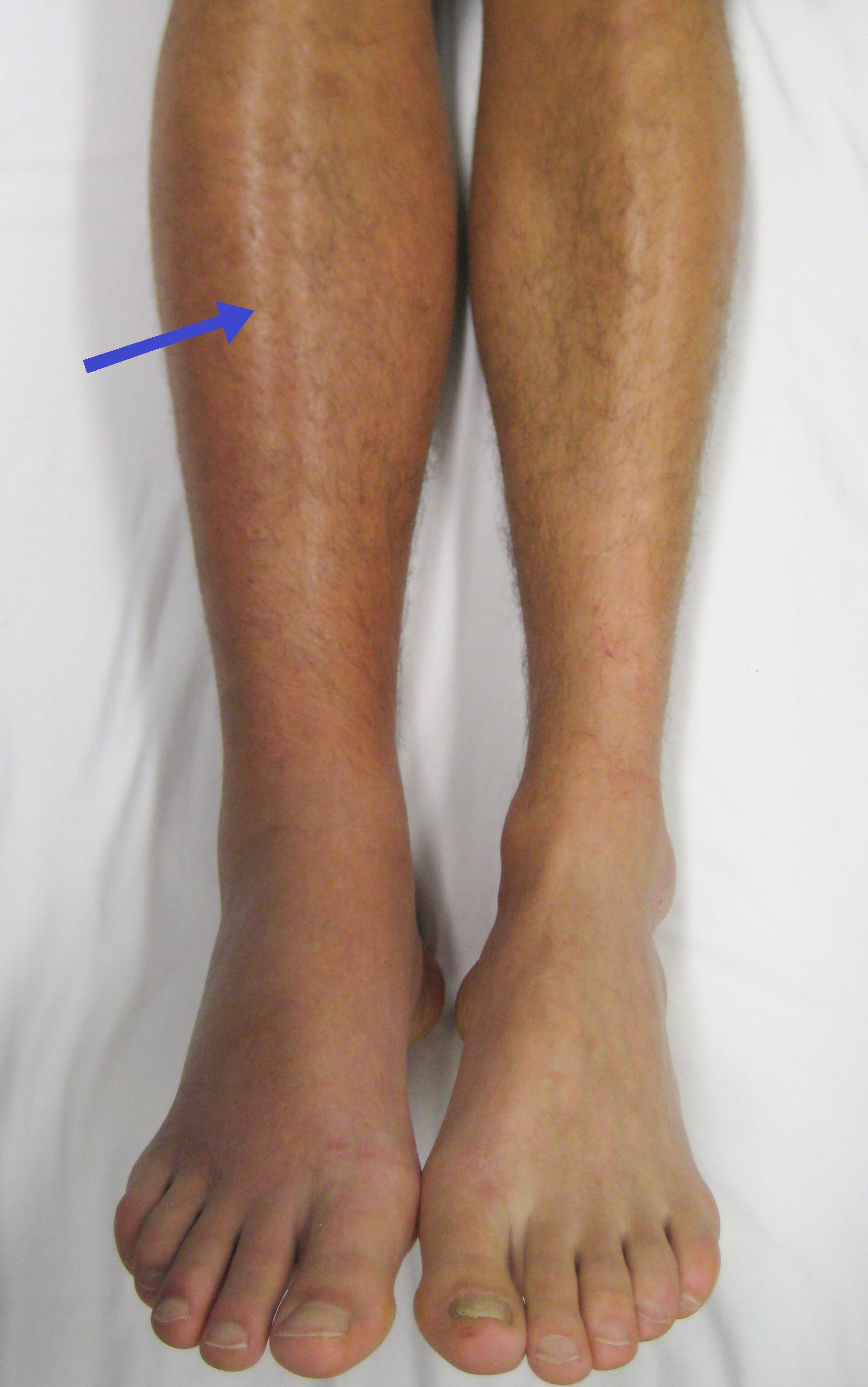
Lower-extremity DVT commonly presents with unilateral limb symptoms, including swelling, pain, tenderness, or functional discomfort. Iliofemoral DVT may produce particularly severe symptoms; in a Japanese series of patients selected for catheter-directed thrombolysis, the median Villalta score at diagnosis was 8, indicating a substantial symptom burden. [572]C Clinical assessment is challenging during pregnancy because leg discomfort, edema, and other symptoms may overlap with normal gestational changes. D-dimer interpretation is also less specific during pregnancy, so suspected pregnancy-associated DVT requires objective imaging rather than reliance on symptoms or D-dimer alone. [576]
Systemic inflammatory indices may assist research-level risk characterization in pregnancy-associated DVT, but the available case-control evidence does not establish them as diagnostic substitutes for compression or Doppler ultrasonography. The study included 36 pregnant women with ultrasonography-confirmed DVT and 36 matched pregnant controls and evaluated neutrophil-to-lymphocyte, platelet-to-lymphocyte, monocyte-to-lymphocyte, and systemic immune-inflammation indices. [576]
Pulmonary embolism
PE may be clinically silent, incidentally detected, symptomatic, or hemodynamically catastrophic. In patients with active cancer, increased use of routine oncological imaging has made incidental PE an important contemporary presentation. A real-world cohort included 58 patients with cancer-associated PE and 323 patients without active malignancy; severity was assessed using shock, systolic blood pressure below 90 mmHg, and/or high-risk PE criteria. [573] These findings support distinguishing incidental or clinically less apparent PE from presentations characterized by circulatory compromise. [573]
Symptomatic PE may include dyspnea, chest or abdominal discomfort, hypoxemia, tachycardia, hypotension, or syncope, although the supplied contemporary cohort evidence indicates that presentation and severity are heterogeneous rather than defined by a single symptom pattern. [573][678]C A rare postoperative example illustrates that PE can coexist with systemic arterial embolism: shortly after laparoscopic-assisted vaginal hysterectomy, a 78-year-old woman developed dyspnea and abdominal discomfort, with computed tomography angiography demonstrating both acute PE and renal artery embolism. [678]C
The clinical duration of symptoms may help identify patients with subacute or chronic thrombus. In patients undergoing mechanical aspiration thrombectomy for presumed acute PE, unsuccessful aspiration was specifically investigated in relation to longer symptom duration and clinical, laboratory, imaging, and procedural features suggesting an underlying subacute or chronic component. [677]C Failure to remove thrombus should therefore prompt consideration that the event may not be purely acute, although the retrospective case-series design does not define a diagnostic threshold for symptom duration. [677]C
Special presentations
Children may present with nonspecific symptoms that prompt consideration of PE, but pediatric diagnostic decision-making differs from adult practice. The multicentre BEEPER study enrolled children aged 4–17 years in emergency departments when clinicians were considering or ordering PE testing and prospectively evaluated the PERC-Peds rule as a radiation-sparing exclusion strategy. [177]B2b The study addresses diagnostic safety rather than a universal symptom profile; consequently, persistent clinical concern should not be dismissed solely because a child lacks a classic adult presentation. [177]B2b
Cerebral venous thrombosis (CVT) may present with headache, focal neurological symptoms, seizures, altered consciousness, or intracranial hemorrhage. A case of inherited antithrombin deficiency involved spontaneous CVT with bilateral frontal-lobe hemorrhage in a 27-year-old woman, demonstrating that venous thrombosis can first manifest through neurological deterioration or hemorrhage rather than peripheral DVT or PE symptoms. [176]C4 Intracranial hemorrhage accompanying CVT should not automatically be interpreted as excluding CVT or as an absolute contraindication to anticoagulation; this conclusion derives from a case report and requires individualized specialist assessment. [176]C4
Patients with paroxysmal nocturnal hemoglobinuria may develop thrombosis in unusual sites, including cerebral or abdominal venous territories, and diagnosis may be delayed because initial symptoms are nonspecific. A Japanese claims-data study examined 160 patients diagnosed with PNH and evaluated the interval from symptom onset to diagnosis, highlighting diagnostic delay as a clinically important feature of thrombotic PNH. [578]
Paradoxical embolism is another possible presentation when venous thrombus crosses an intracardiac shunt. Patent foramen ovale is present in approximately 20%–30% of adults and is often incidental, but clinical manifestations can include stroke, seizures, or migraine. [575]C Patients with congenital heart disease and intracardiac shunts may be particularly vulnerable to paradoxical embolism during major orthopedic surgery, including total knee arthroplasty. [579]C
Practical recognition
Suspect VTE when new unilateral limb symptoms, unexplained dyspnea, chest or abdominal discomfort, syncope, hypoxemia, neurological symptoms, or unexplained organ ischemia occurs, especially in pregnancy, active cancer, postoperative states, prolonged immobility, or known thrombophilia. [572]C[573][576][678]C Urgent assessment is required for hypotension, shock, severe hypoxemia, neurological deterioration, or suspected concurrent arterial embolism. [573][176]C4[678]C
| Territory/context | Representative clinical presentation or concern | Evidence |
|---|---|---|
| Lower-extremity or iliofemoral DVT | Limb swelling, pain, tenderness, functional discomfort; severe symptom burden may occur | [572]C |
| Pregnancy-associated DVT | Symptoms may overlap with normal gestation; D-dimer specificity is reduced | [576] |
| PE in cancer | May be incidentally detected on routine imaging or present with severe hemodynamic compromise | [573] |
| Acute or mixed-age PE | Dyspnea, discomfort, or hemodynamic instability; subacute/chronic thrombus may complicate aspiration | [677]C[678]C |
| CVT | Neurological symptoms, seizures, or intracranial hemorrhage | [176]C4 |
| Paradoxical embolism | Stroke, seizures, migraine, or other systemic arterial ischemia in the presence of a shunt | [575]C[579]C |
| Thrombotic PNH | Nonspecific symptoms and delayed diagnosis, potentially with unusual-site thrombosis | [578] |
5. Diagnosis & Workup: Smear, Marrow, Flow Cytometry & Molecular Profiling
- ▸The supplied evidence does not validate peripheral smear, bone-marrow examination, flow cytometry, cytogenetics, or molecular profiling for diagnosing VTE. [585][593][595]
- ▸Venous ultrasonography was used for postoperative DVT screening, cancer surveillance, and exclusion of baseline DVT; contrast-enhanced CT supplemented ultrasound in cancer cohorts. [567][587]
- ▸The Hydra randomized trial evaluated YEARS versus CTPA-only assessment for suspected PE in active cancer, but the supplied abstract does not provide D-dimer thresholds or numerical outcomes. [585]
- ▸In the supplied pregnancy study, inflammatory indices were investigated in 36 women with Doppler-confirmed DVT and 36 matched controls, without a reported diagnostic cutoff. [576]
- ▸Early ROTEM abnormalities in major trauma were associated with hemorrhagic rather than thromboembolic complications in the supplied study. [588]
- ▸Cancer-associated VTE risk was documented in endometrial cancer, solid tumors, pancreatic cancer, breast-cancer survivors, and long-term survivors of 21 cancer subtypes. [561][567][592][593][563]
Scope and evidence update
The supplied evidence does not evaluate peripheral-blood smear review, bone-marrow aspiration or biopsy, flow cytometry, cytogenetics, or molecular profiling as diagnostic tests for venous thromboembolism (VTE). Instead, it supports an imaging-, clinical-risk-, and laboratory-oriented approach to suspected VTE, particularly in patients with cancer, pregnancy, critical illness, trauma, and postoperative states. [584]C[585][587][588]C[591][593]
Initial clinical assessment
Diagnostic assessment should begin by documenting the clinical setting and major provoking or predisposing factors. The available studies specifically address active cancer, cancer treatment, critical illness, major trauma, orthopaedic surgery, pregnancy, and selected drug exposures as contexts in which VTE risk or diagnostic complexity may be increased. [561]C[567]C[587][588]C[591][576][586] In hospitalized medical patients, a systematic review and meta-analysis identified multiple VTE-associated risk factors, although the supplied abstract does not provide a single validated diagnostic threshold or replacement risk score. [238]B2a ICU exposure was evaluated as a population-level risk factor for clinically recognized VTE within 90 days of hospitalization in an Ontario cohort. [591]
A complete blood count may contribute contextual information, but it is not established by these references as a stand-alone diagnostic test for VTE. In pregnancy, CBC-derived neutrophil-to-lymphocyte, platelet-to-lymphocyte, monocyte-to-lymphocyte, and systemic immune-inflammation indices were investigated in a retrospective case-control study of 36 pregnant patients with Doppler-confirmed DVT and 36 matched controls; the abstract does not establish a validated cutoff suitable for routine diagnosis. [576] Similarly, early ROTEM abnormalities in major trauma were studied primarily in relation to hemorrhagic complications, and the investigators reported that abnormalities may be associated with bleeding but not thromboembolic complications. [588]C
Imaging-based confirmation and surveillance
For suspected lower-extremity DVT after shoulder arthroscopy, systematic bilateral venous color Doppler ultrasonography was performed preoperatively and on postoperative day 1, illustrating the use of ultrasound to detect otherwise clinically unrecognized postoperative events. [587] In patients with newly diagnosed locally advanced, recurrent, or metastatic solid tumors, scheduled lower-extremity ultrasonography was performed at baseline and at weeks 12, 24, 36, 48, 72, and 96, with contrast-enhanced CT used as a supplement. [567]C A prospective study in advanced pancreatic cancer likewise used baseline and longitudinal surveillance for VTE and evaluated circulating coagulation and neutrophil-extracellular-trap-related biomarkers, supporting the possibility that systematic surveillance identifies a larger thrombotic burden than symptom-triggered evaluation alone. [593]
For suspected acute PE in patients with active cancer, the randomized Hydra trial directly compared the YEARS algorithm with a CTPA-only strategy; the supplied abstract identifies the trial’s purpose and design but does not report the numerical safety outcome or the applicable D-dimer thresholds. [585] Accordingly, no D-dimer cutoff, YEARS-item threshold, or CTPA exclusion rule should be inferred from the supplied evidence. Cancer-associated PE may coexist with DVT, and the ONCO PE post-hoc analysis specifically stratified patients according to concomitant DVT at diagnosis, using groups of 104 patients with DVT and 74 without DVT. [556]
Cancer-associated and treatment-related findings
Cancer status should be recorded because VTE may occur during active treatment and remain relevant during survivorship. In a cohort of 292 patients receiving systemic therapy for initial endometrial cancer, 78 (26.7%) developed VTE after cancer diagnosis; stage was reported as associated with VTE diagnosis. [561]C A prospective Japanese study enrolled patients with newly diagnosed locally advanced, recurrent, or metastatic solid cancers, excluded pre-existing DVT by baseline ultrasonography, and assessed VTE through 96 weeks using scheduled ultrasound with CT supplementation. [567]C Breast-cancer survivors also demonstrated ongoing mid- and long-term VTE risk in a nationwide Korean cohort of 112,522 women, while a Danish nationwide study evaluated VTE risk among 5-year survivors of 21 cancer subtypes. [592][563]
Medication exposure is relevant to pretest assessment rather than confirmation. A systematic review and meta-analysis examined VTE associated with CDK4/6 inhibitors in HR-positive, HER2-negative, non-metastatic breast cancer and included 7 studies after screening 4,624 publications. [586] The supplied abstract does not provide a diagnostic biomarker, imaging criterion, or molecular assay that can confirm VTE. [586] Postmenopausal hormone-replacement therapy was evaluated for broad long-term outcomes according to age at menopause, but the supplied abstract does not establish a VTE diagnostic method. [566]
Smear, marrow, flow cytometry, and molecular profiling
Peripheral smear, marrow examination, flow cytometry, and molecular profiling should not be presented as routine tests for diagnosing VTE on the basis of the supplied literature. None of the cited studies validates these modalities for confirming DVT or PE. The available biomarker work concerns coagulation or NET-associated thromboinflammation in advanced pancreatic cancer, while the diagnostic studies rely principally on venous ultrasonography, CT, or CTPA-based strategies. [585][567]C[593] Lupus anticoagulant testing was described in a real-world anticoagulation study using dRVVT or lupus-sensitive aPTT assays, with anticardiolipin and anti-β2-glycoprotein I antibodies used for exclusion; this concerns anticoagulant selection in atrial arrhythmia patients with isolated lupus anticoagulant, not routine VTE confirmation. [595]
Practical conclusion
The evidence supports documenting risk context, using validated clinical pathways only when their reported criteria are available, and confirming suspected DVT or PE with appropriate vascular or chest imaging. [585][587][567]C[591] The supplied references do not justify adding smear, marrow, flow-cytometric, or molecular testing to the standard diagnostic workup unless a separate hematologic or oncologic indication exists. [585][593][595]
| Modality or domain | Evidence-supported use | Limitation |
|---|---|---|
| Venous Doppler ultrasonography | Detection or surveillance of lower-extremity DVT, including postoperative and cancer-associated events. [567]C[587] | The supplied references do not define a universal screening schedule for all patients. [567]C[587] |
| CTPA and CT | Evaluation of suspected PE and supplementary assessment in cancer surveillance. [585][567]C | The supplied abstract does not report YEARS D-dimer thresholds or trial outcome values. [585] |
| CBC-derived inflammatory indices | Investigational association with pregnancy-associated DVT. [576] | No validated diagnostic cutoff is reported. [576] |
| ROTEM | Early assessment of trauma-associated coagulation abnormalities and bleeding risk. [588]C | Abnormalities were not shown to diagnose thromboembolic complications. [588]C |
| Coagulation and NET-related biomarkers | Investigational assessment of hypercoagulability and thromboinflammation in advanced pancreatic cancer. [593] | Not established as routine VTE confirmation tests. [593] |
| Smear, marrow, flow cytometry, molecular profiling | No validated VTE diagnostic role identified in the supplied references. [585][593][595] | Consider only for a separate hematologic or oncologic indication. [585][593][595] |
6. Staging, Risk Stratification & Prognostic Scoring
- ▸Acute PE staging should prioritize shock or systolic blood pressure <90 mmHg, with syncope prompting careful assessment of acute severity. [573][681]
- ▸Chronic venous disease, cancer, spinal cord injury, severe obesity, metabolic syndrome, and surgery are important context-specific VTE risk modifiers. [680][596][668][597]
- ▸D-dimer and circulating microRNAs are promising prognostic or biologic markers but are not sufficiently established as stand-alone staging tools. [684][540]
- ▸Dynamic reassessment, including serial Caprini assessment, may better reflect changing perioperative risk than a single admission score. [659]
- ▸AI and machine-learning models require external validation, calibration, and clinical-impact assessment; current evidence shows substantial risk of bias. [559][682]
Scope and principles
VTE risk stratification should distinguish (1) risk of developing VTE, (2) acute PE severity and early mortality, (3) risk of recurrence, and (4) bleeding risk during anticoagulation. The updated evidence supports a multidimensional approach combining clinical context, haemodynamic status, comorbidity, laboratory biomarkers, imaging, and—when sufficiently validated—prediction models. However, much of the newer literature remains observational, heterogeneous, or insufficiently externally validated, so no single biomarker or artificial-intelligence model should replace clinical assessment. [682]
Predisposition to incident VTE
Chronic venous disease is now supported as a potential prognostic marker for subsequent VTE. A systematic review and meta-analysis identified 7 longitudinal prognostic-factor studies involving 3,760,257 participants; the review followed Cochrane Prognosis Methods Group and PRISMA 2020 methods and assessed certainty using GRADE. [680] The abstract confirms an association was evaluated, but does not provide a pooled effect estimate; therefore, chronic venous disease should be treated as a risk-enhancing feature rather than a stand-alone indication for anticoagulation. [680]
Risk is strongly context-dependent in cancer, critical illness, trauma, and surgery. In cervical cancer-associated thrombosis, systematic-review evidence examined biological, molecular, genetic, and imaging biomarkers of hypercoagulability and thromboinflammation, while incorporating translational evidence from breast cancer and broader cancer-associated thrombosis populations. The evidence was heterogeneous, limiting immediate adoption of any single biomarker for routine scoring. [596] In lung cancer, a retrospective single-centre study evaluated clinical characteristics, laboratory parameters, treatment-related factors, multivariable risk factors, and machine-learning approaches for VTE prediction; its exploratory design supports hypothesis generation rather than universal implementation. [589]
Patients with spinal cord injury represent a high-risk subgroup. A meta-analysis of 9 studies including 394,322 patients assessed factors associated with PE and pooled odds ratios, with study quality evaluated by the Newcastle–Ottawa Scale. [668] The findings support formal risk assessment in spinal cord injury, but the abstract does not establish a single transferable scoring threshold. [668] Similarly, elective spine-surgery risk is modified by severe obesity and metabolic syndrome; a systematic review evaluated BMI ≥40 kg/m², complication patterns, resource use, patient-reported outcomes, and the possible influence of surgical approach. [597]
Acute PE severity and prognostic staging
Haemodynamic presentation remains the central determinant of acute PE severity. In a real-world cohort of 381 hospitalized patients with acute PE, including 58 with active cancer, severe presentation was defined by shock, systolic blood pressure <90 mmHg, and/or high-risk PE according to European Society of Cardiology criteria. [573] Cancer-associated PE was compared with non-cancer PE for severity markers, management, and in-hospital outcomes; increasing detection of incidental PE through routine oncological imaging means that presentation mode should be recorded separately from physiological severity. [573]
Syncope is a potentially important clinical modifier. A prospective single-centre cohort of symptomatic PE diagnosed between 2010 and 2025 compared patients with and without syncope and evaluated a 30-day composite of all-cause mortality, major bleeding, and recurrent VTE using inverse-probability weighting. [681] The study also explored phenotypes within the syncope subgroup after balancing baseline confounders and measured acute-severity markers, supporting syncope as a trigger for careful haemodynamic and right-heart assessment rather than an isolated severity category. [681]
Biomarkers and molecular stratification
D-dimer has potential prognostic and thrombotic-stratification value in multiple myeloma. A systematic review and meta-analysis compared D-dimer levels in patients with poor prognostic features, including advanced International Staging System stage, or thrombotic events, with reference groups, and considered integration with ISS, revised ISS, and IMPEDE-VTE frameworks. [684] Because D-dimer may reflect both hypercoagulability and disease burden, an elevated value should be interpreted with cancer stage, treatment, symptoms, and imaging rather than used alone to diagnose or stage VTE. [684]
Circulating microRNAs are an emerging research category. A systematic review evaluated dysregulated microRNAs as possible biomarkers and therapeutic targets in VTE, emphasizing their post-transcriptional regulation of messenger RNA and the continuing need for clinical validation. [540] In cervical cancer, broader hypercoagulability and thromboinflammatory biomarkers—including molecular and imaging markers—remain promising but heterogeneous. [596]
Prediction models, scores, and artificial intelligence
Established clinical scores remain preferable when validated for the relevant population, but their use should be dynamic when risk changes during hospitalization or after surgery. In arthroscopic meniscus surgery, a retrospective implementation study assessed Caprini scoring at admission, postoperative day 1, and discharge, linking serial categories to graded nursing and prophylaxis delivery. [659]C This supports reassessment rather than reliance on a single admission score, although the cohort included only 90 patients and was designed primarily to assess feasibility and implementation. [659]C
AI and machine-learning models may improve individualized prediction in selected settings. An explainable model for septic-shock patients used an internal development cohort of 733 patients and an independent external-validation cohort of 257 patients. [559] Nevertheless, broader review evidence found 18 of 20 prediction or detection studies (90%) at high risk of bias; only 7 of 20 (35%) demonstrated meaningful external or prospective validation, and calibration was not reported in 14 (70%). [682] Consequently, discrimination statistics alone are insufficient: calibration, external validation, clinical-impact testing, class balance, event numbers, and overfitting must be examined before deployment. [682]
Population-specific modifiers and evidence limitations
Postoperative risk varies by procedure and approach. National database analyses evaluated 90-day VTE after otolaryngology–head and neck surgery in 277,187 patients, while a propensity-score-matched national analysis assessed 30-day VTE-related readmission after open versus minimally invasive ventral hernia repair. [687][602] These studies support procedure-specific rather than generic postoperative stratification. Other cited studies address VTE-related morbidity after lumbar fusion, including prolonged postoperative stay, but are not direct validations of a VTE score. [603]C Studies of retinal vein occlusion with obstructive sleep apnea evaluated subsequent systemic VTE and arterial outcomes, suggesting comorbidity-based risk modification but not a validated VTE staging system. [686] The remaining prognostic cohort concerning pituitary adenomas and the case series of thrombopoietin-receptor agonists for chemotherapy-induced thrombocytopenia do not provide direct evidence for VTE staging or scoring. [685][683]
Practical synthesis
Use haemodynamic instability to identify high-risk PE; incorporate syncope, cancer, chronic venous disease, spinal cord injury, severe obesity, surgery, and active treatment as risk modifiers; interpret D-dimer and molecular biomarkers contextually; reassess risk dynamically; and require external validation and calibration before adopting AI-based tools. [680][573][681][596][684][659]C[682]
| Domain | Examples supported by the cited evidence | Interpretation |
|---|---|---|
| Acute PE severity | Shock; systolic blood pressure <90 mmHg; high-risk PE; syncope | Determines urgency and early-risk assessment. [573][681] |
| Patient context | Active cancer, chronic venous disease, spinal cord injury, severe obesity/metabolic syndrome | Modifies baseline or incident-VTE risk; do not use alone as a treatment threshold. [680][596][668][597] |
| Biomarkers | D-dimer; circulating microRNAs; cancer-associated thromboinflammatory markers | Adjunctive and investigational; interpret with disease burden and clinical findings. [684][540][596] |
| Perioperative status | Procedure type, surgical approach, changing postoperative condition | Supports procedure-specific and dynamic reassessment. [602][659]C[687] |
| Predictive analytics | Machine learning and AI models | Require external validation, calibration, and prospective clinical-impact evidence. [559][682] |
7. Acute & Emergency Management
- ▸Use structured diagnostic pathways cautiously in active cancer, pregnancy, and children; the cited abstracts do not supply complete outcome estimates for universal adoption. [585][616][177]
- ▸Outpatient VTE management may be supported by a pathway combining low-risk selection, a 30-day DOAC prescription, pharmacist education, and 1-week follow-up. [613]
- ▸Aspirin versus low-molecular-weight heparin remains an evidence question in acute orthopaedic trauma; the supplied abstract does not report pooled estimates or establish a preferred agent. [302]
- ▸Intracranial injury, prior VTE, severe burns, critical illness, and major surgery require individualized assessment of thrombosis and bleeding risk. [609][608][594][690][689]
Initial assessment and risk stratification
Suspected acute venous thromboembolism (VTE) requires prompt clinical assessment, with simultaneous evaluation of haemodynamic status, oxygenation, bleeding risk, comorbidity, pregnancy, malignancy, recent surgery or trauma, and the feasibility of outpatient follow-up. The supplied evidence does not provide a new universal resuscitation algorithm; it mainly updates diagnostic exclusion pathways, emergency-department disposition, and thromboprophylaxis in selected high-risk settings. [585][613][616][177]B2b
Patients with suspected pulmonary embolism (PE) who are unstable or have clinically significant cardiopulmonary compromise should be managed in an appropriately monitored emergency or inpatient environment while diagnostic and supportive care proceed; the cited studies do not define revised thresholds for thrombolysis, thrombectomy, or vasopressor therapy. [585][613]
Diagnostic exclusion of pulmonary embolism
The YEARS strategy is being evaluated in patients with active cancer, a population in which clinicians have traditionally been advised to proceed directly to computed tomographic pulmonary angiography (CTPA) because the diagnostic safety of D-dimer-based exclusion was considered uncertain. The 2026 Hydra randomized noninferiority trial compared YEARS with CTPA-only assessment in adults with active cancer and suspected acute PE recruited from emergency departments or medical units across 21 hospitals. [585] The study was open-label, investigator initiated, and used blinded central outcome adjudication, with final follow-up on 21 August 2025. [585] Its findings should inform whether selected patients with cancer can safely avoid imaging, but the supplied abstract does not report the primary outcome or numerical safety results; therefore, CTPA should not be withheld solely on the basis of this citation until the full results are reviewed. [585]
In pregnancy, the pregnancy-adapted YEARS guideline was evaluated retrospectively in the SPEED-ED Pregnancy study. This single-centre analysis included 532 pregnant women investigated for possible PE, including 76 before and 456 after guideline implementation; safety was defined as 90-day VTE and effectiveness as the proportion avoiding imaging. [616] The study therefore supports structured evaluation of pregnancy-associated suspected PE, but its retrospective, single-centre design and the absence of complete outcome data in the supplied abstract limit generalisation. [616]
For children, the multicentre prospective BEEPER diagnostic-accuracy study evaluated PERC-Peds in patients aged 4–17 years presenting with symptoms that prompted clinicians to order or strongly consider PE testing. The study was conducted in 21 US paediatric emergency departments and assessed whether PERC-Peds could exclude PE without radiation. [177]B2b PERC-Peds should consequently be regarded as an evidence-generating paediatric rule rather than automatically extrapolated to adults; the supplied abstract does not provide the complete diagnostic-performance estimates. [177]B2b
Emergency-department disposition and outpatient treatment
A structured discharge pathway can support outpatient treatment of carefully selected low-risk patients with VTE. In one institutional retrospective cohort, the pathway incorporated a 1-week outpatient vascular-medicine appointment, a 30-day direct oral anticoagulant prescription, and pharmacist-facilitated anticoagulant education. [613] The cohort included 1,260 emergency-department patients with VTE identified between July 2014 and June 2018, and the study assessed discharge rates and safety before and after pathway implementation. [613] Discharge should therefore depend on clinical stability, low predicted short-term risk, ability to obtain and correctly take anticoagulants, social support, and reliable follow-up; the supplied abstract does not provide sufficient numerical outcome data to establish universal discharge criteria. [613]
Trauma, surgery, and thromboprophylaxis
Acute orthopaedic trauma remains an important setting for VTE prevention. A 2026 systematic review and meta-analysis of randomized trials compared aspirin with low-molecular-weight heparin in adults with acute orthopaedic trauma requiring thromboprophylaxis. [302]A1a The review searched PubMed, Scopus, and Web of Science through 21 March 2026 and assessed all-cause mortality and bleeding among its prespecified outcomes. [302]A1a Aspirin may be considered only within the injury-specific evidence base and after assessing bleeding risk, fracture pattern, mobility, and local protocols; the supplied abstract does not report the pooled estimates, so it cannot establish equivalence or a preferred agent. [302]A1a
Day surgery is associated with reduced postoperative complication risk, including VTE, compared with inpatient care in the consensus statement from UK anaesthesia and day-surgery organisations; overall UK day-surgery rates were reported as exceeding 85%. [689] However, ambulatory surgery does not eliminate VTE risk, and peri-operative prophylaxis should remain individualized according to procedure, patient risk, mobility, and bleeding risk. [689]
Patients with prior VTE undergoing microsurgical autologous breast reconstruction represent a higher-concern group because thrombotic events may jeopardize reconstruction. A retrospective TriNetX study of 14,309 patients evaluated postoperative DVT, PE, infection, wound dehiscence, and bleeding according to history of VTE. [608] The abstract does not provide comparative event rates; therefore, it supports heightened peri-operative risk assessment rather than a specified intensified anticoagulation regimen. [608]
Special populations and risk context
Small-volume isolated traumatic brain injury requires particular caution because anticoagulation decisions must balance intracranial bleeding against VTE prevention. A national ACS-TQIP analysis examined adults aged 40 years or older with isolated blunt injuries, including subdural or epidural haematomas up to 8 mm and contusions up to 2 cm, stratified by age 40–64 versus ≥65 years. [609] These thresholds define the study population, not a universal anticoagulation rule; prophylaxis timing should be coordinated with trauma and neurosurgical assessment. [609]
Venous thromboembolism is also reported among complications in critically ill patients receiving therapeutic coma for non-convulsive status epilepticus; a retrospective cohort found that therapeutic coma was associated with increased complications and mortality, although the supplied abstract does not provide adjusted VTE estimates. [690] Severe burns, ectopic Cushing syndrome, and major thoracic ballistic trauma are additional contexts in which VTE risk or VTE-related outcomes were specifically investigated, but the cited abstracts do not provide treatment thresholds. [594][612][611]C
Observational studies also examined VTE-related outcomes after spine surgery, including GLP-1 receptor agonist exposure, cannabis and nicotine use, and non-tobacco nicotine use, while another study assessed postoperative outcomes after cervical surgery in patients taking antipsychotics. [607][271]B2b[533][614] These studies should be used for risk recognition, not to select emergency anticoagulant therapy, because their supplied abstracts describe retrospective associations and do not establish causal prophylaxis recommendations. Socioeconomic deprivation and travel distance have likewise been examined in arthroplasty populations as potential determinants of postoperative outcomes and access to follow-up. [297]B2a[691]
Practical safety principles
Reassess bleeding risk, neurological status, renal function, medication access, adherence, and follow-up before outpatient anticoagulation. [609][613] In pregnancy, children, active cancer, recent trauma, prior VTE, or major surgery, apply the population-specific evidence cautiously and involve the relevant specialist service when diagnostic or anticoagulation decisions remain uncertain. [585][177]B2b[616][608][609]
| Clinical context | Evidence update | Operational implication |
|---|---|---|
| Active cancer with suspected PE | Randomized Hydra trial compared YEARS with CTPA-only assessment. [585] | Do not assume D-dimer-based exclusion is appropriate until full results are reviewed. [585] |
| Pregnancy with suspected PE | Pregnancy-adapted YEARS assessed in 532 women; safety endpoint was 90-day VTE. [616] | Use structured pregnancy-specific assessment; recognise retrospective, single-centre limitations. [616] |
| Children aged 4–17 years | PERC-Peds evaluated prospectively across 21 paediatric EDs. [177]B2b | Do not extrapolate adult rules automatically; use paediatric expertise. [177]B2b |
| Low-risk ED VTE | Pathway included 30-day DOAC supply, pharmacist education, and 1-week review. [613] | Consider discharge only when stability, adherence, support, and follow-up are secure. [613] |
| Acute orthopaedic trauma | Randomized-trial meta-analysis compared aspirin with LMWH. [302]A1a | Select prophylaxis using injury-specific and bleeding-risk assessment; pooled results were not supplied. [302]A1a |
| Small-volume traumatic brain injury | Study definitions included SDH/EDH ≤8 mm and contusions ≤2 cm. [609] | Coordinate prophylaxis with trauma/neurosurgical review rather than applying size thresholds alone. [609] |
Long-term & Definitive Management
- ▸For unprovoked VTE, extended DOAC therapy reduces recurrence from 8-10% to 1-2% per year (NNT 14-34) with acceptable bleeding risk.
- ▸Reduced-dose DOACs (apixaban 2.5 mg BID, rivaroxaban 10 mg daily) are non-inferior to full-dose after initial 6 months, with less major bleeding (RENOVE, API-CAT, EVE).
- ▸Provoked VTE with enduring risk factors benefits from low-dose apixaban extended therapy (HI-PRO trial, NNT 11).
Once the acute phase is controlled, the central decision shifts to duration and intensity of anticoagulation. This balance between recurrent VTE prevention and bleeding risk is guided by provoked versus unprovoked status, sex, D‑dimer after stopping, antibhospholipid antibody status, and bleeding risk (115, 308).
Step 1: Risk Stratification for Recurrence
Patients with VTE provoked by a major transient risk factor (surgery, trauma, immobilisation) can discontinue anticoagulation after 3 months (ASH 2020, conditional recommendation [308]A1c). For a first unprovoked proximal DVT or PE, the 1‑year recurrence risk is approximately 10% and the 5‑year risk approaches 30% (115). Factors favouring indefinite therapy include male sex, presentation as PE, elevated D‑dimer after stopping, and low bleeding risk (308, 343).
Step 2: Choice of Extended Anticoagulant
Direct oral anticoagulants (DOACs) are preferred for most patients requiring extended therapy because of superior safety compared with vitamin K antagonists (308). For cancer‑associated VTE, DOACs are now first‑line in most patients (311, 329). LMWH remains the standard in pregnancy (76).
| Strategy | Regimen | Recurrent VTE rate | Major bleeding | NNT (vs comparator) | Trial |
|---|---|---|---|---|---|
| Apixaban 2.5 mg vs placebo | 2.5 mg BID × 12 mo | 1.7% vs 8.8% | 0.2% vs 0.5% | 14 (95% CI 11-20) | AMPLIFY‑EXT [314]A1b |
| Apixaban 5 mg vs placebo | 5 mg BID × 12 mo | 1.7% vs 8.8% | 0.1% vs 0.5% | 14 | AMPLIFY‑EXT [314]A1b |
| Rivaroxaban 20 mg vs | 20 mg daily × ≤12 mo | 1.5% vs 4.4% | 0.5% vs 0.3% | 34 (95% CI 23-66) | EINSTEIN CHOICE [79]A1b |
| Rivaroxaban 10 mg vs aspirin | 10 mg daily × ≤12 mo | 1.2% vs 4.4% | 0.4% vs 0.3% | 31 (95% CI 22-53) | EINSTEIN CHOICE [79]A1b |
| Rivaroxaban 20 mg vs placebo | 20 mg daily × 6-12 mo | 1.3% vs 7.1% | 0.7% vs 0% | 17 (95% CI 12-29) | EINSTEIN EXT [318]A1b |
| Apixaban 2.5 mg vs placebo (provoked + enduring risk) | 2.5 mg BID × 12 mo | 1.3% vs 10.0% | 0.3% vs 0% | 11 (95% CI 8-20) | HI‑PRO [77]A1b |
| Apixaban vs dalteparin (cancer) | 10/5 mg vs dalteparin | 5.6% vs 7.9% | 3.8% vs 4.0% | 43 (95% CI 22-∞) | Caravaggio [316]A1b |
| Rivaroxaban vs dalteparin (cancer) | 15/20 mg vs dalteparin | 4% vs 11% | 6% vs 4% | 14 (95% CI 8-50) | SELECT‑D [322]A1b |
NNT calculated from absolute risk difference reported in each abstract.
Step 3: Dose Reduction for Extended Therapy
After the initial 6 months, reduced‑dose DOACs ( 2.5 mg twice daily or 10 mg once daily) are a validated option. The RENOVE trial confirmed non‑inferiority of reduced‑dose to full‑dose for preventing recurrence (19 of 1383 vs 19 of 1385 patients) with lower major bleeding over a median 37 months [88]A1b. Similarly, in cancer patients, API‑CAT showed reduced‑dose apixaban non‑inferior to full‑dose with fewer clinically relevant bleeding [307]B2b, and the EVE trial found no significant difference in recurrence (5.0% vs 5.0%) or bleeding between apixaban 2.5 mg and 5 mg twice daily [332]A1b.
Step 4: Special Populations
- Provoked VTE with enduring risk factors: The HI‑PRO trial supports low‑dose apixaban for 12 months, reducing recurrence from 10.0% to 1.3% (HR 0.13; 95% CI 0.04-0.36) with minimal bleeding [77]A1b.
- Antiphospholipid syndrome (APS): (INR 2-3) remains the standard; DOACs are associated with increased arterial events and are not recommended (ASH 2020, conditional recommendation [308]A1c).
- Myeloproliferative neoplasms (MPN): Observational data suggest that anticoagulation (VKA or DOAC) plus cytoreduction yields the lowest recurrence risk [334]B2a.
- Pediatric VTE: For children requiring extended therapy, and have demonstrated non‑inferior efficacy and acceptable safety (304, 305, 309).
Step 5: Monitoring and Discontinuation
When anticoagulation is stopped, a negative D‑dimer measured 1 month later identifies a lower‑risk group (165). Periodic reassessment of bleeding risk and patient preference is essential.
What NOT to Do
- Do not routinely use for primary prevention (308).
- Do not substitute aspirin for a DOAC in unprovoked VTE; DOACs are significantly more effective (EINSTEIN CHOICE [79]A1b).
- Do not use DOACs in triple‑positive antiphospholipid syndrome (9).
Controversies and Guideline Disagreement
| Question | Position A | Position B | Strength | Implication |
|---|---|---|---|---|
| Indefinite therapy for first unprovoked VTE | ASH 2020: conditional recommendation for indefinite anticoagulation if low bleeding risk [308]A1c | ESC 2019: consider extended therapy for all unprovoked VTE; shared decision‑making | Mild | Most patients will be offered extended therapy; individualise by sex, D‑dimer, and bleeding risk. |
| Reduced‑dose vs full‑dose DOAC for extended therapy | ASH 2020: no specific recommendation (pre‑2020) | BSH 2024 (cancer): suggests full‑dose for initial 6 months, then consider reduced dose [329]A1c | Moderate | Reduced‑dose is now an evidence‑based option after 6 months; discuss risks/benefits. |
| DOACs in antiphospholipid syndrome | ASH 2020: conditional recommendation against DOACs for thrombotic APS [308]A1c | Some experts: may consider in low‑risk single‑positive patients | Strong | Use VKA for definitively diagnosed APS; avoid DOACs in triple‑positive or high‑risk patients. |
Pearl: For most patients with unprovoked VTE, extended DOAC therapy reduces recurrence by approximately 80-90% compared with placebo or aspirin (NNT 14-34); after 6 months, reduced‑dose apixaban or rivaroxaban provides non‑inferior efficacy with less major bleeding.
| Strategy | Regimen | Recurrent VTE rate | Major bleeding | NNT | Trial |
|---|---|---|---|---|---|
| Apixaban 2.5 mg vs placebo | 2.5 mg BID × 12 mo | 1.7% vs 8.8% | 0.2% vs 0.5% | 14 | AMPLIFY-EXT [314]A1b |
| Apixaban 5 mg vs placebo | 5 mg BID × 12 mo | 1.7% vs 8.8% | 0.1% vs 0.5% | 14 | AMPLIFY-EXT [314]A1b |
| Rivaroxaban 20 mg vs aspirin | 20 mg daily × ≤12 mo | 1.5% vs 4.4% | 0.5% vs 0.3% | 34 | EINSTEIN CHOICE [79]A1b |
| Rivaroxaban 10 mg vs aspirin | 10 mg daily × ≤12 mo | 1.2% vs 4.4% | 0.4% vs 0.3% | 31 | EINSTEIN CHOICE [79]A1b |
| Rivaroxaban 20 mg vs placebo | 20 mg daily × 6-12 mo | 1.3% vs 7.1% | 0.7% vs 0% | 17 | EINSTEIN EXT [318]A1b |
| Apixaban 2.5 mg vs placebo (provoked + enduring risk) | 2.5 mg BID × 12 mo | 1.3% vs 10.0% | 0.3% vs 0% | 11 | HI-PRO [77]A1b |
| Apixaban vs dalteparin (cancer) | 10/5 mg vs dalteparin | 5.6% vs 7.9% | 3.8% vs 4.0% | 43 | Caravaggio [316]A1b |
| Rivaroxaban vs dalteparin (cancer) | 15/20 mg vs dalteparin | 4% vs 11% | 6% vs 4% | 14 | SELECT-D [322]A1b |
9. Hematopoietic Cell Transplantation & Cellular Therapy
- ▸Symptomatic VTE after HSCT occurred at a 1-year incidence of 3.7% in one cohort; non-catheter-related events occurred in 1.2% of recipients. [377]
- ▸Late VTE remains clinically relevant after allogeneic transplantation, including among survivors at least 2 years post-HCT. [372,619]
- ▸Chronic GVHD, inflammatory biology, treatment exposures, comorbidities, and prior VTE are important risk-assessment considerations. [372,381,369]
- ▸In newly diagnosed multiple myeloma treated with lenalidomide/bortezomib/dexamethasone, VTE incidence was 4.8% by 6 months and 1.5% during months 6-12; prior VTE increased risk approximately fivefold. [369]
- ▸CAR-T therapy is associated with reported VTE and coagulation abnormalities, but estimates are derived mainly from heterogeneous clinical-trial and observational evidence. [379,384]
- ▸DOAC evidence after HCT is limited to retrospective data; no major bleeding occurred among 126 reported DOAC-treated HCT recipients. [622]
- ▸Children and young adults undergoing HSCT can experience both thrombosis and major bleeding, with greater hemostatic complication burden reported after allogeneic than autologous HSCT. [623]
Clinical burden and timing
Venous thromboembolism (VTE), comprising deep-vein thrombosis (DVT) and pulmonary embolism (PE), is a recognized complication after hematopoietic stem-cell transplantation (HSCT), occurring in the setting of intensive antineoplastic therapy, central venous access, endothelial injury, immobility, malignancy-associated hypercoagulability, and inflammation. [381]A1a In a retrospective cohort of 589 HSCT recipients (382 autologous and 207 allogeneic), the 1-year incidence of symptomatic VTE was 3.7%; non-catheter-related symptomatic VTE occurred in 7 patients (1.2%), including four PE and three DVT events. [377]B3b A systematic review and meta-analysis included 17 allogeneic-HSCT studies and 10 autologous-HSCT studies involving 6693 patients, confirming that VTE incidence has been reported across both transplant populations. [381]A1a
VTE risk extends beyond the early post-transplant period. Allogeneic blood or marrow transplant survivors who remained alive for at least 2 years were evaluated in the BMTSS-HiGHS2 cohort, which included 1554 survivors and 907 siblings; the investigators developed a model for late-occurring VTE. [372]B3b Chronic graft-versus-host disease (GVHD), proinflammatory biology, treatment exposures, and comorbidities were identified as clinically relevant components of long-term risk assessment. [372]B3b A contemporary retrospective cohort of 431 allogeneic HCT recipients transplanted from 2014 through 2019 specifically evaluated post-HCT VTE incidence, risk factors, and outcomes using competing-risk analysis. [620]
Risk assessment after allogeneic HSCT
GVHD may modify VTE risk after HSCT, and the association between GVHD and thrombosis was a principal focus of the systematic review and meta-analysis. [381]A1a Late VTE prediction has been addressed in both survivorship and single-center models: the BMTSS-HiGHS2 model evaluated survivors at least 2 years after transplant, while the HCT-VTE-J model was developed in 1292 adults undergoing first allogeneic HSCT at a Japanese center between 2006 and 2022, with late-onset VTE defined to include PE, proximal DVT, and isolated distal DVT. [372]B3b[619]C
A machine-learning prognostic model has also been developed for patients who already experienced post-transplant VTE. Deng and colleagues retrospectively evaluated 256 consecutive allogeneic-HSCT patients with VTE treated between 2008 and 2019; 205 patients formed the derivation cohort and 51 formed the test cohort. [375]B3b The purpose was to identify VTE patients at high risk of death, because post-transplant VTE was associated with increased nonrelapse mortality in the study rationale. [375]B3b This type of model may support intensity of follow-up and individualized therapeutic decision-making, but it is prognostic rather than a validated screening instrument for preventing VTE. [375]B3b
Multiple myeloma and autologous transplantation
In the IFM/DFCI 2009 substudy, 700 patients with newly diagnosed multiple myeloma received lenalidomide, bortezomib, and dexamethasone, with or without subsequent autologous HSCT. [369]B2b VTE incidence was 4.8% by 6 months (95% confidence interval [CI], 3.3%-6.9%) and 1.5% from 6 to 12 months (95% CI, 0.8%-2.9%). [369]B2b A history of VTE was a strong independent risk factor (odds ratio, 5.1; 95% CI, 1.6-16.7; P=.007). [369]B2b Erythropoietin exposure was not confirmed as a risk factor in multivariable analysis (odds ratio, 0.6; 95% CI, 0.2-1.7; P=.3). [369]B2b These findings support documenting prior VTE before initiating myeloma therapy and reassessing risk during induction, mobilization, and transplantation. [369]B2b
CAR-T and other cellular therapies
Thrombotic and coagulation abnormalities are also reported after chimeric antigen receptor T-cell (CAR-T) therapy. A meta-analysis of phase 2 and phase 3 trials identified nine studies involving 1017 CAR-T recipients and evaluated aggregate VTE risk. [379]A1a A separate systematic review and meta-analysis included 45 trials and 2541 patients to assess coagulation-related laboratory abnormalities, including thrombocytopenia and other coagulation disorders. [384]A1a Because CAR-T recipients may simultaneously develop thrombosis, thrombocytopenia, cytokine release syndrome, immune effector cell-associated neurotoxicity syndrome, infection, and organ dysfunction, anticoagulation decisions require repeated assessment of bleeding and thrombotic risk rather than reliance on a single laboratory value. [384]A1a
Anticoagulation and bleeding considerations
Evidence for direct oral anticoagulants (DOACs) after HCT remains limited. A multicenter retrospective cohort included 126 adult HCT recipients treated with a DOAC for VTE; 91 patients had undergone autologous HCT and 35 allogeneic HCT. [622] No major bleeding events were observed in that cohort. [622] These data are observational and do not establish DOAC superiority or universal suitability in the setting of thrombocytopenia, drug interactions, mucosal injury, renal or hepatic dysfunction, or active GVHD. [622]
Pediatric evidence is also limited. In a retrospective review of 238 patients younger than 21 years undergoing HSCT, 16 symptomatic thrombotic complications occurred in 15 patients and 13 major bleeding events were recorded; hemostatic complications were more frequent after allogeneic than autologous HSCT. [623]C Thus, pediatric anticoagulation requires age- and weight-appropriate dosing with transplant-specific platelet and bleeding assessment. [623]C
Related transplantation signals
A prospective multicenter lung-transplant trial reported increased VTE risk with a sirolimus-based immunosuppression regimen compared with a tacrolimus/azathioprine-based regimen. [376]B2b This finding concerns solid-organ transplantation and should not be directly extrapolated to HSCT or CAR-T populations. [376]B2b
| Population or setting | Reported evidence | Clinical implication |
|---|---|---|
| HSCT overall | Symptomatic 1-year VTE incidence 3.7%; non-catheter-related symptomatic VTE 1.2% in one cohort. [377]B3b | Maintain vigilance for both catheter-related and non-catheter-related events. |
| Allogeneic-HCT survivors | BMTSS-HiGHS2 evaluated 1554 two-year survivors and developed a late-VTE model. [372]B3b | Risk assessment should continue during survivorship. |
| Multiple myeloma therapy ± autologous HSCT | VTE incidence 4.8% by 6 months and 1.5% during months 6-12; prior VTE OR 5.1. [369]B2b | Prior VTE should trigger intensified preventive assessment. |
| CAR-T therapy | Nine phase 2/3 studies and 1017 recipients were included in a VTE meta-analysis; 45 studies and 2541 patients were assessed for coagulation abnormalities. [379]A1a[384]A1a | Reassess thrombosis and bleeding risk throughout cellular-therapy toxicity phases. |
| HCT treated with DOACs | Retrospective cohort of 126 recipients; 91 autologous and 35 allogeneic; no major bleeding reported. [622] | DOAC use may be feasible in selected patients but remains evidence-limited. |
10. Transfusion, Anticoagulation & Cytoreduction (Hematology-Distinctive Management)
- ▸LMWH and UFH have been directly compared for VTE prophylaxis in adult traumatic brain injury, with thrombotic, hemorrhagic, and mortality outcomes assessed; treatment must remain individualized to the neurosurgical context. [692]
- ▸In pediatric acute lymphoblastic leukemia, routine primary prophylaxis and routine inherited-thrombophilia screening are not recommended; prophylaxis may be considered during induction in selected high-risk groups. [696]
- ▸Severe chemotherapy-induced thrombocytopenia in the reported series was defined as platelets <25 × 10⁹/L for ≥4 weeks; combined avatrombopag and romiplostim targeted platelets ≥100 × 10⁹/L within 8 weeks but remains supported only by eight retrospective cases. [683]
- ▸Pancreatic cancer has an approximately one-in-five VTE incidence, while prophylaxis in ambulatory chemotherapy patients remains underused despite evidence of efficacy and safety. [693]
- ▸TXA may reduce bleeding and transfusion requirements in non-gynecologic abdominal and pelvic oncologic surgery, but it is not a treatment substitute for indicated anticoagulation. [694]
- ▸IVC filters and mechanical thrombectomy should be reserved for selected patients because the supporting evidence is heterogeneous, observational, or consensus-derived. [665][667]
Scope and hematology-specific principles
Management of VTE in patients with hematologic disease, cancer, thrombocytopenia, critical illness, trauma, or active bleeding requires simultaneous assessment of thrombosis, hemorrhage, platelet count, procedural requirements, and the underlying prothrombotic disorder. The evidence supplied here is heterogeneous and population-specific; it supports risk-adapted treatment rather than a single anticoagulation or transfusion strategy. [663][696][683]
Anticoagulation in special populations
In adults with traumatic brain injury, a 2026 systematic review and meta-analysis directly compared low-molecular-weight heparin (LMWH) with unfractionated heparin (UFH) for VTE prophylaxis and included thromboembolic, hemorrhagic, and mortality outcomes. [692] The review searched the literature through March 2026 and incorporated randomized and cohort evidence using random-effects models; choice between LMWH and UFH should therefore be individualized according to intracranial bleeding risk, renal function, reversibility, and local neurosurgical practice rather than inferred from non-trauma populations. [692] In a separate neurosurgical cohort, an institutional transition from enoxaparin to tinzaparin was evaluated for VTE and postoperative rebleeding, providing real-world comparative safety and effectiveness data but not randomized evidence. [671]
For hospitalized patients with COVID-19, the HERO-19 randomized clinical trial compared therapeutic anticoagulation added to standard care with prophylactic anticoagulation in intensive-care and non-intensive-care wards. [656] The trial was prospective, multicenter, assessor-blinded, placebo-controlled, and included patients hospitalized between November 2020 and January 2023; its results should be applied to the studied COVID-19 setting and not automatically extrapolated to cancer-associated or hematologic VTE. [656] In critically ill adults generally, a systematic review found that thrombin-generation assays may complement conventional coagulation measures, including anti-Xa activity, when studying VTE and pharmacologic thromboprophylaxis; however, assay heterogeneity and the evidence base do not establish thrombin-generation testing as a replacement for clinical assessment. [663]
Pediatric cerebral sinovenous thrombosis (CSVT) is a distinct indication. A systematic review and meta-analysis of 12 nonrandomized studies compared anticoagulation with no anticoagulation and evaluated mortality, neurological deficit, thrombus resolution, recurrence, and bleeding. [698] Because the evidence was observational, treatment decisions should incorporate intracranial hemorrhage, neurological status, clot progression, and bleeding risk rather than rely on an unqualified adult VTE algorithm. [698]
Cancer, leukemia, and thrombocytopenia
Pancreatic cancer carries a particularly high VTE burden, with approximately 1 in 5 patients developing VTE. [693] Randomized trials have shown that primary thromboprophylaxis can be effective and safe in ambulatory patients receiving chemotherapy, yet a nationwide survey of Dutch oncologists found that prophylaxis remains underused despite international recommendations. [693] Risk assessment, bleeding risk, drug interactions, renal function, chemotherapy schedule, and patient preference should therefore be documented when deciding whether to offer prophylaxis. [693]
In childhood acute lymphoblastic leukemia, SFCE recommendations do not support routine primary VTE prophylaxis, although prophylaxis may be considered during induction in selected high-risk subgroups. [696] Routine inherited-thrombophilia screening is also not recommended; testing is reserved for children with an unexplained personal VTE history or a first-degree family history of inherited thrombophilia, and indicated testing should be performed outside periods of asparaginase exposure. [696]
Severe chemotherapy-induced thrombocytopenia creates a competing bleeding and thrombosis problem. In a retrospective series of eight adults with nonhematologic malignancy and refractory grade 4 thrombocytopenia, defined as platelets <25 × 10⁹/L for ≥4 weeks, combined off-label avatrombopag 40 mg/day plus romiplostim 3 μg/kg/week was titrated using weekly platelet counts; the target was platelets ≥100 × 10⁹/L within 8 weeks. [683] All eight patients achieved the stated platelet target, but the sample was very small, uncontrolled, and limited to refractory cases; this combination should therefore not be treated as established routine cytoreductive or anticoagulation-supportive therapy. [683]
Transfusion and antifibrinolytic considerations
Tranexamic acid (TXA) is relevant when perioperative blood loss threatens transfusion requirements. A systematic review and meta-analysis of nine randomized studies evaluated TXA in non-gynecologic abdominal and pelvic oncologic surgery, focusing on bleeding, transfusion, and safety outcomes. [694] The evidence supports considering TXA as a blood-conservation intervention in the studied surgical context, but it does not establish TXA as treatment for established VTE or as a substitute for anticoagulation when anticoagulation is indicated. [694]
Mechanical and adjunctive strategies
Real-world data from 200 patients evaluated the large-bore CLEANER-VAC system for percutaneous venous mechanical thrombectomy, an approach intended to remove thrombus while limiting exposure to fibrinolytic therapy. [665]C Because this was a real-world analysis rather than definitive randomized comparative evidence, mechanical thrombectomy should remain a selected intervention based on clot burden, symptoms, bleeding risk, anatomy, and institutional expertise. [665]C
A systematic-review-based consensus guideline addressed inferior vena cava filter placement in severely injured patients and used randomized and observational evidence followed by a Delphi process involving 21 experts. [667] The heterogeneous evidence and consensus-derived nature of the recommendations reinforce that filters require a clearly defined indication and should not be used as an automatic substitute for anticoagulation. [667]
Exercise-based interventions have been studied for DVT prevention and management, including preventive or venous-haemodynamic strategies and supervised mobilization after objectively confirmed DVT. [695] These interventions may complement, but do not replace, pharmacologic or procedural management when those treatments are indicated. [695] Additional observational studies identify chronic venous disease as a possible contributor to ICU VTE risk, describe variation in postoperative VTE timing across surgical specialties, and examine thrombotic risk after arthroplasty in rheumatoid arthritis patients receiving JAK versus TNF inhibitors; these findings support individualized risk assessment but do not define transfusion or anticoagulant thresholds. [657][673][700]
Practical hematology checklist
Document the indication for prophylactic or therapeutic anticoagulation, platelet trajectory, active bleeding, recent surgery or intracranial injury, renal function, cancer treatment, and procedural plans. [656][663][671][692][696][698] Reassess the balance after platelet recovery, new bleeding, recurrent thrombosis, chemotherapy changes, or clinical deterioration. [683][693][694]
| Clinical setting | Evidence-supported implication | Important limitation |
|---|---|---|
| Adult traumatic brain injury | LMWH and UFH are comparative prophylaxis options studied for thrombotic, hemorrhagic, and mortality outcomes. [692] | Evidence includes randomized and cohort studies; individualized neurosurgical assessment remains necessary. [692] |
| Hospitalized COVID-19 | Therapeutic versus prophylactic anticoagulation was tested in the HERO-19 randomized trial. [656] | Findings are specific to the studied COVID-19 population and care setting. [656] |
| Pediatric ALL | Do not use routine primary prophylaxis or routine thrombophilia screening; consider induction prophylaxis in selected high-risk groups. [696] | Recommendations include literature review and expert consensus. [696] |
| Severe chemotherapy-induced thrombocytopenia | Reported off-label combination: avatrombopag 40 mg/day plus romiplostim 3 μg/kg/week, titrated weekly. [683] | Only eight retrospective patients were studied. [683] |
| Abdominal/pelvic oncologic surgery | TXA can be considered for perioperative blood conservation. [694] | Evidence does not support TXA as VTE treatment. [694] |
| Severe injury or extensive venous thrombosis | IVC filters and mechanical thrombectomy may be considered selectively. [665]C[667] | Evidence is heterogeneous, observational, or consensus-derived. [665]C[667] |
History and Evolution of Treatment
- ▸Contemporary SVT management may combine an initial **45-day** fondaparinux course with investigation of longer-term secondary prevention. [555]
- ▸Pediatric VTE treatment is expanding toward oral apixaban, evaluated in a multinational randomized study with a **12-week** primary phase and optional **6–12-week** extension. [69]
- ▸Cancer-associated thrombosis management increasingly incorporates disease-specific risk models, survivorship risk, and prospective evaluation of diagnostic algorithms such as YEARS. [585][601][563][592]
- ▸Postoperative prophylaxis is being tailored to procedure, age, cancer status, and predicted **90-day** risk. [363][530][640]
- ▸Research is broadening prevention beyond anticoagulants to hormonal formulation, metabolic therapy, inflammatory disease, environmental exposure, and intrinsic capacity. [569][639][568][641][642]
From parenteral anticoagulation to tailored secondary prevention
Modern venous thromboembolism (VTE) management has evolved from broadly applied anticoagulation toward treatment duration and intensity tailored to the provoking condition, recurrence risk, bleeding risk, age, cancer status, and procedure. Contemporary evidence still supports a staged approach in superficial vein thrombosis (SVT): in the METRO trial, adults with lower-limb SVT first completed 45 days of fondaparinux before randomization to longer-term mesoglycan or placebo for secondary prevention of recurrent or extending SVT. Mesoglycan was investigated because of its mild antithrombotic activity and proposed endothelial glycocalyx-restoring effects, although the supplied evidence identifies the trial design and rationale rather than reporting its comparative clinical outcomes. [555]
Postoperative prophylaxis similarly continues to evolve from single-agent strategies toward procedure- and patient-specific regimens. In elderly patients undergoing total hip replacement, a prospective randomized trial compared aspirin plus low-molecular-weight heparin (LMWH) with sequential therapy using LMWH and aspirin, assessing VTE at 7 and 30 days together with blood loss and other perioperative outcomes. [363]A1b These findings are relevant to the continuing reassessment of whether combined or sequential prophylaxis provides an acceptable balance between prevention and bleeding, but the supplied abstract does not provide the numerical results. [363]A1b Risk assessment is also becoming more individualized after oncologic surgery: a claims-based study of pancreatic and liver cancer operations compared existing prediction systems with a newly developed model for 90-day postoperative VTE, illustrating the movement toward procedure-specific prediction rather than reliance on generic scores. [640]
Expansion of direct oral anticoagulants into pediatric care
A major therapeutic development has been the extension of direct oral anticoagulants (DOACs) beyond adult practice. The multinational pediatric apixaban trial was an open-label, randomized, controlled descriptive study conducted at 120 sites in 14 countries, with a 12-week main treatment phase and an optional 6–12-week extension for selected children requiring additional anticoagulation after their index VTE. The study was designed to address the limited evidence base for DOAC use in children and to evaluate apixaban safety and efficacy in pediatric VTE. [69]A1b This represents a shift from predominantly parenteral or vitamin K antagonist-based pediatric treatment toward age-appropriate oral therapy, while emphasizing the need for population-specific trial evidence. [69]A1b
Cancer-associated thrombosis: from universal imaging to risk-adapted pathways
Cancer-associated thrombosis has driven both therapeutic and diagnostic refinement. Lymphoma is associated with VTE incidence estimates of approximately 4%–12%, while the Khorana score may discriminate less reliably in lymphoma because it does not adequately capture disease-specific predictors; a systematic review of 44 eligible studies therefore examined alternative predictors and risk-assessment models. [601] Long-term survivorship has also become clinically relevant: Danish registry data evaluated VTE in adults who had survived 5 years after one of 21 cancers, reflecting concern that thrombotic risk may persist beyond the immediate treatment period. [563] A Korean nationwide cohort likewise followed 112,522 female breast-cancer survivors for a mean of 7.4 years and examined VTE risk across time periods and treatment modalities. [592]
Diagnostic management is being integrated with this risk-adapted approach. The Hydra randomized noninferiority trial, conducted from 2019 through 2025 across 21 hospitals, compared the YEARS algorithm with a strategy of computed tomographic pulmonary angiography (CTPA) for excluding acute pulmonary embolism (PE) in patients with active cancer. The study addresses the previous guideline tendency to proceed directly to CTPA because robust validation of YEARS in cancer had been lacking. [585] Until outcome data are available, this trial should be regarded as evidence of an important transition in evaluation strategy rather than proof that YEARS can replace CTPA in all patients with cancer. [585]
Prophylaxis and treatment in specialized surgical and traumatic settings
Evidence increasingly focuses on balancing thrombosis prevention against surgical bleeding and reconstruction failure. A national trauma analysis examined whether cervical decompression within 24 hours of traumatic cervical spinal-cord injury was associated with in-hospital PE, using propensity-score matching and multiple robustness analyses; this reflects ongoing evaluation of how operative timing may influence thromboembolic outcomes. [636] In microsurgical autologous breast reconstruction, a retrospective cohort of 14,309 patients compared postoperative DVT, PE, bleeding, infection, and wound complications in patients with and without prior VTE, recognizing previous VTE as a marker of possible hypercoagulability. [608] Similar observational work has quantified 90-day VTE after anatomic or reverse shoulder arthroplasty and assessed demographic, comorbidity, hospitalization, and Charlson-index factors. [530]C
Prevention beyond anticoagulant drugs
VTE prevention is also being investigated through modification of hormonal, metabolic, inflammatory, and environmental exposures. In women aged 18–40 years with polycystic ovary syndrome, a randomized 12-week trial compared estetrol/drospirenone with drospirenone-only therapy using thrombin-generation parameters, symptoms, and bleeding patterns as outcomes, reflecting efforts to reduce thrombotic effects while retaining hormonal treatment benefits. [569] A nationwide Danish cohort followed women with endometriosis from 1977 to 2024 to assess long-term VTE risk associated with chronic inflammatory disease. [568] A U.S. multicenter cohort evaluated whether tirzepatide was associated with incident PE or DVT compared with lifestyle intervention alone in adults with type 2 diabetes and overweight or obesity. [639] Taiwanese claims data further examined interaction between corticosteroid exposure and seasonal PM2.5 concentrations for cardiovascular and thromboembolic events in high-risk adults aged 65 years or older. [641] UK Biobank analyses investigated intrinsic capacity, measured across 7 physical and mental domains, together with genetic predisposition to incident VTE. [642]
These developments indicate that VTE care is progressing from uniform anticoagulation toward integrated prevention, validated diagnosis, risk prediction, and individualized treatment across pediatric, oncologic, surgical, hormonal, metabolic, and survivorship populations. [69]A1b[555][585][601][608][640]
| Area | Contemporary evidence and threshold |
|---|---|
| Superficial vein thrombosis | Fondaparinux for 45 days, followed by evaluation of mesoglycan for extended secondary prevention. [555] |
| Pediatric VTE | Apixaban studied for 12 weeks, with optional 6–12-week extension. [69]A1b |
| Cancer-associated PE diagnosis | YEARS compared with CTPA-only evaluation in active cancer across 21 hospitals. [585] |
| Hip-replacement prophylaxis | Aspirin/LMWH strategies assessed at 7 and 30 days. [363]A1b |
| Cancer surgery | Prediction of postoperative VTE assessed at 90 days after pancreatic or liver surgery. [640] |
Complications
- ▸Postthrombotic syndrome occurs in 20-50% of DVT survivors and is linked to enhanced NET formation (citrullinated histone H3) [472].
- ▸Anticoagulant prophylaxis in medically ill inpatients does not reduce mortality; benefit is limited to high-risk subgroups (cancer, prior VTE) [456][462].
- ▸Apixaban 2.5 mg twice daily is effective for primary prevention in ambulatory cancer patients with Khorana ≥2 but increases major bleeding [389].
The evolution of VTE treatment has dramatically reduced acute mortality, yet survivors face a substantial burden of complications, both early and late, that require vigilant monitoring and proactive . The table below summarizes key complications, their frequency, prevention strategies, and management approaches.
Complication Table
| Complication | Frequency | Prevention | Management |
|---|---|---|---|
| Postthrombotic syndrome (PTS) | 20-50% at 2 years | Elastic compression stockings (debated), early mobilization, adequate anticoagulation [472]B2b | Graduated compression stockings (30-40 mmHg), leg elevation, supervised exercise, wound care |
| Chronic thromboembolic pulmonary (CTEPH) | 0.1-4% after acute PE | Prompt diagnosis and treatment of PE; adequate anticoagulation [171]D5 | Pulmonary endarterectomy, riociguat, balloon pulmonary angioplasty |
| Recurrent VTE | 5-10% per year off anticoagulation; lower on therapy | Risk-stratified duration of anticoagulation (consider extended therapy for unprovoked or cancer-associated VTE) | Escalate anticoagulation (switch to LMWH or increase dose), rule out malignancy/thrombophilia [471]B2b |
| Major bleeding (anticoagulation-related) | 1-3% per year with DOACs; higher with VKAs | Use validated risk scores ( ), select appropriate agent and dose; avoid in severe thrombocytopenia | Reversal agents (idarucizumab for , andexanet alfa for factor Xa inhibitors), transfusion support [389]A1b |
| -induced thrombocytopenia (HIT) | <1% with LMWH, up to 3% with UFH | Prefer LMWH over UFH; monitor platelet count q2-3 days | Stop heparin, start non-heparin anticoagulant (e.g., argatroban, fondaparinux) |
| 1-10% per year | Use minimal dwell time, proper catheter positioning; consider prophylactic anticoagulation in high-risk patients | Anticoagulation if symptomatic; consider catheter removal [34]D5[113]D5 |
Respiratory Monitoring
In acute PE, close respiratory monitoring is critical. Indications for intubation include refractory hypoxemia (PaO₂ <60 mmHg despite high-flow oxygen), severe (pH <7.2), or hemodynamic instability. Serial assessment of oxygen saturation, respiratory rate, and cardiac biomarkers (troponin, BNP) guides escalation of care [171]D5. In massive PE, early consideration of thrombolysis or embolectomy can prevent respiratory decompensation.
Autonomic and Hemodynamic Complications
Massive PE can produce bradycardia, hypotension, and syncope from acute right ventricular failure. Autonomic instability may also manifest as ileus or urinary retention in immobilized patients. Continuous cardiac monitoring, vasopressor support (e.g., norepinephrine), and careful fluid administration are warranted. For profound hypotension, intravenous fluids should be given cautiously to avoid right ventricular volume overload [171]D5.
DVT/PE Prophylaxis in At-Risk Populations
Prophylaxis strategies must be tailored to each patient’s risk profile:
- Acutely ill medical patients: 40 mg daily plus graduated compression stockings does not reduce mortality compared to stockings alone (4.9% vs 4.8%; RR 1.0) [456]A1b. DOACs offer no advantage over LMWH and increase major bleeding [462]A1a.
- Ambulatory cancer patients (Khorana ≥2): 2.5 mg twice daily reduces VTE (HR 0.41; 4.2% vs 10.2%) but increases major bleeding (HR 2.0) [389]A1b. ASH guidelines recommend prophylaxis in high-risk patients [311]A1c.
- Cancer surgery: Apixaban and enoxaparin have similar efficacy for gynecologic oncology surgery [482]A1a.
- Major orthopedic surgery: Intermittent pneumatic compression (IPC) reduces DVT (OR 0.40) and PE (OR 0.45) with less bleeding than pharmacologic agents [130]A1a.
- Knee arthroscopy / lower-leg casting: Prophylactic LMWH does not reduce symptomatic VTE (RR 1.6 and 0.8) [391]A1b.
- Acute lymphoblastic leukemia (ALL): LMWH during asparaginase therapy reduces VTE from 27.3% to 13.6% (OR 0.42) [463]B2b.
Pain Management
Pain in DVT results from venous distension and inflammation. First-line options include acetaminophen (up to 4 g daily) and NSAIDs (e.g., ibuprofen 400-600 mg q6h), but NSAIDs should be avoided in patients on anticoagulation due to bleeding risk. For severe pain, a short course of opioids (e.g., 5-10 mg IV as needed) may be used. Topical analgesics can be applied for venous ulcers.
Rehabilitation
Early mobilization after acute DVT reduces PTS risk. A structured exercise program that strengthens calf muscles improves venous return. For established PTS, compression stockings (30-40 mmHg) combined with supervised exercise reduces leg pain and swelling [472]B2b. Rehabilitation should also address psychological sequelae such as anxiety and depression common after VTE.
Hospital-Acquired Complications
Immobilization predisposes to pressure injuries, urinary tract infections, and pneumonia. Preventive measures include turning schedules, early mobilization, avoiding unnecessary urinary catheters, and oral hygiene. Inaccurate VTE risk assessment (e.g., Padua score misclassification) leads to missed prophylaxis and preventable VTE [475]B2b. Automated risk calculation using structured data may improve accuracy.
Pearl: For ambulatory cancer patients at high risk (Khorana ≥2), thromboprophylaxis with apixaban 2.5 mg twice daily offers a 59% relative risk reduction for VTE but carries a doubling of major bleeding, individualize based on bleeding risk [389]A1b.
12. Prognosis & Natural History
- ▸Chronic venous disease has been evaluated as a prognostic factor for subsequent VTE in 7 longitudinal studies involving 3,760,257 participants, although the supplied evidence does not include the pooled effect estimate. [680]
- ▸Prognosis is strongly context-dependent, particularly in hospital-associated VTE, trauma, TBI, cancer, COVID-19, pediatric CSVT, and critical illness. [656][657][692][698][704][712]
- ▸The supplied references do not support one universal estimate of recurrence, mortality, or post-thrombotic complications for all patients with VTE. [657][680][704][712]
Overview
Venous thromboembolism (VTE) comprises deep-vein thrombosis (DVT) and pulmonary embolism (PE), with clinical outcomes ranging from asymptomatic or incidentally detected thrombosis to fatal PE, major bleeding, chronic venous disease, and recurrent VTE. The supplied evidence base is heterogeneous: it includes prognostic-factor studies, retrospective cohorts, treatment comparisons, diagnostic studies, and systematic reviews, so direct estimates of untreated natural history or long-term recurrence cannot be generalized across all patients. [665]C[680][704]
Risk of subsequent VTE
Chronic venous disease (CVD) is supported as a prognostic factor for subsequent VTE by a systematic review of 7 longitudinal studies involving 3,760,257 participants; the review followed Cochrane Prognosis Methods Group guidance and assessed certainty using GRADE. [680] The available abstract does not provide the pooled effect estimate or certainty rating, therefore the magnitude of excess risk should not be inferred from this evidence alone. [680] A separate MIMIC-IV cohort specifically examined adults admitted to an intensive-care unit for ≥48 hours, classifying CVD from CEAP classes C2–C6 and evaluating in-hospital VTE with multivariable logistic regression; the abstract supplied does not report the adjusted association. [657]
Hospital-acquired VTE remains clinically important because it is described as a preventable cause of unexpected mortality. A nationwide multicentre Chinese cohort included radiologically confirmed in-hospital VTE diagnosed between January 2021 and September 2023 across 76 hospitals, and assessed VTE and bleeding risk within 24 hours of admission using embedded hospital tools; the available abstract does not provide the cohort’s outcome rates or post-discharge prognosis. [704]
Acute illness, trauma, and postoperative prognosis
Severe injury and traumatic brain injury (TBI) create simultaneous thrombotic and haemorrhagic hazards. A 2026 systematic review and consensus guideline evaluated inferior vena cava-filter placement in severely injured patients using randomized trials and observational cohorts, followed by a Delphi process involving 21 experts from 5 specialties; the supplied abstract confirms ongoing controversy but does not provide the pooled clinical-effect estimates. [667] In adult TBI, a systematic review and meta-analysis compared low-molecular-weight heparin (LMWH) with unfractionated heparin (UFH) for prophylaxis, pooling thromboembolic, haemorrhagic, and mortality outcomes; searches extended through March 2026, but the abstract supplied does not state the pooled risk ratios. [692]
Orthopaedic trauma is another setting in which prophylaxis influences short-term VTE and bleeding outcomes. A systematic review and meta-analysis compared aspirin with LMWH in patients undergoing orthopaedic trauma or fracture surgery, evaluating efficacy and safety; the supplied abstract identifies aspirin as a potential alternative but does not report the comparative event estimates. [661] Following spinal fusion, a systematic review and literature-based decision analysis modelled postoperative VTE, DVT, PE, and epidural haematoma to examine the balance between chemoprophylaxis benefits and harms; it was explicitly exploratory rather than a direct prognosis cohort. [711]C In neurosurgical patients, a retrospective before-and-after cohort evaluated a hospital-wide switch from enoxaparin to tinzaparin, with VTE and postoperative rebleeding as outcomes; the abstract provided does not state the observed event rates. [671]
Special populations and competing risks
Cancer-associated VTE has a prognosis shaped by both recurrent thrombosis and bleeding. In Asian patients with cancer-associated VTE, a systematic review included 7 observational studies comprising 13,387 patients, comparing direct oral anticoagulants with LMWH; recurrent VTE and major bleeding were the primary outcomes, with weighted and competing-risk subdistribution hazard ratios planned, but the supplied abstract does not provide the pooled estimates. [712] In patients with cancer and atrial fibrillation treated with apixaban, a Saudi Arabian real-world cohort assessed thrombotic and bleeding outcomes within 6 months of treatment initiation; the abstract does not report the observed risks. [697]C
Pediatric cerebral sinovenous thrombosis (CSVT) has distinct neurological consequences. A systematic review identified 12 nonrandomized intervention studies comparing anticoagulation with no anticoagulation and evaluated mortality, neurological deficit, thrombus resolution, recurrence, and bleeding; certainty was assessed with GRADE, but numerical pooled effects are not included in the supplied abstract. [698]
COVID-19-associated coagulopathy may increase the risk of DVT and PE. The HERO-19 randomized clinical trial enrolled hospitalized patients in intensive-care and non-intensive-care wards across 10 German university hospitals between November 2020 and January 2023 and compared therapeutic with prophylactic anticoagulation on top of standard care; the supplied abstract does not report the trial’s endpoint results. [656] In multiple myeloma, a systematic review evaluated elevated D-dimer as a marker associated with high-risk disease features and thrombotic events and discussed its relationship to IMPEDE-VTE and other risk-stratification approaches; the abstract does not provide pooled prognostic estimates. [684]
Diagnostic and treatment-related outcome considerations
For suspected PE, age-adjusted and clinical-probability-adjusted D-dimer strategies were assessed in a systematic review of prospective diagnostic-management studies. The key safety endpoint was diagnostic failure among patients with D-dimer values >500 ng/mL but below the adaptive threshold, termed the “adaptive window”; the supplied abstract does not report the pooled failure proportion. [710] Mechanical thrombectomy was evaluated in a real-world series of 200 patients treated with the CLEANER Vac system, focusing on procedural efficacy, safety, and clinical utility; the abstract does not provide long-term recurrence or post-thrombotic outcomes. [665]C
Evidence outside conventional VTE populations should not be extrapolated automatically. A propensity-matched study examined tolvaptan exposure and VTE incidence in adults with autosomal dominant polycystic kidney disease, excluding inherited thrombophilia and prothrombin G20210A mutation, but the supplied abstract does not state the association. [666] A cohort of older adults with rheumatoid arthritis compared JAK inhibitors with TNF inhibitors for VTE, major cardiovascular events, malignancy, and mortality over up to 3 years; numerical results are not provided. [713] Evidence concerning continuous or extended-cycle combined oral contraceptives primarily addresses contraceptive effectiveness, safety, and acceptability versus cyclic regimens, not the prognosis of established VTE; therefore it should not be used to estimate VTE recurrence or mortality. [709]
Practical interpretation
Overall, prognosis depends on the provoking context, baseline thrombotic burden, bleeding risk, comorbidity, cancer or inflammatory disease, chronic venous disease, and the effectiveness and safety of anticoagulant or procedural treatment. [680][704][712] The references supplied support risk stratification across several high-risk settings but do not provide a single universally applicable recurrence, mortality, or post-thrombotic-syndrome estimate. [657][698][704][712]
| Domain | Population or exposure | Outcomes examined |
|---|---|---|
| Chronic venous disease | Longitudinal populations; ICU patients with CVD classified as CEAP C2–C6 | Subsequent or in-hospital VTE [680][657] |
| Hospital-associated VTE | Patients across 76 Chinese hospitals | In-hospital and post-discharge management and outcomes [704] |
| Trauma and neurosurgery | Orthopaedic trauma, severe injury, TBI, spinal fusion, and neurosurgery | VTE, bleeding, rebleeding, epidural haematoma, and mortality [661][667][692][671][711]C |
| Cancer and systemic disease | Cancer-associated VTE, cancer with atrial fibrillation, multiple myeloma, COVID-19, ADPKD, and rheumatoid arthritis | Recurrent VTE, bleeding, thrombosis, mortality, and biomarker-associated risk [656][666][684][697]C[712][713] |
| Cerebral venous thrombosis | Children with CSVT | Mortality, neurological deficit, thrombus resolution, recurrence, and bleeding [698] |
13. Special Populations & Pregnancy
- ▸LMWH is the preferred anticoagulant for VTE treatment during pregnancy and lactation; direct oral anticoagulants are contraindicated during pregnancy and breastfeeding [714].
- ▸Vitamin K antagonists are contraindicated during weeks 6–12 of gestation and are avoided in the third trimester because of bleeding risk [714].
- ▸The available 2026 systematic review evaluates fixed, weight-based, and anti-Xa-monitored LMWH dosing, but the supplied abstract does not establish superiority of routine anti-Xa monitoring [626].
- ▸Pediatric TBI, PICU illness, and cerebral sinovenous thrombosis require individualized balancing of thrombosis and bleeding risks because available evidence is largely retrospective or nonrandomized [703][648][698].
- ▸Socioeconomic context and social determinants should be incorporated into pregnancy and pediatric VTE care planning, although the supplied abstracts do not define treatment-changing thresholds [651][635].
Pregnancy-associated VTE
Pregnancy and the postpartum period are clinically distinct VTE-risk states, and diagnostic and therapeutic decisions should account for physiological changes, fetal safety, bleeding risk, and delivery planning [714]. The 2026 multidisciplinary Spanish consensus identifies low-molecular-weight heparin (LMWH) as the anticoagulant treatment of choice for VTE during pregnancy and lactation [714]. Vitamin K antagonists are contraindicated during weeks 6–12 of gestation because of their association with a characteristic embryopathy and are also avoided during the third trimester because of bleeding risk [714]. Direct oral anticoagulants are contraindicated during pregnancy and breastfeeding because of concern regarding prenatal malformations and drug exposure [714].
For pulmonary embolism with hemodynamic instability, reperfusion strategies—including systemic thrombolysis or mechanical thrombectomy—are reserved for selected cases rather than used routinely [714]. The same consensus therefore supports an individualized, multidisciplinary approach when maternal instability creates competing maternal, fetal, and procedural risks [714].
LMWH dosing and anti-Xa monitoring
LMWH is widely used for prevention and treatment of pregnancy-associated VTE and in pregnant individuals with mechanical heart valves [626]. A 2026 systematic review and meta-analysis specifically compared weight-based, fixed, and anti-factor Xa-monitored LMWH dosing, evaluating maternal death, thromboembolic complications, and major bleeding through random-effects meta-analysis [626]. The review searched six databases for studies published before August 2024, assessed prognostic-study bias, and graded certainty of evidence [626].
The supplied abstract does not provide the pooled event estimates or subgroup conclusions; therefore, the evidence available here does not establish that routine anti-factor Xa monitoring is superior to weight-based or fixed dosing for all pregnant patients [626]. Monitoring decisions should consequently be individualized according to indication, dose, renal function, body size, mechanical-valve status, recurrent thrombosis, and local specialist protocols rather than inferred from the existence of a monitoring strategy alone [626].
Antiphospholipid antibodies and pregnancy
A Danish population-based cohort evaluated 2,961 pregnancies reaching 10 weeks’ gestation among women who had undergone antiphospholipid-antibody testing before pregnancy; 137 pregnancies (4.6%) were classified as aPL-negative in the supplied results summary [604]. The study was designed to estimate pregnancy complications, adverse birth outcomes, and VTE according to antiphospholipid-antibody status and to apply the 2023 ACR/EULAR APS framework [604]. Because the provided abstract does not report the comparative VTE estimates, aPL status should be treated as a risk-stratification factor requiring clinical interpretation rather than as a stand-alone indication for a specific anticoagulant regimen [604].
Social determinants and pregnancy-related VTE
A nationwide Dutch population-based study examined the relationship between socioeconomic status and VTE during pregnancy and postpartum using pregnancies resulting in births after 16 weeks’ gestation in 2014–2015 [651]. The study used linked perinatal, healthcare, and sociodemographic data, with VTE identified through diagnostic and ICD-10 codes [651]. This evidence supports incorporating socioeconomic context into risk assessment, access planning, medication affordability, follow-up, and postpartum safety-netting; however, the supplied abstract does not provide the effect estimates or identify a specific socioeconomic threshold for altering anticoagulation [651].
Pediatric and adolescent populations
Children with provoked VTE may experience recurrence and post-thrombotic sequelae, including chronic venous insufficiency after limb DVT [635]. A secondary analysis of the multinational Kids-DOTT trial assessed whether clinical features and outcomes varied by sociodemographic characteristics and proxies for social determinants of health [635]. The supplied abstract does not provide the stratified outcome estimates, so pediatric treatment duration or intensity should not be modified solely on the basis of race, ethnicity, or socioeconomic proxy without considering the provoking event, bleeding risk, adherence, and clinical course [635].
Pediatric traumatic brain injury is an under-recognized setting for VTE, and a systematic review evaluated VTE frequency, risk factors, and chemoprophylaxis in children with moderate or severe TBI [703]. The review searched eight databases and trial registries through June 2025 [703]. The supplied abstract does not report pooled frequency, risk factors, or prophylaxis effects; therefore, decisions must balance VTE risk against intracranial bleeding and involve pediatric trauma, neurosurgical, and hematology expertise [703].
In the PICU, intermittent subcutaneous unfractionated heparin has been studied retrospectively in patients aged ≤18 years [648]C. Its proposed practical advantages include a short half-life, reversibility, titratability, usefulness in renal dysfunction or limited intravenous access, and flexibility when operative plans are uncertain [648]C. Evidence remains limited because the study was a single-center retrospective cohort, so sUFH should not be considered equivalent to LMWH or universally appropriate for pediatric prophylaxis [648]C.
For pediatric cerebral sinovenous thrombosis, a systematic review and meta-analysis included 12 nonrandomized intervention studies comparing anticoagulation with no anticoagulation and assessed mortality, neurological deficit, thrombus resolution, recurrence, and bleeding [698]. Because the evidence was nonrandomized and the supplied abstract does not provide pooled estimates, treatment decisions should be individualized, including assessment of intracranial hemorrhage, neurological status, thrombus extension, and bleeding risk [698].
Other special populations and evidence boundaries
Bivalirudin has been used in critically ill children as an alternative anticoagulant for mechanical circulatory support, heparin failure, or heparin-induced thrombocytopenia, but pediatric data for treatment or prevention of venous and arterial thrombosis remain limited [649]. Thrombotic events can also occur in rare bleeding disorders, particularly in high-risk clinical contexts or during replacement therapy, so a bleeding phenotype does not completely eliminate thrombotic risk [655]C.
Severe COVID-19 in pregnancy has been associated with intensive-care and perinatal concerns in a retrospective cohort comparing pregnant or postpartum women with nonpregnant reproductive-age women [653]. Other supplied studies address geriatric atopic dermatitis, isolated adult TBI, hip-fracture surgery, hip-spine surgery, and chronic venous disease; they do not directly establish VTE prophylaxis or treatment recommendations for pregnancy or pediatric VTE [705][609][652][638]. Chronic venous disease data nevertheless identify previous pregnancy as strongly associated with varicose veins, a manifestation within the broader chronic venous disease spectrum, rather than proof of acute VTE [715].
| Therapy or strategy | Evidence-based position |
|---|---|
| LMWH | Preferred treatment for pregnancy-associated VTE and compatible with lactation according to the 2026 consensus [714]. |
| Vitamin K antagonists | Contraindicated during weeks 6–12 and avoided in the third trimester because of embryopathy and bleeding concerns, respectively [714]. |
| Direct oral anticoagulants | Contraindicated during pregnancy and breastfeeding because of potential prenatal malformations and exposure concerns [714]. |
| Anti-factor Xa monitoring | Evaluated against fixed and weight-based LMWH dosing; supplied evidence does not establish universal routine monitoring [626]. |
| Systemic thrombolysis or mechanical thrombectomy | Reserved for pulmonary embolism with hemodynamic instability [714]. |
14. Prevention, Screening & Surveillance
- ▸Assess VTE and bleeding risk within **24 hours** of admission and reassess after changes in mobility, surgery, trauma, cancer therapy, or bleeding risk. [704,706]
- ▸Use dynamic mobility assessment; lower mobility is associated with higher hospital-associated VTE risk. [706]
- ▸Do not perform routine inherited-thrombophilia screening in children with ALL; test only selected patients and avoid testing during asparaginase exposure. [696]
- ▸Ambulatory pancreatic-cancer patients receiving chemotherapy may benefit from primary prophylaxis, but real-world uptake remains low. [693]
- ▸IVC filters, anti-factor XI therapy, AI tools, and exercise-based interventions require selective use because evidence, validation, or clinical-impact data remain limited. [667,629,682,695]
- ▸Five-year cancer survivors may retain clinically relevant VTE risk, supporting individualized long-term surveillance. [563]
Risk assessment and surveillance
Prevention should begin with structured assessment of thrombotic and bleeding risk at hospital admission and after major changes in clinical status. A nationwide multicentre Chinese cohort used electronic tools to assess both risks within 24 hours of admission, illustrating the feasibility of embedding VTE evaluation in hospital information systems; the study also examined in-hospital and post-discharge prevention and treatment patterns. [704] Immobility should be assessed dynamically rather than treated as a binary variable. In a retrospective cohort of adult general-medicine inpatients, progressively lower daily mobility measured with the Johns Hopkins Highest Level of Mobility scale was associated with hospital-associated VTE risk, including among patients prescribed pharmacological prophylaxis. [706]
Routine population screening for asymptomatic VTE is not supported by the evidence supplied here. In children with acute lymphoblastic leukaemia (ALL), routine inherited-thrombophilia testing is specifically not recommended; testing should be reserved for an unexplained personal history of VTE or a first-degree family history of inherited thrombophilia. When indicated, testing should target protein C, protein S, antithrombin, factor V Leiden, and the prothrombin G20210A polymorphism, and should be performed outside periods of asparaginase exposure. [696]
Artificial-intelligence tools may assist prevention, detection, imaging, management, and follow-up, but they should not replace clinical assessment. A review of 23 studies found that 18 of 20 (90%) prediction or detection studies had a high risk of bias; only 7 of 20 (35%) demonstrated meaningful external or prospective validation, and calibration was not reported in 14 (70%). [682]
Hospital, trauma, and postoperative prevention
Pharmacological prophylaxis should be considered using an individualized balance of VTE and bleeding risk, with reassessment during hospitalization and after discharge. Severe injury remains a high-risk setting in which inferior vena cava-filter use is controversial; a 2026 systematic-review-based guideline used randomized and observational evidence plus a multidisciplinary Delphi process to develop an algorithm for severely injured patients, underscoring that filters require selective rather than routine use. [667]
Paediatric traumatic brain injury is another high-risk population. A systematic review and meta-analysis evaluated VTE frequency, risk factors, and chemoprophylaxis in children with moderate or severe traumatic brain injury, highlighting VTE as an under-recognized complication and the need to integrate prevention with neurological and bleeding-risk assessment. [703]
Postoperative risk persists despite guideline-based prophylaxis. In a multicentre surgical cohort of 1,520 patients with imaging-confirmed postoperative VTE, the timing of VTE and prophylaxis differed by surgical subspecialty, supporting specialty-specific surveillance rather than assuming uniform postoperative risk. [673] Preoperative exercise is not a substitute for standard prophylaxis: a nationwide population-based cohort evaluated habitual exercise frequency before surgery, including 0, 1–2, and ≥3 sessions per week, and assessed postoperative VTE after adjustment for demographic, clinical, and surgical factors. [707] A systematic review found that exercise-related interventions have been studied both for prevention or venous-haemodynamic outcomes in people without DVT and for mobilization after objectively confirmed acute DVT, but the evidence base comprised only 11 primary studies. [695]
Cancer-associated prevention
Pancreatic cancer carries a particularly high VTE burden, with approximately 1 in 5 patients developing VTE. Randomized trials have shown that primary thromboprophylaxis can be effective and safe in ambulatory patients receiving chemotherapy, yet a nationwide survey found that prophylaxis remained underused in clinical practice. [693] Decisions should therefore explicitly consider cancer-related thrombotic risk, chemotherapy, bleeding risk, drug interactions, renal function, patient preference, and feasibility of monitoring. [693]
In children receiving treatment for ALL, routine primary prophylaxis is not recommended. It may nevertheless be considered during induction in selected high-risk subgroups, according to the SFCE harmonization recommendations. [696] In high-risk ovarian-cancer surgery, a randomized phase 2 trial compared the anti-factor XI antibody SHR-2004 with an active-control strategy of inpatient enoxaparin followed after discharge by rivaroxaban 10 mg once daily until day 28; the composite VTE outcome was assessed through 28 days, with major or clinically relevant non-major bleeding as the principal safety assessment. [629] This represents investigational evidence, not a basis for routine replacement of established prophylaxis. [629]
Lifestyle and environmental measures
Physical activity and early mobilization are reasonable components of prevention, although current evidence does not define a single optimal exercise prescription. The available systematic review included preventive, haemodynamic, and post-DVT rehabilitation studies, while the preoperative cohort specifically examined exercise frequency and postoperative VTE. [695][707] Environmental exposure may also contribute to risk: a meta-analysis of 23 population-based studies involving more than 1.4 million venous thrombotic events evaluated associations between air pollutants and DVT, PE, or VTE. [664] These findings support attention to modifiable environmental exposures and cardiometabolic health, but do not establish an individual air-quality threshold for prophylactic anticoagulation. [664]
Cardiovascular risk modification and long-term cancer surveillance
VTE and atherosclerotic cardiovascular disease share risk factors. A 2026 ESC/ESVM consensus statement proposes considering lipid-lowering therapy as a possible risk modifier for primary VTE prevention in populations at high cardiovascular risk, while emphasizing that anticoagulation remains the mainstay of VTE management; lipid-lowering therapy should therefore not be presented as a replacement for indicated anticoagulation or established thromboprophylaxis. [702]
Surveillance should continue beyond the initial cancer-treatment period. In Danish nationwide data, five-year survivors of 21 cancer types were compared with matched background populations to quantify long-term VTE risk by cancer subtype, age, and sex, demonstrating the clinical importance of evaluating persistent risk even after the acute cancer period. [563] Conversely, thrombosis prevention must be individualized in patients with competing indications for antithrombotic therapy; observational evidence in patients with active malignancy and ischemic stroke showed variation between anticoagulant and antiplatelet strategies, without establishing a universal regimen for VTE prevention. [701]
Practical implementation
A prevention programme should therefore combine admission risk assessment, repeated mobility and bleeding review, appropriate pharmacological or mechanical prophylaxis when indicated, early mobilization, cancer-specific risk assessment, selective thrombophilia testing, post-discharge planning, and reassessment after surgery, trauma, chemotherapy, or changing mobility. [693][696][704][706] New biomarkers, anti-factor XI agents, AI prediction systems, and alternative anticoagulant-monitoring strategies remain areas of evolving evidence and should be implemented only within validated indications and local protocols. [629][626][682]
| Population or setting | Evidence-informed priority | Key limitation |
|---|---|---|
| General medical inpatients | Assess VTE/bleeding risk within 24 hours and track mobility dynamically. [704][706] | Evidence includes retrospective cohort data. [704][706] |
| Severe injury or paediatric TBI | Individualize chemoprophylaxis and consider IVC filters only selectively. [667][703] | Filter use and paediatric prophylaxis remain context-dependent. [667][703] |
| Pancreatic cancer on chemotherapy | Consider primary prophylaxis after balancing thrombosis and bleeding risk. [693] | Prophylaxis remains underused; patient selection is essential. [693] |
| ALL in children | Avoid routine prophylaxis and thrombophilia testing; consider prophylaxis only in selected high-risk induction patients. [696] | Recommendations are population- and treatment-specific. [696] |
| Cancer survivors | Continue individualized VTE-risk assessment after 5 years of survival. [563] | Risk varies by cancer subtype, age, and sex. [563] |
References
- [1]
Barnes GD, Ageno W, Castellucci LA et al.. “Recommendation on the nomenclature for anticoagulants: updated communication from the International Society on Thrombosis and Haemostasis Scientific and Standardization Commitee on the Control of Anticoagulation.” Journal of thrombosis and haemostasis : JTH (2023). PMID: 36796485 ↗
L1GUIDELINECited in: 1. Definition, Classification & Nomenclature - [2]
Eerenberg ES, Middeldorp S, Levi M et al.. “Clinical impact and course of major bleeding with rivaroxaban and vitamin K antagonists.” Journal of thrombosis and haemostasis : JTH (2015). PMID: 26179293 ↗
L2RCTCited in: 1. Definition, Classification & Nomenclature - [3]
Guman NAM, Mulder FI, Ferwerda B et al.. “Polygenic risk scores for prediction of cancer-associated venous thromboembolism in the UK Biobank cohort study.” Journal of thrombosis and haemostasis : JTH (2023). PMID: 37481074 ↗
L2COHORTCited in: 1. Definition, Classification & Nomenclature - [4]
Branchford BR, Mourani P, Bajaj L et al.. “Risk factors for in-hospital venous thromboembolism in children: a case-control study employing diagnostic validation.” Haematologica (2011). PMID: 22133768 ↗
L3CASE_CONTROLCited in: 1. Definition, Classification & Nomenclature, 3. Epidemiology, Etiology & Risk Factors, 4. Clinical Presentation, 6. Staging, Risk Stratification & Prognostic Scoring, 11. Complications, 13. Special Populations & Pregnancy, 14. Prevention, Screening & Surveillance - [5]
Blondon M, Harrington LB, Righini M et al.. “Racial and ethnic differences in the risk of postpartum venous thromboembolism: a population-based, case-control study.” Journal of thrombosis and haemostasis : JTH (2014). PMID: 25279442 ↗
L3CASE_CONTROLCited in: 1. Definition, Classification & Nomenclature - [6]
Cordua S, Kjaer L, Skov V et al.. “Prevalence and phenotypes of JAK2 V617F and calreticulin mutations in a Danish general population.” Blood (2019). PMID: 31217187 ↗
L4OTHERCited in: 1. Definition, Classification & Nomenclature - [7]
Creager MA, Barnes GD, Giri J et al.. “2026 AHA/ACC/ACCP/ACEP/CHEST/SCAI/SHM/SIR/SVM/SVN Guideline for the Evaluation and Management of Acute Pulmonary Embolism in Adults: A Report of the American College of Cardiology/American Heart Association Joint Committee on Clinical Practice Guidelines.” Journal of the American College of Cardiology (2026). PMID: 41712898 ↗
L1GUIDELINECited in: 1. Definition, Classification & Nomenclature - [8]
Creager MA, Barnes GD, Giri J et al.. “2026 AHA/ACC/ACCP/ACEP/CHEST/SCAI/SHM/SIR/SVM/SVN Guideline for the Evaluation and Management of Acute Pulmonary Embolism in Adults: A Report of the American College of Cardiology/American Heart Association Joint Committee on Clinical Practice Guidelines.” Circulation (2026). PMID: 41712677 ↗
L1GUIDELINECited in: 1. Definition, Classification & Nomenclature - [9]
Manning JE, Arachchillage DJ. “Dilemmas in the diagnosis and management of antiphospholipid syndrome.” Journal of thrombosis and haemostasis : JTH (2024). PMID: 38705387 ↗
L5CASE_REPORTCited in: 1. Definition, Classification & Nomenclature, 4. Clinical Presentation, 5. Diagnosis & Workup: Smear, Marrow, Flow Cytometry & Molecular Profiling, 8. Long-term & Definitive Management, 10. Transfusion, Anticoagulation & Cytoreduction (Hematology-Distinctive Management), 13. Special Populations & Pregnancy, 14. Prevention, Screening & Surveillance - [10]
Chiang CH, Song J, Chang YC et al.. “Glucagon-like peptide 1 receptor agonists and venous thromboembolism in type 2 diabetes: a target trial emulation.” Blood advances (2025). PMID: 39908569 ↗
L2OTHERCited in: 1. Definition, Classification & Nomenclature - [11]
Kumar R, Stanek J, Creary S et al.. “Prevalence and risk factors for venous thromboembolism in children with sickle cell disease: an administrative database study.” Blood advances (2018). PMID: 29431623 ↗
L2OTHERCited in: 1. Definition, Classification & Nomenclature - [12]
Hendriksen JM, Geersing GJ, Moons KG et al.. “Diagnostic and prognostic prediction models.” Journal of thrombosis and haemostasis : JTH (2013). PMID: 23809117 ↗
L5REVIEW_NARRATIVECited in: 1. Definition, Classification & Nomenclature, 6. Staging, Risk Stratification & Prognostic Scoring - [13]
Kaweme NM, Buttress SMN, Nguweneza A et al.. “Burden and outcomes of cardiovascular and pulmonary complications in adolescents and adults with sickle cell disease: a systematic review and meta-analysis.” Systematic reviews (2026). PMID: 41673762 ↗
L2SR_OBSCited in: 1. Definition, Classification & Nomenclature - [14]
Zhang Q, Yao Y, Wei Y et al.. “Independent and Joint Associations of Circadian Rhythm Patterns and Physical Activity Levels With Venous Thromboembolism: A Large-Scale Cohort Study Using Accelerometry Measurements.” Journal of physical activity & health (2026). PMID: 41569854 ↗
L2COHORTCited in: 1. Definition, Classification & Nomenclature - [15]
Yang YJ, Yan HB, Liu WT et al.. “Application of machine learning to predict the occurrence of venous thromboembolism in patients hospitalized for coronary artery disease: a single-center retrospective study.” Frontiers in cardiovascular medicine (2025). PMID: 41393263 ↗
L2COHORTCited in: 1. Definition, Classification & Nomenclature - [16]
Mian UU, Hameed A, Azeem T et al.. “The Endoscopic Versus Open Approach for Anterior Skull Base Tumors: A Systematic Review of Comparative Outcomes and a Framework for Surgical Selection.” Neurology research international (2025). PMID: 41281588 ↗
L2SR_OBSCited in: 1. Definition, Classification & Nomenclature - [17]
Verhamme P, Yi BA, Segers A et al.. “Abelacimab for Prevention of Venous Thromboembolism.” The New England journal of medicine (2021). PMID: 34297496 ↗
L1RCTCited in: 2. Pathophysiology & Mechanism, History and Evolution of Treatment, 12. Prognosis & Natural History, 14. Prevention, Screening & Surveillance - [18]
Austin H, Key NS, Benson JM et al.. “Sickle cell trait and the risk of venous thromboembolism among blacks.” Blood (2007). PMID: 17409269 ↗
L3TRIAL_NONRANDOMCited in: 2. Pathophysiology & Mechanism - [19]
Dentali F, Squizzato A, Brivio L et al.. “JAK2V617F mutation for the early diagnosis of Ph- myeloproliferative neoplasms in patients with venous thromboembolism: a meta-analysis.” Blood (2009). PMID: 19273837 ↗
L2SR_OBSCited in: 2. Pathophysiology & Mechanism - [20]
Watson HG, Baglin TP. “Guidelines on travel-related venous thrombosis.” British journal of haematology (2010). PMID: 21083651 ↗
L1GUIDELINECited in: 2. Pathophysiology & Mechanism, 3. Epidemiology, Etiology & Risk Factors, 10. Transfusion, Anticoagulation & Cytoreduction (Hematology-Distinctive Management), History and Evolution of Treatment, 14. Prevention, Screening & Surveillance - [21]
Carlin S, Cuker A, Gatt A et al.. “Anticoagulation for stroke prevention in atrial fibrillation and treatment of venous thromboembolism and portal vein thrombosis in cirrhosis: guidance from the SSC of the ISTH.” Journal of thrombosis and haemostasis : JTH (2024). PMID: 38823454 ↗
L1GUIDELINECited in: 2. Pathophysiology & Mechanism, 3. Epidemiology, Etiology & Risk Factors, 8. Long-term & Definitive Management, 10. Transfusion, Anticoagulation & Cytoreduction (Hematology-Distinctive Management), History and Evolution of Treatment, 14. Prevention, Screening & Surveillance - [22]
Brandão LR, Tartakovsky I, Albisetti M et al.. “Dabigatran in the treatment and secondary prophylaxis of venous thromboembolism in children with thrombophilia.” Blood advances (2022). PMID: 36150047 ↗
L2TRIAL_NONRANDOMCited in: 2. Pathophysiology & Mechanism, 8. Long-term & Definitive Management, 13. Special Populations & Pregnancy, 14. Prevention, Screening & Surveillance - [23]
Marchiori A, Mosena L, Prins MH et al.. “The risk of recurrent venous thromboembolism among heterozygous carriers of factor V Leiden or prothrombin G20210A mutation. A systematic review of prospective studies.” Haematologica (2007). PMID: 17650440 ↗
L2SR_OBSCited in: 2. Pathophysiology & Mechanism, 3. Epidemiology, Etiology & Risk Factors, 8. Long-term & Definitive Management - [24]
van Vlijmen EF, Wiewel-Verschueren S, Monster TB et al.. “Combined oral contraceptives, thrombophilia and the risk of venous thromboembolism: a systematic review and meta-analysis.” Journal of thrombosis and haemostasis : JTH (2016). PMID: 27121914 ↗
L2SR_OBSCited in: 2. Pathophysiology & Mechanism - [25]
El-Galaly TC, Severinsen MT, Overvad K et al.. “Single nucleotide polymorphisms and the risk of venous thrombosis: results from a Danish case-cohort study.” British journal of haematology (2012). PMID: 23150947 ↗
L3COHORTCited in: 2. Pathophysiology & Mechanism - [26]
Englisch C, Vostatek R, Schramm T et al.. “Association of clonal haematopoiesis with recurrent venous thromboembolism: A case-control study.” British journal of haematology (2024). PMID: 39497597 ↗
L3CASE_CONTROLCited in: 2. Pathophysiology & Mechanism - [27]
Zon RL, Sekar A, Clapham K et al.. “JAK2-mutant clonal hematopoiesis is associated with venous thromboembolism.” Blood (2024). PMID: 39102652 ↗
L2OTHERCited in: 2. Pathophysiology & Mechanism - [28]
Kaiser R, Dewender R, Mulkers M et al.. “Procoagulant platelet activation promotes venous thrombosis.” Blood (2024). PMID: 39440970 ↗
L5OTHERCited in: 2. Pathophysiology & Mechanism, 10. Transfusion, Anticoagulation & Cytoreduction (Hematology-Distinctive Management), 14. Prevention, Screening & Surveillance - [29]
Kaiser R, Anjum A, Nicolai L. “Platelet heterogeneity in disease: the many and the diverse?” Blood (2025). PMID: 40906924 ↗
L5REVIEW_NARRATIVECited in: 2. Pathophysiology & Mechanism, 5. Diagnosis & Workup: Smear, Marrow, Flow Cytometry & Molecular Profiling, 10. Transfusion, Anticoagulation & Cytoreduction (Hematology-Distinctive Management) - [30]
Dahlbäck B. “Advances in understanding pathogenic mechanisms of thrombophilic disorders.” Blood (2008). PMID: 18574041 ↗
L5REVIEW_NARRATIVECited in: 2. Pathophysiology & Mechanism - [31]
Warkentin TE, Anderson JA. “How I treat patients with a history of heparin-induced thrombocytopenia.” Blood (2016). PMID: 27114458 ↗
L5REVIEW_NARRATIVECited in: 2. Pathophysiology & Mechanism, History and Evolution of Treatment - [32]
Vedantham S, Sista AK. “How I use catheter-directed interventional therapy to treat patients with venous thromboembolism.” Blood (2018). PMID: 29295847 ↗
L5REVIEW_NARRATIVECited in: 2. Pathophysiology & Mechanism, History and Evolution of Treatment - [33]
ten Kate MK, Mulder R, Platteel M et al.. “Identification of a novel PROS1 c.1113T-->GG frameshift mutation in a family with mixed type I/type III protein S deficiency.” Haematologica (2006). PMID: 16885060 ↗
L4CASE_REPORTCited in: 2. Pathophysiology & Mechanism - [34]
Falanga A, Marchetti M. “Venous thromboembolism in the hematologic malignancies.” Journal of clinical oncology : official journal of the American Society of Clinical Oncology (2009). PMID: 19752334 ↗
L5REVIEW_NARRATIVECited in: 2. Pathophysiology & Mechanism, 3. Epidemiology, Etiology & Risk Factors, 8. Long-term & Definitive Management, 10. Transfusion, Anticoagulation & Cytoreduction (Hematology-Distinctive Management), 11. Complications - [35]
Ahlbrecht J, Dickmann B, Ay C et al.. “Tumor grade is associated with venous thromboembolism in patients with cancer: results from the Vienna Cancer and Thrombosis Study.” Journal of clinical oncology : official journal of the American Society of Clinical Oncology (2012). PMID: 23008313 ↗
L2OTHERCited in: 2. Pathophysiology & Mechanism - [36]
Kasthuri RS, Taubman MB, Mackman N. “Role of tissue factor in cancer.” Journal of clinical oncology : official journal of the American Society of Clinical Oncology (2009). PMID: 19738116 ↗
L5REVIEW_NARRATIVECited in: 2. Pathophysiology & Mechanism - [37]
Kroone C, Tieken C, Kocatürk B et al.. “Tumor-expressed factor VII is associated with survival and regulates tumor progression in breast cancer.” Blood advances (2023). PMID: 36920782 ↗
L5OTHERCited in: 2. Pathophysiology & Mechanism - [38]
Lee EJ, Dykas DJ, Leavitt AD et al.. “Whole-exome sequencing in evaluation of patients with venous thromboembolism.” Blood advances (2017). PMID: 29296762 ↗
L4OTHERCited in: 2. Pathophysiology & Mechanism - [39]
Kendrick NC, Harvey GJ, Castro SA et al.. “Neutrophil cathepsin G potentiates biased signaling through protease-activated receptor 4.” Blood advances (2026). PMID: 41370205 ↗
L5OTHERCited in: 2. Pathophysiology & Mechanism - [40]
Todorovski A, Wang TF, Carrier M et al.. “CHIP away at the marrow-clot connection: inflammation, clonal hematopoiesis, and thromboembolic disease.” Blood advances (2025). PMID: 39561373 ↗
L5REVIEW_NARRATIVECited in: 2. Pathophysiology & Mechanism - [41]
Obiorah IE, Patel BA, Groarke EM et al.. “Benign and malignant hematologic manifestations in patients with VEXAS syndrome due to somatic mutations in UBA1.” Blood advances (2021). PMID: 34427584 ↗
L4OTHERCited in: 2. Pathophysiology & Mechanism - [42]
Noone DG, Iijima K, Parekh R. “Idiopathic nephrotic syndrome in children.” Lancet (London, England) (2018). PMID: 29910038 ↗
L5REVIEW_NARRATIVECited in: 2. Pathophysiology & Mechanism, 8. Long-term & Definitive Management, 11. Complications - [43]
Al-Samkari H, Kasthuri RS, Parambil JG et al.. “An international, multicenter study of intravenous bevacizumab for bleeding in hereditary hemorrhagic telangiectasia: the InHIBIT-Bleed study.” Haematologica (2021). PMID: 32675221 ↗
L4OTHERCited in: 2. Pathophysiology & Mechanism, 8. Long-term & Definitive Management, 10. Transfusion, Anticoagulation & Cytoreduction (Hematology-Distinctive Management) - [44]
Conran N, De Paula EV. “Thromboinflammatory mechanisms in sickle cell disease - challenging the hemostatic balance.” Haematologica (2020). PMID: 33054078 ↗
L5OTHERCited in: 2. Pathophysiology & Mechanism, 10. Transfusion, Anticoagulation & Cytoreduction (Hematology-Distinctive Management) - [45]
Gran OV, Smith EN, Brækkan SK et al.. “Joint effects of cancer and variants in the factor 5 gene on the risk of venous thromboembolism.” Haematologica (2016). PMID: 27479824 ↗
L3OTHERCited in: 2. Pathophysiology & Mechanism, 5. Diagnosis & Workup: Smear, Marrow, Flow Cytometry & Molecular Profiling - [46]
Kim HJ, Seo JY, Lee KO et al.. “Distinct frequencies and mutation spectrums of genetic thrombophilia in Korea in comparison with other Asian countries both in patients with thromboembolism and in the general population.” Haematologica (2013). PMID: 24162787 ↗
L3OTHERCited in: 2. Pathophysiology & Mechanism - [47]
Navarro S, Medina P, Mira Y et al.. “Haplotypes of the EPCR gene, prothrombin levels, and the risk of venous thrombosis in carriers of the prothrombin G20210A mutation.” Haematologica (2008). PMID: 18403391 ↗
L3OTHERCited in: 2. Pathophysiology & Mechanism - [48]
Hald EM, Brækkan SK, Mathiesen EB et al.. “High-sensitivity C-reactive protein is not a risk factor for venous thromboembolism: the Tromso study.” Haematologica (2011). PMID: 21508123 ↗
L2OTHERCited in: 2. Pathophysiology & Mechanism - [49]
Steensma DP. “Clonal haemopoiesis and venous thromboembolism risk.” British journal of haematology (2024). PMID: 39543860 ↗
L5OTHERCited in: 2. Pathophysiology & Mechanism - [50]
Preston RJS, O'Sullivan JM, O'Donnell JS. “Advances in understanding the molecular mechanisms of venous thrombosis.” British journal of haematology (2019). PMID: 30906986 ↗
L5REVIEW_NARRATIVECited in: 2. Pathophysiology & Mechanism, 12. Prognosis & Natural History - [51]
Wilson S, Ellsworth P, Key NS. “Pregnancy in sickle cell trait: what we do and don't know.” British journal of haematology (2020). PMID: 32064587 ↗
L5REVIEW_NARRATIVECited in: 2. Pathophysiology & Mechanism, 13. Special Populations & Pregnancy - [52]
O'Neill C, O'Connell C. “Idiopathic erythrocytosis: A diagnostic and management challenge with emerging areas for exploration.” British journal of haematology (2024). PMID: 38262687 ↗
L5REVIEW_NARRATIVECited in: 2. Pathophysiology & Mechanism, 8. Long-term & Definitive Management, 11. Complications, 12. Prognosis & Natural History - [53]
Swan D, Rocci A, Bradbury C et al.. “Venous thromboembolism in multiple myeloma - choice of prophylaxis, role of direct oral anticoagulants and special considerations.” British journal of haematology (2018). PMID: 30450656 ↗
L5REVIEW_NARRATIVECited in: 2. Pathophysiology & Mechanism, 6. Staging, Risk Stratification & Prognostic Scoring, 8. Long-term & Definitive Management, 12. Prognosis & Natural History - [54]
Swan D, Turner R, Grove EL et al.. “Direct oral anticoagulant failure in patients with venous thromboembolism-why and what next?” Journal of thrombosis and haemostasis : JTH (2025). PMID: 40199444 ↗
L5REVIEW_NARRATIVECited in: 2. Pathophysiology & Mechanism - [55]
Najem MY, Couturaud F, Lemarié CA. “Cytokine and chemokine regulation of venous thromboembolism.” Journal of thrombosis and haemostasis : JTH (2020). PMID: 32020753 ↗
L5REVIEW_NARRATIVECited in: 2. Pathophysiology & Mechanism - [56]
Baglin T. “What happens after venous thromboembolism?” Journal of thrombosis and haemostasis : JTH (2009). PMID: 19630818 ↗
L5REVIEW_NARRATIVECited in: 2. Pathophysiology & Mechanism - [57]
Saadatagah S, Kim RB, Sukumar S et al.. “Clonal hematopoiesis of indeterminate potential and incidence of venous thromboembolism in older adults.” Journal of thrombosis and haemostasis : JTH (2025). PMID: 40252845 ↗
L2OTHERCited in: 2. Pathophysiology & Mechanism, History and Evolution of Treatment - [58]
Jenkins EO, Schiff D, Mackman N et al.. “Venous thromboembolism in malignant gliomas.” Journal of thrombosis and haemostasis : JTH (2009). PMID: 19912518 ↗
L5REVIEW_NARRATIVECited in: 2. Pathophysiology & Mechanism, 6. Staging, Risk Stratification & Prognostic Scoring - [59]
Conway EM, Pryzdial ELG. “Is the COVID-19 thrombotic catastrophe complement-connected?” Journal of thrombosis and haemostasis : JTH (2020). PMID: 32762081 ↗
L5REVIEW_NARRATIVECited in: 2. Pathophysiology & Mechanism, 7. Acute & Emergency Management - [60]
Reikvam H, Tiu RV. “Venous thromboembolism in patients with essential thrombocythemia and polycythemia vera.” Leukemia (2011). PMID: 22076463 ↗
L5REVIEW_NARRATIVECited in: 2. Pathophysiology & Mechanism, 5. Diagnosis & Workup: Smear, Marrow, Flow Cytometry & Molecular Profiling, 8. Long-term & Definitive Management, 12. Prognosis & Natural History, 14. Prevention, Screening & Surveillance - [61]
de Sousa Bernardes L, de Oliveira Woehl L, de Oliveira JG et al.. “Assessment of venous thromboembolism in adult-type diffuse gliomas at a quaternary neuro-oncology center: a retrospective cross-sectional study and systematic review.” Neurosurgical review (2026). PMID: 42032381 ↗
L2SR_OBSCited in: 2. Pathophysiology & Mechanism - [62]
Prouse T, Majumder R, Majumder S. “High Intratumoral PROS1 Expression Correlates with Improved Survival and Is Associated with Suppressed Oncogenic Signaling in Pancreatic Ductal Adenocarcinoma.” International journal of molecular sciences (2026). PMID: 41977152 ↗
L2SR_OBSCited in: 2. Pathophysiology & Mechanism - [63]
Navarro SM, Thompson RJ, Spears GM et al.. “Circulating Nucleosomes Are Elevated In Trauma Patients With Venous Thromboembolism: A Prospective Case-Cohort Study.” Shock (Augusta, Ga.) (2026). PMID: 41886536 ↗
L2COHORTCited in: 2. Pathophysiology & Mechanism - [64]
Kumar R, Rodriguez V, Cohen C et al.. “Nonextremity thrombosis sequelae in children: screening, diagnosis, and management.” Journal of thrombosis and haemostasis : JTH (2026). PMID: 41833694 ↗
L5CASE_REPORTCited in: 2. Pathophysiology & Mechanism - [65]
Chiara E, Bagni G, Raho A et al.. “Mechanisms, clinical manifestations and management of cardiovascular diseases in ANCA-associated vasculitis.” Rheumatology (Oxford, England) (2026). PMID: 42391608 ↗
L5REVIEW_NARRATIVECited in: 2. Pathophysiology & Mechanism - [66]
Acquasaliente L, Pierangelini A, Uliana F et al.. “The Natural Mutation Arg221aTrp in Human α-Thrombin Abrogates Physiological Na+ Binding and Preferentially Hinders the Protease Anticoagulant Functions.” Journal of thrombosis and haemostasis : JTH (2026). PMID: 42372952 ↗
L5OTHERCited in: 2. Pathophysiology & Mechanism - [67]
Mayger K, Orlando C, Hunt BJ. “Physiological Anticoagulant Deficiencies: Pathogenesis, Diagnosis, and Clinical Implications.” Journal of thrombosis and haemostasis : JTH (2026). PMID: 42362031 ↗
L5REVIEW_NARRATIVECited in: 2. Pathophysiology & Mechanism - [68]
Yin J, Zhu E, Zheng X et al.. “Immune drivers of venous thrombosis: orchestrating initiation, formation, and resolution within the hypoxic microenvironment.” Frontiers in immunology (2026). PMID: 42358987 ↗
L5REVIEW_NARRATIVECited in: 2. Pathophysiology & Mechanism, History and Evolution of Treatment - [69]
Brandão LR, Driscoll J, Newburger JW et al.. “Apixaban for the treatment of venous thromboembolic events in paediatric patients: an open-label, multicentre, randomised, controlled descriptive trial.” The Lancet. Haematology (2026). PMID: 42392108 ↗
L1RCTCited in: 3. Epidemiology, Etiology & Risk Factors, 8. Long-term & Definitive Management, 10. Transfusion, Anticoagulation & Cytoreduction (Hematology-Distinctive Management), History and Evolution of Treatment, 12. Prognosis & Natural History, 14. Prevention, Screening & Surveillance - [70]
O'Brien SH, Rodriguez V, Lew G et al.. “Apixaban versus no anticoagulation for the prevention of venous thromboembolism in children with newly diagnosed acute lymphoblastic leukaemia or lymphoma (PREVAPIX-ALL): a phase 3, open-label, randomised, controlled trial.” The Lancet. Haematology (2023). PMID: 37980924 ↗
L1RCTCited in: 3. Epidemiology, Etiology & Risk Factors, 7. Acute & Emergency Management, 8. Long-term & Definitive Management, 10. Transfusion, Anticoagulation & Cytoreduction (Hematology-Distinctive Management), History and Evolution of Treatment, 11. Complications, 12. Prognosis & Natural History, 14. Prevention, Screening & Surveillance - [71]
Beyer-Westendorf J, Schellong SM, Gerlach H et al.. “Prevention of thromboembolic complications in patients with superficial-vein thrombosis given rivaroxaban or fondaparinux: the open-label, randomised, non-inferiority SURPRISE phase 3b trial.” The Lancet. Haematology (2017). PMID: 28219692 ↗
L1RCTCited in: 3. Epidemiology, Etiology & Risk Factors, 4. Clinical Presentation, 8. Long-term & Definitive Management, 10. Transfusion, Anticoagulation & Cytoreduction (Hematology-Distinctive Management), History and Evolution of Treatment, 12. Prognosis & Natural History, 13. Special Populations & Pregnancy, 14. Prevention, Screening & Surveillance - [72]
Male C, Lensing AWA, Chan AKC et al.. “Extended-phase anticoagulant treatment of acute venous thromboembolism in children: a cohort study from the EINSTEIN-Jr phase 3 trial.” The Lancet. Haematology (2025). PMID: 40222370 ↗
L2RCTCited in: 3. Epidemiology, Etiology & Risk Factors, 8. Long-term & Definitive Management, 10. Transfusion, Anticoagulation & Cytoreduction (Hematology-Distinctive Management), History and Evolution of Treatment, 12. Prognosis & Natural History - [73]
Brekelmans MP, Ageno W, Beenen LF et al.. “Recurrent venous thromboembolism in patients with pulmonary embolism and right ventricular dysfunction: a post-hoc analysis of the Hokusai-VTE study.” The Lancet. Haematology (2016). PMID: 27570090 ↗
L2RCTCited in: 3. Epidemiology, Etiology & Risk Factors, History and Evolution of Treatment, 12. Prognosis & Natural History, 14. Prevention, Screening & Surveillance - [74]
Raskob G, Ageno W, Cohen AT et al.. “Extended duration of anticoagulation with edoxaban in patients with venous thromboembolism: a post-hoc analysis of the Hokusai-VTE study.” The Lancet. Haematology (2016). PMID: 27132697 ↗
L2RCTCited in: 3. Epidemiology, Etiology & Risk Factors, 10. Transfusion, Anticoagulation & Cytoreduction (Hematology-Distinctive Management), History and Evolution of Treatment, 14. Prevention, Screening & Surveillance - [75]
Monagle P, Cuello CA, Augustine C et al.. “American Society of Hematology 2018 Guidelines for management of venous thromboembolism: treatment of pediatric venous thromboembolism.” Blood advances (2018). PMID: 30482766 ↗
L1GUIDELINECited in: 3. Epidemiology, Etiology & Risk Factors, 6. Staging, Risk Stratification & Prognostic Scoring, 8. Long-term & Definitive Management, History and Evolution of Treatment, 12. Prognosis & Natural History, 13. Special Populations & Pregnancy - [76]
Bates SM, Rajasekhar A, Middeldorp S et al.. “American Society of Hematology 2018 guidelines for management of venous thromboembolism: venous thromboembolism in the context of pregnancy.” Blood advances (2018). PMID: 30482767 ↗
L1GUIDELINECited in: 3. Epidemiology, Etiology & Risk Factors, 5. Diagnosis & Workup: Smear, Marrow, Flow Cytometry & Molecular Profiling, 8. Long-term & Definitive Management, History and Evolution of Treatment, 12. Prognosis & Natural History, 13. Special Populations & Pregnancy, 14. Prevention, Screening & Surveillance - [77]
Piazza G, Bikdeli B, Pandey AK et al.. “Apixaban for Extended Treatment of Provoked Venous Thromboembolism.” The New England journal of medicine (2025). PMID: 40888734 ↗
L1RCTCited in: 3. Epidemiology, Etiology & Risk Factors, 8. Long-term & Definitive Management, 10. Transfusion, Anticoagulation & Cytoreduction (Hematology-Distinctive Management), History and Evolution of Treatment, 12. Prognosis & Natural History - [78]
O'Toole RV, Stein DM, O'Hara NN et al.. “Aspirin or Low-Molecular-Weight Heparin for Thromboprophylaxis after a Fracture.” The New England journal of medicine (2023). PMID: 36652352 ↗
L1RCTCited in: 3. Epidemiology, Etiology & Risk Factors, 10. Transfusion, Anticoagulation & Cytoreduction (Hematology-Distinctive Management), History and Evolution of Treatment - [79]
Weitz JI, Lensing AWA, Prins MH et al.. “Rivaroxaban or Aspirin for Extended Treatment of Venous Thromboembolism.” The New England journal of medicine (2017). PMID: 28316279 ↗
L1RCTCited in: 3. Epidemiology, Etiology & Risk Factors, 8. Long-term & Definitive Management, 10. Transfusion, Anticoagulation & Cytoreduction (Hematology-Distinctive Management), History and Evolution of Treatment - [80]
Devereaux PJ, Marcucci M, Painter TW et al.. “Tranexamic Acid in Patients Undergoing Noncardiac Surgery.” The New England journal of medicine (2022). PMID: 35363452 ↗
L1RCTCited in: 3. Epidemiology, Etiology & Risk Factors - [81]
Das Pradhan A, Glynn RJ, Fruchart JC et al.. “Triglyceride Lowering with Pemafibrate to Reduce Cardiovascular Risk.” The New England journal of medicine (2022). PMID: 36342113 ↗
L1RCTCited in: 3. Epidemiology, Etiology & Risk Factors, 8. Long-term & Definitive Management - [82]
Khorana AA, Soff GA, Kakkar AK et al.. “Rivaroxaban for Thromboprophylaxis in High-Risk Ambulatory Patients with Cancer.” The New England journal of medicine (2019). PMID: 30786186 ↗
L1RCTCited in: 3. Epidemiology, Etiology & Risk Factors, 10. Transfusion, Anticoagulation & Cytoreduction (Hematology-Distinctive Management), 14. Prevention, Screening & Surveillance - [83]
Samama CM, Laporte S, Rosencher N et al.. “Rivaroxaban or Enoxaparin in Nonmajor Orthopedic Surgery.” The New England journal of medicine (2020). PMID: 32223113 ↗
L1RCTCited in: 3. Epidemiology, Etiology & Risk Factors, 14. Prevention, Screening & Surveillance - [84]
Willems RAL, van Diepen AE, Dekker EN et al.. “Thromboembolic Events During Perioperative Therapy for Resectable and Borderline Resectable Pancreatic Cancer in the PREOPANC-2 Trial.” Journal of clinical oncology : official journal of the American Society of Clinical Oncology (2026). PMID: 41610374 ↗
L1RCTCited in: 3. Epidemiology, Etiology & Risk Factors, 8. Long-term & Definitive Management, 10. Transfusion, Anticoagulation & Cytoreduction (Hematology-Distinctive Management), History and Evolution of Treatment, 12. Prognosis & Natural History - [85]
Moik F, Chan WE, Wiedemann S et al.. “Incidence, risk factors, and outcomes of venous and arterial thromboembolism in immune checkpoint inhibitor therapy.” Blood (2021). PMID: 33067632 ↗
L2TRIAL_NONRANDOMCited in: 3. Epidemiology, Etiology & Risk Factors, History and Evolution of Treatment, 12. Prognosis & Natural History - [86]
Rogers MAM, Blumberg N, Bernstein SJ et al.. “Association between delivery methods for red blood cell transfusion and the risk of venous thromboembolism: a longitudinal study.” The Lancet. Haematology (2016). PMID: 27818170 ↗
L2TRIAL_NONRANDOMCited in: 3. Epidemiology, Etiology & Risk Factors, 10. Transfusion, Anticoagulation & Cytoreduction (Hematology-Distinctive Management) - [87]
Valeriani E, Di Nisio M, Riva N et al.. “Anticoagulant therapy for splanchnic vein thrombosis: a systematic review and meta-analysis.” Blood (2021). PMID: 32911539 ↗
L1SR_OBSCited in: 3. Epidemiology, Etiology & Risk Factors, 12. Prognosis & Natural History - [88]
Couturaud F, Schmidt J, Sanchez O et al.. “Extended treatment of venous thromboembolism with reduced-dose versus full-dose direct oral anticoagulants in patients at high risk of recurrence: a non-inferiority, multicentre, randomised, open-label, blinded endpoint trial.” Lancet (London, England) (2025). PMID: 40023651 ↗
L1RCTCited in: 3. Epidemiology, Etiology & Risk Factors, 8. Long-term & Definitive Management, 10. Transfusion, Anticoagulation & Cytoreduction (Hematology-Distinctive Management), History and Evolution of Treatment, 12. Prognosis & Natural History - [89]
Ridker PM, Pradhan A, MacFadyen JG et al.. “Cardiovascular benefits and diabetes risks of statin therapy in primary prevention: an analysis from the JUPITER trial.” Lancet (London, England) (2012). PMID: 22883507 ↗
L1RCTCited in: 3. Epidemiology, Etiology & Risk Factors, 5. Diagnosis & Workup: Smear, Marrow, Flow Cytometry & Molecular Profiling, 8. Long-term & Definitive Management, History and Evolution of Treatment, 12. Prognosis & Natural History, 14. Prevention, Screening & Surveillance - [90]
Weitz JI, Kithcart AP, O'Brien MP et al.. “Efficacy and safety of REGN9933A2 and REGN7508Cat for preventing postoperative venous thromboembolism (ROXI-VTE-I and ROXI-VTE-II): two randomised, open-label, phase 2 trials.” Lancet (London, England) (2025). PMID: 41218619 ↗
L1RCTCited in: 3. Epidemiology, Etiology & Risk Factors, 8. Long-term & Definitive Management, History and Evolution of Treatment, 12. Prognosis & Natural History, 14. Prevention, Screening & Surveillance - [91]
Rodger MA, Hague WM, Kingdom J et al.. “Antepartum dalteparin versus no antepartum dalteparin for the prevention of pregnancy complications in pregnant women with thrombophilia (TIPPS): a multinational open-label randomised trial.” Lancet (London, England) (2014). PMID: 25066248 ↗
L1RCTCited in: 3. Epidemiology, Etiology & Risk Factors, 13. Special Populations & Pregnancy - [92]
Kakkar AK, Brenner B, Dahl OE et al.. “Extended duration rivaroxaban versus short-term enoxaparin for the prevention of venous thromboembolism after total hip arthroplasty: a double-blind, randomised controlled trial.” Lancet (London, England) (2008). PMID: 18582928 ↗
L1RCTCited in: 3. Epidemiology, Etiology & Risk Factors, 10. Transfusion, Anticoagulation & Cytoreduction (Hematology-Distinctive Management) - [93]
Costa LJ, Chhabra S, Medvedova E et al.. “Daratumumab, Carfilzomib, Lenalidomide, and Dexamethasone With Minimal Residual Disease Response-Adapted Therapy in Newly Diagnosed Multiple Myeloma.” Journal of clinical oncology : official journal of the American Society of Clinical Oncology (2021). PMID: 34898239 ↗
L4TRIAL_NONRANDOMCited in: 3. Epidemiology, Etiology & Risk Factors, 8. Long-term & Definitive Management, 12. Prognosis & Natural History, 14. Prevention, Screening & Surveillance - [94]
Palumbo A, Rajkumar SV, Dimopoulos MA et al.. “Prevention of thalidomide- and lenalidomide-associated thrombosis in myeloma.” Leukemia (2007). PMID: 18094721 ↗
L5GUIDELINECited in: 3. Epidemiology, Etiology & Risk Factors, 5. Diagnosis & Workup: Smear, Marrow, Flow Cytometry & Molecular Profiling, 8. Long-term & Definitive Management, History and Evolution of Treatment, 14. Prevention, Screening & Surveillance - [95]
Becattini C, Bauersachs R, Maraziti G et al.. “Renal function and clinical outcome of patients with cancer-associated venous thromboembolism randomized to receive apixaban or dalteparin. Results from the Caravaggio trial.” Haematologica (2022). PMID: 34382385 ↗
L1RCTCited in: 3. Epidemiology, Etiology & Risk Factors, 8. Long-term & Definitive Management, History and Evolution of Treatment, 12. Prognosis & Natural History, 13. Special Populations & Pregnancy - [96]
Mulder FI, Horváth-Puhó E, van Es N et al.. “Venous thromboembolism in cancer patients: a population-based cohort study.” Blood (2021). PMID: 33171494 ↗
L2COHORTCited in: 3. Epidemiology, Etiology & Risk Factors, 5. Diagnosis & Workup: Smear, Marrow, Flow Cytometry & Molecular Profiling, 8. Long-term & Definitive Management, 12. Prognosis & Natural History - [97]
Seng S, Liu Z, Chiu SK et al.. “Risk of venous thromboembolism in patients with cancer treated with Cisplatin: a systematic review and meta-analysis.” Journal of clinical oncology : official journal of the American Society of Clinical Oncology (2012). PMID: 23150697 ↗
L1SR_OBSCited in: 3. Epidemiology, Etiology & Risk Factors - [98]
Chalayer E, Frere C, Daguenet E et al.. “Thromboembolism in transplant-ineligible multiple myeloma patients on triplet/quadruplet therapy: a post hoc analysis of BENEFIT trial.” Journal of thrombosis and haemostasis : JTH (2025). PMID: 40523501 ↗
L1RCTCited in: 3. Epidemiology, Etiology & Risk Factors, 8. Long-term & Definitive Management, 10. Transfusion, Anticoagulation & Cytoreduction (Hematology-Distinctive Management), History and Evolution of Treatment - [99]
Ward J, Le NQ, Suryakant S et al.. “Polygenic risk of major depressive disorder as a risk factor for venous thromboembolism.” Blood advances (2023). PMID: 37399490 ↗
L2SR_OBSCited in: 3. Epidemiology, Etiology & Risk Factors, History and Evolution of Treatment - [100]
Lin KH, Granka JM, Shastri AJ et al.. “Ancestry-independent risk of venous thromboembolism in individuals with sickle cell trait vs factor V Leiden.” Blood advances (2024). PMID: 39255335 ↗
L2SR_OBSCited in: 3. Epidemiology, Etiology & Risk Factors, History and Evolution of Treatment - [101]
Candeloro M, Valeriani E, Monreal M et al.. “Anticoagulant therapy for splanchnic vein thrombosis: an individual patient data meta-analysis.” Blood advances (2022). PMID: 35613465 ↗
L2SR_OBSCited in: 3. Epidemiology, Etiology & Risk Factors - [102]
Patel P, Patel P, Bhatt M et al.. “Systematic review and meta-analysis of outcomes in patients with suspected pulmonary embolism.” Blood advances (2021). PMID: 33900385 ↗
L2SR_OBSCited in: 3. Epidemiology, Etiology & Risk Factors - [103]
Kraaijpoel N, Bleker SM, Meyer G et al.. “Treatment and Long-Term Clinical Outcomes of Incidental Pulmonary Embolism in Patients With Cancer: An International Prospective Cohort Study.” Journal of clinical oncology : official journal of the American Society of Clinical Oncology (2019). PMID: 31116676 ↗
L2COHORTCited in: 3. Epidemiology, Etiology & Risk Factors, 5. Diagnosis & Workup: Smear, Marrow, Flow Cytometry & Molecular Profiling - [104]
van Es N, Di Nisio M, Cesarman G et al.. “Comparison of risk prediction scores for venous thromboembolism in cancer patients: a prospective cohort study.” Haematologica (2017). PMID: 28550192 ↗
L2TRIAL_NONRANDOMCited in: 3. Epidemiology, Etiology & Risk Factors, 12. Prognosis & Natural History - [105]
Becattini C, Verso M, Muňoz A et al.. “Updated meta-analysis on prevention of venous thromboembolism in ambulatory cancer patients.” Haematologica (2019). PMID: 31171643 ↗
L1SR_OBSCited in: 3. Epidemiology, Etiology & Risk Factors, 12. Prognosis & Natural History, 14. Prevention, Screening & Surveillance - [106]
Mulder FI, Candeloro M, Kamphuisen PW et al.. “The Khorana score for prediction of venous thromboembolism in cancer patients: a systematic review and meta-analysis.” Haematologica (2019). PMID: 30606788 ↗
L2SR_OBSCited in: 3. Epidemiology, Etiology & Risk Factors, 10. Transfusion, Anticoagulation & Cytoreduction (Hematology-Distinctive Management) - [107]
Orsi FA, Lijfering WM, Geersing GJ et al.. “Glucocorticoid use and risk of first and recurrent venous thromboembolism: self-controlled case-series and cohort study.” British journal of haematology (2021). PMID: 33748963 ↗
L2TRIAL_NONRANDOMCited in: 3. Epidemiology, Etiology & Risk Factors - [108]
Musallam KM, Tamim HM, Richards T et al.. “Preoperative anaemia and postoperative outcomes in non-cardiac surgery: a retrospective cohort study.” Lancet (London, England) (2011). PMID: 21982521 ↗
L2COHORTCited in: 3. Epidemiology, Etiology & Risk Factors - [109]
Jacobs JW, Sharma D, Stephens LD et al.. “Thrombosis risk with haemoglobin C trait and haemoglobin C disease: A systematic review.” British journal of haematology (2024). PMID: 38291731 ↗
L3SR_OBSCited in: 3. Epidemiology, Etiology & Risk Factors - [110]
Abdulrehman J, Elbaz C, Aziz D et al.. “Recurrence after stopping anticoagulants in women with combined oral contraceptive-associated venous thromboembolism: A systematic review and meta-analysis.” British journal of haematology (2022). PMID: 35877546 ↗
L2SR_OBSCited in: 3. Epidemiology, Etiology & Risk Factors - [111]
Jaspers TCC, Remmelzwaal PC, Weersink EPS et al.. “A systematic review on anti-Xa monitoring in the therapeutic use of low-molecular-weight heparins.” Journal of thrombosis and haemostasis : JTH (2025). PMID: 40617505 ↗
L2SR_OBSCited in: 3. Epidemiology, Etiology & Risk Factors, 12. Prognosis & Natural History, 13. Special Populations & Pregnancy - [112]
Danwang C, Temgoua MN, Agbor VN et al.. “Epidemiology of venous thromboembolism in Africa: a systematic review.” Journal of thrombosis and haemostasis : JTH (2017). PMID: 28796427 ↗
L2SR_OBSCited in: 3. Epidemiology, Etiology & Risk Factors, 13. Special Populations & Pregnancy - [113]
Young G. “How I treat pediatric venous thromboembolism.” Blood (2017). PMID: 28774877 ↗
L5CASE_REPORTCited in: 3. Epidemiology, Etiology & Risk Factors, 11. Complications, 13. Special Populations & Pregnancy - [114]
Shet AS, Wun T. “How I diagnose and treat venous thromboembolism in sickle cell disease.” Blood (2018). PMID: 29764840 ↗
L5CASE_REPORTCited in: 3. Epidemiology, Etiology & Risk Factors, 4. Clinical Presentation, 5. Diagnosis & Workup: Smear, Marrow, Flow Cytometry & Molecular Profiling, 6. Staging, Risk Stratification & Prognostic Scoring - [115]
Kearon C, Kahn SR. “Long-term treatment of venous thromboembolism.” Blood (2020). PMID: 31917402 ↗
L5REVIEW_NARRATIVECited in: 3. Epidemiology, Etiology & Risk Factors, 4. Clinical Presentation, 8. Long-term & Definitive Management, 10. Transfusion, Anticoagulation & Cytoreduction (Hematology-Distinctive Management), 14. Prevention, Screening & Surveillance - [116]
Munsch G, Thibord F, Bezerra OC et al.. “Molecular determinants of thrombosis recurrence risk across venous thromboembolism subtypes.” Blood (2025). PMID: 40811855 ↗
L2OTHERCited in: 3. Epidemiology, Etiology & Risk Factors, 4. Clinical Presentation, 8. Long-term & Definitive Management - [117]
Francis CW. “Prevention of venous thromboembolism in hospitalized patients with cancer.” Journal of clinical oncology : official journal of the American Society of Clinical Oncology (2009). PMID: 19704060 ↗
L5REVIEW_NARRATIVECited in: 3. Epidemiology, Etiology & Risk Factors, 10. Transfusion, Anticoagulation & Cytoreduction (Hematology-Distinctive Management), 14. Prevention, Screening & Surveillance - [118]
Alcalay A, Wun T, Khatri V et al.. “Venous thromboembolism in patients with colorectal cancer: incidence and effect on survival.” Journal of clinical oncology : official journal of the American Society of Clinical Oncology (2006). PMID: 16505431 ↗
L2OTHERCited in: 3. Epidemiology, Etiology & Risk Factors, 5. Diagnosis & Workup: Smear, Marrow, Flow Cytometry & Molecular Profiling - [119]
Datta T, Brunson A, Mahajan A et al.. “Racial disparities in cancer-associated thrombosis.” Blood advances (2022). PMID: 35171995 ↗
L2OTHERCited in: 3. Epidemiology, Etiology & Risk Factors, 7. Acute & Emergency Management, 11. Complications - [120]
Khan F, Tritschler T, Kahn SR et al.. “Venous thromboembolism.” Lancet (London, England) (2021). PMID: 33984268 ↗
L5REVIEW_NARRATIVECited in: 3. Epidemiology, Etiology & Risk Factors, 5. Diagnosis & Workup: Smear, Marrow, Flow Cytometry & Molecular Profiling, 8. Long-term & Definitive Management, 10. Transfusion, Anticoagulation & Cytoreduction (Hematology-Distinctive Management) - [121]
Houston BL, McIsaac DI, Breau RH et al.. “Hospital Policy of Tranexamic Acid to Reduce Transfusion in Major Noncardiac Surgery.” The New England journal of medicine (2026). PMID: 42267805 ↗
L1RCTCited in: 3. Epidemiology, Etiology & Risk Factors, 5. Diagnosis & Workup: Smear, Marrow, Flow Cytometry & Molecular Profiling, 10. Transfusion, Anticoagulation & Cytoreduction (Hematology-Distinctive Management), History and Evolution of Treatment - [122]
Verso M, Moik F, Graziani M et al.. “Targeted anti-cancer agents and risk of venous thromboembolism.” Haematologica (2024). PMID: 39618297 ↗
L5REVIEW_NARRATIVECited in: 3. Epidemiology, Etiology & Risk Factors, 5. Diagnosis & Workup: Smear, Marrow, Flow Cytometry & Molecular Profiling, 8. Long-term & Definitive Management, 12. Prognosis & Natural History - [123]
Speed V, Roberts LN, Patel JP et al.. “Venous thromboembolism and women's health.” British journal of haematology (2018). PMID: 30334572 ↗
L5REVIEW_NARRATIVECited in: 3. Epidemiology, Etiology & Risk Factors, 8. Long-term & Definitive Management, 13. Special Populations & Pregnancy, 14. Prevention, Screening & Surveillance - [124]
Czuprynska J, Arya R. “Annotation: travel and thrombosis.” British journal of haematology (2019). PMID: 31372991 ↗
L5OTHERCited in: 3. Epidemiology, Etiology & Risk Factors, 10. Transfusion, Anticoagulation & Cytoreduction (Hematology-Distinctive Management) - [125]
Roberts LN, Patel RK, Arya R. “Venous thromboembolism and ethnicity.” British journal of haematology (2009). PMID: 19552721 ↗
L5REVIEW_NARRATIVECited in: 3. Epidemiology, Etiology & Risk Factors - [126]
Dix C, Hunt BJ. “The changing face of cerebral venous sinus thrombosis-emerging new causes and treatments.” Journal of thrombosis and haemostasis : JTH (2024). PMID: 39260741 ↗
L5REVIEW_NARRATIVECited in: 3. Epidemiology, Etiology & Risk Factors, 8. Long-term & Definitive Management, 10. Transfusion, Anticoagulation & Cytoreduction (Hematology-Distinctive Management), 11. Complications - [127]
Monnet M, Dufrost V, Wahl D et al.. “Epidemiology, natural history, diagnosis, and management of ovarian vein thrombosis: a scoping review.” Journal of thrombosis and haemostasis : JTH (2024). PMID: 39209258 ↗
L1REVIEW_NARRATIVECited in: 3. Epidemiology, Etiology & Risk Factors, 5. Diagnosis & Workup: Smear, Marrow, Flow Cytometry & Molecular Profiling, History and Evolution of Treatment - [128]
Winter MP, Schernthaner GH, Lang IM. “Chronic complications of venous thromboembolism.” Journal of thrombosis and haemostasis : JTH (2017). PMID: 28762624 ↗
L5REVIEW_NARRATIVECited in: 3. Epidemiology, Etiology & Risk Factors, 5. Diagnosis & Workup: Smear, Marrow, Flow Cytometry & Molecular Profiling, History and Evolution of Treatment, 14. Prevention, Screening & Surveillance - [129]
De Stefano V, Ruggeri M, Cervantes F et al.. “High rate of recurrent venous thromboembolism in patients with myeloproliferative neoplasms and effect of prophylaxis with vitamin K antagonists.” Leukemia (2016). PMID: 27113812 ↗
L2OTHERCited in: 3. Epidemiology, Etiology & Risk Factors, 8. Long-term & Definitive Management - [130]
Yayac M, Konen T, Parvizi J. “The Use of Intermittent Pneumatic Compression in Orthopaedic Surgery: An Umbrella Review and Meta-Analysis.” JB & JS open access (2026). PMID: 42428035 ↗
L1SR_OBSCited in: 3. Epidemiology, Etiology & Risk Factors, 11. Complications, 12. Prognosis & Natural History - [131]
Catania S, Caruana C. “A Systematic Review and Meta-Analysis on the Use of Rivaroxaban as Thromboprophylaxis Following Bariatric Surgery.” Obesity surgery (2026). PMID: 42380548 ↗
L1SR_OBSCited in: 3. Epidemiology, Etiology & Risk Factors, 10. Transfusion, Anticoagulation & Cytoreduction (Hematology-Distinctive Management), 12. Prognosis & Natural History, 14. Prevention, Screening & Surveillance - [132]
Klein K, Wing SE, Chen L et al.. “The Clinical Net Benefit of Venous Thromboembolism Prophylaxis in Mild-Risk Thrombophilia and Pregnancy: A Systematic Review and Meta-Analysis.” American journal of obstetrics & gynecology MFM (2026). PMID: 42362114 ↗
L1SR_OBSCited in: 3. Epidemiology, Etiology & Risk Factors, 10. Transfusion, Anticoagulation & Cytoreduction (Hematology-Distinctive Management), 12. Prognosis & Natural History, 13. Special Populations & Pregnancy, 14. Prevention, Screening & Surveillance - [133]
Vosoughi F, Ayati Firoozabadi A, Seyedi D et al.. “Impact of Diabetes Mellitus on Complications and Revision Risk After Anterior Cruciate Ligament Reconstruction: A Systematic Review and Meta-analysis.” Orthopaedic journal of sports medicine (2026). PMID: 42358459 ↗
L1SR_OBSCited in: 3. Epidemiology, Etiology & Risk Factors, 11. Complications, 12. Prognosis & Natural History - [134]
Kang W, Lam BPY, Lau RTL et al.. “Safety and Effectiveness of Direct Oral Anticoagulants Versus Low-Molecular-Weight Heparin for Cancer-Associated Thrombosis: A Systematic Review and Meta-analysis.” Drug safety (2026). PMID: 42295501 ↗
L1SR_OBSCited in: 3. Epidemiology, Etiology & Risk Factors - [135]
Key NS, Khorana AA, Kuderer NM et al.. “Venous Thromboembolism Prophylaxis and Treatment in Patients With Cancer: ASCO Clinical Practice Guideline Update.” Journal of clinical oncology : official journal of the American Society of Clinical Oncology (2019). PMID: 31381464 ↗
L1GUIDELINECited in: 4. Clinical Presentation, 8. Long-term & Definitive Management, 10. Transfusion, Anticoagulation & Cytoreduction (Hematology-Distinctive Management), History and Evolution of Treatment - [136]
Lyman GH, Bohlke K, Khorana AA et al.. “Venous thromboembolism prophylaxis and treatment in patients with cancer: american society of clinical oncology clinical practice guideline update 2014.” Journal of clinical oncology : official journal of the American Society of Clinical Oncology (2015). PMID: 25605844 ↗
L1GUIDELINECited in: 4. Clinical Presentation, 8. Long-term & Definitive Management, 10. Transfusion, Anticoagulation & Cytoreduction (Hematology-Distinctive Management), History and Evolution of Treatment, 12. Prognosis & Natural History - [137]
Lyman GH, Khorana AA, Kuderer NM et al.. “Venous thromboembolism prophylaxis and treatment in patients with cancer: American Society of Clinical Oncology clinical practice guideline update.” Journal of clinical oncology : official journal of the American Society of Clinical Oncology (2013). PMID: 23669224 ↗
L1GUIDELINECited in: 4. Clinical Presentation, 8. Long-term & Definitive Management, 10. Transfusion, Anticoagulation & Cytoreduction (Hematology-Distinctive Management), History and Evolution of Treatment - [138]
van der Pol LM, Tromeur C, Bistervels IM et al.. “Pregnancy-Adapted YEARS Algorithm for Diagnosis of Suspected Pulmonary Embolism.” The New England journal of medicine (2019). PMID: 30893534 ↗
L2TRIAL_NONRANDOMCited in: 4. Clinical Presentation, 5. Diagnosis & Workup: Smear, Marrow, Flow Cytometry & Molecular Profiling, 13. Special Populations & Pregnancy - [139]
Levi M, Toh CH, Thachil J et al.. “Guidelines for the diagnosis and management of disseminated intravascular coagulation. British Committee for Standards in Haematology.” British journal of haematology (2009). PMID: 19222477 ↗
L1GUIDELINECited in: 4. Clinical Presentation, 5. Diagnosis & Workup: Smear, Marrow, Flow Cytometry & Molecular Profiling, 7. Acute & Emergency Management, 8. Long-term & Definitive Management, 10. Transfusion, Anticoagulation & Cytoreduction (Hematology-Distinctive Management), History and Evolution of Treatment - [140]
Watson HG, Keeling DM, Laffan M et al.. “Guideline on aspects of cancer-related venous thrombosis.” British journal of haematology (2015). PMID: 26114207 ↗
L1GUIDELINECited in: 4. Clinical Presentation, History and Evolution of Treatment, 14. Prevention, Screening & Surveillance - [141]
Sherman DG, Albers GW, Bladin C et al.. “The efficacy and safety of enoxaparin versus unfractionated heparin for the prevention of venous thromboembolism after acute ischaemic stroke (PREVAIL Study): an open-label randomised comparison.” Lancet (London, England) (2007). PMID: 17448820 ↗
L1RCTCited in: 4. Clinical Presentation, 14. Prevention, Screening & Surveillance - [142]
Büller HR, Gallus AS, Pillion G et al.. “Enoxaparin followed by once-weekly idrabiotaparinux versus enoxaparin plus warfarin for patients with acute symptomatic pulmonary embolism: a randomised, double-blind, double-dummy, non-inferiority trial.” Lancet (London, England) (2011). PMID: 22130488 ↗
L1RCTCited in: 4. Clinical Presentation - [143]
Mearns ES, Coleman CI, Patel D et al.. “Index clinical manifestation of venous thromboembolism predicts early recurrence type and frequency: a meta-analysis of randomized controlled trials.” Journal of thrombosis and haemostasis : JTH (2015). PMID: 25819920 ↗
L1SR_MA_RCTCited in: 4. Clinical Presentation - [144]
Fronas SG, Dahm AEA, Wik HS et al.. “Safety and feasibility of rivaroxaban in deferred workup of patients with suspected deep vein thrombosis.” Blood advances (2020). PMID: 32502267 ↗
L4TRIAL_NONRANDOMCited in: 4. Clinical Presentation, 7. Acute & Emergency Management - [145]
Zhang Z, Marcano A, Huisman MV et al.. “Intermittent compression devices as antithrombotic strategy in neurosurgical interventions: a prospective randomized controlled trial (Trial In Prevention of Post-Operative ThromboEmbolic Events).” Journal of thrombosis and haemostasis : JTH (2025). PMID: 40288684 ↗
L1RCTCited in: 4. Clinical Presentation - [146]
van der Hulle T, Cheung WY, Kooij S et al.. “Simplified diagnostic management of suspected pulmonary embolism (the YEARS study): a prospective, multicentre, cohort study.” Lancet (London, England) (2017). PMID: 28549662 ↗
L2TRIAL_NONRANDOMCited in: 4. Clinical Presentation, 5. Diagnosis & Workup: Smear, Marrow, Flow Cytometry & Molecular Profiling - [147]
Baglin T, Douketis J, Tosetto A et al.. “Does the clinical presentation and extent of venous thrombosis predict likelihood and type of recurrence? A patient-level meta-analysis.” Journal of thrombosis and haemostasis : JTH (2010). PMID: 20723032 ↗
L2SR_OBSCited in: 4. Clinical Presentation - [148]
Prandoni P, Noventa F, Ghirarduzzi A et al.. “The risk of recurrent venous thromboembolism after discontinuing anticoagulation in patients with acute proximal deep vein thrombosis or pulmonary embolism. A prospective cohort study in 1,626 patients.” Haematologica (2007). PMID: 17296569 ↗
L2COHORTCited in: 4. Clinical Presentation, History and Evolution of Treatment - [149]
Limperger V, Klostermeier UC, Kenet G et al.. “Clinical and laboratory characteristics of children with venous thromboembolism and protein C-deficiency: an observational Israeli-German cohort study.” British journal of haematology (2014). PMID: 25039884 ↗
L2COHORTCited in: 4. Clinical Presentation - [150]
Limperger V, Kenet G, Goldenberg NA et al.. “Impact of high-risk thrombophilia status on recurrence among children with a first non-central-venous-catheter-associated VTE: an observational multicentre cohort study.” British journal of haematology (2016). PMID: 27329967 ↗
L2COHORTCited in: 4. Clinical Presentation - [151]
Zia A, Goldenberg NA, Rajpurkar M. “How I treat pediatric pulmonary embolism.” Blood (2025). PMID: 40643104 ↗
L5REVIEW_NARRATIVECited in: 4. Clinical Presentation, 5. Diagnosis & Workup: Smear, Marrow, Flow Cytometry & Molecular Profiling, 8. Long-term & Definitive Management, 10. Transfusion, Anticoagulation & Cytoreduction (Hematology-Distinctive Management), 13. Special Populations & Pregnancy - [152]
Becattini C, Agnelli G. “Acute treatment of venous thromboembolism.” Blood (2020). PMID: 31917399 ↗
L5REVIEW_NARRATIVECited in: 4. Clinical Presentation, 8. Long-term & Definitive Management, 10. Transfusion, Anticoagulation & Cytoreduction (Hematology-Distinctive Management) - [153]
Al-Samkari H, Friday C, Kasthuri RS et al.. “Clinical Spectrum of Hereditary Hemorrhagic Telangiectasia: Data from the Comprehensive HHT Outcomes Registry of the US (CHORUS).” Blood (2026). PMID: 41843464 ↗
L2OTHERCited in: 4. Clinical Presentation - [154]
Belghasem M, Roth D, Richards S et al.. “Metabolites in a mouse cancer model enhance venous thrombogenicity through the aryl hydrocarbon receptor-tissue factor axis.” Blood (2019). PMID: 31877217 ↗
L5OTHERCited in: 4. Clinical Presentation - [155]
White C, Noble SIR, Watson M et al.. “Prevalence, symptom burden, and natural history of deep vein thrombosis in people with advanced cancer in specialist palliative care units (HIDDen): a prospective longitudinal observational study.” The Lancet. Haematology (2019). PMID: 30709436 ↗
L2OTHERCited in: 4. Clinical Presentation - [156]
Streiff MB. “Diagnosis and initial treatment of venous thromboembolism in patients with cancer.” Journal of clinical oncology : official journal of the American Society of Clinical Oncology (2009). PMID: 19738109 ↗
L5REVIEW_NARRATIVECited in: 4. Clinical Presentation, 5. Diagnosis & Workup: Smear, Marrow, Flow Cytometry & Molecular Profiling, 8. Long-term & Definitive Management, 10. Transfusion, Anticoagulation & Cytoreduction (Hematology-Distinctive Management), 11. Complications - [157]
Galanaud JP, Trujillo-Santos J, Bikdeli B et al.. “Clinical Presentation and Outcomes of Patients With Cancer-Associated Isolated Distal Deep Vein Thrombosis.” Journal of clinical oncology : official journal of the American Society of Clinical Oncology (2023). PMID: 37471683 ↗
L2OTHERCited in: 4. Clinical Presentation - [158]
O'Connell CL, Boswell WD, Duddalwar V et al.. “Unsuspected pulmonary emboli in cancer patients: clinical correlates and relevance.” Journal of clinical oncology : official journal of the American Society of Clinical Oncology (2006). PMID: 17050877 ↗
L3OTHERCited in: 4. Clinical Presentation, 6. Staging, Risk Stratification & Prognostic Scoring - [159]
Steiner D, Staudacher M, Wildner B et al.. “Structured exercise training and rehabilitation in patients with acute venous thromboembolism: a systematic review of randomized controlled trials.” European journal of preventive cardiology (2026). PMID: 41790033 ↗
L1SR_MA_RCTCited in: 4. Clinical Presentation - [160]
Esefeld M, Handtke S, Kaiser R et al.. “Platelet-activating histone/antihistone IgG complexes in anti-PF4-negative thrombosis and thrombocytopenia syndrome.” Blood advances (2025). PMID: 40179418 ↗
L4OTHERCited in: 4. Clinical Presentation, 7. Acute & Emergency Management - [161]
Prabhakar A, Chatterjee T, Bajaj N et al.. “Venous thrombosis at altitude presents with distinct biochemical profiles: a comparative study from the Himalayas to the plains.” Blood advances (2019). PMID: 31765479 ↗
L3OTHERCited in: 4. Clinical Presentation - [162]
Vann RD, Butler FK, Mitchell SJ et al.. “Decompression illness.” Lancet (London, England) (2011). PMID: 21215883 ↗
L5REVIEW_NARRATIVECited in: 4. Clinical Presentation, 8. Long-term & Definitive Management - [163]
Bourjeily G, Paidas M, Khalil H et al.. “Pulmonary embolism in pregnancy.” Lancet (London, England) (2009). PMID: 19889451 ↗
L5OTHERCited in: 4. Clinical Presentation, 5. Diagnosis & Workup: Smear, Marrow, Flow Cytometry & Molecular Profiling, 6. Staging, Risk Stratification & Prognostic Scoring, 13. Special Populations & Pregnancy - [164]
Alkhatib MN, Abd-Alghafoor T, Elmassry A et al.. “Management of acute ischaemic stroke at Nasser Hospital, Gaza Strip: a clinical audit.” Lancet (London, England) (2018). PMID: 29553426 ↗
L4OTHERCited in: 4. Clinical Presentation - [165]
Franchini M, Focosi D, Pezzo MP et al.. “How we manage a high D-dimer.” Haematologica (2024). PMID: 37881856 ↗
L5REVIEW_NARRATIVECited in: 4. Clinical Presentation, 7. Acute & Emergency Management, 8. Long-term & Definitive Management, 13. Special Populations & Pregnancy - [166]
Ay C, Tengler T, Vormittag R et al.. “Venous thromboembolism--a manifestation of the metabolic syndrome.” Haematologica (2007). PMID: 17339187 ↗
L3OTHERCited in: 4. Clinical Presentation - [167]
Imberti D, Agnelli G, Ageno W et al.. “Clinical characteristics and management of cancer-associated acute venous thromboembolism: findings from the MASTER Registry.” Haematologica (2008). PMID: 18223291 ↗
L2OTHERCited in: 4. Clinical Presentation, 8. Long-term & Definitive Management - [168]
Arya R. “How I manage venous thromboembolism in pregnancy.” British journal of haematology (2011). PMID: 21501137 ↗
L5REVIEW_NARRATIVECited in: 4. Clinical Presentation, 5. Diagnosis & Workup: Smear, Marrow, Flow Cytometry & Molecular Profiling, 13. Special Populations & Pregnancy - [169]
El-Amin N, Lauzon SD, Nietert PJ et al.. “Which adults with sickle cell disease need an evaluation for pulmonary embolism?” British journal of haematology (2021). PMID: 34472094 ↗
L3OTHERCited in: 4. Clinical Presentation - [170]
Weingarz L, Schwonberg J, Schindewolf M et al.. “Prevalence of thrombophilia according to age at the first manifestation of venous thromboembolism: results from the MAISTHRO registry.” British journal of haematology (2013). PMID: 24219332 ↗
L2OTHERCited in: 4. Clinical Presentation - [171]
Cox C, Roberts LN. “Basics of diagnosis and treatment of venous thromboembolism.” Journal of thrombosis and haemostasis : JTH (2025). PMID: 39938684 ↗
L5REVIEW_NARRATIVECited in: 4. Clinical Presentation, 5. Diagnosis & Workup: Smear, Marrow, Flow Cytometry & Molecular Profiling, 6. Staging, Risk Stratification & Prognostic Scoring, 8. Long-term & Definitive Management, 10. Transfusion, Anticoagulation & Cytoreduction (Hematology-Distinctive Management), 11. Complications, 12. Prognosis & Natural History - [172]
Coutinho JM. “Cerebral venous thrombosis.” Journal of thrombosis and haemostasis : JTH (2015). PMID: 26149030 ↗
L5REVIEW_NARRATIVECited in: 4. Clinical Presentation - [173]
Capecchi M, Abbattista M, Martinelli I. “Cerebral venous sinus thrombosis.” Journal of thrombosis and haemostasis : JTH (2018). PMID: 29923367 ↗
L5REVIEW_NARRATIVECited in: 4. Clinical Presentation, 5. Diagnosis & Workup: Smear, Marrow, Flow Cytometry & Molecular Profiling - [174]
Moragón-Ledesma S, Ortiz-Rodríguez M, Fidalgo-Fernández MÁ et al.. “Executive summary of the consensus document for recommendations on the diagnosis of venous thromboembolism in pregnancy. Recommendations from the Spanish Society of Internal Medicine, the Spanish Society of Medical Radiology, the Spanish Society of Vascular Interventional Radiology, and the Spanish Society of Gynecology and Obstetrics 2025.” Revista clinica espanola (2026). PMID: 41933833 ↗
L1GUIDELINECited in: 4. Clinical Presentation, 13. Special Populations & Pregnancy - [175]
Wang Y, Qi L, Sun H et al.. “Dual-Channel Inhibition With Rivaroxaban and Aspirin for Thromboprophylaxis in Patients With Long-Term Inferior Vena Cava Filter Implantation: A Two-Center Cohort Study.” Clinical and applied thrombosis/hemostasis : official journal of the International Academy of Clinical and Applied Thrombosis/Hemostasis (2026). PMID: 42366998 ↗
L2COHORTCited in: 4. Clinical Presentation - [176]
Zhou H, Yin L, Zhang L et al.. “Rare inherited antithrombin deficiency presenting as spontaneous cerebral venous thrombosis with concomitant parenchymal hemorrhage: a case report.” Frontiers in medicine (2026). PMID: 42221117 ↗
L4CASE_REPORTCited in: 4. Clinical Presentation - [177]
Ellison AM, Kuppermann N, Shihabuddin BS et al.. “PERC-Peds rule for bedside exclusion of pulmonary embolism without radiation in children in the USA (BEEPER): a multicentre, prospective, observational, diagnostic accuracy study.” The Lancet. Respiratory medicine (2026). PMID: 42398511 ↗
L2OTHERCited in: 4. Clinical Presentation - [178]
Zhao L, Fan Z, He J et al.. “The burden and unique patterns of extraintestinal manifestations in Chinese inflammatory bowel disease: a nationwide multicenter investigation.” Clinical and experimental medicine (2026). PMID: 42360371 ↗
L4OTHERCited in: 4. Clinical Presentation - [179]
Thomas C, Carere O, Clarfield L et al.. “Indications and Efficacy of Progestogen-Monotherapy as Menopause Hormone Therapy: A Narrative Review.” BJOG : an international journal of obstetrics and gynaecology (2026). PMID: 42347558 ↗
L5REVIEW_NARRATIVECited in: 4. Clinical Presentation - [180]
Prins MH, Lensing AW, Brighton TA et al.. “Oral rivaroxaban versus enoxaparin with vitamin K antagonist for the treatment of symptomatic venous thromboembolism in patients with cancer (EINSTEIN-DVT and EINSTEIN-PE): a pooled subgroup analysis of two randomised controlled trials.” The Lancet. Haematology (2014). PMID: 27030066 ↗
L1RCTCited in: 5. Diagnosis & Workup: Smear, Marrow, Flow Cytometry & Molecular Profiling - [181]
Amin EE, Ten Cate-Hoek AJ, Bouman AC et al.. “Individually shortened duration versus standard duration of elastic compression therapy for prevention of post-thrombotic syndrome: a cost-effectiveness analysis.” The Lancet. Haematology (2018). PMID: 30314712 ↗
L1RCTCited in: 5. Diagnosis & Workup: Smear, Marrow, Flow Cytometry & Molecular Profiling, 14. Prevention, Screening & Surveillance - [182]
Cuker A, Arepally GM, Chong BH et al.. “American Society of Hematology 2018 guidelines for management of venous thromboembolism: heparin-induced thrombocytopenia.” Blood advances (2018). PMID: 30482768 ↗
L1GUIDELINECited in: 5. Diagnosis & Workup: Smear, Marrow, Flow Cytometry & Molecular Profiling, 8. Long-term & Definitive Management, 10. Transfusion, Anticoagulation & Cytoreduction (Hematology-Distinctive Management), History and Evolution of Treatment, 14. Prevention, Screening & Surveillance - [183]
Lim W, Le Gal G, Bates SM et al.. “American Society of Hematology 2018 guidelines for management of venous thromboembolism: diagnosis of venous thromboembolism.” Blood advances (2018). PMID: 30482764 ↗
L1GUIDELINECited in: 5. Diagnosis & Workup: Smear, Marrow, Flow Cytometry & Molecular Profiling - [184]
Liem RI, Lanzkron S, D Coates T et al.. “American Society of Hematology 2019 guidelines for sickle cell disease: cardiopulmonary and kidney disease.” Blood advances (2019). PMID: 31794601 ↗
L1GUIDELINECited in: 5. Diagnosis & Workup: Smear, Marrow, Flow Cytometry & Molecular Profiling - [185]
Carrier M, Lazo-Langner A, Shivakumar S et al.. “Screening for Occult Cancer in Unprovoked Venous Thromboembolism.” The New England journal of medicine (2015). PMID: 26095467 ↗
L1RCTCited in: 5. Diagnosis & Workup: Smear, Marrow, Flow Cytometry & Molecular Profiling, 14. Prevention, Screening & Surveillance - [186]
Brandão LR, Albisetti M, Halton J et al.. “Safety of dabigatran etexilate for the secondary prevention of venous thromboembolism in children.” Blood (2020). PMID: 31805182 ↗
L2TRIAL_NONRANDOMCited in: 5. Diagnosis & Workup: Smear, Marrow, Flow Cytometry & Molecular Profiling - [187]
Ageno W, Camporese G, Riva N et al.. “Analysis of an algorithm incorporating limited and whole-leg assessment of the deep venous system in symptomatic outpatients with suspected deep-vein thrombosis (PALLADIO): a prospective, multicentre, cohort study.” The Lancet. Haematology (2015). PMID: 26686257 ↗
L2TRIAL_NONRANDOMCited in: 5. Diagnosis & Workup: Smear, Marrow, Flow Cytometry & Molecular Profiling - [188]
Klok FA, Toenges G, Mavromanoli AC et al.. “Early switch to oral anticoagulation in patients with acute intermediate-risk pulmonary embolism (PEITHO-2): a multinational, multicentre, single-arm, phase 4 trial.” The Lancet. Haematology (2021). PMID: 34363769 ↗
L2TRIAL_NONRANDOMCited in: 5. Diagnosis & Workup: Smear, Marrow, Flow Cytometry & Molecular Profiling - [189]
Betensky M, Mosha M, Tarango C et al.. “Outcomes in children with provoked venous thrombosis and antiphospholipid antibodies: findings from the Kids-DOTT trial.” Blood advances (2024). PMID: 39321425 ↗
L2RCTCited in: 5. Diagnosis & Workup: Smear, Marrow, Flow Cytometry & Molecular Profiling - [190]
. “Accelerated surgery versus standard care in hip fracture (HIP ATTACK): an international, randomised, controlled trial.” Lancet (London, England) (2020). PMID: 32050090 ↗
L1RCTCited in: 5. Diagnosis & Workup: Smear, Marrow, Flow Cytometry & Molecular Profiling, 8. Long-term & Definitive Management, History and Evolution of Treatment, 12. Prognosis & Natural History - [191]
Larsen TB, Skjøth F, Kjældgaard JN et al.. “Effectiveness and safety of rivaroxaban and warfarin in patients with unprovoked venous thromboembolism: a propensity-matched nationwide cohort study.” The Lancet. Haematology (2017). PMID: 28411120 ↗
L2COHORTCited in: 5. Diagnosis & Workup: Smear, Marrow, Flow Cytometry & Molecular Profiling - [192]
Pelland-Marcotte MC, Tucker C, Klaassen A et al.. “Outcomes and risk factors of massive and submassive pulmonary embolism in children: a retrospective cohort study.” The Lancet. Haematology (2019). PMID: 30772417 ↗
L2COHORTCited in: 5. Diagnosis & Workup: Smear, Marrow, Flow Cytometry & Molecular Profiling - [193]
Søgaard KK, Adelborg K, Darvalics B et al.. “Risk of bleeding and arterial cardiovascular events in patients with splanchnic vein thrombosis in Denmark: a population-based cohort study.” The Lancet. Haematology (2018). PMID: 30201587 ↗
L2COHORTCited in: 5. Diagnosis & Workup: Smear, Marrow, Flow Cytometry & Molecular Profiling - [194]
Zwicker JI, Liebman HA, Bauer KA et al.. “Prediction and prevention of thromboembolic events with enoxaparin in cancer patients with elevated tissue factor-bearing microparticles: a randomized-controlled phase II trial (the Microtec study).” British journal of haematology (2012). PMID: 23240761 ↗
L1RCTCited in: 5. Diagnosis & Workup: Smear, Marrow, Flow Cytometry & Molecular Profiling - [195]
Lam BD, Chrysafi P, Chiasakul T et al.. “Machine learning natural language processing for identifying venous thromboembolism: systematic review and meta-analysis.” Blood advances (2024). PMID: 38522096 ↗
L1SR_OBSCited in: 5. Diagnosis & Workup: Smear, Marrow, Flow Cytometry & Molecular Profiling, 12. Prognosis & Natural History - [196]
Zhang Y, Begum HA, Grewal H et al.. “Cost-effectiveness of diagnostic strategies for venous thromboembolism: a systematic review.” Blood advances (2022). PMID: 34607343 ↗
L2SR_OBSCited in: 5. Diagnosis & Workup: Smear, Marrow, Flow Cytometry & Molecular Profiling - [197]
Covut F, Ahmed R, Chawla S et al.. “Validation of the IMPEDE VTE score for prediction of venous thromboembolism in multiple myeloma: a retrospective cohort study.” British journal of haematology (2021). PMID: 33997961 ↗
L3TRIAL_NONRANDOMCited in: 5. Diagnosis & Workup: Smear, Marrow, Flow Cytometry & Molecular Profiling, 6. Staging, Risk Stratification & Prognostic Scoring - [198]
Strongman H, Gadd S, Matthews A et al.. “Medium and long-term risks of specific cardiovascular diseases in survivors of 20 adult cancers: a population-based cohort study using multiple linked UK electronic health records databases.” Lancet (London, England) (2019). PMID: 31443926 ↗
L2COHORTCited in: 5. Diagnosis & Workup: Smear, Marrow, Flow Cytometry & Molecular Profiling - [199]
Hunt BJ, Parmar K, Horspool K et al.. “The DiPEP (Diagnosis of PE in Pregnancy) biomarker study: An observational cohort study augmented with additional cases to determine the diagnostic utility of biomarkers for suspected venous thromboembolism during pregnancy and puerperium.” British journal of haematology (2018). PMID: 29359796 ↗
L2COHORTCited in: 5. Diagnosis & Workup: Smear, Marrow, Flow Cytometry & Molecular Profiling, 13. Special Populations & Pregnancy - [200]
Jørgensen H, Horváth-Puhó E, Laugesen K et al.. “Venous thromboembolism and risk of depression: a population-based cohort study.” Journal of thrombosis and haemostasis : JTH (2022). PMID: 36696217 ↗
L2COHORTCited in: 5. Diagnosis & Workup: Smear, Marrow, Flow Cytometry & Molecular Profiling - [201]
Leader A, Wilcox JA, Zwicker JI. “How I treat acute venous thromboembolism in patients with brain tumors.” Blood (2024). PMID: 39197077 ↗
L5CASE_REPORTCited in: 5. Diagnosis & Workup: Smear, Marrow, Flow Cytometry & Molecular Profiling, 11. Complications - [202]
Halfdanarson TR, Litzow MR, Murray JA. “Hematologic manifestations of celiac disease.” Blood (2006). PMID: 16973955 ↗
L5REVIEW_NARRATIVECited in: 5. Diagnosis & Workup: Smear, Marrow, Flow Cytometry & Molecular Profiling - [203]
Huisman MV, Klok FA. “Current challenges in diagnostic imaging of venous thromboembolism.” Blood (2015). PMID: 26585807 ↗
L5REVIEW_NARRATIVECited in: 5. Diagnosis & Workup: Smear, Marrow, Flow Cytometry & Molecular Profiling, History and Evolution of Treatment - [204]
Chakraborty R, Rybicki L, Wei W et al.. “Abnormal metaphase cytogenetics predicts venous thromboembolism in myeloma: derivation and validation of the PRISM score.” Blood (2022). PMID: 35772005 ↗
L2OTHERCited in: 5. Diagnosis & Workup: Smear, Marrow, Flow Cytometry & Molecular Profiling - [205]
Dawwas GK, Brown J, Dietrich E et al.. “Effectiveness and safety of apixaban versus rivaroxaban for prevention of recurrent venous thromboembolism and adverse bleeding events in patients with venous thromboembolism: a retrospective population-based cohort analysis.” The Lancet. Haematology (2018). PMID: 30558988 ↗
L2OTHERCited in: 5. Diagnosis & Workup: Smear, Marrow, Flow Cytometry & Molecular Profiling - [206]
Ageno W, Mantovani LG, Haas S et al.. “Safety and effectiveness of oral rivaroxaban versus standard anticoagulation for the treatment of symptomatic deep-vein thrombosis (XALIA): an international, prospective, non-interventional study.” The Lancet. Haematology (2015). PMID: 26765643 ↗
L2OTHERCited in: 5. Diagnosis & Workup: Smear, Marrow, Flow Cytometry & Molecular Profiling - [207]
Kearon C, de Wit K, Parpia S et al.. “Diagnosis of Pulmonary Embolism with d-Dimer Adjusted to Clinical Probability.” The New England journal of medicine (2019). PMID: 31774957 ↗
L2OTHERCited in: 5. Diagnosis & Workup: Smear, Marrow, Flow Cytometry & Molecular Profiling - [208]
Kamel H, Navi BB, Sriram N et al.. “Risk of a thrombotic event after the 6-week postpartum period.” The New England journal of medicine (2014). PMID: 24524551 ↗
L2OTHERCited in: 5. Diagnosis & Workup: Smear, Marrow, Flow Cytometry & Molecular Profiling, 7. Acute & Emergency Management - [209]
Flum DR, Belle SH, King WC et al.. “Perioperative safety in the longitudinal assessment of bariatric surgery.” The New England journal of medicine (2009). PMID: 19641201 ↗
L2OTHERCited in: 5. Diagnosis & Workup: Smear, Marrow, Flow Cytometry & Molecular Profiling - [210]
Ndumele CE, Rodriguez F, Dixon DL et al.. “2026 AHA/ACC/ADA/ASN Guideline for the Prevention, Detection, Evaluation, and Management of Cardiovascular-Kidney-Metabolic Syndrome: A Report of the American College of Cardiology/American Heart Association Joint Committee on Clinical Practice Guidelines.” Journal of the American College of Cardiology (2026). PMID: 42265997 ↗
L1GUIDELINECited in: 5. Diagnosis & Workup: Smear, Marrow, Flow Cytometry & Molecular Profiling, History and Evolution of Treatment, 14. Prevention, Screening & Surveillance - [211]
Ndumele CE, Rodriguez F, Dixon DL et al.. “2026 AHA/ACC/ADA/ASN Guideline for the Prevention, Detection, Evaluation, and Management of Cardiovascular-Kidney-Metabolic Syndrome: A Report of the American College of Cardiology/American Heart Association Joint Committee on Clinical Practice Guidelines.” Circulation (2026). PMID: 42263157 ↗
L1GUIDELINECited in: 5. Diagnosis & Workup: Smear, Marrow, Flow Cytometry & Molecular Profiling, 14. Prevention, Screening & Surveillance - [212]
Kuderer NM, Ortel TL, Francis CW. “Impact of venous thromboembolism and anticoagulation on cancer and cancer survival.” Journal of clinical oncology : official journal of the American Society of Clinical Oncology (2009). PMID: 19738120 ↗
L5REVIEW_NARRATIVECited in: 5. Diagnosis & Workup: Smear, Marrow, Flow Cytometry & Molecular Profiling, 8. Long-term & Definitive Management, 10. Transfusion, Anticoagulation & Cytoreduction (Hematology-Distinctive Management) - [213]
Khorana AA, Connolly GC. “Assessing risk of venous thromboembolism in the patient with cancer.” Journal of clinical oncology : official journal of the American Society of Clinical Oncology (2009). PMID: 19720906 ↗
L5REVIEW_NARRATIVECited in: 5. Diagnosis & Workup: Smear, Marrow, Flow Cytometry & Molecular Profiling, 8. Long-term & Definitive Management, 10. Transfusion, Anticoagulation & Cytoreduction (Hematology-Distinctive Management) - [214]
Muñoz A, Ay C, Grilz E et al.. “A Clinical-Genetic Risk Score for Predicting Cancer-Associated Venous Thromboembolism: A Development and Validation Study Involving Two Independent Prospective Cohorts.” Journal of clinical oncology : official journal of the American Society of Clinical Oncology (2023). PMID: 36730884 ↗
L2OTHERCited in: 5. Diagnosis & Workup: Smear, Marrow, Flow Cytometry & Molecular Profiling, 6. Staging, Risk Stratification & Prognostic Scoring - [215]
Chew HK, Wun T, Harvey DJ et al.. “Incidence of venous thromboembolism and the impact on survival in breast cancer patients.” Journal of clinical oncology : official journal of the American Society of Clinical Oncology (2007). PMID: 17194906 ↗
L2OTHERCited in: 5. Diagnosis & Workup: Smear, Marrow, Flow Cytometry & Molecular Profiling - [216]
Lagerlöf I, Fohlin H, Enblad G et al.. “Limited, But Not Eliminated, Excess Long-Term Morbidity in Stage I-IIA Hodgkin Lymphoma Treated With Doxorubicin, Bleomycin, Vinblastine, and Dacarbazine and Limited-Field Radiotherapy.” Journal of clinical oncology : official journal of the American Society of Clinical Oncology (2022). PMID: 35077204 ↗
L2OTHERCited in: 5. Diagnosis & Workup: Smear, Marrow, Flow Cytometry & Molecular Profiling - [217]
Madenci AL, Weil BR, Liu Q et al.. “Long-Term Risk of Venous Thromboembolism in Survivors of Childhood Cancer: A Report From the Childhood Cancer Survivor Study.” Journal of clinical oncology : official journal of the American Society of Clinical Oncology (2018). PMID: 30216123 ↗
L2OTHERCited in: 5. Diagnosis & Workup: Smear, Marrow, Flow Cytometry & Molecular Profiling, 14. Prevention, Screening & Surveillance - [218]
Spyropoulos AC. “The management of venous thromboembolism in hospitalized patients with COVID-19.” Blood advances (2020). PMID: 32841342 ↗
L5REVIEW_NARRATIVECited in: 5. Diagnosis & Workup: Smear, Marrow, Flow Cytometry & Molecular Profiling, 8. Long-term & Definitive Management, 10. Transfusion, Anticoagulation & Cytoreduction (Hematology-Distinctive Management) - [219]
Anderson DR, Gangaraju R, Sedhom WG et al.. “Derivation and external validation of a venous thromboembolism risk prediction model in asparaginase-treated ALL.” Blood advances (2026). PMID: 41170879 ↗
L2OTHERCited in: 5. Diagnosis & Workup: Smear, Marrow, Flow Cytometry & Molecular Profiling, 6. Staging, Risk Stratification & Prognostic Scoring, 10. Transfusion, Anticoagulation & Cytoreduction (Hematology-Distinctive Management) - [220]
Goldhaber SZ, Bounameaux H. “Pulmonary embolism and deep vein thrombosis.” Lancet (London, England) (2012). PMID: 22494827 ↗
L5REVIEW_NARRATIVECited in: 5. Diagnosis & Workup: Smear, Marrow, Flow Cytometry & Molecular Profiling, 6. Staging, Risk Stratification & Prognostic Scoring, 10. Transfusion, Anticoagulation & Cytoreduction (Hematology-Distinctive Management) - [221]
Zöller B, Li X, Sundquist J et al.. “Risk of pulmonary embolism in patients with autoimmune disorders: a nationwide follow-up study from Sweden.” Lancet (London, England) (2011). PMID: 22119579 ↗
L2OTHERCited in: 5. Diagnosis & Workup: Smear, Marrow, Flow Cytometry & Molecular Profiling - [222]
Bever KM, Masha LI, Sun F et al.. “Risk factors for venous thromboembolism in immunoglobulin light chain amyloidosis.” Haematologica (2015). PMID: 26452981 ↗
L2OTHERCited in: 5. Diagnosis & Workup: Smear, Marrow, Flow Cytometry & Molecular Profiling, 8. Long-term & Definitive Management, 10. Transfusion, Anticoagulation & Cytoreduction (Hematology-Distinctive Management) - [223]
Kekre N, Kim HT, Ho VT et al.. “Venous thromboembolism is associated with graft-versus-host disease and increased non-relapse mortality after allogeneic hematopoietic stem cell transplantation.” Haematologica (2017). PMID: 28341735 ↗
L2OTHERCited in: 5. Diagnosis & Workup: Smear, Marrow, Flow Cytometry & Molecular Profiling, 9. Hematopoietic Cell Transplantation & Cellular Therapy, History and Evolution of Treatment - [224]
Zhu T, Ding Q, Bai X et al.. “Normal ranges and genetic variants of antithrombin, protein C and protein S in the general Chinese population. Results of the Chinese Hemostasis Investigation on Natural Anticoagulants Study I Group.” Haematologica (2011). PMID: 21486865 ↗
L4OTHERCited in: 5. Diagnosis & Workup: Smear, Marrow, Flow Cytometry & Molecular Profiling - [225]
De Stefano V, Za T, Rossi E et al.. “Recurrent thrombosis in patients with polycythemia vera and essential thrombocythemia: incidence, risk factors, and effect of treatments.” Haematologica (2008). PMID: 18268279 ↗
L2OTHERCited in: 5. Diagnosis & Workup: Smear, Marrow, Flow Cytometry & Molecular Profiling, 14. Prevention, Screening & Surveillance - [226]
Rühle F, Stoll M. “Advances in predicting venous thromboembolism risk in children.” British journal of haematology (2017). PMID: 29265336 ↗
L5REVIEW_NARRATIVECited in: 5. Diagnosis & Workup: Smear, Marrow, Flow Cytometry & Molecular Profiling, 8. Long-term & Definitive Management, 10. Transfusion, Anticoagulation & Cytoreduction (Hematology-Distinctive Management) - [227]
Wrenn JO, Kabrhel C. “Emergency department diagnosis and management of acute pulmonary embolism.” British journal of haematology (2024). PMID: 39183380 ↗
L5OTHERCited in: 5. Diagnosis & Workup: Smear, Marrow, Flow Cytometry & Molecular Profiling, 6. Staging, Risk Stratification & Prognostic Scoring, 7. Acute & Emergency Management - [228]
Rodeghiero F, Ruggeri M. “Short- and long-term risks of splenectomy for benign haematological disorders: should we revisit the indications?” British journal of haematology (2012). PMID: 22571181 ↗
L5REVIEW_NARRATIVECited in: 5. Diagnosis & Workup: Smear, Marrow, Flow Cytometry & Molecular Profiling, 11. Complications - [229]
Fotiou D, Theodorakakou F, Spiliopoulou S et al.. “Thrombotic and bleeding complications in patients with AL amyloidosis.” British journal of haematology (2024). PMID: 38321638 ↗
L4OTHERCited in: 5. Diagnosis & Workup: Smear, Marrow, Flow Cytometry & Molecular Profiling - [230]
Langer AL, Togioka B, Smith NA et al.. “Managing anticoagulation peripartum.” Journal of thrombosis and haemostasis : JTH (2025). PMID: 41015159 ↗
L5REVIEW_NARRATIVECited in: 5. Diagnosis & Workup: Smear, Marrow, Flow Cytometry & Molecular Profiling, 10. Transfusion, Anticoagulation & Cytoreduction (Hematology-Distinctive Management) - [231]
Le Gal G, Righini M. “Controversies in the diagnosis of venous thromboembolism.” Journal of thrombosis and haemostasis : JTH (2015). PMID: 26149033 ↗
L5REVIEW_NARRATIVECited in: 5. Diagnosis & Workup: Smear, Marrow, Flow Cytometry & Molecular Profiling, History and Evolution of Treatment - [232]
Cosmi B. “Management of superficial vein thrombosis.” Journal of thrombosis and haemostasis : JTH (2015). PMID: 25903684 ↗
L5REVIEW_NARRATIVECited in: 5. Diagnosis & Workup: Smear, Marrow, Flow Cytometry & Molecular Profiling - [233]
Xiong W, Wang D, Han F et al.. “Extended Rivaroxaban Therapy for Cancer-Associated Low-Risk Pulmonary Embolism by Chemotherapy Status: Insights from the ONCO PE Trial.” Thrombosis and haemostasis (2026). PMID: 42140238 ↗
L1TRIAL_NONRANDOMCited in: 5. Diagnosis & Workup: Smear, Marrow, Flow Cytometry & Molecular Profiling - [234]
Sung J, Chang R, Chen SN et al.. “Obstructive Sleep Apnea and Risk for Thromboembolic Complication Among Patients With Polycystic Ovary Syndrome: A Retrospective Cohort Study.” BJOG : an international journal of obstetrics and gynaecology (2026). PMID: 42248807 ↗
L2COHORTCited in: 5. Diagnosis & Workup: Smear, Marrow, Flow Cytometry & Molecular Profiling - [235]
Wu JY, Lee KW, Huang SC et al.. “Comparative effectiveness of tirzepatide versus GLP-1 receptor agonists on the risk of venous thromboembolism in patients with obesity: a real-world cohort study.” Frontiers in medicine (2026). PMID: 42239959 ↗
L2COHORTCited in: 5. Diagnosis & Workup: Smear, Marrow, Flow Cytometry & Molecular Profiling - [236]
Lim MY, Gangaraju R, Jafari O et al.. “Clinically Relevant Bleeding in Individuals With Cancer: Insights From a Nationwide Cohort Study.” American journal of hematology (2026). PMID: 42237094 ↗
L2COHORTCited in: 5. Diagnosis & Workup: Smear, Marrow, Flow Cytometry & Molecular Profiling, History and Evolution of Treatment - [237]
Ko AK, Milana L, Riva N et al.. “Splanchnic vein thrombosis with and without myeloproliferative neoplasms: a comparative cohort study.” Journal of thrombosis and haemostasis : JTH (2026). PMID: 42173290 ↗
L2COHORTCited in: 5. Diagnosis & Workup: Smear, Marrow, Flow Cytometry & Molecular Profiling - [238]
Clapham RE, Speed V, Cox C et al.. “Identifying risk factors for venous thromboembolism in medical inpatients: a systematic review and meta-analysis.” Research and practice in thrombosis and haemostasis (2026). PMID: 42318434 ↗
L2SR_OBSCited in: 5. Diagnosis & Workup: Smear, Marrow, Flow Cytometry & Molecular Profiling, 10. Transfusion, Anticoagulation & Cytoreduction (Hematology-Distinctive Management), History and Evolution of Treatment - [239]
Betensky M, Azzam M, Bercovitz R et al.. “ASH/ISTH 2026 guidelines for anticoagulant prophylaxis in pediatric patients at risk of venous thromboembolism.” Blood advances (2026). PMID: 41949461 ↗
L1GUIDELINECited in: 6. Staging, Risk Stratification & Prognostic Scoring, 13. Special Populations & Pregnancy, 14. Prevention, Screening & Surveillance - [240]
Tritschler T, Méan M, Limacher A et al.. “Predicting recurrence after unprovoked venous thromboembolism: prospective validation of the updated Vienna Prediction Model.” Blood (2015). PMID: 26341256 ↗
L2TRIAL_NONRANDOMCited in: 6. Staging, Risk Stratification & Prognostic Scoring - [241]
Darzi AJ, Karam SG, Charide R et al.. “Prognostic factors for VTE and bleeding in hospitalized medical patients: a systematic review and meta-analysis.” Blood (2020). PMID: 32092132 ↗
L2SR_OBSCited in: 6. Staging, Risk Stratification & Prognostic Scoring, History and Evolution of Treatment, 14. Prevention, Screening & Surveillance - [242]
Houghton DE, Ashrani A, Liedl D et al.. “Reduced calf muscle pump function is a risk factor for venous thromboembolism: a population-based cohort study.” Blood (2021). PMID: 33657212 ↗
L2COHORTCited in: 6. Staging, Risk Stratification & Prognostic Scoring - [243]
Cannegieter SC, Horváth-Puhó E, Schmidt M et al.. “Risk of venous and arterial thrombotic events in patients diagnosed with superficial vein thrombosis: a nationwide cohort study.” Blood (2014). PMID: 25398934 ↗
L2COHORTCited in: 6. Staging, Risk Stratification & Prognostic Scoring - [244]
Cieslik J, Mrozinska S, Broniatowska E et al.. “Altered plasma clot properties increase the risk of recurrent deep vein thrombosis: a cohort study.” Blood (2017). PMID: 29242187 ↗
L2COHORTCited in: 6. Staging, Risk Stratification & Prognostic Scoring - [245]
Gade IL, Riddersholm SJ, Christiansen I et al.. “Venous thromboembolism in chronic lymphocytic leukemia: a Danish nationwide cohort study.” Blood advances (2018). PMID: 30425066 ↗
L2COHORTCited in: 6. Staging, Risk Stratification & Prognostic Scoring, 11. Complications - [246]
Delluc A, Miranda S, Exter PD et al.. “Accuracy of the Ottawa score in risk stratification of recurrent venous thromboembolism in patients with cancer-associated venous thromboembolism: a systematic review and meta-analysis.” Haematologica (2019). PMID: 31273089 ↗
L2SR_OBSCited in: 6. Staging, Risk Stratification & Prognostic Scoring, 8. Long-term & Definitive Management, 10. Transfusion, Anticoagulation & Cytoreduction (Hematology-Distinctive Management) - [247]
Mahajerin A, Branchford BR, Amankwah EK et al.. “Hospital-associated venous thromboembolism in pediatrics: a systematic review and meta-analysis of risk factors and risk-assessment models.” Haematologica (2015). PMID: 26001789 ↗
L2SR_OBSCited in: 6. Staging, Risk Stratification & Prognostic Scoring, 13. Special Populations & Pregnancy, 14. Prevention, Screening & Surveillance - [248]
Klok FA, Barco S, Turpie AGG et al.. “Predictive value of venous thromboembolism (VTE)-BLEED to predict major bleeding and other adverse events in a practice-based cohort of patients with VTE: results of the XALIA study.” British journal of haematology (2018). PMID: 30123981 ↗
L2TRIAL_NONRANDOMCited in: 6. Staging, Risk Stratification & Prognostic Scoring - [249]
Tøndel BG, Morelli VM, Hansen JB et al.. “Risk factors and predictors for venous thromboembolism in people with ischemic stroke: A systematic review.” Journal of thrombosis and haemostasis : JTH (2022). PMID: 35815351 ↗
L2SR_OBSCited in: 6. Staging, Risk Stratification & Prognostic Scoring, 11. Complications - [250]
Horner D, Pandor A, Goodacre S et al.. “Individual risk factors predictive of venous thromboembolism in patients with temporary lower limb immobilization due to injury: a systematic review.” Journal of thrombosis and haemostasis : JTH (2019). PMID: 30580466 ↗
L2SR_OBSCited in: 6. Staging, Risk Stratification & Prognostic Scoring - [251]
Tosetto A, Iorio A, Marcucci M et al.. “Predicting disease recurrence in patients with previous unprovoked venous thromboembolism: a proposed prediction score (DASH).” Journal of thrombosis and haemostasis : JTH (2012). PMID: 22489957 ↗
L2SR_OBSCited in: 6. Staging, Risk Stratification & Prognostic Scoring - [252]
Kraaijpoel N, Carrier M. “How I treat cancer-associated venous thromboembolism.” Blood (2018). PMID: 30478093 ↗
L5CASE_REPORTCited in: 6. Staging, Risk Stratification & Prognostic Scoring, 11. Complications, 12. Prognosis & Natural History - [253]
Khorana AA, Kuderer NM, Culakova E et al.. “Development and validation of a predictive model for chemotherapy-associated thrombosis.” Blood (2008). PMID: 18216292 ↗
L2OTHERCited in: 6. Staging, Risk Stratification & Prognostic Scoring, 10. Transfusion, Anticoagulation & Cytoreduction (Hematology-Distinctive Management) - [254]
Pabinger I, van Es N, Heinze G et al.. “A clinical prediction model for cancer-associated venous thromboembolism: a development and validation study in two independent prospective cohorts.” The Lancet. Haematology (2018). PMID: 29885940 ↗
L2OTHERCited in: 6. Staging, Risk Stratification & Prognostic Scoring, 11. Complications - [255]
Li A, La J, May SB et al.. “Derivation and Validation of a Clinical Risk Assessment Model for Cancer-Associated Thrombosis in Two Unique US Health Care Systems.” Journal of clinical oncology : official journal of the American Society of Clinical Oncology (2023). PMID: 36626707 ↗
L2OTHERCited in: 6. Staging, Risk Stratification & Prognostic Scoring - [256]
Soff GA. “Cancer-Associated Thrombosis: Management of a Patient With an Isolated Calf Deep Vein Thrombosis.” Journal of clinical oncology : official journal of the American Society of Clinical Oncology (2024). PMID: 38181305 ↗
L5REVIEW_NARRATIVECited in: 6. Staging, Risk Stratification & Prognostic Scoring - [257]
Fotopoulou C, duBois A, Karavas AN et al.. “Incidence of venous thromboembolism in patients with ovarian cancer undergoing platinum/paclitaxel-containing first-line chemotherapy: an exploratory analysis by the Arbeitsgemeinschaft Gynaekologische Onkologie Ovarian Cancer Study Group.” Journal of clinical oncology : official journal of the American Society of Clinical Oncology (2008). PMID: 18509180 ↗
L2OTHERCited in: 6. Staging, Risk Stratification & Prognostic Scoring - [258]
Smith SRM, Morgan NV, Brill A. “Venous thrombosis unchained: Pandora's box of noninflammatory mechanisms.” Blood advances (2025). PMID: 40117491 ↗
L5REVIEW_NARRATIVECited in: 6. Staging, Risk Stratification & Prognostic Scoring - [259]
Vladić N, Englisch C, Berger JM et al.. “Validation of risk assessment models for venous thromboembolism in patients with cancer receiving systemic therapies.” Blood advances (2025). PMID: 40117478 ↗
L2OTHERCited in: 6. Staging, Risk Stratification & Prognostic Scoring - [260]
Wolford BN, Zhao QY, Wu KH et al.. “Multipopulation GWAS for venous thromboembolism identifies novel loci followed by experimental validation in zebrafish.” Blood advances (2025). PMID: 40554366 ↗
L3OTHERCited in: 6. Staging, Risk Stratification & Prognostic Scoring - [261]
Wells PS, Tritschler T, Khan F et al.. “Predicting major bleeding during extended anticoagulation for unprovoked or weakly provoked venous thromboembolism.” Blood advances (2022). PMID: 35679460 ↗
L2OTHERCited in: 6. Staging, Risk Stratification & Prognostic Scoring - [262]
Giaccherini C, Marchetti M, Masci G et al.. “Thrombotic biomarkers for risk prediction of malignant disease recurrence in patients with early stage breast cancer.” Haematologica (2019). PMID: 31558668 ↗
L2OTHERCited in: 6. Staging, Risk Stratification & Prognostic Scoring - [263]
Potere N, Bertù L, Bucherini E et al.. “Incidence and predictors of recurrent venous thromboembolism after isolated distal deep vein thrombosis: a post-hoc analysis of the RIDTS trial.” Haematologica (2026). PMID: 42389836 ↗
L2OTHERCited in: 6. Staging, Risk Stratification & Prognostic Scoring, 10. Transfusion, Anticoagulation & Cytoreduction (Hematology-Distinctive Management) - [264]
Ay C, Dunkler D, Pirker R et al.. “High D-dimer levels are associated with poor prognosis in cancer patients.” Haematologica (2012). PMID: 22371182 ↗
L2OTHERCited in: 6. Staging, Risk Stratification & Prognostic Scoring - [265]
Guimicheva B, Czuprynska J, Arya R. “The prevention of pregnancy-related venous thromboembolism.” British journal of haematology (2014). PMID: 25312482 ↗
L5REVIEW_NARRATIVECited in: 6. Staging, Risk Stratification & Prognostic Scoring, 10. Transfusion, Anticoagulation & Cytoreduction (Hematology-Distinctive Management), 12. Prognosis & Natural History, 13. Special Populations & Pregnancy, 14. Prevention, Screening & Surveillance - [266]
Prandoni P, Samama MM. “Risk stratification and venous thromboprophylaxis in hospitalized medical and cancer patients.” British journal of haematology (2008). PMID: 18422787 ↗
L5REVIEW_NARRATIVECited in: 6. Staging, Risk Stratification & Prognostic Scoring - [267]
Yuan C, Luo R, Li J et al.. “Development of a machine learning-based predictive model for venous thromboembolism risk assessment in orthopaedic patients with routine prophylaxis.” British journal of haematology (2025). PMID: 40670089 ↗
L2OTHERCited in: 6. Staging, Risk Stratification & Prognostic Scoring - [268]
Mora D, Mateo J, Nieto JA et al.. “Machine learning to predict major bleeding during anticoagulation for venous thromboembolism: possibilities and limitations.” British journal of haematology (2023). PMID: 36942630 ↗
L2OTHERCited in: 6. Staging, Risk Stratification & Prognostic Scoring - [269]
Anijs RJS, Nguyen YN, Cannegieter SC et al.. “MicroRNAs as prognostic biomarkers for (cancer-associated) venous thromboembolism.” Journal of thrombosis and haemostasis : JTH (2022). PMID: 36695398 ↗
L5REVIEW_NARRATIVECited in: 6. Staging, Risk Stratification & Prognostic Scoring - [270]
Ten Cate V, Rapp S, Schulz A et al.. “Circulating microRNAs predict recurrence and death following venous thromboembolism.” Journal of thrombosis and haemostasis : JTH (2023). PMID: 37481073 ↗
L2OTHERCited in: 6. Staging, Risk Stratification & Prognostic Scoring - [271]
Hamad CD, Wiener J, Shahamatdar S et al.. “Independent and combined associations of cannabis and nicotine use with postoperative outcomes after cervical and lumbar interbody fusion: a retrospective cohort study.” North American Spine Society journal (2026). PMID: 42434720 ↗
L2COHORTCited in: 6. Staging, Risk Stratification & Prognostic Scoring, 7. Acute & Emergency Management, 11. Complications - [272]
Zhang J, Cui J, Li F et al.. “Development and validation of a predictive model for postoperative urinary retention following pelvic organ prolapse surgery: a retrospective study.” Frontiers in medicine (2026). PMID: 42422811 ↗
L2COHORTCited in: 6. Staging, Risk Stratification & Prognostic Scoring, 11. Complications - [273]
Kim J, Kim TH. “Extended Postoperative Risk of Venous Thromboembolism After Degenerative Spine Surgery: A Nationwide Cohort Study.” Spine (2026). PMID: 42308362 ↗
L2COHORTCited in: 6. Staging, Risk Stratification & Prognostic Scoring - [274]
Lu J, Sun S, Shang X et al.. “Genetic Evidence for the Benefits and Risks of Glucose-Lowering Drugs on Cardiovascular-Kidney-Metabolic Syndrome: A Drug-Target Mendelian Randomization Study.” International journal of medical sciences (2026). PMID: 42328113 ↗
L2SR_OBSCited in: 6. Staging, Risk Stratification & Prognostic Scoring - [275]
Sun T, Chen Y, Shang X et al.. “Risk prediction models for venous thromboembolism in lung cancer patients after surgery: a systematic review and meta-analysis.” Frontiers in oncology (2026). PMID: 42245741 ↗
L2SR_OBSCited in: 6. Staging, Risk Stratification & Prognostic Scoring - [276]
Yang J, Pu Y, Li Y et al.. “Risk prediction models for venous thromboembolism among patients with multiple myeloma: a systematic review and meta-analysis.” PeerJ (2026). PMID: 42222482 ↗
L1SR_OBSCited in: 6. Staging, Risk Stratification & Prognostic Scoring - [277]
Li W, Zheng H, Zhen L et al.. “Association between D-dimer difference and risk of postoperative venous thromboembolism in endometrial cancer: a retrospective cohort study.” Thrombosis journal (2026). PMID: 42365345 ↗
L3COHORTCited in: 6. Staging, Risk Stratification & Prognostic Scoring, 8. Long-term & Definitive Management - [278]
Sartori M, Trentini A, Cavara S et al.. “Outcome of catheter associated upper extremity deep vein thrombosis in cancer: A two year prospective study with enoxaparin.” Thrombosis research (2026). PMID: 42322917 ↗
L2COHORTCited in: 6. Staging, Risk Stratification & Prognostic Scoring, 8. Long-term & Definitive Management - [279]
Al-Samkari H, Karp Leaf RS, Dzik WH et al.. “COVID-19 and coagulation: bleeding and thrombotic manifestations of SARS-CoV-2 infection.” Blood (2020). PMID: 32492712 ↗
L3TRIAL_NONRANDOMCited in: 7. Acute & Emergency Management, 11. Complications - [280]
Monagle P, Lensing AWA, Thelen K et al.. “Bodyweight-adjusted rivaroxaban for children with venous thromboembolism (EINSTEIN-Jr): results from three multicentre, single-arm, phase 2 studies.” The Lancet. Haematology (2019). PMID: 31420317 ↗
L4TRIAL_NONRANDOMCited in: 7. Acute & Emergency Management - [281]
Douillet D, Penaloza A, Viglino D et al.. “Targeted prophylactic anticoagulation based on the TRiP(cast) score in patients with lower limb immobilisation: a multicentre, stepped wedge, randomised implementation trial.” Lancet (London, England) (2024). PMID: 38368901 ↗
L1RCTCited in: 7. Acute & Emergency Management, 8. Long-term & Definitive Management, 10. Transfusion, Anticoagulation & Cytoreduction (Hematology-Distinctive Management), History and Evolution of Treatment, 12. Prognosis & Natural History - [282]
Aujesky D, Roy PM, Verschuren F et al.. “Outpatient versus inpatient treatment for patients with acute pulmonary embolism: an international, open-label, randomised, non-inferiority trial.” Lancet (London, England) (2011). PMID: 21703676 ↗
L1RCTCited in: 7. Acute & Emergency Management, 10. Transfusion, Anticoagulation & Cytoreduction (Hematology-Distinctive Management) - [283]
Shah MA, Jhawer M, Ilson DH et al.. “Phase II study of modified docetaxel, cisplatin, and fluorouracil with bevacizumab in patients with metastatic gastroesophageal adenocarcinoma.” Journal of clinical oncology : official journal of the American Society of Clinical Oncology (2010). PMID: 21189380 ↗
L4TRIAL_NONRANDOMCited in: 7. Acute & Emergency Management, 11. Complications - [284]
Hill JB, Garcia D, Crowther M et al.. “Frequency of venous thromboembolism in 6513 patients with COVID-19: a retrospective study.” Blood advances (2020). PMID: 33137202 ↗
L3COHORTCited in: 7. Acute & Emergency Management, 11. Complications - [285]
Germini F, Zarabi S, Eventov M et al.. “Pulmonary embolism prevalence among emergency department cohorts: A systematic review and meta-analysis by country of study.” Journal of thrombosis and haemostasis : JTH (2020). PMID: 33048461 ↗
L1SR_OBSCited in: 7. Acute & Emergency Management - [286]
Barnes GD, Li Y, Gu X et al.. “Periprocedural bridging anticoagulation in patients with venous thromboembolism: A registry-based cohort study.” Journal of thrombosis and haemostasis : JTH (2020). PMID: 32428998 ↗
L3COHORTCited in: 7. Acute & Emergency Management - [287]
Libourel EJ, Klerk CPW, van Norden Y et al.. “Disseminated intravascular coagulation at diagnosis is a strong predictor for thrombosis in acute myeloid leukemia.” Blood (2016). PMID: 27354723 ↗
L2OTHERCited in: 7. Acute & Emergency Management - [288]
Han H, O'Hare C, Joyce E et al.. “JTH in Clinic: management of low-risk pulmonary embolism.” Journal of thrombosis and haemostasis : JTH (2024). PMID: 39395541 ↗
L5CASE_REPORTCited in: 7. Acute & Emergency Management - [289]
Qdaisat A, Kamal M, Al-Breiki A et al.. “Clinical characteristics, management, and outcome of incidental pulmonary embolism in cancer patients.” Blood advances (2020). PMID: 32311012 ↗
L3OTHERCited in: 7. Acute & Emergency Management - [290]
Hariharan N, Brunson A, Mahajan A et al.. “Bleeding in patients with sickle cell disease: a population-based study.” Blood advances (2020). PMID: 32108229 ↗
L3OTHERCited in: 7. Acute & Emergency Management - [291]
Kjaergaard J, Bang LE, Sonne-Holm E et al.. “Randomized trial of low-dose, ultrasound-assisted thrombolysis or heparin for pulmonary embolism.” Cardiovascular research (2026). PMID: 41610160 ↗
L1RCTCited in: 7. Acute & Emergency Management - [292]
Kollias A, Kyriakoulis KG, Dimakakos E et al.. “Thromboembolic risk and anticoagulant therapy in COVID-19 patients: emerging evidence and call for action.” British journal of haematology (2020). PMID: 32304577 ↗
L5OTHERCited in: 7. Acute & Emergency Management - [293]
Kline JA, Courtney DM, Kabrhel C et al.. “Prospective multicenter evaluation of the pulmonary embolism rule-out criteria.” Journal of thrombosis and haemostasis : JTH (2008). PMID: 18318689 ↗
L2OTHERCited in: 7. Acute & Emergency Management - [294]
Hisada Y, Archibald SJ, Bansal K et al.. “Biomarkers of bleeding and venous thromboembolism in patients with acute leukemia.” Journal of thrombosis and haemostasis : JTH (2024). PMID: 38574862 ↗
L3OTHERCited in: 7. Acute & Emergency Management - [295]
Farmakis IT, Christodoulou KC, Hobohm L et al.. “Trends in home treatment and early discharge of patients with low-risk pulmonary embolism.” Journal of thrombosis and haemostasis : JTH (2025). PMID: 40107384 ↗
L2OTHERCited in: 7. Acute & Emergency Management - [296]
Righini M, Perrier A, De Moerloose P et al.. “D-Dimer for venous thromboembolism diagnosis: 20 years later.” Journal of thrombosis and haemostasis : JTH (2008). PMID: 18419743 ↗
L5REVIEW_NARRATIVECited in: 7. Acute & Emergency Management - [297]
Furyes AR, Elmenawi KA, Hackett L et al.. “Is Neighborhood Socioeconomic Deprivation Associated With Outcomes Following Primary THA and TKA? A Systematic Review Utilizing the Area Deprivation Index.” Clinical orthopaedics and related research (2026). PMID: 42275670 ↗
L2SR_OBSCited in: 7. Acute & Emergency Management, 11. Complications - [298]
Wang D, Buczacki SJA, Gu Q et al.. “Impact of preoperative weight-loss interventions on outcomes after elective non-bariatric surgery: meta-analysis.” BJS open (2025). PMID: 41739521 ↗
L1SR_OBSCited in: 7. Acute & Emergency Management - [299]
Bonsu KO, Chitsike RS, Lee TA et al.. “Clinical effectiveness of a multidisciplinary thrombosis service versus usual care in the management of venous thromboembolism: A retrospective cohort study.” Vascular medicine (London, England) (2026). PMID: 42267761 ↗
L3COHORTCited in: 7. Acute & Emergency Management - [300]
Mirahmadi A, Leland CR, Ibrahim IO et al.. “Open reduction and internal fixation vs acute total hip arthroplasty for geriatric acetabular fractures: A multicenter matched cohort study.” Injury (2026). PMID: 41967155 ↗
L3COHORTCited in: 7. Acute & Emergency Management - [301]
Srinivas R, Phadke R, Salman S et al.. “Endoscopic versus open lumbar decompression: a retrospective cohort study of 31,000 patients with 90-day follow-up.” Neurosurgical review (2026). PMID: 41721128 ↗
L2COHORTCited in: 7. Acute & Emergency Management - [302]
Alshehri AF, Samarkandi WO, Muhanad L et al.. “Meta-analysis of Randomized Trials in Emergency and Acute Orthopedic Trauma Comparing Aspirin and Low-Molecular-Weight Heparin for Thromboprophylaxis.” Orthopedic reviews (2026). PMID: 42405299 ↗
L1SR_OBSCited in: 7. Acute & Emergency Management, 8. Long-term & Definitive Management, 10. Transfusion, Anticoagulation & Cytoreduction (Hematology-Distinctive Management) - [303]
Key NS, Khorana AA, Kuderer NM et al.. “Venous Thromboembolism Prophylaxis and Treatment in Patients With Cancer: ASCO Guideline Update.” Journal of clinical oncology : official journal of the American Society of Clinical Oncology (2023). PMID: 37075273 ↗
L1GUIDELINECited in: 8. Long-term & Definitive Management, 10. Transfusion, Anticoagulation & Cytoreduction (Hematology-Distinctive Management), History and Evolution of Treatment - [304]
Male C, Lensing AWA, Palumbo JS et al.. “Rivaroxaban compared with standard anticoagulants for the treatment of acute venous thromboembolism in children: a randomised, controlled, phase 3 trial.” The Lancet. Haematology (2019). PMID: 31699660 ↗
L1RCTCited in: 8. Long-term & Definitive Management, 10. Transfusion, Anticoagulation & Cytoreduction (Hematology-Distinctive Management), History and Evolution of Treatment, 12. Prognosis & Natural History - [305]
Halton J, Brandão LR, Luciani M et al.. “Dabigatran etexilate for the treatment of acute venous thromboembolism in children (DIVERSITY): a randomised, controlled, open-label, phase 2b/3, non-inferiority trial.” The Lancet. Haematology (2020). PMID: 33290737 ↗
L1RCTCited in: 8. Long-term & Definitive Management, 10. Transfusion, Anticoagulation & Cytoreduction (Hematology-Distinctive Management), History and Evolution of Treatment - [306]
Skeith L, Malinowski AK, El-Chaâr D et al.. “Low-dose aspirin versus placebo in postpartum venous thromboembolism: a multi-national, pilot, randomised, placebo-controlled trial.” The Lancet. Haematology (2025). PMID: 39827892 ↗
L1RCTCited in: 8. Long-term & Definitive Management, 10. Transfusion, Anticoagulation & Cytoreduction (Hematology-Distinctive Management), History and Evolution of Treatment, 12. Prognosis & Natural History, 13. Special Populations & Pregnancy - [307]
Mahé I, Chapelle C, Girard P et al.. “Predictors of clinically relevant bleeding during extended anticoagulation for cancer-associated venous thromboembolism (API-CAT): a post-hoc analysis of a randomised, non-inferiority trial.” The Lancet. Haematology (2025). PMID: 41365312 ↗
L2RCTCited in: 8. Long-term & Definitive Management, 10. Transfusion, Anticoagulation & Cytoreduction (Hematology-Distinctive Management), History and Evolution of Treatment - [308]
Ortel TL, Neumann I, Ageno W et al.. “American Society of Hematology 2020 guidelines for management of venous thromboembolism: treatment of deep vein thrombosis and pulmonary embolism.” Blood advances (2020). PMID: 33007077 ↗
L1GUIDELINECited in: 8. Long-term & Definitive Management, 10. Transfusion, Anticoagulation & Cytoreduction (Hematology-Distinctive Management), History and Evolution of Treatment, 14. Prevention, Screening & Surveillance - [309]
Monagle P, Azzam M, Bercovitz R et al.. “American Society of Hematology/International Society on Thrombosis and Haemostasis 2024 updated guidelines for treatment of venous thromboembolism in pediatric patients.” Blood advances (2025). PMID: 40423983 ↗
L1GUIDELINECited in: 8. Long-term & Definitive Management, History and Evolution of Treatment, 12. Prognosis & Natural History, 13. Special Populations & Pregnancy - [310]
Witt DM, Nieuwlaat R, Clark NP et al.. “American Society of Hematology 2018 guidelines for management of venous thromboembolism: optimal management of anticoagulation therapy.” Blood advances (2018). PMID: 30482765 ↗
L1GUIDELINECited in: 8. Long-term & Definitive Management, 10. Transfusion, Anticoagulation & Cytoreduction (Hematology-Distinctive Management), History and Evolution of Treatment - [311]
Lyman GH, Carrier M, Ay C et al.. “American Society of Hematology 2021 guidelines for management of venous thromboembolism: prevention and treatment in patients with cancer.” Blood advances (2021). PMID: 33570602 ↗
L1GUIDELINECited in: 8. Long-term & Definitive Management, 10. Transfusion, Anticoagulation & Cytoreduction (Hematology-Distinctive Management), History and Evolution of Treatment, 11. Complications, 12. Prognosis & Natural History, 14. Prevention, Screening & Surveillance - [312]
Castellucci LA, Chen VM, Kovacs MJ et al.. “Bleeding Risk with Apixaban vs. Rivaroxaban in Acute Venous Thromboembolism.” The New England journal of medicine (2026). PMID: 41812192 ↗
L1RCTCited in: 8. Long-term & Definitive Management, History and Evolution of Treatment, 12. Prognosis & Natural History - [313]
Yang JC, Lu S, Hayashi H et al.. “Overall Survival with Amivantamab-Lazertinib in EGFR-Mutated Advanced NSCLC.” The New England journal of medicine (2025). PMID: 40923797 ↗
L1RCTCited in: 8. Long-term & Definitive Management, History and Evolution of Treatment, 12. Prognosis & Natural History - [314]
Agnelli G, Buller HR, Cohen A et al.. “Apixaban for extended treatment of venous thromboembolism.” The New England journal of medicine (2012). PMID: 23216615 ↗
L1RCTCited in: 8. Long-term & Definitive Management, 10. Transfusion, Anticoagulation & Cytoreduction (Hematology-Distinctive Management), History and Evolution of Treatment - [315]
Vedantham S, Goldhaber SZ, Julian JA et al.. “Pharmacomechanical Catheter-Directed Thrombolysis for Deep-Vein Thrombosis.” The New England journal of medicine (2017). PMID: 29211671 ↗
L1RCTCited in: 8. Long-term & Definitive Management, 10. Transfusion, Anticoagulation & Cytoreduction (Hematology-Distinctive Management), History and Evolution of Treatment, 12. Prognosis & Natural History - [316]
Agnelli G, Becattini C, Meyer G et al.. “Apixaban for the Treatment of Venous Thromboembolism Associated with Cancer.” The New England journal of medicine (2020). PMID: 32223112 ↗
L1RCTCited in: 8. Long-term & Definitive Management, History and Evolution of Treatment, 12. Prognosis & Natural History - [317]
Agnelli G, Buller HR, Cohen A et al.. “Oral apixaban for the treatment of acute venous thromboembolism.” The New England journal of medicine (2013). PMID: 23808982 ↗
L1RCTCited in: 8. Long-term & Definitive Management, History and Evolution of Treatment, 12. Prognosis & Natural History - [318]
Bauersachs R, Berkowitz SD, Brenner B et al.. “Oral rivaroxaban for symptomatic venous thromboembolism.” The New England journal of medicine (2010). PMID: 21128814 ↗
L1RCTCited in: 8. Long-term & Definitive Management, 10. Transfusion, Anticoagulation & Cytoreduction (Hematology-Distinctive Management), History and Evolution of Treatment - [319]
Raskob GE, van Es N, Verhamme P et al.. “Edoxaban for the Treatment of Cancer-Associated Venous Thromboembolism.” The New England journal of medicine (2017). PMID: 29231094 ↗
L1RCTCited in: 8. Long-term & Definitive Management, History and Evolution of Treatment - [320]
Büller HR, Décousus H, Grosso MA et al.. “Edoxaban versus warfarin for the treatment of symptomatic venous thromboembolism.” The New England journal of medicine (2013). PMID: 23991658 ↗
L1RCTCited in: 8. Long-term & Definitive Management - [321]
Leighl NB, Akamatsu H, Lim SM et al.. “Subcutaneous Versus Intravenous Amivantamab, Both in Combination With Lazertinib, in Refractory Epidermal Growth Factor Receptor-Mutated Non-Small Cell Lung Cancer: Primary Results From the Phase III PALOMA-3 Study.” Journal of clinical oncology : official journal of the American Society of Clinical Oncology (2024). PMID: 38857463 ↗
L1RCTCited in: 8. Long-term & Definitive Management, History and Evolution of Treatment, 12. Prognosis & Natural History - [322]
Young AM, Marshall A, Thirlwall J et al.. “Comparison of an Oral Factor Xa Inhibitor With Low Molecular Weight Heparin in Patients With Cancer With Venous Thromboembolism: Results of a Randomized Trial (SELECT-D).” Journal of clinical oncology : official journal of the American Society of Clinical Oncology (2018). PMID: 29746227 ↗
L1RCTCited in: 8. Long-term & Definitive Management, History and Evolution of Treatment, 12. Prognosis & Natural History - [323]
Korst CLBM, Plattel W, de Kort EA et al.. “Iberdomide plus low-dose cyclophosphamide and dexamethasone in patients with relapsed and refractory multiple myeloma (the ICON study): a multicentre, single-arm, phase 2 trial.” The Lancet. Haematology (2026). PMID: 41482445 ↗
L4TRIAL_NONRANDOMCited in: 8. Long-term & Definitive Management - [324]
Connor P, Sánchez van Kammen M, Lensing AWA et al.. “Safety and efficacy of rivaroxaban in pediatric cerebral venous thrombosis (EINSTEIN-Jr CVT).” Blood advances (2020). PMID: 33351120 ↗
L1RCTCited in: 8. Long-term & Definitive Management, 10. Transfusion, Anticoagulation & Cytoreduction (Hematology-Distinctive Management), History and Evolution of Treatment, 12. Prognosis & Natural History, 13. Special Populations & Pregnancy - [325]
Mulder FI, Bosch FTM, Young AM et al.. “Direct oral anticoagulants for cancer-associated venous thromboembolism: a systematic review and meta-analysis.” Blood (2020). PMID: 32396939 ↗
L1SR_OBSCited in: 8. Long-term & Definitive Management, 12. Prognosis & Natural History - [326]
Kunutsor SK, Seidu S, Khunti K. “Statins and primary prevention of venous thromboembolism: a systematic review and meta-analysis.” The Lancet. Haematology (2017). PMID: 28089655 ↗
L2SR_OBSCited in: 8. Long-term & Definitive Management, 14. Prevention, Screening & Surveillance - [327]
Klemen ND, Feingold PL, Hashimoto B et al.. “Mortality risk associated with venous thromboembolism: a systematic review and Bayesian meta-analysis.” The Lancet. Haematology (2020). PMID: 32735837 ↗
L1SR_OBSCited in: 8. Long-term & Definitive Management - [328]
Schünemann HJ, Ventresca M, Crowther M et al.. “Evaluating prophylactic heparin in ambulatory patients with solid tumours: a systematic review and individual participant data meta-analysis.” The Lancet. Haematology (2020). PMID: 32976752 ↗
L1SR_OBSCited in: 8. Long-term & Definitive Management, 10. Transfusion, Anticoagulation & Cytoreduction (Hematology-Distinctive Management) - [329]
Alikhan R, Gomez K, Maraveyas A et al.. “Cancer-associated venous thrombosis in adults (second edition): A British Society for Haematology Guideline.” British journal of haematology (2024). PMID: 38664942 ↗
L1GUIDELINECited in: 8. Long-term & Definitive Management, 10. Transfusion, Anticoagulation & Cytoreduction (Hematology-Distinctive Management), History and Evolution of Treatment - [330]
Danese S, Vermeire S, Zhou W et al.. “Upadacitinib as induction and maintenance therapy for moderately to severely active ulcerative colitis: results from three phase 3, multicentre, double-blind, randomised trials.” Lancet (London, England) (2022). PMID: 35644166 ↗
L1RCTCited in: 8. Long-term & Definitive Management, History and Evolution of Treatment, 11. Complications - [331]
Bistervels IM, Buchmüller A, Wiegers HMG et al.. “Intermediate-dose versus low-dose low-molecular-weight heparin in pregnant and post-partum women with a history of venous thromboembolism (Highlow study): an open-label, multicentre, randomised, controlled trial.” Lancet (London, England) (2022). PMID: 36354038 ↗
L1RCTCited in: 8. Long-term & Definitive Management, 10. Transfusion, Anticoagulation & Cytoreduction (Hematology-Distinctive Management), History and Evolution of Treatment, 12. Prognosis & Natural History, 13. Special Populations & Pregnancy, 14. Prevention, Screening & Surveillance - [332]
McBane RD, Loprinzi CL, Zemla T et al.. “Extending venous thromboembolism secondary prevention with apixaban in cancer patients. The EVE trial.” Journal of thrombosis and haemostasis : JTH (2024). PMID: 38537780 ↗
L1RCTCited in: 8. Long-term & Definitive Management, 10. Transfusion, Anticoagulation & Cytoreduction (Hematology-Distinctive Management), History and Evolution of Treatment, 12. Prognosis & Natural History, 14. Prevention, Screening & Surveillance - [333]
McBane RD, Wysokinski WE, Le-Rademacher JG et al.. “Apixaban and dalteparin in active malignancy-associated venous thromboembolism: The ADAM VTE trial.” Journal of thrombosis and haemostasis : JTH (2019). PMID: 31630479 ↗
L1RCTCited in: 8. Long-term & Definitive Management, History and Evolution of Treatment, 12. Prognosis & Natural History - [334]
Hamulyák EN, Daams JG, Leebeek FWG et al.. “A systematic review of antithrombotic treatment of venous thromboembolism in patients with myeloproliferative neoplasms.” Blood advances (2021). PMID: 33570633 ↗
L2SR_OBSCited in: 8. Long-term & Definitive Management - [335]
Young G, Lensing AWA, Monagle P et al.. “Rivaroxaban for treatment of pediatric venous thromboembolism. An Einstein-Jr phase 3 dose-exposure-response evaluation.” Journal of thrombosis and haemostasis : JTH (2020). PMID: 32246743 ↗
L2TRIAL_NONRANDOMCited in: 8. Long-term & Definitive Management, 10. Transfusion, Anticoagulation & Cytoreduction (Hematology-Distinctive Management), 13. Special Populations & Pregnancy - [336]
Giossi R, Menichelli D, D'Amico F et al.. “Efficacy and safety of direct oral anticoagulants in the pediatric population: a systematic review and a meta-analysis.” Journal of thrombosis and haemostasis : JTH (2023). PMID: 37481075 ↗
L1SR_OBSCited in: 8. Long-term & Definitive Management, 10. Transfusion, Anticoagulation & Cytoreduction (Hematology-Distinctive Management), 12. Prognosis & Natural History, 13. Special Populations & Pregnancy - [337]
Bhat RV, Young G, Sharathkumar AA. “How I treat pediatric venous thromboembolism in the DOAC era.” Blood (2024). PMID: 37390311 ↗
L5OTHERCited in: 8. Long-term & Definitive Management, 10. Transfusion, Anticoagulation & Cytoreduction (Hematology-Distinctive Management), 13. Special Populations & Pregnancy, 14. Prevention, Screening & Surveillance - [338]
Gailani D, Gruber A. “Targeting factor XI and factor XIa to prevent thrombosis.” Blood (2024). PMID: 38142404 ↗
L5REVIEW_NARRATIVECited in: 8. Long-term & Definitive Management, 10. Transfusion, Anticoagulation & Cytoreduction (Hematology-Distinctive Management) - [339]
Witmer C, Raffini L. “Treatment of venous thromboembolism in pediatric patients.” Blood (2020). PMID: 31917400 ↗
L5REVIEW_NARRATIVECited in: 8. Long-term & Definitive Management, 10. Transfusion, Anticoagulation & Cytoreduction (Hematology-Distinctive Management), 13. Special Populations & Pregnancy - [340]
Weitz JI, Chan NC. “Novel antithrombotic strategies for treatment of venous thromboembolism.” Blood (2020). PMID: 31917385 ↗
L5REVIEW_NARRATIVECited in: 8. Long-term & Definitive Management, 10. Transfusion, Anticoagulation & Cytoreduction (Hematology-Distinctive Management) - [341]
Lee AY, Peterson EA. “Treatment of cancer-associated thrombosis.” Blood (2013). PMID: 23843493 ↗
L5REVIEW_NARRATIVECited in: 8. Long-term & Definitive Management - [342]
Garcia D, Libby E, Crowther MA. “The new oral anticoagulants.” Blood (2009). PMID: 19880491 ↗
L5REVIEW_NARRATIVECited in: 8. Long-term & Definitive Management, 14. Prevention, Screening & Surveillance - [343]
Middeldorp S, Nieuwlaat R, Baumann Kreuziger L et al.. “American Society of Hematology 2023 guidelines for management of venous thromboembolism: thrombophilia testing.” Blood advances (2023). PMID: 37195076 ↗
L1OTHERCited in: 8. Long-term & Definitive Management, 10. Transfusion, Anticoagulation & Cytoreduction (Hematology-Distinctive Management) - [344]
Di Nisio M, van Es N, Büller HR. “Deep vein thrombosis and pulmonary embolism.” Lancet (London, England) (2016). PMID: 27375038 ↗
L5REVIEW_NARRATIVECited in: 8. Long-term & Definitive Management, 10. Transfusion, Anticoagulation & Cytoreduction (Hematology-Distinctive Management) - [345]
Quenby S, Gallos ID, Dhillon-Smith RK et al.. “Miscarriage matters: the epidemiological, physical, psychological, and economic costs of early pregnancy loss.” Lancet (London, England) (2021). PMID: 33915094 ↗
L5REVIEW_NARRATIVECited in: 8. Long-term & Definitive Management, 11. Complications, 13. Special Populations & Pregnancy - [346]
Ghanima W, Cooper N, Rodeghiero F et al.. “Thrombopoietin receptor agonists: ten years later.” Haematologica (2019). PMID: 31073079 ↗
L5REVIEW_NARRATIVECited in: 8. Long-term & Definitive Management, 10. Transfusion, Anticoagulation & Cytoreduction (Hematology-Distinctive Management), 11. Complications - [347]
Tran A, Lutsey PL, Carrier M. “Minor trauma and venous thromboembolism: the threshold for antithrombotic prophylaxis.” Haematologica (2024). PMID: 39618296 ↗
L5REVIEW_NARRATIVECited in: 8. Long-term & Definitive Management, 10. Transfusion, Anticoagulation & Cytoreduction (Hematology-Distinctive Management) - [348]
Birenboim SB, Rabinowicz R. “Acute therapy-related toxicities in pediatric acute lymphoblastic leukemia.” Haematologica (2025). PMID: 40045890 ↗
L5REVIEW_NARRATIVECited in: 8. Long-term & Definitive Management, 12. Prognosis & Natural History, 13. Special Populations & Pregnancy - [349]
Migliacci R, Becattini C, Pesavento R et al.. “Endothelial dysfunction in patients with spontaneous venous thromboembolism.” Haematologica (2007). PMID: 17550854 ↗
L3OTHERCited in: 8. Long-term & Definitive Management, History and Evolution of Treatment - [350]
Sanfilippo KM, Moik F, Candeloro M et al.. “Unanswered questions in cancer-associated thrombosis.” British journal of haematology (2022). PMID: 35611985 ↗
L5REVIEW_NARRATIVECited in: 8. Long-term & Definitive Management, 10. Transfusion, Anticoagulation & Cytoreduction (Hematology-Distinctive Management), 12. Prognosis & Natural History - [351]
Barsam SJ, Patel R, Arya R. “Anticoagulation for prevention and treatment of cancer-related venous thromboembolism.” British journal of haematology (2013). PMID: 23560605 ↗
L5REVIEW_NARRATIVECited in: 8. Long-term & Definitive Management, 10. Transfusion, Anticoagulation & Cytoreduction (Hematology-Distinctive Management), 12. Prognosis & Natural History - [352]
Roberts LN, Thachil J. “Prevention and management of venous thrombosis in patients with cirrhosis.” British journal of haematology (2024). PMID: 39186931 ↗
L5REVIEW_NARRATIVECited in: 8. Long-term & Definitive Management, 10. Transfusion, Anticoagulation & Cytoreduction (Hematology-Distinctive Management), 14. Prevention, Screening & Surveillance - [353]
Scott G, Mahdi AJ, Alikhan R. “Superficial vein thrombosis: a current approach to management.” British journal of haematology (2014). PMID: 25521017 ↗
L5REVIEW_NARRATIVECited in: 8. Long-term & Definitive Management - [354]
Abdou JK, Auyeung V, Patel JP et al.. “Adherence to long-term anticoagulation treatment, what is known and what the future might hold.” British journal of haematology (2016). PMID: 27173746 ↗
L5REVIEW_NARRATIVECited in: 8. Long-term & Definitive Management, 10. Transfusion, Anticoagulation & Cytoreduction (Hematology-Distinctive Management) - [355]
de Jong PG, Coppens M, Middeldorp S. “Duration of anticoagulant therapy for venous thromboembolism: balancing benefits and harms on the long term.” British journal of haematology (2012). PMID: 22734929 ↗
L5REVIEW_NARRATIVECited in: 8. Long-term & Definitive Management - [356]
Martin KA, Beyer-Westendorf J, Davidson BL et al.. “Use of direct oral anticoagulants in patients with obesity for treatment and prevention of venous thromboembolism: Updated communication from the ISTH SSC Subcommittee on Control of Anticoagulation.” Journal of thrombosis and haemostasis : JTH (2021). PMID: 34259389 ↗
L5REVIEW_NARRATIVECited in: 8. Long-term & Definitive Management, 10. Transfusion, Anticoagulation & Cytoreduction (Hematology-Distinctive Management), 14. Prevention, Screening & Surveillance - [357]
Falanga A, Marchetti M. “Cancer-associated thrombosis: enhanced awareness and pathophysiologic complexity.” Journal of thrombosis and haemostasis : JTH (2023). PMID: 36931602 ↗
L5REVIEW_NARRATIVECited in: 8. Long-term & Definitive Management, History and Evolution of Treatment, 12. Prognosis & Natural History - [358]
Vedantham S. “Interventional therapy for venous thromboembolism.” Journal of thrombosis and haemostasis : JTH (2015). PMID: 26149031 ↗
L5REVIEW_NARRATIVECited in: 8. Long-term & Definitive Management, History and Evolution of Treatment - [359]
Dimopoulos MA, Leleu X, Palumbo A et al.. “Expert panel consensus statement on the optimal use of pomalidomide in relapsed and refractory multiple myeloma.” Leukemia (2014). PMID: 24496300 ↗
L5REVIEW_NARRATIVECited in: 8. Long-term & Definitive Management, 11. Complications, 13. Special Populations & Pregnancy, 14. Prevention, Screening & Surveillance - [360]
Dimopoulos MA, Palumbo A, Attal M et al.. “Optimizing the use of lenalidomide in relapsed or refractory multiple myeloma: consensus statement.” Leukemia (2011). PMID: 21293488 ↗
L5OTHERCited in: 8. Long-term & Definitive Management, 13. Special Populations & Pregnancy, 14. Prevention, Screening & Surveillance - [361]
Hoveidaei AH, Niakan R, Salmannezhad A et al.. “The Efficacy and Safety of Tranexamic Acid in Revision Total Knee and Total Hip Arthroplasty: A Systematic Review and Meta-Analysis.” Arthroplasty today (2026). PMID: 42382163 ↗
L1SR_OBSCited in: 8. Long-term & Definitive Management, 10. Transfusion, Anticoagulation & Cytoreduction (Hematology-Distinctive Management) - [362]
Tang J, Zheng Y, Pan L et al.. “Thrombotic outcomes and mortality with roxadustat for anemia in chronic kidney disease: a systematic review and meta-analysis of randomized trials.” Frontiers in pharmacology (2026). PMID: 42358369 ↗
L1SR_OBSCited in: 8. Long-term & Definitive Management, 12. Prognosis & Natural History, 14. Prevention, Screening & Surveillance - [363]
Zhou L, Ma X, Wang Z et al.. “Comparable Efficacy of Two Anticoagulant Strategies Following Total Hip Replacement in Elderly Patients: A Prospective Randomised Controlled Trial.” Journal of the College of Physicians and Surgeons--Pakistan : JCPSP (2026). PMID: 42403128 ↗
L1RCTCited in: 8. Long-term & Definitive Management, 10. Transfusion, Anticoagulation & Cytoreduction (Hematology-Distinctive Management), History and Evolution of Treatment, 13. Special Populations & Pregnancy - [364]
Delrue M, Crichi B, Crassard I et al.. “Direct oral anticoagulants versus vitamin K antagonists for the treatment of cerebral venous thrombosis: A systematic review and meta-analysis of randomized clinical trials.” Thrombosis research (2026). PMID: 42361491 ↗
L1SR_OBSCited in: 8. Long-term & Definitive Management - [365]
Talerico R, Cavallaro C, Iorio M et al.. “Bleeding risk in patients receiving concurrent treatment with direct oral anticoagulants and corticosteroids: A systematic review.” Thrombosis research (2026). PMID: 42320245 ↗
L2SR_OBSCited in: 8. Long-term & Definitive Management - [366]
Santini P, Santagata D, Mosoni C et al.. “Full- vs Reduced-Dose Direct Oral Anticoagulants for Extended Treatment of Cancer-Associated Thrombosis: A Multicenter Retrospective Cohort Study.” Seminars in thrombosis and hemostasis (2026). PMID: 42379243 ↗
L3COHORTCited in: 8. Long-term & Definitive Management, 10. Transfusion, Anticoagulation & Cytoreduction (Hematology-Distinctive Management) - [367]
Strijdhorst A, Salet DM, Schoenaker JM et al.. “Antiphospholipid antibody formation during immune checkpoint inhibition in patients with cancer: a prospective cohort study.” Research and practice in thrombosis and haemostasis (2026). PMID: 42328266 ↗
L2COHORTCited in: 8. Long-term & Definitive Management - [368]
Parvataneni HK, Gray CF, Prieto HA et al.. “Clinical and psychosocial impact of limited mobility during the interstage period of two-stage revision arthroplasty for prosthetic joint infection: a state-of-the-art review.” Journal of orthopaedic surgery and research (2026). PMID: 42432721 ↗
L5REVIEW_NARRATIVECited in: 8. Long-term & Definitive Management - [369]
Chalayer E, Talbot A, Frenzel L et al.. “Prediction of venous thromboembolism in patients with multiple myeloma treated with lenalidomide, bortezomib, dexamethasone, and transplantation: Lessons from the substudy of IFM/DFCI 2009 cohort.” Journal of thrombosis and haemostasis : JTH (2022). PMID: 35557490 ↗
L2RCTCited in: 9. Hematopoietic Cell Transplantation & Cellular Therapy - [370]
Gerber DE, Segal JB, Levy MY et al.. “The incidence of and risk factors for venous thromboembolism (VTE) and bleeding among 1514 patients undergoing hematopoietic stem cell transplantation: implications for VTE prevention.” Blood (2008). PMID: 18480425 ↗
L3OTHERCited in: 9. Hematopoietic Cell Transplantation & Cellular Therapy - [371]
Armenian SH, Chen Y, Hageman L et al.. “Burden of Long-Term Morbidity Borne by Survivors of Acute Myeloid Leukemia Treated With Blood or Marrow Transplantation: The Results of the BMT Survivor Study.” Journal of clinical oncology : official journal of the American Society of Clinical Oncology (2022). PMID: 35731989 ↗
L3OTHERCited in: 9. Hematopoietic Cell Transplantation & Cellular Therapy - [372]
Gangaraju R, Chen Y, Hageman L et al.. “Late-occurring venous thromboembolism in allogeneic blood or marrow transplant survivors: a BMTSS-HiGHS2 risk model.” Blood advances (2021). PMID: 34461633 ↗
L3OTHERCited in: 9. Hematopoietic Cell Transplantation & Cellular Therapy - [373]
Martens KL, da Costa WL, Amos CI et al.. “HIGH-2-LOW risk model to predict venous thromboembolism in allogeneic transplant patients after platelet engraftment.” Blood advances (2021). PMID: 33570631 ↗
L3OTHERCited in: 9. Hematopoietic Cell Transplantation & Cellular Therapy - [374]
Hashmi H, Mirza AS, Darwin A et al.. “Venous thromboembolism associated with CD19-directed CAR T-cell therapy in large B-cell lymphoma.” Blood advances (2020). PMID: 32877523 ↗
L4OTHERCited in: 9. Hematopoietic Cell Transplantation & Cellular Therapy - [375]
Deng RX, Zhu XL, Zhang AB et al.. “Machine learning algorithm as a prognostic tool for venous thromboembolism in allogeneic transplant patients.” Transplantation and cellular therapy (2022). PMID: 36272528 ↗
L3RCTCited in: 9. Hematopoietic Cell Transplantation & Cellular Therapy - [376]
Ahya VN, McShane PJ, Baz MA et al.. “Increased risk of venous thromboembolism with a sirolimus-based immunosuppression regimen in lung transplantation.” The Journal of heart and lung transplantation : the official publication of the International Society for Heart Transplantation (2010). PMID: 20947384 ↗
L2RCTCited in: 9. Hematopoietic Cell Transplantation & Cellular Therapy - [377]
Gonsalves A, Carrier M, Wells PS et al.. “Incidence of symptomatic venous thromboembolism following hematopoietic stem cell transplantation.” Journal of thrombosis and haemostasis : JTH (2008). PMID: 18627443 ↗
L3OTHERCited in: 9. Hematopoietic Cell Transplantation & Cellular Therapy - [378]
Buchbinder N, Wallyn F, Lhuillier E et al.. “[Post-transplant pulmonary complications: Guidelines from the francophone Society of bone marrow transplantation and cellular therapy (SFGM-TC)].” Bulletin du cancer (2018). PMID: 30595221 ↗
L1GUIDELINECited in: 9. Hematopoietic Cell Transplantation & Cellular Therapy - [379]
Chitkara A, Sreenivasan S, Yin Y et al.. “Venous Thromboembolism Risk in Hematological Malignancies Post-Chimeric Antigen Receptor T-Cell (CAR-T) Therapy: A Meta-Analysis of Phase 2 and Phase 3 Clinical Trials.” Current oncology (Toronto, Ont.) (2024). PMID: 39195306 ↗
L1TRIAL_NONRANDOMCited in: 9. Hematopoietic Cell Transplantation & Cellular Therapy - [380]
Vergis N, Phillips R, Cornelius V et al.. “Multi-arm Trial of Inflammatory Signal Inhibitors (MATIS) for hospitalised patients with mild or moderate COVID-19 pneumonia: a structured summary of a study protocol for a randomised controlled trial.” Trials (2021). PMID: 33845867 ↗
L5TRIAL_NONRANDOMCited in: 9. Hematopoietic Cell Transplantation & Cellular Therapy - [381]
Zahid MF, Murad MH, Litzow MR et al.. “Venous thromboembolism following hematopoietic stem cell transplantation-a systematic review and meta-analysis.” Annals of hematology (2016). PMID: 27103008 ↗
L1SR_OBSCited in: 9. Hematopoietic Cell Transplantation & Cellular Therapy - [382]
Raymond C. “Venous and arterial thrombosis following extracorporeal photopheresis: A descriptive cohort study using a federated electronic health record network.” Transfusion (2026). PMID: 42313400 ↗
L3COHORTCited in: 9. Hematopoietic Cell Transplantation & Cellular Therapy - [383]
Juul MB, Jelicic J, Anru PL et al.. “Cardiovascular diseases in elderly survivors of diffuse large B-cell lymphoma: a Danish population-based cohort study.” Leukemia & lymphoma (2022). PMID: 35437098 ↗
L2COHORTCited in: 9. Hematopoietic Cell Transplantation & Cellular Therapy - [384]
Xia Y, Tang L, Hu Y. “The risk factors for coagulation disorder of chimeric antigen receptor-T cell therapy in patients with hematological tumors: A systematic review and meta-analysis.” Technology and health care : official journal of the European Society for Engineering and Medicine (2023). PMID: 37545264 ↗
L1SR_OBSCited in: 9. Hematopoietic Cell Transplantation & Cellular Therapy - [385]
Erickson K, Powers ME. “Factor V leiden thrombophilia in a female collegiate soccer athlete: a case report.” Journal of athletic training (2013). PMID: 23675803 ↗
L4CASE_REPORTCited in: 9. Hematopoietic Cell Transplantation & Cellular Therapy - [386]
Soo RA, Fernandez-Penas P, Li M et al.. “Asia-Pacific practical consensus in the management of adverse events related to amivantamab-based therapies in non-small cell lung cancer.” Lung cancer (Amsterdam, Netherlands) (2026). PMID: 42048802 ↗
L1REVIEW_NARRATIVECited in: 9. Hematopoietic Cell Transplantation & Cellular Therapy - [387]
Cuker A, Tseng EK, Nieuwlaat R et al.. “American Society of Hematology living guidelines on the use of anticoagulation for thromboprophylaxis in patients with COVID-19: May 2021 update on the use of intermediate-intensity anticoagulation in critically ill patients.” Blood advances (2021). PMID: 34474482 ↗
L1GUIDELINECited in: 10. Transfusion, Anticoagulation & Cytoreduction (Hematology-Distinctive Management) - [388]
Cuker A, Tseng EK, Nieuwlaat R et al.. “American Society of Hematology living guidelines on the use of anticoagulation for thromboprophylaxis in patients with COVID-19: July 2021 update on postdischarge thromboprophylaxis.” Blood advances (2022). PMID: 34727173 ↗
L1GUIDELINECited in: 10. Transfusion, Anticoagulation & Cytoreduction (Hematology-Distinctive Management) - [389]
Carrier M, Abou-Nassar K, Mallick R et al.. “Apixaban to Prevent Venous Thromboembolism in Patients with Cancer.” The New England journal of medicine (2018). PMID: 30511879 ↗
L1RCTCited in: 10. Transfusion, Anticoagulation & Cytoreduction (Hematology-Distinctive Management), 11. Complications - [390]
Arabi YM, Al-Hameed F, Burns KEA et al.. “Adjunctive Intermittent Pneumatic Compression for Venous Thromboprophylaxis.” The New England journal of medicine (2019). PMID: 30779530 ↗
L1RCTCited in: 10. Transfusion, Anticoagulation & Cytoreduction (Hematology-Distinctive Management) - [391]
van Adrichem RA, Nemeth B, Algra A et al.. “Thromboprophylaxis after Knee Arthroscopy and Lower-Leg Casting.” The New England journal of medicine (2016). PMID: 27959702 ↗
L1RCTCited in: 10. Transfusion, Anticoagulation & Cytoreduction (Hematology-Distinctive Management), 11. Complications - [392]
Spyropoulos AC, Ageno W, Albers GW et al.. “Rivaroxaban for Thromboprophylaxis after Hospitalization for Medical Illness.” The New England journal of medicine (2018). PMID: 30145946 ↗
L1RCTCited in: 10. Transfusion, Anticoagulation & Cytoreduction (Hematology-Distinctive Management) - [393]
Palumbo JS, Lensing AWA, Brandão LR et al.. “Anticoagulation in pediatric cancer-associated venous thromboembolism: a subgroup analysis of EINSTEIN-Jr.” Blood advances (2022). PMID: 36006613 ↗
L2RCTCited in: 10. Transfusion, Anticoagulation & Cytoreduction (Hematology-Distinctive Management), 13. Special Populations & Pregnancy - [394]
Tang L, Wu YY, Lip GY et al.. “Heart failure and risk of venous thromboembolism: a systematic review and meta-analysis.” The Lancet. Haematology (2015). PMID: 26765646 ↗
L1SR_OBSCited in: 10. Transfusion, Anticoagulation & Cytoreduction (Hematology-Distinctive Management) - [395]
Lassen MR, Raskob GE, Gallus A et al.. “Apixaban versus enoxaparin for thromboprophylaxis after knee replacement (ADVANCE-2): a randomised double-blind trial.” Lancet (London, England) (2010). PMID: 20206776 ↗
L1RCTCited in: 10. Transfusion, Anticoagulation & Cytoreduction (Hematology-Distinctive Management), History and Evolution of Treatment, 14. Prevention, Screening & Surveillance - [396]
Turpie AG, Lassen MR, Davidson BL et al.. “Rivaroxaban versus enoxaparin for thromboprophylaxis after total knee arthroplasty (RECORD4): a randomised trial.” Lancet (London, England) (2009). PMID: 19411100 ↗
L1RCTCited in: 10. Transfusion, Anticoagulation & Cytoreduction (Hematology-Distinctive Management), History and Evolution of Treatment, 12. Prognosis & Natural History, 14. Prevention, Screening & Surveillance - [397]
Ramacciotti E, Barile Agati L, Calderaro D et al.. “Rivaroxaban versus no anticoagulation for post-discharge thromboprophylaxis after hospitalisation for COVID-19 (MICHELLE): an open-label, multicentre, randomised, controlled trial.” Lancet (London, England) (2021). PMID: 34921756 ↗
L1RCTCited in: 10. Transfusion, Anticoagulation & Cytoreduction (Hematology-Distinctive Management), History and Evolution of Treatment, 14. Prevention, Screening & Surveillance - [398]
Devereaux PJ, Duceppe E, Guyatt G et al.. “Dabigatran in patients with myocardial injury after non-cardiac surgery (MANAGE): an international, randomised, placebo-controlled trial.” Lancet (London, England) (2018). PMID: 29900874 ↗
L1RCTCited in: 10. Transfusion, Anticoagulation & Cytoreduction (Hematology-Distinctive Management), 11. Complications - [399]
Lyman GH, Khorana AA, Falanga A et al.. “American Society of Clinical Oncology guideline: recommendations for venous thromboembolism prophylaxis and treatment in patients with cancer.” Journal of clinical oncology : official journal of the American Society of Clinical Oncology (2007). PMID: 17968019 ↗
L1SR_OBSCited in: 10. Transfusion, Anticoagulation & Cytoreduction (Hematology-Distinctive Management), 12. Prognosis & Natural History, 14. Prevention, Screening & Surveillance - [400]
Kawtharany H, Azzam M, Alkhader A et al.. “Efficacy and safety of thrombolysis for pediatric venous thromboembolism: a systematic review and meta-analysis.” Blood advances (2025). PMID: 40561511 ↗
L1SR_OBSCited in: 10. Transfusion, Anticoagulation & Cytoreduction (Hematology-Distinctive Management), 12. Prognosis & Natural History - [401]
Kusne Y, Ghorbanzadeh A, Dulau-Florea A et al.. “Venous and arterial thrombosis in patients with VEXAS syndrome.” Blood (2024). PMID: 38306657 ↗
L4OTHERCited in: 10. Transfusion, Anticoagulation & Cytoreduction (Hematology-Distinctive Management) - [402]
Sochet AA, Kiskaddon A, Goldenberg NA. “How I approach pharmacological thromboprophylaxis in children.” Blood (2025). PMID: 39899879 ↗
L5REVIEW_NARRATIVECited in: 10. Transfusion, Anticoagulation & Cytoreduction (Hematology-Distinctive Management), 13. Special Populations & Pregnancy - [403]
Gerber DE, Grossman SA, Streiff MB. “Management of venous thromboembolism in patients with primary and metastatic brain tumors.” Journal of clinical oncology : official journal of the American Society of Clinical Oncology (2006). PMID: 16525187 ↗
L5REVIEW_NARRATIVECited in: 10. Transfusion, Anticoagulation & Cytoreduction (Hematology-Distinctive Management), 11. Complications - [404]
Paciullo F, Bury L, Noris P et al.. “Antithrombotic prophylaxis for surgery-associated venous thromboembolism risk in patients with inherited platelet disorders. The SPATA-DVT Study.” Haematologica (2019). PMID: 31558677 ↗
L4OTHERCited in: 10. Transfusion, Anticoagulation & Cytoreduction (Hematology-Distinctive Management) - [405]
Shet AS, Lizarralde-Iragorri MA, Naik RP. “The molecular basis for the prothrombotic state in sickle cell disease.” Haematologica (2020). PMID: 33054077 ↗
L5OTHERCited in: 10. Transfusion, Anticoagulation & Cytoreduction (Hematology-Distinctive Management), History and Evolution of Treatment - [406]
Stevens H, Ho WWH, Singh M et al.. “Prothrombotic genetic variants and cancer-associated venous thromboembolism: defining thrombotic risk across tumor types.” Haematologica (2026). PMID: 42095241 ↗
L2OTHERCited in: 10. Transfusion, Anticoagulation & Cytoreduction (Hematology-Distinctive Management) - [407]
Ferroni P, Guadagni F, Riondino S et al.. “Evaluation of mean platelet volume as a predictive marker for cancer-associated venous thromboembolism during chemotherapy.” Haematologica (2014). PMID: 25085351 ↗
L2OTHERCited in: 10. Transfusion, Anticoagulation & Cytoreduction (Hematology-Distinctive Management) - [408]
Roberts LN, Arya R, Hunt BJ. “Advances and current research in primary thromboprophylaxis to prevent hospital-associated venous thromboembolism.” British journal of haematology (2024). PMID: 38577829 ↗
L5REVIEW_NARRATIVECited in: 10. Transfusion, Anticoagulation & Cytoreduction (Hematology-Distinctive Management) - [409]
Keeling D, Alikhan R. “Management of venous thromboembolism--controversies and the future.” British journal of haematology (2013). PMID: 23531017 ↗
L5REVIEW_NARRATIVECited in: 10. Transfusion, Anticoagulation & Cytoreduction (Hematology-Distinctive Management) - [410]
Jones A, Swan D, Lisman T et al.. “Anticoagulation in chronic kidney disease: current status and future perspectives.” Journal of thrombosis and haemostasis : JTH (2023). PMID: 37778512 ↗
L5REVIEW_NARRATIVECited in: 10. Transfusion, Anticoagulation & Cytoreduction (Hematology-Distinctive Management), 12. Prognosis & Natural History - [411]
Barbar S, Noventa F, Rossetto V et al.. “A risk assessment model for the identification of hospitalized medical patients at risk for venous thromboembolism: the Padua Prediction Score.” Journal of thrombosis and haemostasis : JTH (2010). PMID: 20738765 ↗
L2OTHERCited in: 10. Transfusion, Anticoagulation & Cytoreduction (Hematology-Distinctive Management) - [412]
Kidder E, Dhanesha N. “Factor XIa inhibition for the prevention of thrombosis: mechanism, clinical trial signals, and indication-specific positioning.” Current opinion in hematology (2026). PMID: 42348666 ↗
L5TRIAL_NONRANDOMCited in: 10. Transfusion, Anticoagulation & Cytoreduction (Hematology-Distinctive Management), 14. Prevention, Screening & Surveillance - [413]
Hershfeld B, Le J, Xie K et al.. “Optimal Route of Tranexamic Acid Administration in Total Knee Arthroplasty: A Bayesian Network Meta-Analysis With Decision-Analytic Cost Evaluation.” The Journal of arthroplasty (2026). PMID: 42373027 ↗
L1SR_OBSCited in: 10. Transfusion, Anticoagulation & Cytoreduction (Hematology-Distinctive Management), 12. Prognosis & Natural History - [414]
Kounoudi C, Serraou EA, Stathopoulou M et al.. “Systematic Review and Meta-analysis on the Efficacy and Safety of Low Dose Anticoagulation Compared with Therapeutic Dose in the Extended Secondary Prophylaxis of Venous Thromboembolism.” European journal of vascular and endovascular surgery : the official journal of the European Society for Vascular Surgery (2026). PMID: 42320637 ↗
L1SR_OBSCited in: 10. Transfusion, Anticoagulation & Cytoreduction (Hematology-Distinctive Management) - [415]
Arakaki D, Iwata M, Terasawa T. “Association between intermittent pneumatic compression use and deep vein thrombosis in hospitalized adult medical patients: a retrospective single-center case-cohort study in Japan.” Thrombosis journal (2026). PMID: 42393717 ↗
L3COHORTCited in: 10. Transfusion, Anticoagulation & Cytoreduction (Hematology-Distinctive Management) - [416]
Schünemann HJ, Cushman M, Burnett AE et al.. “American Society of Hematology 2018 guidelines for management of venous thromboembolism: prophylaxis for hospitalized and nonhospitalized medical patients.” Blood advances (2018). PMID: 30482763 ↗
L1GUIDELINECited in: History and Evolution of Treatment - [417]
Eikelboom JW, Mazzarol A, Quinlan DJ et al.. “Thromboprophylaxis practice patterns in two Western Australian teaching hospitals.” Haematologica (2004). PMID: 15136222 ↗
L2GUIDELINECited in: History and Evolution of Treatment - [418]
Pengo V, Denas G, Zoppellaro G et al.. “Rivaroxaban vs warfarin in high-risk patients with antiphospholipid syndrome.” Blood (2018). PMID: 30002145 ↗
L1RCTCited in: History and Evolution of Treatment, 14. Prevention, Screening & Surveillance - [419]
Becattini C, Pace U, Pirozzi F et al.. “Rivaroxaban vs placebo for extended antithrombotic prophylaxis after laparoscopic surgery for colorectal cancer.” Blood (2022). PMID: 35580191 ↗
L1RCTCited in: History and Evolution of Treatment - [420]
Cohen H, Hunt BJ, Efthymiou M et al.. “Rivaroxaban versus warfarin to treat patients with thrombotic antiphospholipid syndrome, with or without systemic lupus erythematosus (RAPS): a randomised, controlled, open-label, phase 2/3, non-inferiority trial.” The Lancet. Haematology (2016). PMID: 27570089 ↗
L1RCTCited in: History and Evolution of Treatment, 14. Prevention, Screening & Surveillance - [421]
Raskob GE, van Es N, Segers A et al.. “Edoxaban for venous thromboembolism in patients with cancer: results from a non-inferiority subgroup analysis of the Hokusai-VTE randomised, double-blind, double-dummy trial.” The Lancet. Haematology (2016). PMID: 27476789 ↗
L2RCTCited in: History and Evolution of Treatment - [422]
Li A, Khatib R, Lopes LC et al.. “Duration of primary/secondary treatment to prevent recurrent venous thromboembolism: a systematic review and meta-analysis.” Blood advances (2025). PMID: 40198201 ↗
L1SR_OBSCited in: History and Evolution of Treatment, 14. Prevention, Screening & Surveillance - [423]
Macbeth F, Noble S, Evans J et al.. “Randomized Phase III Trial of Standard Therapy Plus Low Molecular Weight Heparin in Patients With Lung Cancer: FRAGMATIC Trial.” Journal of clinical oncology : official journal of the American Society of Clinical Oncology (2015). PMID: 26700124 ↗
L1RCTCited in: History and Evolution of Treatment, 11. Complications, 12. Prognosis & Natural History - [424]
Khorana AA, Kamphuisen PW, Meyer G et al.. “Tissue Factor As a Predictor of Recurrent Venous Thromboembolism in Malignancy: Biomarker Analyses of the CATCH Trial.” Journal of clinical oncology : official journal of the American Society of Clinical Oncology (2016). PMID: 28029329 ↗
L2RCTCited in: History and Evolution of Treatment - [425]
Lee AY, Rickles FR, Julian JA et al.. “Randomized comparison of low molecular weight heparin and coumarin derivatives on the survival of patients with cancer and venous thromboembolism.” Journal of clinical oncology : official journal of the American Society of Clinical Oncology (2005). PMID: 15699480 ↗
L2RCTCited in: History and Evolution of Treatment - [426]
Verso M, Agnelli G, Bertoglio S et al.. “Enoxaparin for the prevention of venous thromboembolism associated with central vein catheter: a double-blind, placebo-controlled, randomized study in cancer patients.” Journal of clinical oncology : official journal of the American Society of Clinical Oncology (2005). PMID: 15767643 ↗
L1RCTCited in: History and Evolution of Treatment - [427]
van Doormaal FF, Di Nisio M, Otten HM et al.. “Randomized trial of the effect of the low molecular weight heparin nadroparin on survival in patients with cancer.” Journal of clinical oncology : official journal of the American Society of Clinical Oncology (2011). PMID: 21502549 ↗
L1RCTCited in: History and Evolution of Treatment - [428]
Mant MJ, O'Brien BD, Thong KL et al.. “Haemorrhagic complications of heparin therapy.” Lancet (London, England) (1977). PMID: 68228 ↗
L2RCTCited in: History and Evolution of Treatment - [429]
Cohen AT, Tapson VF, Bergmann JF et al.. “Venous thromboembolism risk and prophylaxis in the acute hospital care setting (ENDORSE study): a multinational cross-sectional study.” Lancet (London, England) (2008). PMID: 18242412 ↗
L2RCTCited in: History and Evolution of Treatment - [430]
Wu O, Robertson L, Twaddle S et al.. “Screening for thrombophilia in high-risk situations: a meta-analysis and cost-effectiveness analysis.” British journal of haematology (2005). PMID: 16173967 ↗
L2SR_OBSCited in: History and Evolution of Treatment - [431]
Scaglione L, Piobbici M, Pagano E et al.. “Implementing guidelines for venous thromboembolism prophylaxis in a large Italian teaching hospital: lights and shadows.” Haematologica (2005). PMID: 15921383 ↗
L2RCTCited in: History and Evolution of Treatment - [432]
Couturaud F, Pernod G, Presles E et al.. “Six months versus two years of oral anticoagulation after a first episode of unprovoked deep-vein thrombosis. The PADIS-DVT randomized clinical trial.” Haematologica (2019). PMID: 30606789 ↗
L1RCTCited in: History and Evolution of Treatment - [433]
Schol-Gelok S, de Maat MPM, Biedermann JS et al.. “Rosuvastatin use increases plasma fibrinolytic potential: a randomised clinical trial.” British journal of haematology (2020). PMID: 32301122 ↗
L2RCTCited in: History and Evolution of Treatment - [434]
Bradbury C, Fletcher K, Sun Y et al.. “A randomised controlled trial of extended anticoagulation treatment versus standard treatment for the prevention of recurrent venous thromboembolism (VTE) and post-thrombotic syndrome in patients being treated for a first episode of unprovoked VTE (the ExACT study).” British journal of haematology (2019). PMID: 31713863 ↗
L1RCTCited in: History and Evolution of Treatment - [435]
Hirsh J, O'Donnell M, Weitz JI. “New anticoagulants.” Blood (2004). PMID: 15191946 ↗
L5REVIEW_NARRATIVECited in: History and Evolution of Treatment - [436]
Middeldorp S, Ganzevoort W. “How I treat venous thromboembolism in pregnancy.” Blood (2020). PMID: 32797192 ↗
L5CASE_REPORTCited in: History and Evolution of Treatment, 12. Prognosis & Natural History, 13. Special Populations & Pregnancy, 14. Prevention, Screening & Surveillance - [437]
Pabinger I, Thaler J. “How I treat patients with hereditary antithrombin deficiency.” Blood (2019). PMID: 31697819 ↗
L5CASE_REPORTCited in: History and Evolution of Treatment - [438]
Gouin-Thibault I, Frere C, Castellucci LA et al.. “How to monitor and manage unfractionated heparin in practice (Part 1)? Guidance from the SSC of the ISTH.” Journal of thrombosis and haemostasis : JTH (2026). PMID: 42162738 ↗
L1GUIDELINECited in: History and Evolution of Treatment - [439]
Pini M, Marchini L, Giordano A. “Diagnostic strategies in venous thromboembolism.” Haematologica (1999). PMID: 10366798 ↗
L5REVIEW_NARRATIVECited in: History and Evolution of Treatment - [440]
Samama MM, Dahl OE, Quinlan DJ et al.. “Quantification of risk factors for venous thromboembolism: a preliminary study for the development of a risk assessment tool.” Haematologica (2003). PMID: 14687996 ↗
L5REVIEW_NARRATIVECited in: History and Evolution of Treatment - [441]
Ruggeri M, Milan M, La Greca G et al.. “Adult patients with the nephrotic syndrome: really at high risk for deep venous thromboembolism? Report of a series and review of the literature.” Haematologica (1993). PMID: 8039758 ↗
L4REVIEW_NARRATIVECited in: History and Evolution of Treatment - [442]
Lecumberri R, Páramo JA, Rocha E. “Anticoagulant treatment and survival in cancer patients. The evidence from clinical studies.” Haematologica (2005). PMID: 16154849 ↗
L5REVIEW_NARRATIVECited in: History and Evolution of Treatment - [443]
Brenner B, Papadakis E, Greer IA et al.. “Assessment-based management of placenta-mediated pregnancy complications: Pragmatism until a precision medicine approach evolves.” British journal of haematology (2023). PMID: 37169354 ↗
L5REVIEW_NARRATIVECited in: History and Evolution of Treatment - [444]
Lee AY. “Management of thrombosis in cancer: primary prevention and secondary prophylaxis.” British journal of haematology (2005). PMID: 15667530 ↗
L5REVIEW_NARRATIVECited in: History and Evolution of Treatment - [445]
Lang I. “Advances in understanding the pathogenesis of chronic thromboembolic pulmonary hypertension.” British journal of haematology (2010). PMID: 20331466 ↗
L5REVIEW_NARRATIVECited in: History and Evolution of Treatment - [446]
Iba T, Helms J, Levi M et al.. “Thromboinflammation in acute injury: infections, heatstroke, and trauma.” Journal of thrombosis and haemostasis : JTH (2023). PMID: 37541590 ↗
L5REVIEW_NARRATIVECited in: History and Evolution of Treatment - [447]
Ginsberg JS, Wells PS, Brill-Edwards P et al.. “Antiphospholipid antibodies and venous thromboembolism.” Blood (1995). PMID: 7579334 ↗
L2OTHERCited in: History and Evolution of Treatment - [448]
Burdett KB, Unruh D, Drumm M et al.. “Determining venous thromboembolism risk in patients with adult-type diffuse glioma.” Blood (2023). PMID: 36399711 ↗
L3OTHERCited in: History and Evolution of Treatment - [449]
Joshi DK, Kirmani N, Coy Z et al.. “Reduced-Dose vs Full-Dose Direct Oral Anticoagulants for Extended Anticoagulation Therapy in Patients With Venous Thromboembolism: A Systematic Review and Meta-Analysis of Randomized Controlled Trials.” Journal of the Society for Cardiovascular Angiography & Interventions (2026). PMID: 42183132 ↗
L1SR_MA_RCTCited in: History and Evolution of Treatment - [450]
Spiazzi BF, Brennan D, Zingano CP et al.. “Bempedoic Acid and Venous Thromboembolism Risk Among Statin-Intolerant Patients: A Post Hoc Analysis of the CLEAR Outcomes Randomized Clinical Trial.” JAMA cardiology (2026). PMID: 42201706 ↗
L2RCTCited in: History and Evolution of Treatment - [451]
Okumura K, Akao M, Fukuzawa M et al.. “Association of Edoxaban Pharmacokinetics With Bleeding in Older Patients With Atrial Fibrillation Treated With Low-Dose Edoxaban: A Post Hoc Analysis of a Randomized Controlled Trial.” Journal of the American Heart Association (2026). PMID: 42132160 ↗
L2RCTCited in: History and Evolution of Treatment - [452]
Bagot CN, Arya R. “Virchow and his triad: a question of attribution.” British journal of haematology (2008). PMID: 18783400 ↗
L5OTHERCited in: History and Evolution of Treatment - [453]
Kobelt K, Biasiutti FD, Mattle HP et al.. “Protein Z in ischaemic stroke.” British journal of haematology (2001). PMID: 11472363 ↗
L3OTHERCited in: History and Evolution of Treatment - [454]
Shang H, Jiang JY, Guffey D et al.. “Natural history of cancer-associated splanchnic vein thrombosis.” Journal of thrombosis and haemostasis : JTH (2024). PMID: 38309433 ↗
L2OTHERCited in: History and Evolution of Treatment - [455]
. “[Comprehensive rehabilitation guideline for lung transplantation].” Zhonghua jie he he hu xi za zhi = Zhonghua jiehe he huxi zazhi = Chinese journal of tuberculosis and respiratory diseases (2026). PMID: 42236453 ↗
L1GUIDELINECited in: History and Evolution of Treatment - [456]
Kakkar AK, Cimminiello C, Goldhaber SZ et al.. “Low-molecular-weight heparin and mortality in acutely ill medical patients.” The New England journal of medicine (2011). PMID: 22204723 ↗
L1RCTCited in: 11. Complications - [457]
Dimopoulos MA, Palumbo A, Corradini P et al.. “Safety and efficacy of pomalidomide plus low-dose dexamethasone in STRATUS (MM-010): a phase 3b study in refractory multiple myeloma.” Blood (2016). PMID: 27226434 ↗
L4TRIAL_NONRANDOMCited in: 11. Complications - [458]
Vonderheide RH, Flaherty KT, Khalil M et al.. “Clinical activity and immune modulation in cancer patients treated with CP-870,893, a novel CD40 agonist monoclonal antibody.” Journal of clinical oncology : official journal of the American Society of Clinical Oncology (2007). PMID: 17327609 ↗
L4TRIAL_NONRANDOMCited in: 11. Complications - [459]
Sultan AA, Tata LJ, West J et al.. “Risk factors for first venous thromboembolism around pregnancy: a population-based cohort study from the United Kingdom.” Blood (2013). PMID: 23550034 ↗
L2COHORTCited in: 11. Complications - [460]
Abdul Sultan A, Grainge MJ, West J et al.. “Impact of risk factors on the timing of first postpartum venous thromboembolism: a population-based cohort study from England.” Blood (2014). PMID: 25157182 ↗
L2COHORTCited in: 11. Complications - [461]
Darzi AJ, Karam SG, Spencer FA et al.. “Risk models for VTE and bleeding in medical inpatients: systematic identification and expert assessment.” Blood advances (2020). PMID: 32542391 ↗
L2SR_OBSCited in: 11. Complications - [462]
Neumann I, Izcovich A, Zhang Y et al.. “DOACs vs LMWHs in hospitalized medical patients: a systematic review and meta-analysis that informed 2018 ASH guidelines.” Blood advances (2020). PMID: 32289163 ↗
L1SR_OBSCited in: 11. Complications - [463]
Sibai H, Chen R, Liu X et al.. “Anticoagulation prophylaxis reduces venous thromboembolism rate in adult acute lymphoblastic leukaemia treated with asparaginase-based therapy.” British journal of haematology (2020). PMID: 32395867 ↗
L2TRIAL_NONRANDOMCited in: 11. Complications - [464]
Quach H, Fernyhough L, Henderson R et al.. “Upfront lower dose lenalidomide is less toxic and does not compromise efficacy for vulnerable patients with relapsed refractory multiple myeloma: final analysis of the phase II RevLite study.” British journal of haematology (2017). PMID: 28197996 ↗
L4TRIAL_NONRANDOMCited in: 11. Complications - [465]
Thomas W, Foukaneli T, Cosgrove J et al.. “Transplant-associated thrombotic microangiopathy and immune haematological complications following intestine-containing organ transplantation: experience from over 100 consecutive cases.” British journal of haematology (2021). PMID: 33954989 ↗
L4TRIAL_NONRANDOMCited in: 11. Complications - [466]
Grainge MJ, West J, Card TR. “Venous thromboembolism during active disease and remission in inflammatory bowel disease: a cohort study.” Lancet (London, England) (2010). PMID: 20149425 ↗
L3COHORTCited in: 11. Complications - [467]
Di Nisio M, Candeloro M, Rutjes AWS et al.. “Venous thromboembolism in cancer patients receiving neoadjuvant chemotherapy: a systematic review and meta-analysis.” Journal of thrombosis and haemostasis : JTH (2018). PMID: 29754426 ↗
L2SR_OBSCited in: 11. Complications, 14. Prevention, Screening & Surveillance - [468]
Santagata D, Abenante A, Squizzato A et al.. “Rates of venous thromboembolism and use of thromboprophylaxis after major orthopedic surgery in patients with congenital hemophilia A or B: a systematic review.” Journal of thrombosis and haemostasis : JTH (2024). PMID: 38215910 ↗
L2SR_OBSCited in: 11. Complications - [469]
Zidane M, van Hulsteijn LH, Brenninkmeijer BJ et al.. “Out of hospital treatment with subcutaneous low molecular weight heparin in patients with acute deep-vein thrombosis: a prospective study in daily practice.” Haematologica (2006). PMID: 16885045 ↗
L4COHORTCited in: 11. Complications - [470]
Oteng-Ntim E, Ayensah B, Knight M et al.. “Pregnancy outcome in patients with sickle cell disease in the UK--a national cohort study comparing sickle cell anaemia (HbSS) with HbSC disease.” British journal of haematology (2014). PMID: 25522142 ↗
L2COHORTCited in: 11. Complications - [471]
Lanting VR, Bosch FTM, Martens ESL et al.. “Management of recurrent venous thromboembolism during anticoagulant treatment in patients with cancer: a prospective cohort study.” Journal of thrombosis and haemostasis : JTH (2025). PMID: 40915572 ↗
L2COHORTCited in: 11. Complications - [472]
Krupa-Zabiegała J, Michel PS, Stępień K et al.. “Higher citrullinated histone H3 is associated with postthrombotic syndrome: a cohort study.” Journal of thrombosis and haemostasis : JTH (2025). PMID: 41192568 ↗
L2COHORTCited in: 11. Complications - [473]
Skeith L, Bates SM. “Sex Hormone Influences on Venous Thrombotic and Cardiovascular Risk.” The New England journal of medicine (2026). PMID: 41985134 ↗
L5REVIEW_NARRATIVECited in: 11. Complications - [474]
Khorana AA, Streiff MB, Farge D et al.. “Venous thromboembolism prophylaxis and treatment in cancer: a consensus statement of major guidelines panels and call to action.” Journal of clinical oncology : official journal of the American Society of Clinical Oncology (2009). PMID: 19720907 ↗
L1REVIEW_NARRATIVECited in: 11. Complications - [475]
Lau BD, Bhave A, Yui JC et al.. “Inaccuracies of venous thromboembolism risk assessment and prevention practices among medically ill patients.” Blood advances (2025). PMID: 40408310 ↗
L2OTHERCited in: 11. Complications - [476]
Smeeth L, Cook C, Thomas S et al.. “Risk of deep vein thrombosis and pulmonary embolism after acute infection in a community setting.” Lancet (London, England) (2006). PMID: 16581406 ↗
L4OTHERCited in: 11. Complications - [477]
Paulsen B, Skille H, Smith EN et al.. “Fibrinogen gamma gene rs2066865 and risk of cancer-related venous thromboembolism.” Haematologica (2019). PMID: 31582554 ↗
L3OTHERCited in: 11. Complications - [478]
Grimnes G, Isaksen T, Tichelaar YIGV et al.. “C-reactive protein and risk of venous thromboembolism: results from a population-based case-crossover study.” Haematologica (2018). PMID: 29674505 ↗
L3OTHERCited in: 11. Complications - [479]
Grilz E, Königsbrügge O, Posch F et al.. “Frequency, risk factors, and impact on mortality of arterial thromboembolism in patients with cancer.” Haematologica (2018). PMID: 29794142 ↗
L2OTHERCited in: 11. Complications - [480]
Englisch C, Moik F, Thaler J et al.. “Tissue factor pathway inhibitor is associated with risk of venous thromboembolism and all-cause mortality in patients with cancer.” Haematologica (2024). PMID: 37822244 ↗
L2OTHERCited in: 11. Complications - [481]
Hunt BJ. “The prevention of hospital-acquired venous thromboembolism in the United Kingdom.” British journal of haematology (2008). PMID: 19076173 ↗
L5REVIEW_NARRATIVECited in: 11. Complications - [482]
Al-Rubaish S, Awad A, Mehros W et al.. “Efficacy and safety of apixaban versus enoxaparin in gynecologic oncology surgery: a systematic review and meta-analysis.” International journal of gynecological cancer : official journal of the International Gynecological Cancer Society (2026). PMID: 42284982 ↗
L1SR_OBSCited in: 11. Complications - [483]
Singh M, Labrom F, Bigwood J et al.. “Robotic-assisted total knee arthroplasty does not increase procedure duration or adverse event incidence: a retrospective comparative cohort study in a secondary public hospital.” European journal of orthopaedic surgery & traumatology : orthopedie traumatologie (2026). PMID: 42406084 ↗
L2COHORTCited in: 11. Complications - [484]
Robertson L, Wu O, Langhorne P et al.. “Thrombophilia in pregnancy: a systematic review.” British journal of haematology (2006). PMID: 16398652 ↗
L2SR_OBSCited in: 12. Prognosis & Natural History, 13. Special Populations & Pregnancy, 14. Prevention, Screening & Surveillance - [485]
Reitter S, Laczkovics C, Waldhoer T et al.. “Long-term survival after venous thromboembolism: a retrospective selected cohort study among young women.” Haematologica (2010). PMID: 20511663 ↗
L2COHORTCited in: 12. Prognosis & Natural History - [486]
Hisada Y, Mackman N. “Cancer-associated pathways and biomarkers of venous thrombosis.” Blood (2017). PMID: 28807983 ↗
L5REVIEW_NARRATIVECited in: 12. Prognosis & Natural History - [487]
Zöller B, Connors JM. “Multimorbidity, comorbidity, frailty, and venous thromboembolism.” Haematologica (2024). PMID: 39618295 ↗
L5REVIEW_NARRATIVECited in: 12. Prognosis & Natural History - [488]
Rodriguez V, O'Brien SH, Orgel E et al.. “Safety and efficacy of apixaban thrombosis prevention in pediatric patients with obesity and acute lymphoblastic leukemia.” Blood advances (2025). PMID: 40505060 ↗
L1RCTCited in: 13. Special Populations & Pregnancy, 14. Prevention, Screening & Surveillance - [489]
Abbattista M, Gianniello F, Novembrino C et al.. “Risk of pregnancy-related venous thromboembolism and obstetrical complications in women with inherited type I antithrombin deficiency: a retrospective, single-centre, cohort study.” The Lancet. Haematology (2020). PMID: 32112716 ↗
L2COHORTCited in: 13. Special Populations & Pregnancy - [490]
Wiegers HMG, Körmendiné Farkas D, Horváth-Puhó E et al.. “Incidence and prognosis of superficial vein thrombosis during pregnancy and the post-partum period: a Danish nationwide cohort study.” The Lancet. Haematology (2023). PMID: 36972715 ↗
L2COHORTCited in: 13. Special Populations & Pregnancy - [491]
Liu N, Vigod SN, Farrugia MM et al.. “Venous thromboembolism after induced abortion: a population-based, propensity-score-matched cohort study in Canada.” The Lancet. Haematology (2018). PMID: 29891177 ↗
L2COHORTCited in: 13. Special Populations & Pregnancy - [492]
McRae S, Tran H, Schulman S et al.. “Effect of patient's sex on risk of recurrent venous thromboembolism: a meta-analysis.” Lancet (London, England) (2006). PMID: 16876665 ↗
L2SR_OBSCited in: 13. Special Populations & Pregnancy - [493]
Tincani E, Mannucci C, Casolari B et al.. “Safety of dalteparin for the prophylaxis of venous thromboembolism in elderly medical patients with renal insufficiency: a pilot study.” Haematologica (2006). PMID: 16757417 ↗
L2TRIAL_NONRANDOMCited in: 13. Special Populations & Pregnancy - [494]
Bellesini M, Robert-Ebadi H, Combescure C et al.. “D-dimer to rule out venous thromboembolism during pregnancy: A systematic review and meta-analysis.” Journal of thrombosis and haemostasis : JTH (2021). PMID: 34161671 ↗
L2SR_OBSCited in: 13. Special Populations & Pregnancy - [495]
Pelland-Marcotte MC, Bouchard V, Bégin E et al.. “Biomarkers in pediatric venous thromboembolism: a systematic review of the literature.” Journal of thrombosis and haemostasis : JTH (2023). PMID: 36958517 ↗
L2SR_OBSCited in: 13. Special Populations & Pregnancy - [496]
Sharathkumar AA, Biss T, Kulkarni K et al.. “Epidemiology and outcomes of clinically unsuspected venous thromboembolism in children: A systematic review.” Journal of thrombosis and haemostasis : JTH (2020). PMID: 31984669 ↗
L2SR_OBSCited in: 13. Special Populations & Pregnancy, 14. Prevention, Screening & Surveillance - [497]
Sultan AA, West J, Tata LJ et al.. “Risk of first venous thromboembolism in and around pregnancy: a population-based cohort study.” British journal of haematology (2011). PMID: 22145820 ↗
L2COHORTCited in: 13. Special Populations & Pregnancy - [498]
Middeldorp S. “How I treat pregnancy-related venous thromboembolism.” Blood (2011). PMID: 21921048 ↗
L5CASE_REPORTCited in: 13. Special Populations & Pregnancy - [499]
O'Brien SH, Zia A. “Hemostatic and thrombotic disorders in the pediatric patient.” Blood (2022). PMID: 34724564 ↗
L5REVIEW_NARRATIVECited in: 13. Special Populations & Pregnancy - [500]
López-Jiménez L, Montero M, González-Fajardo JA et al.. “Venous thromboembolism in very elderly patients: findings from a prospective registry (RIETE).” Haematologica (2006). PMID: 16885044 ↗
L2OTHERCited in: 13. Special Populations & Pregnancy - [501]
Borch KH, Hansen-Krone I, Braekkan SK et al.. “Physical activity and risk of venous thromboembolism. The Tromso study.” Haematologica (2010). PMID: 20801904 ↗
L2OTHERCited in: 13. Special Populations & Pregnancy - [502]
Bakry HE, Abdellah MI, Khalaf HA et al.. “Efficacy and safety of direct oral anticoagulants in pediatric congenital and acquired heart disease: a systematic review and meta-analysis of randomized controlled trials.” Thrombosis journal (2026). PMID: 42032668 ↗
L1SR_MA_RCTCited in: 13. Special Populations & Pregnancy - [503]
Parker K, Thachil J. “The use of direct oral anticoagulants in chronic kidney disease.” British journal of haematology (2018). PMID: 30183070 ↗
L5REVIEW_NARRATIVECited in: 13. Special Populations & Pregnancy - [504]
Kitamura K, Colli E, Kikuyama R et al.. “Safety and Efficacy of a 24-Cycle Administration of a Drospirenone-Only Pill in Japanese Women.” The journal of obstetrics and gynaecology research (2026). PMID: 42152782 ↗
L4TRIAL_NONRANDOMCited in: 13. Special Populations & Pregnancy - [505]
Tanaka Y, Taylor PC, Ritsema JAS et al.. “Efficacy/Effectiveness, Safety and Treatment Persistence of Filgotinib in Rheumatoid Arthritis: A Narrative Review of Clinical Trials and Real-World Evidence.” Rheumatology and therapy (2026). PMID: 41903081 ↗
L5TRIAL_NONRANDOMCited in: 13. Special Populations & Pregnancy - [506]
Hiratsuka D, Matsuo M, Ishizawa C et al.. “Increased risk of thromboembolism in adenomyosis: a case-control study.” Reproductive biomedicine online (2026). PMID: 42184779 ↗
L3CASE_CONTROLCited in: 13. Special Populations & Pregnancy - [507]
Anderson DR, Dunbar M, Murnaghan J et al.. “Aspirin or Rivaroxaban for VTE Prophylaxis after Hip or Knee Arthroplasty.” The New England journal of medicine (2018). PMID: 29466159 ↗
L1RCTCited in: 14. Prevention, Screening & Surveillance - [508]
Mahé I, Carrier M, Mayeur D et al.. “Extended Reduced-Dose Apixaban for Cancer-Associated Venous Thromboembolism.” The New England journal of medicine (2025). PMID: 40162636 ↗
L1TRIAL_NONRANDOMCited in: 14. Prevention, Screening & Surveillance - [509]
Weitz JI, Strony J, Ageno W et al.. “Milvexian for the Prevention of Venous Thromboembolism.” The New England journal of medicine (2021). PMID: 34780683 ↗
L1TRIAL_NONRANDOMCited in: 14. Prevention, Screening & Surveillance - [510]
Eriksson BI, Dahl OE, Rosencher N et al.. “Dabigatran etexilate versus enoxaparin for prevention of venous thromboembolism after total hip replacement: a randomised, double-blind, non-inferiority trial.” Lancet (London, England) (2007). PMID: 17869635 ↗
L1RCTCited in: 14. Prevention, Screening & Surveillance - [511]
Cornell RF, Goldhaber SZ, Engelhardt BG et al.. “Primary prevention of venous thromboembolism with apixaban for multiple myeloma patients receiving immunomodulatory agents.” British journal of haematology (2020). PMID: 32314352 ↗
L4TRIAL_NONRANDOMCited in: 14. Prevention, Screening & Surveillance - [512]
Yuan S, Titova OE, Zhang K et al.. “Plasma protein and venous thromboembolism: prospective cohort and mendelian randomisation analyses.” British journal of haematology (2023). PMID: 36734038 ↗
L2SR_OBSCited in: 14. Prevention, Screening & Surveillance - [513]
Connors JM. “Testing and monitoring direct oral anticoagulants.” Blood (2018). PMID: 30201757 ↗
L5REVIEW_NARRATIVECited in: 14. Prevention, Screening & Surveillance - [514]
Kakkar AK. “Prevention of venous thromboembolism in the cancer surgical patient.” Journal of clinical oncology : official journal of the American Society of Clinical Oncology (2009). PMID: 19738112 ↗
L5REVIEW_NARRATIVECited in: 14. Prevention, Screening & Surveillance - [515]
Levine MN. “New antithrombotic drugs: potential for use in oncology.” Journal of clinical oncology : official journal of the American Society of Clinical Oncology (2009). PMID: 19738103 ↗
L5REVIEW_NARRATIVECited in: 14. Prevention, Screening & Surveillance - [516]
Lauritsen J, Hansen MK, Bandak M et al.. “Cardiovascular Risk Factors and Disease After Male Germ Cell Cancer.” Journal of clinical oncology : official journal of the American Society of Clinical Oncology (2019). PMID: 31821065 ↗
L2OTHERCited in: 14. Prevention, Screening & Surveillance - [517]
Rana P, Levine MN. “Prevention of thrombosis in ambulatory patients with cancer.” Journal of clinical oncology : official journal of the American Society of Clinical Oncology (2009). PMID: 19752331 ↗
L5REVIEW_NARRATIVECited in: 14. Prevention, Screening & Surveillance - [518]
Samama MM, Dahl OE, Mismetti P et al.. “An electronic tool for venous thromboembolism prevention in medical and surgical patients.” Haematologica (2006). PMID: 16434372 ↗
L5OTHERCited in: 14. Prevention, Screening & Surveillance - [519]
Kristinsson SY, Pfeiffer RM, Björkholm M et al.. “Thrombosis is associated with inferior survival in multiple myeloma.” Haematologica (2012). PMID: 22511493 ↗
L2OTHERCited in: 14. Prevention, Screening & Surveillance - [520]
Krauth MT, Lechner K, Neugebauer EA et al.. “The postoperative splenic/portal vein thrombosis after splenectomy and its prevention--an unresolved issue.” Haematologica (2008). PMID: 18556406 ↗
L5OTHERCited in: 14. Prevention, Screening & Surveillance - [521]
Carroll BJ, Piazza G, Goldhaber SZ. “Sulodexide in venous disease.” Journal of thrombosis and haemostasis : JTH (2018). PMID: 30394690 ↗
L5REVIEW_NARRATIVECited in: 14. Prevention, Screening & Surveillance - [522]
Zhang L, Luo H, Gong Y et al.. “Antiplatelets match anticoagulants for VTE prevention after joint arthroplasty: a meta-analysis of randomized clinical trials.” EFORT open reviews (2026). PMID: 42383695 ↗
L1SR_OBSCited in: 14. Prevention, Screening & Surveillance - [523]
Mathieu F, Piçarra C, Malhotra A et al.. “Optimization and External Validation of a Deep Learning Model for Segmentation and Quantification of Traumatic Brain Injury Lesions on Head Computed Tomography.” Journal of neurotrauma (2026). PMID: 41705651 ↗
L1bCited in: 1. Definition, Classification & Nomenclature - [524]
Eichinger S, Eischer L, Kaider A et al.. “Risk of recurrence in patients with provoked venous thromboembolism: a prospective cohort study.” Blood (2026). PMID: 42574295 ↗
L4Cited in: 1. Definition, Classification & Nomenclature - [525]
Heinig SA, Corr F, Stieger A et al.. “Frequency and risk factors for symptomatic pulmonary embolism following spinal fusion surgery exceeding 6 hours: dynamic risk stratification using a 2-stage predictive model.” The spine journal : official journal of the North American Spine Society (2026). PMID: 42208665 ↗
L2bCited in: 1. Definition, Classification & Nomenclature - [526]
Hoberstorfer T, Spielvogel CP, Englisch C et al.. “Prediction of cancer-associated thrombosis by machine learning: results from the Vienna Cancer and Thrombosis Study.” ESMO open (2026). PMID: 42202491 ↗
L2bCited in: 1. Definition, Classification & Nomenclature - [527]
Jara-Palomares L, Bikdeli B, Jiménez D et al.. “Development and external validation of an international score to predict cancer 1 year after venous thromboembolism.” European journal of internal medicine (2026). PMID: 42185149 ↗
L4Cited in: 1. Definition, Classification & Nomenclature - [528]
Chen D, Yang Y, Bhaskar SMM. “Pulmonary Embolism After Acute Ischaemic Stroke (PEARL-AIS): Global Prevalence, Risk Factors, Outcomes, and Evidence Grading from a Meta-Analysis.” Neurology international (2025). PMID: 41149789 ↗
L2aCited in: 1. Definition, Classification & Nomenclature - [529]
Li X, Liu Q, Ni H et al.. “Causal factors for migraine in Mendelian randomization studies: a systematic review and meta-analysis.” Frontiers in neurology (2025). PMID: 40994718 ↗
L2aCited in: 1. Definition, Classification & Nomenclature - [530]
Elias LH, Allen M, Adeleye O et al.. “Ninety-day venous thromboembolism incidence and associated risk factors after total and reverse shoulder arthroplasty: a national database analysis.” Journal of shoulder and elbow arthroplasty (2026). PMID: 42604140 ↗
L4Cited in: 1. Definition, Classification & Nomenclature - [531]
Mallett KE, Weinblatt AI, Ondek NT et al.. “Finding the Sweet Spot: A Mixed-Effects Analysis of Four Tourniquet Strategies and Blood Conservation in 15,394 Primary Total Knee Arthroplasties.” The Journal of arthroplasty (2026). PMID: 42492793 ↗
L3bCited in: 1. Definition, Classification & Nomenclature - [532]
Kaur A, El-Taji O, Alnajjar H et al.. “Venous thromboembolism after penile cancer surgery: a UK PeCaN study.” BJU international (2026). PMID: 42389899 ↗
L3bCited in: 1. Definition, Classification & Nomenclature - [533]
Nguyen A, Hall R, Lebens R et al.. “Non-tobacco nicotine use and complications in single-level posterior lumbar and transforaminal lumbar interbody fusion.” European spine journal : official publication of the European Spine Society, the European Spinal Deformity Society, and the European Section of the Cervical Spine Research Society (2026). PMID: 42287381 ↗
L3bCited in: 1. Definition, Classification & Nomenclature - [534]
Fowler C, Tlimat A, Kaelber DC et al.. “Obstructive sleep apnea is associated with a higher 28-day incidence of venous thromboembolism and stroke after total hip arthroplasty.” Sleep & breathing = Schlaf & Atmung (2026). PMID: 42262663 ↗
L3bCited in: 1. Definition, Classification & Nomenclature - [535]
Tsakiris E, Feng H, Bidaoui G et al.. “Adverse Cardiovascular Outcomes in Patients With Syphilis.” JAMA network open (2026). PMID: 41973418 ↗
L3bCited in: 1. Definition, Classification & Nomenclature - [536]
Kaddoura S, Malik S, Ganti L. “Predictors of stroke, myocardial infarction, and venous thromboembolism within 30 days of partial mastectomy.” American journal of surgery (2026). PMID: 41921395 ↗
L3bCited in: 1. Definition, Classification & Nomenclature - [537]
Cantera Estefanía R, Gálvez Sánchez R, García Ruiz R et al.. “Development of clinical manifestations in individuals positive for antiphospholipid antibodies according to the 2023 ACR/EULAR serological domains.” Seminars in arthritis and rheumatism (2026). PMID: 41763087 ↗
L3bCited in: 1. Definition, Classification & Nomenclature - [538]
Lashgari AM, Goldstein AR, Monroe GW et al.. “Initial Patella Vertical Fracture Displacement Is a Predictor of Nonunion and Hardware Failure.” Journal of orthopaedic trauma (2026). PMID: 41589876 ↗
L4Cited in: 1. Definition, Classification & Nomenclature - [539]
Vrotniakaite-Bajerciene K, Wang TF, Sabri E et al.. “Recurrent VTE in patients with thrombophilia after stopping anticoagulation - A systematic review and meta-analysis.” Blood advances (2026). PMID: 42448302 ↗
L1aCited in: 2. Pathophysiology & Mechanism - [540]
Kantarcioglu B, Erölmez HN, Nigudkar M et al.. “The Role of Circulating MicroRNAs as Biomarkers and Therapeutic Targets in Venous Thromboembolism: A Systematic Review.” Journal of clinical medicine (2026). PMID: 42652709 ↗
L2aCited in: 2. Pathophysiology & Mechanism - [541]
Cipolletta E, Mamas MA, Abhishek A. “Systemic effects of gout flares beyond the joints.” Current opinion in rheumatology (2026). PMID: 42615565 ↗
L3bCited in: 2. Pathophysiology & Mechanism - [542]
Onar LC, Guner E, Dalkiran IO et al.. “Thromboinflammatory and Pharmacological Effects of Low-Molecular-Weight Heparins in Acute Venous Thromboembolism: An Integrated Clinical and In Silico Analysis.” Medical sciences (Basel, Switzerland) (2026). PMID: 42201052 ↗
L3bCited in: 2. Pathophysiology & Mechanism - [543]
Abdulqader AMR, Noori AS, Noori AS et al.. “Clinical Impact of Inherited Thrombophilia in Patients With Thrombosis: Evaluating the Real Risk of FVL, PTG20210A, and MTHFR Mutations in the Kurdistan Region of Iraq.” Clinical and applied thrombosis/hemostasis : official journal of the International Academy of Clinical and Applied Thrombosis/Hemostasis (2026). PMID: 42544730 ↗
L2bCited in: 2. Pathophysiology & Mechanism - [544]
Onsaker AL, van Hylckama Vlieg A, Ueland T et al.. “Plasma levels of adiponectin and risk of future incident venous thromboembolism.” Journal of thrombosis and haemostasis : JTH (2026). PMID: 42532277 ↗
L3bCited in: 2. Pathophysiology & Mechanism - [545]
Sagoo R, Sagoo NS, Murdock P et al.. “In-hospital cardiovascular outcomes of COVID-19-associated cytokine storm: a population-level study.” Frontiers in epidemiology (2026). PMID: 42317392 ↗
L4Cited in: 2. Pathophysiology & Mechanism - [546]
Iori AP, Notaro R, Salvatori M et al.. “Prophylaxis and management of thromboembolism in pnh patients: an italian survey.” Annals of hematology (2026). PMID: 42455314 ↗
L3bCited in: 2. Pathophysiology & Mechanism - [547]
Morelli VM, Figueiredo RC, Barreto SM et al.. “Anthropometric measures of obesity and thrombin generation: Results from the ELSA-Brasil cohort.” Thrombosis research (2026). PMID: 42105633 ↗
L3bCited in: 2. Pathophysiology & Mechanism - [548]
Luo X, Li Y, Feng Y et al.. “From Barrier Disruption and Immune Dysregulation to Targeted Therapies in Atopic Dermatitis.” Clinical reviews in allergy & immunology (2026). PMID: 42667317 ↗
L5Cited in: 2. Pathophysiology & Mechanism - [549]
Sorrentino F, Vona L, Nappi L et al.. “Bad Blood: Navigating VTE Risk in Breast, Ovarian, and Endometrial Cancer.” Cancers (2026). PMID: 42649979 ↗
L5Cited in: 2. Pathophysiology & Mechanism - [550]
Ni R, Barrett TJ, Garshick MS. “Platelet Activation and Autoimmunity: Mechanisms Linking Hemostasis and Cardiovascular Risk in Rheumatologic Disease.” Journal of the American Heart Association (2026). PMID: 42517579 ↗
L5Cited in: 2. Pathophysiology & Mechanism - [551]
Armstrong AW, Lebwohl M, Warren RB et al.. “Deucravacitinib 5-Year Safety and Efficacy Results in Plaque Psoriasis: A Phase 3 Open-Label Extension of Randomized Clinical Trials.” American journal of clinical dermatology (2026). PMID: 42563042 ↗
L1bCited in: 3. Epidemiology, Etiology & Risk Factors - [552]
Xu C, Yao J, Wang L et al.. “Construction and application of a smart hospital platform-based VTE risk management system.” Frontiers in public health (2026). PMID: 42517092 ↗
L1bCited in: 3. Epidemiology, Etiology & Risk Factors - [553]
Tippins M, Loader A, Al-Lami BS et al.. “Venous thromboembolism prophylaxis in multiple myeloma patients receiving immunomodulatory therapy: a systematic review and meta-analysis.” Journal of thrombosis and thrombolysis (2026). PMID: 42622759 ↗
L1aCited in: 3. Epidemiology, Etiology & Risk Factors - [554]
Ding T, Chen Y, Huang M et al.. “Meta-analysis of the effectiveness of ankle pump exercise combined with anticoagulant therapy for the prevention of post-operative lower extremity deep vein thrombosis.” Frontiers in neurology (2026). PMID: 42523846 ↗
L1aCited in: 3. Epidemiology, Etiology & Risk Factors - [555]
Camporese G, Bernardi E, Bortoluzzi C et al.. “Mesoglycan for long-term secondary prevention in patients with superficial vein thrombosis (METRO): a multicentre randomised clinical trial in Italy.” EClinicalMedicine (2026). PMID: 42534458 ↗
L2bCited in: 3. Epidemiology, Etiology & Risk Factors - [556]
Xiong W, Yamashita Y, Morimoto T et al.. “Extended Anticoagulation Therapy with Rivaroxaban for Cancer-Associated Low-Risk Pulmonary Embolism According to Status of Concomitant Deep Vein Thrombosis: Insights from the ONCO PE Randomized Trial.” Seminars in thrombosis and hemostasis (2026). PMID: 42601051 ↗
L1bCited in: 3. Epidemiology, Etiology & Risk Factors - [557]
Rajagopalan V, Putta S, Pamidimukkala U et al.. “Peripheral and splanchnic venous thromboembolism in acute and infected necrotizing pancreatitis: A systematic review and meta-analysis.” Pancreatology : official journal of the International Association of Pancreatology (IAP) ... [et al.] (2026). PMID: 42668240 ↗
L2aCited in: 3. Epidemiology, Etiology & Risk Factors - [558]
Gönüllü ME, Çetin MF, Gürsoy F et al.. “Risk-Stratified Thromboembolic and Bleeding Outcomes Following Sleeve Gastrectomy Under Uniform Extended Enoxaparin Prophylaxis.” Obesity surgery (2026). PMID: 42631907 ↗
L2bCited in: 3. Epidemiology, Etiology & Risk Factors - [559]
Li Y, Xin Q, Lu Y et al.. “Explainable machine learning for predicting venous thromboembolism in septic shock patients.” Frontiers in immunology (2026). PMID: 42548631 ↗
L2bCited in: 3. Epidemiology, Etiology & Risk Factors - [560]
Ho CYA, Chan YC, Cheung GC. “Association of clinical frailty with the development and adverse outcomes of venous diseases: A systematic review and meta-analysis.” Phlebology (2026). PMID: 42613745 ↗
L2aCited in: 3. Epidemiology, Etiology & Risk Factors - [561]
Thayer EG, Roecker ZA, Roof KA et al.. “High rates of venous thromboembolism in endometrial cancer patients requiring systemic therapy: an opportunity for risk assessment and intervention.” Gynecologic oncology (2026). PMID: 42667794 ↗
L4Cited in: 3. Epidemiology, Etiology & Risk Factors - [562]
Awada A, Ghais A, Faraj S et al.. “Thrombotic complications in patients treated with immune checkpoint inhibitors: a retrospective study of incidence, risk factors, and survival outcomes.” Frontiers in immunology (2026). PMID: 42666283 ↗
L3bCited in: 3. Epidemiology, Etiology & Risk Factors - [563]
Yafasova A, Sun G, Hutchings M et al.. “Venous thromboembolism in 5-year cancer survivors: a nationwide cohort study.” European journal of preventive cardiology (2026). PMID: 42666031 ↗
L3bCited in: 3. Epidemiology, Etiology & Risk Factors - [564]
Aslani A, Frontado G, Arani A. “Body Feminization Surgery 4.0: Do We Need a Safety Update?” Aesthetic plastic surgery (2026). PMID: 42637856 ↗
L3bCited in: 3. Epidemiology, Etiology & Risk Factors - [565]
Wilkins CR, Shah D, Derkach A et al.. “Clinically Relevant Outcomes With Romiplostim in Patients With Solid Tumors and Persistent Chemotherapy Induced Thrombocytopenia.” American journal of hematology (2026). PMID: 42626844 ↗
L3bCited in: 3. Epidemiology, Etiology & Risk Factors - [566]
Lu TF, Lu CH, Shih YH et al.. “Long-term systemic outcomes of postmenopausal hormone replacement therapy by age at menopause: a real-world cohort study.” Human reproduction open (2026). PMID: 42626741 ↗
L3bCited in: 3. Epidemiology, Etiology & Risk Factors - [567]
Ohata S, Imamura Y, Nose T et al.. “Incidence of Cancer-Associated Venous Thromboembolism in Patients With Solid Cancers in Japan - A Prospective Study.” Circulation journal : official journal of the Japanese Circulation Society (2026). PMID: 42618223 ↗
L4Cited in: 3. Epidemiology, Etiology & Risk Factors - [568]
Ryde HV, Reinert MS, Hartwell D et al.. “Endometriosis and long-term risk of venous thromboembolism: a Danish nationwide study.” European heart journal (2026). PMID: 42568051 ↗
L3bCited in: 3. Epidemiology, Etiology & Risk Factors - [569]
Chantrapanichkul P, Wiwatboworn P, Rattanachaiyanont M et al.. “Effects of estetrol/drospirenone vs drospirenone-only on thrombin generation in women with polycystic ovary syndrome: a randomized, double-blind, controlled trial.” Research and practice in thrombosis and haemostasis (2026). PMID: 42662895 ↗
L1bCited in: 4. Clinical Presentation - [570]
Alzobi OZ, Moghamis I, Alebbini M et al.. “Complications Related to Arthroscopic Isolated Posterior Cruciate Ligament Reconstruction: A Systematic Review and Meta-analysis of 4162 Patients.” Orthopaedic journal of sports medicine (2026). PMID: 42568750 ↗
L2aCited in: 4. Clinical Presentation - [571]
Silverberg JI, Simpson EL, Farooqui SA et al.. “Efficacy and Safety of Variable-Dose Versus Continuous-Dose Abrocitinib Treatment in Patients with Moderate-to-Severe Atopic Dermatitis: A Pooled Analysis.” Dermatology and therapy (2026). PMID: 42162528 ↗
L2bCited in: 4. Clinical Presentation - [572]
Kobayashi S, Ogihara Y, Sato T et al.. “Clinical experience and safety of catheter-directed thrombolysis using monteplase for acute iliofemoral deep vein thrombosis: a retrospective single-center analysis.” Cardiovascular intervention and therapeutics (2026). PMID: 42608616 ↗
L4Cited in: 4. Clinical Presentation - [573]
Pop C, Manea V, Pop LL et al.. “Cancer-Associated Pulmonary Embolism in Contemporary Clinical Practice: Clinical Severity, Incidental Detection, and Early Outcomes in a Real-World Cohort.” Journal of clinical medicine (2026). PMID: 42590194 ↗
L3bCited in: 4. Clinical Presentation - [574]
Azar J, Johnkennedy R, Levine LJ et al.. “Prevalence, patient characteristics, and outcomes of high-dose upadacitinib in inflammatory bowel disease.” Therapeutic advances in gastroenterology (2026). PMID: 42180388 ↗
L3bCited in: 4. Clinical Presentation - [575]
Suri R, Saha SP. “Transcatheter Closure of Patent Foramen Ovale - A Single Center Experience.” The Journal of surgical research (2026). PMID: 42092276 ↗
L4Cited in: 4. Clinical Presentation - [576]
Kurt DS, Ağaoğlu RT, Çakır A et al.. “Evaluation of Systemic Inflammatory Indices in Pregnant Women With Deep Vein Thrombosis.” American journal of reproductive immunology (New York, N.Y. : 1989) (2026). PMID: 42616274 ↗
L2bCited in: 4. Clinical Presentation - [577]
Mai V, Martens ESL, Righini M et al.. “Patterns of presentation of suspected and confirmed recurrent venous thromboembolism in patients with prior venous thromboembolism.” Research and practice in thrombosis and haemostasis (2026). PMID: 42058833 ↗
L2bCited in: 4. Clinical Presentation - [578]
Ueda Y, Kawaguchi T, Ikezoe T et al.. “Diagnostic delay and clinical outcomes of paroxysmal nocturnal hemoglobinuria: a retrospective cohort study using Japanese claims data.” International journal of hematology (2026). PMID: 42611108 ↗
L3bCited in: 4. Clinical Presentation - [579]
Kazemi SM, Parvandi A, Asgari AM et al.. “Total Knee Arthroplasty in the Presence of Congenital Heart Disease: An Under-Recognized Risk.” Arthroplasty today (2026). PMID: 42292316 ↗
L4Cited in: 4. Clinical Presentation - [580]
Thi Nguyen KT, Tran LCD, Van Nguyen T. “Nurse-led education to improve deep vein thrombosis prevention knowledge after hip arthroplasty: a sequential controlled quasi-experimental study.” International journal of orthopaedic and trauma nursing (2026). PMID: 42570556 ↗
L2bCited in: 4. Clinical Presentation - [581]
Wang M, Wang S, Yin MY. “Assessing the content and quality of deep vein thrombosis on Bilibili, TikTok, and YouTube: a cross-sectional study.” Thrombosis journal (2026). PMID: 42116102 ↗
L3bCited in: 4. Clinical Presentation - [582]
Di Nisio M, Mahé I, Sadeghipour P et al.. “Global survey of women's awareness of pregnancy- and postpartum-associated venous thromboembolism (World Thrombosis Day 2025).” Research and practice in thrombosis and haemostasis (2026). PMID: 42027302 ↗
L3bCited in: 4. Clinical Presentation - [583]
Nappi RE, Binkowska M, Depypere H et al.. “Literature review of estradiol/dydrogesterone in perimenopausal and postmenopausal women.” Climacteric : the journal of the International Menopause Society (2026). PMID: 42610382 ↗
L5Cited in: 4. Clinical Presentation - [584]
Devine DK, Grubel J, Haas SB et al.. “The Safety and Feasibility of Oral Aspirin and Ketamine for Acute Pain Management After Total Knee Arthroplasty: A Pilot Study.” HSS journal : the musculoskeletal journal of Hospital for Special Surgery (2026). PMID: 42544195 ↗
L4Cited in: 5. Diagnosis & Workup: Smear, Marrow, Flow Cytometry & Molecular Profiling - [585]
Akerboom B, Martens ESL, Stals MAM et al.. “YEARS Algorithm for Diagnosis of Suspected Pulmonary Embolism in Patients With Cancer: A Randomized Clinical Trial.” JAMA (2026). PMID: 42437322 ↗
L1bCited in: 5. Diagnosis & Workup: Smear, Marrow, Flow Cytometry & Molecular Profiling - [586]
Cortez E, Torres Luna E, Blancerte Ibarra M et al.. “Risk of venous thromboembolism with CDK4/6 inhibitor use in breast cancer: a systematic review and meta-analysis.” The oncologist (2026). PMID: 42438148 ↗
L2aCited in: 5. Diagnosis & Workup: Smear, Marrow, Flow Cytometry & Molecular Profiling - [587]
Wang Y, Zhang B, Guo H et al.. “Operative Duration as an Independent Risk Factor for Lower-Extremity Deep Vein Thrombosis Following Shoulder Arthroscopy: A Prospective Cohort Study With Systematic Ultrasonographic Screening.” Orthopaedic journal of sports medicine (2026). PMID: 42453309 ↗
L2bCited in: 5. Diagnosis & Workup: Smear, Marrow, Flow Cytometry & Molecular Profiling - [588]
Rostagno C, Marchetti C, Nencioni A et al.. “Early Rotem Evaluation Abnormalities May Be Associated with Hemorragic but Not Thromboembolic Complications in Patients with Major Trauma Referred to Hospital Within the First Hour.” Journal of clinical medicine (2026). PMID: 42652719 ↗
L4Cited in: 5. Diagnosis & Workup: Smear, Marrow, Flow Cytometry & Molecular Profiling - [589]
Jia H, Chen Y, Qian K et al.. “Clinical risk factors and machine learning for venous thromboembolism in lung cancer: an exploratory single-center study.” Frontiers in medicine (2026). PMID: 42602235 ↗
L3bCited in: 5. Diagnosis & Workup: Smear, Marrow, Flow Cytometry & Molecular Profiling - [590]
Milioto A, Ragnarsson O, Ferone D et al.. “Cardiovascular morbidity and mortality in acromegaly-associated diabetes: a Swedish Nationwide study.” The Journal of clinical endocrinology and metabolism (2026). PMID: 42573188 ↗
L3bCited in: 5. Diagnosis & Workup: Smear, Marrow, Flow Cytometry & Molecular Profiling - [591]
Tran A, Talarico R, Wang TF et al.. “Incidence and Risk of Venous Thromboembolism in Critical Care: A Population-based Observational Cohort Study.” Annals of the American Thoracic Society (2026). PMID: 42518211 ↗
L3bCited in: 5. Diagnosis & Workup: Smear, Marrow, Flow Cytometry & Molecular Profiling - [592]
Kang J, Jung W, Kim B et al.. “Mid- and Long-Term Risk of Venous Thromboembolism Among Female Breast Cancer Survivors: A Nationwide Cohort Study.” International journal of cancer (2026). PMID: 42487451 ↗
L3bCited in: 5. Diagnosis & Workup: Smear, Marrow, Flow Cytometry & Molecular Profiling - [593]
Lee L, Miki M, Hijioka M et al.. “Hypercoagulability Predicts Survival and Reflects NET-Associated Thromboinflammation in Advanced Pancreatic Cancer.” Cancers (2026). PMID: 42449662 ↗
L3bCited in: 5. Diagnosis & Workup: Smear, Marrow, Flow Cytometry & Molecular Profiling - [594]
Lin YH, Wang YC, Chen TL et al.. “Adult Burn Survivors Face Elevated Long-Term Risk of Major Adverse Cardiovascular Events, Venous Thromboembolism, and Mortality: A Real-World Analysis.” Advances in wound care (2026). PMID: 42331749 ↗
L3bCited in: 5. Diagnosis & Workup: Smear, Marrow, Flow Cytometry & Molecular Profiling - [595]
Obeidat O, Alhuneafat L, Ismail MF et al.. “Comparative Effectiveness and Outcomes of Direct Oral Anticoagulants vs. Vitamin K Antagonists (VKA) in Atrial Arrhythmias Patients with Isolated Lupus Anticoagulant Without Antiphospholipid Syndrome: A Real-World Cohort Analysis.” The American journal of the medical sciences (2026). PMID: 42648356 ↗
L2bCited in: 5. Diagnosis & Workup: Smear, Marrow, Flow Cytometry & Molecular Profiling - [596]
Taizhanova D, Serikbay N, Casas PHFDCL et al.. “Biomarkers of Hypercoagulability and Thromboinflammation in Cervical Cancer-Associated Thrombosis: A Systematic Review with Translational Insights from Breast Cancer.” International journal of molecular sciences (2026). PMID: 42653312 ↗
L2aCited in: 6. Staging, Risk Stratification & Prognostic Scoring - [597]
Ferraz VR, Piedade GS, Dawoud B et al.. “The impact of morbid obesity and metabolic syndrome in elective spine surgery outcomes: A systematic review.” North American Spine Society journal (2026). PMID: 42569195 ↗
L2aCited in: 6. Staging, Risk Stratification & Prognostic Scoring - [598]
Wang H, Kovacs MJ, Lazo-Langner A et al.. “Elevated on-treatment D-dimer level is associated with major bleeding during extended anticoagulation for venous thromboembolism.” Haematologica (2026). PMID: 42459131 ↗
L2bCited in: 6. Staging, Risk Stratification & Prognostic Scoring - [599]
Couturaud F, Jiménez D, Sanchez O et al.. “Prognosis Prediction and Shared Decision-Making for Personalized Anticoagulant Therapy after Unprovoked Venous Thromboembolism: The MORPHEUS Project.” Thrombosis and haemostasis (2026). PMID: 42447897 ↗
L2bCited in: 6. Staging, Risk Stratification & Prognostic Scoring - [600]
Bouras T, Antzoulas P, Giannatos V et al.. “Thromboprophylaxis After ACL Reconstruction: Controversies and Future Challenges.” Medicina (Kaunas, Lithuania) (2026). PMID: 42512857 ↗
L2aCited in: 6. Staging, Risk Stratification & Prognostic Scoring - [601]
Pop AM, Rütti M. “Predictors and Risk Assessment Models for Venous Thromboembolism in Patients Diagnosed with Lymphoma: A Systematic Review.” Current oncology (Toronto, Ont.) (2026). PMID: 42505203 ↗
L2aCited in: 6. Staging, Risk Stratification & Prognostic Scoring - [602]
Boyal N, da Silveira CB, Kang P et al.. “Venous thromboembolism-related readmission after ventral hernia repair in the United States: a propensity score-matched analysis of open and minimally invasive surgery and insights from a national database.” Hernia : the journal of hernias and abdominal wall surgery (2026). PMID: 42663728 ↗
L3bCited in: 6. Staging, Risk Stratification & Prognostic Scoring - [603]
Dai X, Chen Z, Huang C et al.. “Moderate discrimination but attenuated predictive precision: a multi-model external validation of prolonged postoperative length of stay models after lumbar interbody fusion in an independent cohort.” European spine journal : official publication of the European Spine Society, the European Spinal Deformity Society, and the European Section of the Cervical Spine Research Society (2026). PMID: 42663633 ↗
L4Cited in: 6. Staging, Risk Stratification & Prognostic Scoring - [604]
Laugesen K, Fuglsang J, Abildgaard A. “Pregnancy complications and birth outcomes in women with antiphospholipid antibodies: a Danish population-based cohort study.” Rheumatology (Oxford, England) (2026). PMID: 42560866 ↗
L3bCited in: 6. Staging, Risk Stratification & Prognostic Scoring - [605]
Yang Z, Qin J. “Epidemiological patterns and risk profiling of hospital acquired venous thromboembolism in a tertiary medical center in eastern China: a retrospective cohort study (2023-2024).” Frontiers in cardiovascular medicine (2026). PMID: 42459186 ↗
L3bCited in: 6. Staging, Risk Stratification & Prognostic Scoring - [606]
Salko M, Myllylahti L, Palomino-Echeverria S et al.. “Post-operative venous thromboembolism in advanced epithelial ovarian cancer: risk factors, tumor gene expression, and survival.” International journal of gynecological cancer : official journal of the International Gynecological Cancer Society (2026). PMID: 42442219 ↗
L3bCited in: 6. Staging, Risk Stratification & Prognostic Scoring - [607]
Rivera NM, Bradley T, Cottrill E et al.. “The Impact of GLP-1 Receptor Agonists on Outcomes in Nondiabetic Patients Undergoing Posterior Cervical Spine Surgery: A Retrospective Analysis.” Clinical spine surgery (2026). PMID: 42615893 ↗
L3bCited in: 7. Acute & Emergency Management - [608]
Lee S, Thomas C, Posso AN et al.. “Is microsurgical autologous breast reconstruction safe in patients with a history of venous thromboembolism? A retrospective cohort study of 14,309 patients.” Journal of plastic, reconstructive & aesthetic surgery : JPRAS (2026). PMID: 42600541 ↗
L3bCited in: 7. Acute & Emergency Management - [609]
Rhodes-Lyons H, McClure DL, Locklear T et al.. “Age-stratified outcomes after small-volume isolated blunt traumatic brain injury: A national ACS-TQIP analysis.” Injury (2026). PMID: 42580979 ↗
L3bCited in: 7. Acute & Emergency Management - [610]
Hewgley WP, Griffin RL, Baird E et al.. “Early calcium replacement after minimal blood transfusion is associated with adverse outcomes.” European journal of trauma and emergency surgery : official publication of the European Trauma Society (2026). PMID: 42565997 ↗
L3bCited in: 7. Acute & Emergency Management - [611]
Azulay AA, Stein M, Tabo LY et al.. “High-velocity gunshot chest trauma: tailoring patient care through insights from a mass casualty experience.” European journal of trauma and emergency surgery : official publication of the European Trauma Society (2026). PMID: 42525108 ↗
L4Cited in: 7. Acute & Emergency Management - [612]
Kappenstein M, Hamm AF, Lehmler E et al.. “Cushing Syndrome Is Associated with Worse Survival and Higher Morbidity in Neuroendocrine Neoplasms.” The Journal of clinical endocrinology and metabolism (2026). PMID: 42489135 ↗
L3bCited in: 7. Acute & Emergency Management - [613]
Stubblefield WB, Barclay J, Wrenn JO et al.. “Initiation of an emergency department discharge pathway for low-risk patients with venous thromboembolism: Factors impact real-world practice.” Vascular medicine (London, England) (2026). PMID: 42405533 ↗
L3bCited in: 7. Acute & Emergency Management - [614]
Hirpara A, Ding I, Abid R et al.. “Antipsychotic Medications are Associated with Higher Rates of Healthcare Utilization, Complications, Opioid Prescriptions, and Subsequent Cervical Surgery after Anterior Cervical Discectomy and Fusion.” Spine (2026). PMID: 42348795 ↗
L3bCited in: 7. Acute & Emergency Management - [615]
Omurzakov A, Omurzakov AM, Burkhart RJ et al.. “Glucagon-Like Peptide-1 Receptor Agonist Use in Obese Patients Is Associated With Decreased Risk of Revision and Retears After Arthroscopic Rotator Cuff Repair.” Arthroscopy : the journal of arthroscopic & related surgery : official publication of the Arthroscopy Association of North America and the International Arthroscopy Association (2026). PMID: 42314072 ↗
L3bCited in: 7. Acute & Emergency Management - [616]
Banks C, Florian B, Bennett B et al.. “Suspected Pulmonary Embolism Exclusion With D-Dimers in Emergency Departments: Pregnancy (SPEED-ED Pregnancy). A Retrospective Evaluation of the Pregnancy-Adapted YEARS Guideline.” Emergency medicine Australasia : EMA (2026). PMID: 42283136 ↗
L3bCited in: 7. Acute & Emergency Management - [617]
Paul BR, Verhey JT, Tarabichi S et al.. “Aspirin Is Associated With Improved Venous Thromboembolism Prophylaxis Compared With Anticoagulants After Total Hip Arthroplasty in Patients Who Have Prior Hematologic Malignancy.” The Journal of arthroplasty (2026). PMID: 42264104 ↗
L3bCited in: 7. Acute & Emergency Management - [618]
Bekelis K, Labropoulos N, Coy S. “Risk of Venous Thromboembolism and Operative Duration in Patients Undergoing Neurosurgical Procedures.” Neurosurgery (2017). PMID: 28327952 ↗
L2bCited in: 9. Hematopoietic Cell Transplantation & Cellular Therapy - [619]
Kurosawa S, Kato K, Sadaga Y et al.. “HCT-VTE-J Model to Predict Late-Onset Venous Thromboembolism after Allogeneic Hematopoietic Stem Cell Transplantation: A Japanese Single-Center Study.” Transplantation and cellular therapy (2025). PMID: 40849007 ↗
L4Cited in: 9. Hematopoietic Cell Transplantation & Cellular Therapy - [620]
Granat LM, Li H, Ondeck M et al.. “Venous Thromboembolism Post-allogeneic Hematopoietic Cell Transplant: Risk Factors, Incidence, and Outcomes.” Thrombosis and haemostasis (2024). PMID: 39009006 ↗
L3bCited in: 9. Hematopoietic Cell Transplantation & Cellular Therapy - [621]
Johnson PC, Neckermann I, Sadrzadeh H et al.. “Clinical Outcomes and Toxicity in Older Adults Receiving Chimeric Antigen Receptor T Cell Therapy.” Transplantation and cellular therapy (2024). PMID: 38412928 ↗
L3bCited in: 9. Hematopoietic Cell Transplantation & Cellular Therapy - [622]
Yang C, Khan F, MacDonald C et al.. “Characterization of direct oral anticoagulants use in adult hematopoietic stem cell transplant recipients.” Journal of thrombosis and thrombolysis (2023). PMID: 37932590 ↗
L3bCited in: 9. Hematopoietic Cell Transplantation & Cellular Therapy - [623]
Kaur D, Ashrani AA, Pruthi R et al.. “Thrombotic and hemorrhagic complications in children and young adult recipients of Hematopoietic Stem Cell Transplant (HSCT).” Thrombosis research (2018). PMID: 29787942 ↗
L4Cited in: 9. Hematopoietic Cell Transplantation & Cellular Therapy - [624]
Zhang GC, Zhang YY, Zeng QZ et al.. “Outcomes of symptomatic venous thromboembolism after haploidentical donor hematopoietic stem cell transplantation and comparison with human leukocyte antigen-identical sibling transplantation.” Thrombosis research (2020). PMID: 32788111 ↗
L3bCited in: 9. Hematopoietic Cell Transplantation & Cellular Therapy - [625]
Nguyen D. “Subcutaneous Amivantamab and Lazertinib in PALOMA-3: Efficacy, Safety, and Administration: A Vodcast.” Targeted oncology (2026). PMID: 42557400 ↗
L5Cited in: 9. Hematopoietic Cell Transplantation & Cellular Therapy - [626]
Ashraf R, Mohamed D, Sayfi S et al.. “The role of anti-Factor-Xa monitoring in the dosing and administration of low molecular weight heparins in pregnancy: a systematic review and meta-analysis.” Journal of thrombosis and haemostasis : JTH (2026). PMID: 42641689 ↗
L1aCited in: 10. Transfusion, Anticoagulation & Cytoreduction (Hematology-Distinctive Management) - [627]
Raaja Sulochana H, Yang Y, Bindila L et al.. “Concomitant lipid-lowering and anticoagulation therapy for recurrent venous thromboembolism prevention: A Bayesian meta-analysis.” Med (New York, N.Y.) (2026). PMID: 42607667 ↗
L1aCited in: 10. Transfusion, Anticoagulation & Cytoreduction (Hematology-Distinctive Management) - [628]
Nageeb ME, Ismail NS, Mohamed AAA et al.. “Extended Venous Thromboembolism Prophylaxis After One-Anastomosis Gastric Bypass: A Three-Arm Randomized Trial of Enoxaparin Duration and Rivaroxaban.” Obesity surgery (2026). PMID: 42579268 ↗
L1bCited in: 10. Transfusion, Anticoagulation & Cytoreduction (Hematology-Distinctive Management) - [629]
Jiang G, Tang J, Zhao H et al.. “SHR-2004, a Humanized Monoclonal Antibody Targeting Factor XI, for Preventing Venous Thromboembolism After Ovarian Cancer Surgery: A Randomized, Active-Controlled Phase 2 Study.” American journal of hematology (2026). PMID: 42644221 ↗
L2bCited in: 10. Transfusion, Anticoagulation & Cytoreduction (Hematology-Distinctive Management) - [630]
Parker K, Hartemink J, Choudhuri S et al.. “Development of best practice statements for anticoagulation in advanced kidney disease using the modified Delphi method.” Journal of nephrology (2026). PMID: 42583885 ↗
L1bCited in: 10. Transfusion, Anticoagulation & Cytoreduction (Hematology-Distinctive Management) - [631]
Huang C, Li S, He J. “Apixaban Versus Low-Molecular-Weight Heparin in Cancer-Associated Thrombosis: An Indication-Stratified Systematic Review and Meta-Analysis of Treatment and Postoperative Prophylaxis.” Cardiovascular drugs and therapy (2026). PMID: 42622790 ↗
L2aCited in: 10. Transfusion, Anticoagulation & Cytoreduction (Hematology-Distinctive Management) - [632]
Izzetti R, Cinquini C, Barone A et al.. “Oral Soft Tissue Biopsy in Patients Receiving Direct Oral Anticoagulants: A Prospective Cohort Study on Bleeding Outcomes.” Oral diseases (2026). PMID: 42552608 ↗
L2bCited in: 10. Transfusion, Anticoagulation & Cytoreduction (Hematology-Distinctive Management) - [633]
Al Yami MS. “Reduced Versus Full Lead-In Apixaban or Rivaroxaban in Acute Venous Thromboembolism: A Systematic Review.” Clinical and applied thrombosis/hemostasis : official journal of the International Academy of Clinical and Applied Thrombosis/Hemostasis (2026). PMID: 42610841 ↗
L2aCited in: 10. Transfusion, Anticoagulation & Cytoreduction (Hematology-Distinctive Management) - [634]
Ibrahim Z, Murphy RP, Guillaume GC et al.. “Biological clocks and blood clots in space: circadian disruption-induced modulation of thrombosis risk.” Research and practice in thrombosis and haemostasis (2026). PMID: 42568801 ↗
L2aCited in: 10. Transfusion, Anticoagulation & Cytoreduction (Hematology-Distinctive Management) - [635]
Wilson HP, Alleyne MM, Ahuja S et al.. “Relationship between sociodemographic characteristics at presentation and outcomes of provoked venous thromboembolism in United States children: a secondary analysis of the multinational Kids-duration of therapy for thrombosis trial.” Research and practice in thrombosis and haemostasis (2026). PMID: 42657323 ↗
L1bCited in: History and Evolution of Treatment - [636]
Salman SG, Phadke RA, Lee NJ. “Early Surgical Decompression and Pulmonary Embolism Risk in Traumatic Cervical Spinal Cord Injury: A Propensity Score-Matched National Analysis.” Global spine journal (2026). PMID: 42508018 ↗
L2bCited in: History and Evolution of Treatment - [637]
Ferdon RJ, Peller J, Hashmi SZ et al.. “The impact of testosterone replacement therapy on clinical outcomes after anterior cervical discectomy and fusion: a propensity-matched cohort study.” European spine journal : official publication of the European Spine Society, the European Spinal Deformity Society, and the European Section of the Cervical Spine Research Society (2026). PMID: 42627387 ↗
L3bCited in: History and Evolution of Treatment - [638]
Siddiqui RN, Gocal JK, Shimizu MR et al.. “Complication Rates of Hip-Spine Syndrome Patients With Total Hip Arthroplasty and Lumbar Spine Surgery.” Journal of the American Academy of Orthopaedic Surgeons. Global research & reviews (2026). PMID: 42485313 ↗
L3bCited in: History and Evolution of Treatment - [639]
Kahkedjian F, Shah J, Kreidieh F. “Tirzepatide and reduced risk of pulmonary embolism and deep vein thrombosis: a multicenter U.S. cohort study.” Frontiers in endocrinology (2026). PMID: 42460324 ↗
L3bCited in: History and Evolution of Treatment - [640]
Dong K, Fuccello A, Vyas V et al.. “Challenges in Venous Thromboembolism Risk Stratification After Pancreatic and Liver Cancer Surgery Using Claims Data.” Journal of surgical oncology (2026). PMID: 42429123 ↗
L3bCited in: History and Evolution of Treatment - [641]
Huang SP, Su CC, Nethery R et al.. “A Drug-Environment Interaction Between PM2 .5 Concentration and Corticosteroid Use on Cardiovascular and Thromboembolic Events in Older Adults.” Pharmacoepidemiology and drug safety (2026). PMID: 42402440 ↗
L3bCited in: History and Evolution of Treatment - [642]
Chen Y, Xu J, Shen R et al.. “Association between intrinsic capacity, genetic predisposition, and risk of venous thromboembolism.” Journal of vascular surgery. Venous and lymphatic disorders (2026). PMID: 42364802 ↗
L3bCited in: History and Evolution of Treatment - [643]
Correa Lara MVM, Chavez JG, Hernandez EM. “Ambient Particulate Matter Exposure and Risk of Venous Thromboembolism: An Updated Systematic Review and Meta-Analysis.” Thrombosis and haemostasis (2026). PMID: 42648705 ↗
L2aCited in: 12. Prognosis & Natural History - [644]
Hayek MA, Estevinho MM, Kayal M et al.. “Comparative risk of postoperative complications in ulcerative colitis patients following preoperative advanced therapies: a network meta-analysis with meta-regression.” Journal of Crohn's & colitis (2026). PMID: 42570330 ↗
L2aCited in: 12. Prognosis & Natural History - [645]
Al-Obaidi I, Alabid I, Al-Dhaheri A et al.. “Perioperative Management of Antirheumatic Medications in Adults with Rheumatoid Arthritis Undergoing Arthroplasty and Other Orthopedic Procedures: A Systematic Review.” Medicina (Kaunas, Lithuania) (2026). PMID: 42654395 ↗
L2aCited in: 12. Prognosis & Natural History - [646]
Seboka BT, Magliano DJ, Marwick TH et al.. “COVID-19 Vaccination and Risk of Post-COVID-19 Cardiovascular Disease: A Population-Based Cohort and Target Trial Emulation Study.” European heart journal. Quality of care & clinical outcomes (2026). PMID: 42669064 ↗
L3bCited in: 12. Prognosis & Natural History - [647]
Mancheron A, Martinez-Vinson C, Beaugerie L et al.. “Benefit-risk balance of advanced therapies in pediatric inflammatory bowel disease: evidence and gaps versus adults.” Inflammatory bowel diseases (2026). PMID: 42334183 ↗
L1bCited in: 13. Special Populations & Pregnancy - [648]
Spyhalsky AM, Welter KJ, DeVine MN et al.. “Intermittent Subcutaneous Unfractionated Heparin for Venous Thromboembolism Prophylaxis in Pediatric Intensive Care Unit Patients.” Pediatric blood & cancer (2026). PMID: 42489566 ↗
L4Cited in: 13. Special Populations & Pregnancy - [649]
Bashir DA, Leija J, Jhanji RN et al.. “Safety of Bivalirudin Use in Critically Ill Children: A Single-Center Experience.” Pediatric critical care medicine : a journal of the Society of Critical Care Medicine and the World Federation of Pediatric Intensive and Critical Care Societies (2026). PMID: 42635486 ↗
L3bCited in: 13. Special Populations & Pregnancy - [650]
Kent L, Wambua S, Singh M et al.. “Antenatal outcomes for women with multiple long-term conditions in pregnancy: a UK-wide retrospective cohort study.” The Lancet. Public health (2026). PMID: 42612651 ↗
L3bCited in: 13. Special Populations & Pregnancy - [651]
Ten Have SG, Nazir M, Huisman MV et al.. “Socioeconomic Status and its Association with Venous Thromboembolism During Pregnancy and Postpartum: Results from a Dutch Population-Based Study.” Journal of thrombosis and haemostasis : JTH (2026). PMID: 42595052 ↗
L3bCited in: 13. Special Populations & Pregnancy - [652]
Alyami AH, Malki AT, Althubaiti A et al.. “Impact of Surgical Timing on Hospital Length of Stay Following Hemiarthroplasty and Internal Fixation for Hip Fractures: A Six-Year Retrospective Cohort Study.” Journal of clinical medicine (2026). PMID: 42513398 ↗
L3bCited in: 13. Special Populations & Pregnancy - [653]
Rizzuto J, Amarin JZ, Polic A et al.. “Severe COVID-19 in Pregnant Versus Nonpregnant Women: Intensive Care Unit Outcomes and Perinatal Risks.” Journal of medical virology (2026). PMID: 42452958 ↗
L3bCited in: 13. Special Populations & Pregnancy - [654]
Friebe S, Scheinert D, Tokur Sonuvar E et al.. “Inpatient Characteristics and Outcomes of Venous Thromboembolism Among Children and Adolescents.” JAMA network open (2026). PMID: 42262755 ↗
L3bCited in: 13. Special Populations & Pregnancy - [655]
Naderi M, Yaghoubi S, Rajaee S et al.. “Thrombosis in rare bleeding disorders: a bleeding phenotype does not fully preclude thrombotic risk- frequency, clinical contexts, and management in a large Iranian cohort.” Thrombosis journal (2026). PMID: 42527937 ↗
L4Cited in: 13. Special Populations & Pregnancy - [656]
Karakas M, Nicolay SS, Wichmann D et al.. “Prophylactic vs Therapeutic Anticoagulation in Hospitalized Patients With COVID-19: A Randomized Clinical Trial.” JAMA network open (2026). PMID: 42776529 ↗
L1bCited in: 1. Definition, Classification & Nomenclature - [657]
Yıldırım AK, Ensarioğlu M. “Chronic Venous Disease and In-Hospital Venous Thromboembolism in Critically Ill Patients: A Retrospective Cohort Study of the MIMIC-IV Database.” Journal of clinical medicine (2026). PMID: 42739700 ↗
L2bCited in: 1. Definition, Classification & Nomenclature - [658]
Ebrahimi R, Dennis PA, Alvarez CA et al.. “Impact of posttraumatic stress disorder on incident cardiovascular outcomes in women veterans: a retrospective longitudinal study.” EClinicalMedicine (2026). PMID: 42751178 ↗
L3bCited in: 1. Definition, Classification & Nomenclature - [659]
Li X, Ma J, Dong Y. “Single-center retrospective feasibility and implementation analysis of dynamic Caprini assessment-based graded nursing for in-hospital VTE risk management in a meniscoplasty-dominant arthroscopic meniscus surgery cohort.” Frontiers in medicine (2026). PMID: 42718576 ↗
L4Cited in: 1. Definition, Classification & Nomenclature - [660]
Jones DT, Sangha T, Manjikian A et al.. “Toxicities of Fruquintinib in Gastrointestinal Malignancies: A Systematic Review and Meta-Analysis.” Oncology research (2026). PMID: 42769859 ↗
L1aCited in: 3. Epidemiology, Etiology & Risk Factors - [661]
Alenezi M, Al-Naseem AO, Alenezi A et al.. “Aspirin vs. Low-Molecular-Weight Heparin in Orthopedic Trauma: A Systematic Review and Meta-Analysis.” Journal of clinical medicine (2026). PMID: 42739773 ↗
L1aCited in: 3. Epidemiology, Etiology & Risk Factors - [662]
Pekyi-Boateng PK, Sollenberger CH, Sioutas GS et al.. “Direct Oral Anticoagulant Plus Single Versus Dual Antiplatelet Therapy After Carotid Artery Stenting: A Multicenter Propensity-Matched Cohort Study.” Neurosurgery (2026). PMID: 42771008 ↗
L1bCited in: 3. Epidemiology, Etiology & Risk Factors - [663]
Zhang C, Durr K, Carrier M et al.. “Thrombin Generation in Critically Ill Adults: A Systematic Review of Venous Thromboembolism and Pharmacological Thromboprophylaxis.” Journal of thrombosis and haemostasis : JTH (2026). PMID: 42829085 ↗
L2aCited in: 3. Epidemiology, Etiology & Risk Factors - [664]
Fang Y, Gu Y, Li G et al.. “Venous Thrombosis and Air Pollution: A Systematic Review and Meta-Analysis of 1.4 Million Adult Patients.” Journal of thrombosis and haemostasis : JTH (2026). PMID: 42762900 ↗
L2aCited in: 3. Epidemiology, Etiology & Risk Factors - [665]
Sayfo S, Ishak CY, Rzadkowolsky-Raoli I et al.. “ARC-VAC Study (Analysis of Real-world multicenter experience with large bore Cleaner-VAC thrombectomy system), an analysis of 200 patients.” Journal of vascular surgery. Venous and lymphatic disorders (2026). PMID: 42805291 ↗
L4Cited in: 3. Epidemiology, Etiology & Risk Factors - [666]
Chen TP, Tsai SF. “Association Between Tolvaptan Exposure and Venous Thromboembolism Risk in ADPKD: A Real-World Propensity-Matched EHR Study.” Nephrology (Carlton, Vic.) (2026). PMID: 42736050 ↗
L2bCited in: 3. Epidemiology, Etiology & Risk Factors - [667]
Rui B, Wu H, Qi M et al.. “An Algorithm for Inferior Vena Cava Filter Placement in Severely Injured Patients: A Systematic Review-Based Consensus and Guidelines by SMA-VS.” British journal of hospital medicine (London, England : 2005) (2026). PMID: 42812097 ↗
L1aCited in: 3. Epidemiology, Etiology & Risk Factors - [668]
Sun CQ, Liang KY. “Analysis of risk factors associated with pulmonary embolism in patients with spinal cord injury: A meta-analysis.” Clinics (Sao Paulo, Brazil) (2026). PMID: 42702107 ↗
L2aCited in: 3. Epidemiology, Etiology & Risk Factors - [669]
Patsakis G, Rousas N, Sotiriadis P et al.. “Incidence of Venous Thromboembolic Events in Hospitalized Cancer Patients with COVID-19: A Systematic Review and Meta-Analysis.” Annals of vascular surgery (2026). PMID: 42685896 ↗
L4Cited in: 3. Epidemiology, Etiology & Risk Factors - [670]
Jesudas R, Wang L, Chen Y et al.. “Late Venous Thromboembolic Events in Survivors of Childhood Cancer: A Report from the St Jude Lifetime Cohort Study.” Blood advances (2026). PMID: 42815881 ↗
L4Cited in: 3. Epidemiology, Etiology & Risk Factors - [671]
Ritter L, Liebert A, Weigel J et al.. “Clinical outcomes following a hospital-wide transition from enoxaparin to tinzaparin for venous thromboembolism prophylaxis in neurosurgical patients.” Acta neurochirurgica (2026). PMID: 42803994 ↗
L3bCited in: 3. Epidemiology, Etiology & Risk Factors - [672]
Thyen AJ, Hughes AJ, Ceppa EP et al.. “Extended venous thromboembolism chemoprophylaxis after pancreas surgery for cancer: Does the subcutaneous needle move the needle?” Surgery (2026). PMID: 42800756 ↗
L3bCited in: 3. Epidemiology, Etiology & Risk Factors - [673]
Campwala I, Lu L, Humar P et al.. “Effect of Surgical Subspecialty on Time to Development of Postoperative Venous Thromboembolism.” Journal of the American College of Surgeons (2026). PMID: 42770948 ↗
L3bCited in: 3. Epidemiology, Etiology & Risk Factors - [674]
Meijs DAM, Visser C, Smeets MJR et al.. “Mediation of the sex disparity in COVID-19 mortality by arterial and venous thromboembolism: a multicenter cohort study the Dutch COVID & Thrombosis Coalition.” Journal of thrombosis and haemostasis : JTH (2026). PMID: 42767509 ↗
L4Cited in: 3. Epidemiology, Etiology & Risk Factors - [675]
Narayanan S, Khadke S, Purcell M et al.. “Trends in diagnosis of amyloid kidney disease in people who inject drugs (PWID).” Preventive medicine reports (2026). PMID: 42741004 ↗
L3bCited in: 3. Epidemiology, Etiology & Risk Factors - [676]
Bofill Rodriguez M, Yong LN, Mirkov S et al.. “Long-term hormone therapy for perimenopausal and postmenopausal women.” The Cochrane database of systematic reviews (2026). PMID: 42695385 ↗
L1aCited in: 4. Clinical Presentation - [677]
Goraya SR, Hyder SN, Moles VM et al.. “Clinical features and outcomes of unsuccessful mechanical aspiration thrombectomy in acute pulmonary embolism.” Vascular medicine (London, England) (2026). PMID: 42798144 ↗
L4Cited in: 4. Clinical Presentation - [678]
Yang Z, Li Y, Wang X et al.. “Case Report: Dual embolism of the pulmonary and renal arteries after laparoscopy.” Frontiers in medicine (2026). PMID: 42787074 ↗
L4Cited in: 4. Clinical Presentation - [679]
Schattner A. “Falls in the Elderly: Under-appreciated Serious Sequela. A Narrative Review.” The American journal of medicine (2026). PMID: 42826857 ↗
L5Cited in: 4. Clinical Presentation - [680]
Bontinis V, Curley D, Antonopoulos CN et al.. “Chronic Venous Disease as a Prognostic Factor for Venous Thromboembolism: A Systematic Review and Meta-Analysis.” European journal of vascular and endovascular surgery : the official journal of the European Society for Vascular Surgery (2026). PMID: 42790804 ↗
L2aCited in: 6. Staging, Risk Stratification & Prognostic Scoring - [681]
López-Rubio M, Martínez-Castilla VM, Cobo-Bustamante A et al.. “Clinical Characteristics and Early Outcomes of Acute Pulmonary Embolism Presenting with Syncope.” Thrombosis and haemostasis (2026). PMID: 42705324 ↗
L2bCited in: 6. Staging, Risk Stratification & Prognostic Scoring - [682]
Moreno O, Zhang R, Huang A et al.. “Integrating artificial intelligence into venous thromboembolism care: Predictive models, implementation challenges, and future directions.” Journal of vascular surgery. Venous and lymphatic disorders (2026). PMID: 42674218 ↗
L2bCited in: 6. Staging, Risk Stratification & Prognostic Scoring - [683]
Chen Y, Sui C, Alm X et al.. “Synergistic Effects of Romiplostim and Avatrombopag in Severe Chemotherapy-Induced Thrombocytopenia: A Serendipitous Finding.” Omics : a journal of integrative biology (2026). PMID: 42773742 ↗
L1bCited in: 6. Staging, Risk Stratification & Prognostic Scoring - [684]
Sun C, Guo Y, Zhao W. “Elevated D-dimer levels in high-risk multiple myeloma patients: a systematic review and meta-analysis.” Frontiers in oncology (2026). PMID: 42780610 ↗
L2aCited in: 6. Staging, Risk Stratification & Prognostic Scoring - [685]
Zhang Y, Xi L, Wu H et al.. “Clinical characteristics and prognostic outcomes of silent corticotroph versus gonadotroph adenomas: A 603-case single-center cohort study.” Neurosurgical review (2026). PMID: 42791427 ↗
L3bCited in: 6. Staging, Risk Stratification & Prognostic Scoring - [686]
Dogra N, Arun A, Breazzano MP. “Obstructive Sleep Apnea as a Modifier of Systemic Thromboembolic Risk Following Retinal Vein Occlusion.” Retina (Philadelphia, Pa.) (2026). PMID: 42765872 ↗
L3bCited in: 6. Staging, Risk Stratification & Prognostic Scoring - [687]
Wu SS, Wei EX, Ma Y et al.. “Venous Thromboembolism Risk Across Otolaryngology-Head and Neck Surgery Subspecialties: A National Database Analysis.” Otolaryngology--head and neck surgery : official journal of American Academy of Otolaryngology-Head and Neck Surgery (2026). PMID: 42765470 ↗
L3bCited in: 6. Staging, Risk Stratification & Prognostic Scoring - [688]
Ashworth A, Shi Z, Tran H et al.. “Genetic risk stratification of common diseases in breast cancer survivors: a population-based cohort study.” JNCI cancer spectrum (2026). PMID: 42711260 ↗
L3bCited in: 6. Staging, Risk Stratification & Prognostic Scoring - [689]
Bailey CR, Bunting D, Hudman L et al.. “Peri-operative management of patients having day surgery: a consensus statement from the Association of Anaesthetists, British Association for Day Surgery and the Association of Paediatric Anaesthetists, Great Britain and Ireland.” Anaesthesia (2026). PMID: 42743690 ↗
L1cCited in: 7. Acute & Emergency Management - [690]
Altarsha E, Diel NJ, Braun M et al.. “Therapeutic coma in non-convulsive status epilepticus is associated with increased complications and mortality: a retrospective cohort study.” Journal of neurology (2026). PMID: 42701136 ↗
L3bCited in: 7. Acute & Emergency Management - [691]
Vennitti C, Burke J, Gandhi S et al.. “Differences in Baseline Demographic Characteristic and Complexity of Patients Based on Distance Traveled to Academic Center for Surgery.” Arthroplasty today (2026). PMID: 42699150 ↗
L3bCited in: 7. Acute & Emergency Management - [692]
Raccagni NG, Di Cosmo L, Dotti M et al.. “Low-Molecular-Weight Heparin Versus Unfractionated Heparin for Venous Thromboembolism Prophylaxis in Adult Traumatic Brain Injury: A Systematic Review and Meta-Analysis.” Neurosurgery (2026). PMID: 42734354 ↗
L1aCited in: 10. Transfusion, Anticoagulation & Cytoreduction (Hematology-Distinctive Management) - [693]
Willems RAL, Graus MUJE, van Gansewinkel EHE et al.. “Prevention of Venous Thromboembolism in Patients With Pancreatic Cancer: A Nationwide Survey.” Cancer medicine (2026). PMID: 42791619 ↗
L1bCited in: 10. Transfusion, Anticoagulation & Cytoreduction (Hematology-Distinctive Management) - [694]
Fan Y, Gou W, Zhang S et al.. “Efficacy and safety of tranexamic acid in non-gynecological abdominal and pelvic oncological surgery: a systematic review and meta-analysis.” Thrombosis research (2026). PMID: 42785193 ↗
L1aCited in: 10. Transfusion, Anticoagulation & Cytoreduction (Hematology-Distinctive Management) - [695]
Del Río Solá ML, Pérez Jiménez A, Pérez Fernández S. “Exercise-based interventions for prevention and management of deep vein thrombosis: A systematic review.” Phlebology (2026). PMID: 42757876 ↗
L1aCited in: 10. Transfusion, Anticoagulation & Cytoreduction (Hematology-Distinctive Management) - [696]
Petit AF, Voisin S, Pluchart C et al.. “[Management of venous thromboembolism in children with acute lymphoblastic leukemia: Recommendations from the harmonization workshops of the Leukemia Committee of the French Society for Childhood Cancer (SFCE)].” Bulletin du cancer (2026). PMID: 42749602 ↗
L1cCited in: 10. Transfusion, Anticoagulation & Cytoreduction (Hematology-Distinctive Management) - [697]
Alabdelmuhsin LS, Alwethairi MF, Alharbi D et al.. “Real-world safety and clinical outcomes of apixaban in patients with cancer and atrial fibrillation.” Frontiers in cardiovascular medicine (2026). PMID: 42798347 ↗
L4Cited in: 10. Transfusion, Anticoagulation & Cytoreduction (Hematology-Distinctive Management) - [698]
Azzam M, Kawtharany H, Betensky M et al.. “Efficacy and safety of anticoagulation for pediatric cerebral sinovenous thrombosis: systematic review and meta-analysis.” Research and practice in thrombosis and haemostasis (2026). PMID: 42718926 ↗
L2aCited in: 10. Transfusion, Anticoagulation & Cytoreduction (Hematology-Distinctive Management) - [699]
Lee AJ, Vos DJ, Blunck CK et al.. “Evaluating the Impact of Therapeutic Anticoagulation Management in Head and Neck Free Tissue Transfer: A Retrospective Study of 126 Cases.” Microsurgery (2026). PMID: 42806682 ↗
L4Cited in: 10. Transfusion, Anticoagulation & Cytoreduction (Hematology-Distinctive Management) - [700]
Kamran R, Chaudhary M, Herbert M et al.. “Venous Thromboembolism Risk Following Total Joint Arthroplasty in Rheumatoid Arthritis Patients Treated with Janus Kinase Inhibitors Versus Tumor Necrosis Factor Inhibitors: A Propensity Score-Matched Cohort Study.” Journal of clinical medicine (2026). PMID: 42795869 ↗
L3bCited in: 10. Transfusion, Anticoagulation & Cytoreduction (Hematology-Distinctive Management) - [701]
Ryan D, Truong T, Lutz MW et al.. “Antithrombotic use patterns for secondary stroke prevention in ischemic stroke patients with active malignancy: The STOP-SPAM study.” Journal of the neurological sciences (2026). PMID: 42790256 ↗
L3bCited in: 10. Transfusion, Anticoagulation & Cytoreduction (Hematology-Distinctive Management) - [702]
Espinola-Klein C, Heiss C, Brodmann M et al.. “Lipid lowering therapy in venous thromboembolism. A Clinical Consensus Statement of the ESC Working Group on Aorta and Peripheral Vascular Diseases, the ESC Working Group on Cardiovascular Pharmacotherapy, the ESC Working Group on Pulmonary Circulation & Right Ventricular Function, and the European Society of Vascular Medicine (ESVM).” European journal of preventive cardiology (2026). PMID: 42712221 ↗
L1cCited in: 14. Prevention, Screening & Surveillance - [703]
Hoffmann I, Chit M, Mayeden S et al.. “Venous thromboembolism in pediatric traumatic brain injury: A systematic review and meta-analysis.” The journal of trauma and acute care surgery (2026). PMID: 42743555 ↗
L2aCited in: 14. Prevention, Screening & Surveillance - [704]
Gu ZC, Yan YD, Jia D et al.. “Risk Assessment, Prophylaxis, and Treatment Among Hospital-Acquired VTE in China: A Nationwide, Multicenter Cohort Study.” JACC. Asia (2026). PMID: 42799726 ↗
L2bCited in: 14. Prevention, Screening & Surveillance - [705]
Wang Y, Chen X, Wang Y et al.. “Real-World Effectiveness, Safety, and 36-Month Persistence of Upadacitinib in Elderly Patients with Moderate-to-Severe Atopic Dermatitis: The 3-6 Month Critical Window and the Role of Early Itch Response and Psychotropic Medication Use.” Journal of clinical medicine (2026). PMID: 42739598 ↗
L3bCited in: 14. Prevention, Screening & Surveillance - [706]
Hoyer EH, Brotman DJ, Young DL et al.. “Every Step Counts: Incremental Mobility and Venous Thromboembolism Risk among Adult General Medicine Inpatients.” Journal of thrombosis and haemostasis : JTH (2026). PMID: 42731731 ↗
L3bCited in: 14. Prevention, Screening & Surveillance - [707]
Kim CS, Park B, Yoon HS et al.. “Association between preoperative physical exercise and the risk of postoperative venous thromboembolism: nationwide population-based cohort study.” BJS open (2026). PMID: 42720536 ↗
L3bCited in: 14. Prevention, Screening & Surveillance - [708]
Bartoli-Abdou JK, Cohen AT, Vernon L et al.. “Comparing outcomes using low-dose apixaban and anti-Xa monitoring and vitamin K antagonists in patients with renal replacement therapy.” British journal of clinical pharmacology (2026). PMID: 42693888 ↗
L3bCited in: 14. Prevention, Screening & Surveillance - [709]
Jiang L, Kshatriya M, Bhutta ZA et al.. “Effectiveness, safety and acceptability of continuous or extended-cycle use of combined oral contraceptives (COCs): a systematic review and meta-analysis.” BMJ sexual & reproductive health (2026). PMID: 42778302 ↗
L1aCited in: 12. Prognosis & Natural History - [710]
Graziani M, Akerboom B, Freund Y et al.. “Safety of Age-Adjusted and Clinical Probability-Adjusted D-dimer Cut-offs in Suspected Pulmonary Embolism: A Systematic Review and Meta-Analysis.” Chest (2026). PMID: 42790624 ↗
L2aCited in: 12. Prognosis & Natural History - [711]
Perez SA, Dean OW, Pophal JG et al.. “Should venous thromboembolism chemoprophylaxis be utilized following spinal fusions?-a systematic review and literature-based decision analysis.” Journal of spine surgery (Hong Kong) (2026). PMID: 42781039 ↗
L4Cited in: 12. Prognosis & Natural History - [712]
Wu YJ, Lin HJ, Lin YH et al.. “Direct oral anticoagulants versus low-molecular-weight heparin in Asian patients with cancer-associated venous thromboembolism: A systematic review and meta-analysis.” Thrombosis research (2026). PMID: 42721543 ↗
L2aCited in: 12. Prognosis & Natural History - [713]
Ibis B, Bahar F, Sheehy S et al.. “Comparative Safety of JAK versus TNF Inhibitors in Older Adults with Rheumatoid Arthritis: A Propensity Score-Matched Cohort Study.” The Journal of rheumatology (2026). PMID: 42823079 ↗
L3bCited in: 12. Prognosis & Natural History - [714]
Fidalgo-Fernández MÁ, Ortiz M, Moragón-Ledesma S et al.. “Executive summary of the consensus document for recommendations on the treatment of venous thromboembolism in pregnancy: consensus document from the Spanish Society of Internal Medicine, the Spanish Society of Medical Radiology, the Spanish Society of Vascular Interventional Radiology and the Spanish Society of Gynecology and Obstetrics 2026.” Revista clinica espanola (2026). PMID: 42586421 ↗
L1cCited in: 13. Special Populations & Pregnancy - [715]
Salim S, Machin M, Mazidi M et al.. “The Clinical Course of Chronic Venous Disease.” European journal of vascular and endovascular surgery : the official journal of the European Society for Vascular Surgery (2026). PMID: 42556557 ↗
L3bCited in: 13. Special Populations & Pregnancy - [716]
Trahan MJ, Wen T, Huang Y et al.. “Maternal Outcomes Among Periviable Births by Cesarean Delivery.” JAMA network open (2026). PMID: 42758508 ↗
L3bCited in: 13. Special Populations & Pregnancy