On this page
Quick Reference
Overview and Recommendations
Background
- •Glioblastoma is an IDH-wildtype, WHO grade 4 diffuse glioma of neuroglial progenitor origin, representing the most common malignant primary brain tumor in adults with an incidence of ~3.2 per 100,000 person-years in the United States. It accounts for 61.5% of all adult gliomas and carries a uniformly fatal prognosis despite multimodality therapy.
- •The disease is defined molecularly by the absence of IDH1/2 mutations, which separates it from IDH-mutant astrocytomas (grade 4). The 2021 WHO classification also requires the presence of microvascular proliferation, pseudopalisading necrosis, or molecular grade 4 features such as TERT promoter mutation, EGFR amplification, or combined chromosome 7 gain/10 loss.
- •Incidence rises with age: ~80% of cases occur in patients ≥45 years, and nearly half are ≥65 years. Males are affected 60% more often than females. The only established risk factors are rare genetic syndromes (Li-Fraumeni, Lynch, neurofibromatosis type 1) and prior therapeutic cranial irradiation; no modifiable environmental or lifestyle factors have been identified.
- •Four transcriptional subtypes, proneural, neural, classical, and mesenchymal, were defined by TCGA, with the mesenchymal subtype associated with radioresistance and a shift toward this phenotype at recurrence. Single-cell studies reveal intratumoral heterogeneity, with cells from multiple subtypes coexisting within the same tumor.
- •The core driver pathways universally dysregulated in GBM are RTK/RAS/PI3K (>90% of tumors), p53 (~87%), and RB (~79%). Key alterations include EGFR amplification (~40%), TERT promoter mutations (~80%), PTEN loss, and CDKN2A/B deletion. MGMT promoter methylation is the most important predictive biomarker, silencing the DNA repair enzyme that confers sensitivity to temozolomide.
Evaluation
- •Suspect glioblastoma in any adult presenting with progressive headache, new-onset focal neurological deficit (hemiparesis, aphasia, visual field cut), unexplained seizure, or cognitive decline evolving over weeks to a few months. The classic triad of headache, seizure, and focal deficit is present in ~50% of patients.
- •Ask about the tempo of symptom onset, presence of nausea/vomiting (suggesting elevated ICP), seizure semiology, medication use (especially anticoagulants), family history of brain tumors or cancer syndromes, and prior radiation exposure.
- •Examine for contralateral pyramidal weakness, hyperreflexia, Babinski sign, sensory loss, neglect, homonymous hemianopia, central facial weakness, and aphasia. Assess mental status with attention to executive function and memory. Funduscopy may reveal papilledema but is often absent in the era of early imaging.
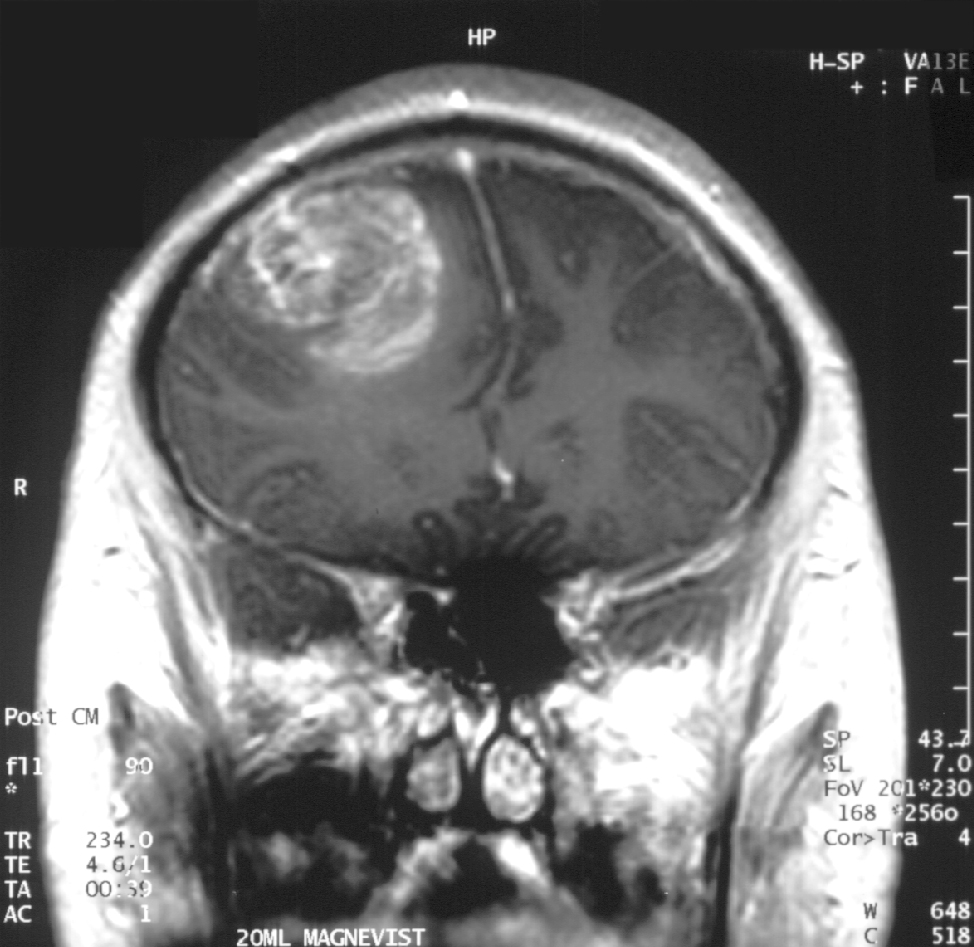
- •Order urgent MRI brain with and without gadolinium as the imaging gold standard. The typical appearance is a ring-enhancing mass with central necrosis, surrounding T2/FLAIR hyperintensity (edema/infiltration), and restricted diffusion. Volume ≥50 cm³ and multifocality are poor prognostic signs.
- •Obtain tissue for histopathologic and molecular diagnosis via maximal safe resection or stereotactic biopsy. The gold-standard diagnostic test is histopathologic evaluation with IDH1/2 mutational status determination. Immunohistochemistry should include GFAP, OLIG2, ATRX, IDH1 R132H, p53, and Ki-67.
- •Mandatory molecular testing includes IDH1/2 sequencing (to confirm wild-type status), MGMT promoter methylation analysis (by pyrosequencing, threshold ≥11% for methylated), and TERT promoter mutation testing. Optional but useful markers include EGFR amplification, CDKN2A/B deletion, and BRAF V600E mutation.
- •Apply the 2021 WHO diagnostic criteria: IDH-wildtype status plus at least one of microvascular proliferation, pseudopalisading necrosis, or molecular grade 4 features (TERT promoter mutation, EGFR amplification, +7/-10 chromosome signature). The presence of IDH mutation reclassifies the tumor as IDH-mutant astrocytoma grade 4.
- •Assess baseline laboratory values including CBC, comprehensive metabolic panel, and coagulation profile before surgery. Consider pregnancy testing in women of childbearing age.
- •Perform postoperative contrast-enhanced MRI within 48 hours to determine extent of resection. Gross total resection (no residual enhancement) is the goal and roughly doubles survival compared with biopsy alone.
- •Use the RTOG RPA classification for pretreatment prognostic staging, incorporating age, Karnofsky Performance Status (KPS), Mini-Mental State Exam score, extent of resection, and neurologic function. For recurrent disease, the Park scale (0-3 points based on eloquent cortex involvement, KPS ≤80, volume ≥50 cm³) predicts survival after repeat surgery.
Management
- •Initiate therapy with maximal safe resection of contrast-enhancing tumor. Gross total resection reduces 1-year mortality by 38% (RR 0.62, NNT=9) compared with subtotal resection. Intraoperative MRI or 5-ALA fluorescence guidance improves complete resection rates.
- •Within 4-6 weeks of surgery, start involved-field radiotherapy (60 Gy in 30 fractions over 6 weeks) with concurrent temozolomide 75 mg/m² orally daily, 7 days per week. This is the Stupp protocol, which improved median OS from 12.1 to 14.6 months (HR 0.63) and 5-year OS from 1.9% to 9.8%.
- •After a 28-day break following chemoradiation, administer adjuvant temozolomide 150-200 mg/m² orally on days 1-5 of each 28-day cycle for 6 cycles. The ASCO-SNO guideline recommends 6 cycles; longer treatment may be considered in selected patients.
- •Add tumor-treating fields (TTFields) to adjuvant temozolomide for eligible patients with newly diagnosed GBM. The EF-14 trial showed improved median OS (20.9 vs 16.0 months; HR 0.67) and PFS (6.7 vs 4.0 months) without worsening quality of life except for itchy skin.
- •For elderly patients (≥65 years) with good performance status (KPS ≥70), use hypofractionated radiotherapy (40 Gy in 15 fractions) with concurrent and adjuvant temozolomide. The Perry trial showed median OS 9.3 vs 7.6 months (HR 0.67). For MGMT-methylated patients, median OS was 13.5 vs 7.7 months.
- •For frail elderly patients (KPS 50-70%), short-course radiotherapy alone (25 Gy in 5 fractions) is non-inferior to 40 Gy in 15 fractions (median OS 7.9 months). Alternatively, temozolomide alone (100 mg/m² days 1-7 of 1-week-on/1-week-off) is non-inferior to radiotherapy in patients >65 years with MGMT-methylated tumors.
- •At recurrence, evaluate for repeat surgery, re-irradiation, or systemic therapy. The Park scale (0-3 points) guides surgical decision: score 0 → median OS 10.8 months; score 3 → 1.0 month. Re-irradiation (35 Gy in 10 fractions) with concurrent bevacizumab improves PFS but not OS vs bevacizumab alone.
- •For first recurrence, consider lomustine 90-110 mg/m² orally every 6 weeks (median OS 8.6 months in EORTC 26101). Bevacizumab 10 mg/kg IV every 2 weeks improves PFS and reduces steroid dependence but does not extend OS when added to lomustine. It is not recommended for newly diagnosed disease.
- •Do NOT use bevacizumab in the upfront setting, two phase III trials (AVAglio, RTOG 0825) showed no OS benefit and worse quality of life. Avoid non-dihydropyridine CCBs (diltiazem, verapamil) as they may exacerbate cerebral edema. Anticonvulsant prophylaxis is not indicated; only treat patients with a history of seizures.
- •Refer all patients to a neuro-oncology specialist, radiation oncologist, and palliative care team early. Consider clinical trials for novel therapies (e.g., checkpoint inhibitors, CAR-T cells, targeted agents) at any point in the disease course. Monitor with MRI every 2-4 months, with awareness that pseudoprogression within 12 weeks of chemoradiation is common and requires a confirmatory scan before declaring progression.
Board Review — High Yield
- •Stupp protocol, RT 60 Gy/30 fractions + concurrent temozolomide 75 mg/m² daily, then adjuvant TMZ 150-200 mg/m² days 1-5/28 for 6 cycles; improves median OS from 12.1 to 14.6 months.
- •MGMT promoter methylation, strongest predictive biomarker for temozolomide benefit; pyrosequencing threshold ≥11% defines methylated; associated with median OS ~28 months when combined with GTR and chemoradiation.
- •IDH-wildtype, required for GBM diagnosis per WHO 2021; IDH mutation reclassifies as IDH-mutant astrocytoma grade 4 with better prognosis (median OS 3.6 vs 1.2 years).
- •TERT promoter mutation, present in 70-80% of IDH-wildtype GBM; a defining molecular alteration; portends worse survival (aHR 2.93).
- •Pseudoprogression, transient increase in enhancement within 12 weeks of chemoradiation, more common in MGMT-methylated tumors; do not declare progression without confirmatory scan.
- •TTFields, low-intensity alternating electric fields added to adjuvant TMZ; EF-14 trial showed median OS 20.9 vs 16.0 months (HR 0.67); FDA-approved for newly diagnosed GBM.
- •Bevacizumab, no OS benefit in newly diagnosed GBM (two phase III trials); used in recurrent disease for PFS and steroid reduction but not recommended by ASCO-SNO upfront.
- •Elderly GBM, hypofractionated RT (40 Gy/15 fractions) + TMZ is standard for fit patients ≥65; TMZ alone is non-inferior to RT for MGMT-methylated patients.
- •Mesenchymal subtype, associated with radioresistance via NF-κB activation; tumors shift toward this phenotype at recurrence.
- •CSF ctDNA, liquid biopsy alternative when tissue unavailable; 84% concordance with tumor genotyping; higher variant allele frequency correlates with worse survival.
Deep Dive — Evidence Details
Definition and Epidemiology
- ▸Glioblastoma is an adult primary malignant brain tumour characterized by diffuse infiltration, aggressive behaviour, and poor prognosis. [510]
- ▸Contemporary cohorts commonly study **WHO grade 4, IDH-wildtype** glioblastoma. [513] [517] [519] [524]
- ▸The disease predominantly affects older adults; the reported mean age was **67.2 years** in a 1,099-patient multicentre cohort. [521]
- ▸Several cohorts report male predominance, including an approximately **2:1** ratio in a Moroccan diffuse-glioma series. [528]
- ▸Biopsy-only disease is a high-risk subgroup, with median overall survival of **3 months** in one cohort. [517]
- ▸Global CNS cancer incidence increased from **3.82 to 4.28 per 100,000** between 1990 and 2021, but these figures are not GBM-specific. [526]
Definition
Glioblastoma (GBM) is an adult primary malignant brain tumour characterized by diffuse infiltration, marked biological aggressiveness, and poor prognosis despite multimodal treatment. It is described as the most common and most aggressive primary malignant brain tumour in adults. [510] Contemporary studies frequently operationalize GBM as WHO grade 4, particularly the molecularly defined IDH-wildtype entity, although the cited cohorts do not provide a complete taxonomy-wide definition. [513] [517] [519] [524] Diagnosis in clinical studies may require histopathological confirmation, as in a nationwide registry cohort of adults undergoing surgery and a population-based study of postoperative treatment. [515] [529]C
The infiltrative nature of GBM makes tumour boundaries difficult to distinguish from functional brain tissue on conventional white-light microscopy. This characteristic is clinically important because residual infiltrating tumour contributes to recurrence risk, while the extent of resection must be balanced against neurological function. [510] The disease is therefore defined not only by malignant histology and molecular classification but also by diffuse growth into surrounding brain parenchyma. [510]
Epidemiology
Available contemporary evidence indicates that GBM predominantly affects older adults, although the reported age distribution varies according to case selection and treatment eligibility. In a multicentre study of 1,099 patients with newly diagnosed GBM, the mean age was 67.2 years. [521] A Moroccan institutional cohort of diffuse infiltrating gliomas reported a median age of 56 years, with GBM representing 64 of 122 patients evaluated for survival. [528] A real-world radiation-oncology series specifically enrolled 63 patients aged ≥65 years, illustrating the substantial representation of older adults in routine practice. [518]
A male predominance is reported in several cohorts. The multicentre seizure study included 617 men and 482 women among 1,099 patients. [521] The Moroccan cohort reported an approximately 2:1 male-to-female ratio among patients with diffuse infiltrating glioma. [528] These observations are consistent with sex-associated differences being relevant to cancer biology, although the cited proteomic study assessed sex differences across eight cancer types and does not establish a GBM-specific incidence mechanism. [522]
The epidemiology of GBM is strongly influenced by referral patterns, age, functional status, resectability, and molecular selection. For example, a retrospective analysis of 153 IDH-wildtype GBM cases from the UPENN-GBM dataset evaluated prognosis in relation to tumour morphology, extent of resection, sex, and a diffusion-tensor imaging biomarker. [513] A separate cohort included 322 patients with IDH-wildtype WHO grade 4 glioblastoma to examine perfusion-radiomic heterogeneity and early mortality. [524] These datasets demonstrate the increasing use of molecularly restricted and imaging-defined populations, but their findings should not be interpreted as population incidence estimates. [513] [524]
Unresectable or biopsy-only disease represents a particularly high-risk clinical subgroup rather than the general GBM population. In a retrospective cohort of 93 IDH-wildtype patients undergoing biopsy without resection, median overall survival was 3 months, and 48 of 89 patients (53.9%) with available survival data died within 3 months of biopsy. [517] This subgroup is enriched for deep, multifocal, anatomically eloquent, or medically compromised presentations, although the cited study reports clinical, radiological, and histomolecular predictors rather than a population prevalence. [517]
Large real-world datasets also show that GBM epidemiology is geographically and clinically heterogeneous. The cited evidence includes national healthcare data from Türkiye, a multicentre Japanese cohort, a Moroccan cancer-centre series, a Chinese institutional cohort, a Scottish regional cohort, and United States registry or consortium datasets. [515] [516]C [521] [528] [527] [513] A Scottish study included 1,196 patients with brain tumours, analysing GBM and other grade 4 tumours as one category alongside lower-grade tumours and metastases; therefore, its aggregate findings cannot be equated with GBM-specific incidence. [516]C
At the broader disease-burden level, global CNS cancer—not GBM specifically—had an age-standardized incidence rate that increased from 3.82 to 4.28 per 100,000 between 1990 and 2021, while the age-standardized mortality rate changed from 3.08 to 3.06 per 100,000. [526] These data indicate an uneven global CNS cancer burden and an incidence–mortality divergence, but they should not be used as GBM-specific rates. [526] A separate analysis reported increased GBM risk among patients with myeloproliferative neoplasms or myelodysplastic syndromes, suggesting a possible high-risk comorbidity population; the available abstract does not provide an effect size sufficient to quantify that risk. [525]
Overall, GBM is best regarded as a predominantly older-adult, male-predominant, diffuse-infiltrating WHO grade 4 malignant glioma, with modern epidemiological studies increasingly focused on molecularly defined IDH-wildtype disease. [510] [513] [517] [519] [524] Reported frequencies and outcomes vary substantially according to age, referral setting, molecular criteria, resectability, and access to treatment. [515] [518] [527] [528]
| Setting or population | Sample and principal finding |
|---|---|
| Newly diagnosed GBM, multicentre | 1,099 patients; mean age 67.2 years; 617 men and 482 women. [521] |
| Diffuse infiltrating glioma, Morocco | 122 patients; median age 56 years; approximately 2:1 male-to-female ratio; 64 GBM cases assessed for survival. [528] |
| Elderly real-world GBM, single centre | 63 patients aged ≥65 years. [518] |
| Biopsy-only IDH-wildtype GBM | 93 patients; median overall survival 3 months; 53.9% early mortality among cases with available survival data. [517] |
| Global CNS cancer, not GBM-specific | Age-standardized incidence increased from 3.82 to 4.28 per 100,000 from 1990–2021; mortality changed from 3.08 to 3.06 per 100,000. [526] |
Risk Factors and Prevention
- ▸No established environmental, occupational, lifestyle, dietary, infectious, or behavioral exposure has been shown in the supplied evidence to prevent or cause GBM, and population screening is not currently justified. [545]
- ▸NF1 is an inherited tumor-predisposition syndrome associated with glioma; HLA associations are investigational susceptibility findings and are not a validated basis for GBM screening. [532]
- ▸MPNs and MDS have been associated with increased glioblastoma risk, but the mechanism and preventive strategy remain undefined. [525]
- ▸EGFR, RTK, ATRX, IDH, metabolic, immune, and radiomic findings currently support classification, prognosis, or treatment research rather than prevention in unaffected people. [531,535,536,539,545,546]
- ▸xCT/system Xc−, FEN1, Fanconi-anemia pathway, CEBPB, vaccines, adoptive T cells, and organoid models are investigational treatment or research approaches, not established preventive interventions. [530,534,537,540-544,548]
Established and suspected risk factors
Glioblastoma (GBM) is usually sporadic, and the supplied evidence does not establish a modifiable environmental, dietary, occupational, lifestyle, infectious, or behavioral cause. A recent exposome-focused review specifically concluded that current evidence does not justify population-level glioma screening based on environmental exposures, although exposure information may improve biomarker discovery and precision-risk research. [545]D
Neurofibromatosis type 1 (NF1) is an inherited tumor-predisposition syndrome associated with gliomas, including high-grade glioma. In a molecular and genetic analysis of individuals with NF1-associated tumors, HLA class I and II alleles were associated with susceptibility to high-grade glioma, low-grade glioma, or other NF1-associated tumors; these findings suggest immunogenetic modifiers of susceptibility but do not provide a clinically validated prevention strategy. [532] The study included 38 individuals with NF1-associated high-grade glioma and 91 with low-grade glioma, so its findings should not be interpreted as a population-wide GBM risk estimate. [532]
A 2026 population and genetic analysis reported increased glioblastoma risk among patients with myeloproliferative neoplasms (MPNs) and myelodysplastic syndromes (MDS). The authors linked this emerging clinical hazard partly to the prolonged survival made possible by modern treatment of MPNs and MDS, but the supplied abstract does not establish a causal mechanism or a preventive intervention. [525] Patients with these hematologic disorders should therefore receive appropriate disease-directed care and clinical assessment of new neurologic symptoms, rather than routine brain imaging solely for GBM screening. [525][545]D
The molecular characteristics described in the supplied studies are primarily prognostic, predictive, or therapeutic biomarkers rather than proven causes of GBM. These include EGFR alterations, which occur in approximately half of GBM cases and have been investigated as treatment targets, [535] RTK signaling, which is one of the major oncogenic pathways in GBM, [531] ATRX status, [536] IDH-wild-type classification, [533][539]D and metabolic or immune features identified by advanced imaging and multi-omics. [539]D[545]D[546]D None currently supports prevention in unaffected people. [531][535][536][539]D[545]D
Prevention and early detection
No intervention in the supplied evidence has been shown to prevent GBM. The available literature is predominantly concerned with treatment resistance, recurrence, biomarker development, or experimental therapy rather than primary prevention. [530,531,534,535,538,540,544-548] Consequently, there is no evidence-based population screening program for GBM, and exposure-based screening is not currently justified. [545]D
For people with NF1 or MPN/MDS, prevention should focus on established care for the underlying disorder, genetic counseling when appropriate, and prompt evaluation of persistent or progressive neurologic symptoms. The available NF1 study identifies HLA associations with tumor susceptibility but does not show that HLA testing can predict GBM sufficiently for clinical surveillance decisions. [532] Similarly, the MPN/MDS analysis identifies an epidemiologic association but does not define an imaging schedule or chemopreventive treatment. [525]
MRI, molecular testing, liquid biopsy, PET, and radiomics are being investigated for diagnosis, recurrence detection, prognostication, or treatment selection—not validated population prevention. Physiologic MRI radiomics has been studied for noninvasive ATRX-status prediction, [536] paired [18F]FDOPA and [18F]FDG PET has shown complementary prognostic associations at recurrence in IDH-wild-type GBM, [539]D and CSF and plasma liquid-biopsy studies have explored recurrence-associated molecular signals. [546]D These approaches remain investigational for risk prediction and should not replace clinically indicated diagnostic assessment. [536][539]D[546]D
Research directions relevant to prevention
Current research may eventually support individualized risk reduction after diagnosis, but it does not yet prevent tumor development. Preclinical studies are investigating inhibition of the xCT/system Xc− pathway to overcome temozolomide resistance, [530] vulnerabilities involving FEN1 in GBM stem cells, [544]D Fanconi-anemia pathway disruption and lomustine sensitivity, [540]D and signaling or metabolic targets identified through compound screening. [538]D Studies of CEBPB, OSM signaling, eIF4G2-mediated translation, and CHI3L1 address mesenchymal transformation and tumor aggressiveness rather than primary prevention. [541]D
Vaccine-based immunotherapy, adoptive T-cell therapy, RNA vaccination, and CIITA/MHC-II induction are being explored to improve antitumor immunity after GBM has developed. [534][537]D[543]D Likewise, organoids and other three-dimensional models are research platforms for studying heterogeneity, invasion, treatment response, and the blood-brain or blood-tumor barriers; they are not routine preventive or diagnostic tools. [542]D[548]D These findings should not be presented as evidence that vaccines, immune manipulation, targeted drugs, or organoid-guided treatment prevent GBM in healthy individuals. [534][537]D[542]D[543]D[548]D
Practical prevention message
Because no proven primary preventive measure is available, risk management consists of recognizing inherited or hematologic predisposition, maintaining appropriate specialist follow-up, avoiding unsupported screening or supplements, and seeking medical evaluation for new or progressive neurologic symptoms. [525][532][545]D Psychological symptoms after diagnosis, including anxiety and depression, warrant clinical attention; in one observational study of 64 adults with IDH-wild-type GBM, postoperative symptom severity was examined in relation to progression-free survival, but this does not demonstrate that anxiety or depression causes GBM or that treating these symptoms prevents it. [533]
| Indicator or finding | What the evidence supports | Current prevention implication |
|---|---|---|
| NF1 | Association with glioma susceptibility; HLA associations require further validation. [532] | Specialist follow-up and symptom awareness; no validated HLA-based GBM screening. [532] |
| MPN or MDS | Reported association with increased glioblastoma risk. [525] | Treat the underlying hematologic disease; no defined brain-imaging or chemoprevention protocol. [525] |
| Environmental or occupational exposure | Exposome research is informative, but evidence does not justify population screening. [545]D | No exposure-based GBM screening recommendation. [545]D |
| EGFR, RTK, ATRX, IDH, PET, radiomic, or liquid-biopsy findings | Classification, prognostic, recurrence, or therapeutic research. [531][535][536][539]D[546]D | Not validated for prevention of GBM in unaffected individuals. [531][535][536][539]D[546]D |
Genetics and Hereditary Predisposition
- ▸Li-Fraumeni syndrome, Lynch syndrome, NF1, and selected pediatric tumor-predisposition syndromes are the principal hereditary contexts discussed in the cited evidence [98, 523, 532, 558].
- ▸Lynch-syndrome-associated GBM is rare but genetically heterogeneous; MSH2 was the most frequent germline defect in a 29-case series (**55.2%**) [558].
- ▸MMR-deficient GBM may reveal previously unrecognized Lynch syndrome, but MMR deficiency does not guarantee hypermutation or response to PD-1 blockade [554, 557].
- ▸Common risk loci, Mendelian-randomization findings, HLA associations, ACE polymorphisms, mitochondrial DNA copy number, and MGMT epimutations remain investigational for individual hereditary-risk prediction [102, 107, 115, 552, 553, 556].
- ▸UGT1A1 testing concerns irinotecan pharmacogenetics and SN-38 toxicity risk, not inherited GBM susceptibility [549].
Overview
Most glioblastomas (GBMs) are sporadic, but a minority arise in the setting of inherited cancer-predisposition syndromes, constitutional epimutations, or inherited variants that influence glioma susceptibility. Current evidence supports a distinction between germline predisposition, which increases susceptibility before tumor development, and somatic alterations, which are acquired within the tumor and generally are not inherited. This distinction is clinically important because hereditary disease may affect relatives, surveillance, treatment selection, and interpretation of tumor sequencing [98]C4[551]C[554]D[558]D[559]D.
Established hereditary syndromes
Li-Fraumeni syndrome (LFS). LFS is a rare, usually TP53-associated hereditary cancer syndrome characterized by early-onset and multiple primary malignancies, particularly sarcomas, breast cancer, and adrenocortical carcinoma. High-grade gliomas, including GBM, are less frequently reported but appear to occur at younger ages in affected individuals than in sporadic disease [98]C4. The available systematic review included clinical studies and case reports, so the strength of evidence for absolute GBM risk and genotype-specific risk remains limited [98]C4.
Lynch syndrome. Lynch syndrome results from germline pathogenic variants affecting DNA mismatch-repair (MMR) genes and predisposes to multiple cancers. Brain tumors are uncommon but recognized manifestations; reported CNS tumors include glioblastoma, astrocytoma, oligodendroglioma, and, rarely, medulloblastoma [116]C4. In a multicenter series of 29 Lynch-syndrome-associated GBMs, germline alterations involved MSH2 in 16 cases (55.2%), MLH1 in 6 (20.7%), MSH6 in 4 (13.8%), and PMS2 in 1 (3.4%); 6.9% had no detectable pathogenic germline variant despite the clinical diagnosis [558]D. These tumors presented at a mean age of 45.7 years with a range of 10–69 years and were reported to be younger than IDH-mutant comparator tumors [558]D.
A prospective cohort analysis identified five adults with germline MMR mutations consistent with Lynch syndrome; these tumors formed a distinct high-risk molecular subgroup and had a median survival of 3.25 months after surgery, although the small number of cases limits generalizability [551]C. A separate adult case demonstrated a giant-cell GBM with isolated PMS2 loss, microsatellite instability-high status, ultra-high tumor mutational burden, and biallelic PMS2 inactivation caused by a likely pathogenic germline splice-site variant plus a somatic nonsense mutation [554]D. These findings illustrate how tumor MMR loss can reveal previously unrecognized Lynch syndrome [554]D.
MMR deficiency in GBM should not automatically be equated with the usual hypermutation and checkpoint-inhibitor sensitivity observed in some other cancers. Experimental models summarized in a recent review found that loss of core MMR genes did not by itself induce hypermutation or improve survival with PD-1 blockade; germline MMR deficiency instead accelerated malignant progression through a myeloid-dominant, T-cell-suppressed immune microenvironment [557]D. Accordingly, treatment decisions require integrated assessment of germline status, MMR protein expression, microsatellite status, tumor mutational burden, and clinical context [554]D[557]D[558]D.
Neurofibromatosis type 1 (NF1). NF1 is an autosomal-dominant tumor-predisposition syndrome with marked phenotypic variability, including variable glioma risk among relatives carrying the same NF1 mutation [532]. In an NF1 cohort comprising individuals with high-grade glioma, low-grade glioma, and malignant peripheral nerve sheath tumors, HLA class I and II alleles were evaluated for associations with tumor susceptibility; the study used RNA sequencing, whole-exome sequencing, and direct DNA sequencing [532]. These findings are investigational and do not establish HLA genotyping as a clinical predictive test [532].
Other pediatric hereditary conditions may be relevant when evaluating a child with a high-grade glioma. A nationwide pediatric cohort of hereditary polyposis syndromes included juvenile polyposis syndrome, familial adenomatous polyposis, Peutz–Jeghers syndrome, PTEN-hamartoma tumor syndrome, and constitutional MMR deficiency among the evaluated disorders [523]C. The cited evidence describes the cohort but does not establish a specific GBM risk estimate for each syndrome [523]C.
Pediatric and tumor-predisposition phenotypes
WHO CNS5 reclassifies pediatric high-grade gliomas into biologically defined entities, including diffuse midline glioma, H3 K27-altered; diffuse hemispheric glioma, H3 G34-mutant; diffuse pediatric-type high-grade glioma, H3-wildtype/IDH-wildtype; and infant-type hemispheric glioma [550]C. These molecularly defined pediatric entities should not be assumed to represent hereditary syndromes, although their occurrence in a young patient may justify careful review of personal and family cancer history and consideration of genetics referral [550]C.
High-grade glioma with pleomorphic and pseudopapillary features—also termed HPAP or GPAP in the cited literature—is a circumscribed tumor with recurrent MAPK-pathway activation, relatively prolonged survival compared with conventional GBM, and frequent tumor-predisposition associations [555]D. In an independent cohort, 20 tumors clustered with previously reported cases and the median age at diagnosis was 37 years [555]D. The entity should therefore be distinguished from conventional GBM before assigning hereditary implications [555]D.
Common susceptibility signals and emerging genetic evidence
Genome-wide and Mendelian-randomization studies identify population-level or molecular associations with glioma risk, but these findings do not generally constitute actionable hereditary syndromes. Brain multi-omic Mendelian randomization analyzed 12,496 cases and 18,190 controls and identified causal evidence for 22 molecular traits across 18 genes or proteins associated with glioma risk [102]B2c. A separate analysis using 12,488 cases and 18,169 controls evaluated mitochondrial DNA copy number and glioma/GBM risk using inverse-variance weighting and sensitivity analyses [107]B2c. Another Mendelian-randomization study assessed possible causal relationships between autoimmune diseases and glioma subtypes using UK Biobank and FinnGen data [115]B2c. These results are hypothesis-generating and should not be used alone for individual genetic counseling [102]B2c[107]B2c[115]B2c.
Population genetics may contribute to incidence differences: GBM incidence has been reported as highest in European populations and lowest in East Asian and African populations, while allele-frequency differences were examined across 673 candidate loci, five superpopulations, and 26 subpopulations [556]D. Such associations reflect population-level risk architecture and do not justify race-based individual risk prediction [556]D. A small Turkish case-control study of 35 GBM patients and 36 controls examined the ACE insertion/deletion polymorphism because ACE may influence angiogenesis and cellular proliferation; its sample size limits clinical interpretation [553].
Constitutional MGMT promoter epimutations were investigated as possible predictors of incident colon cancer, GBM, and diffuse large B-cell lymphoma in a nested case-control study of postmenopausal women, but the cited evidence does not establish a definitive GBM-predisposition test [552]. Conversely, somatic mitochondrial and nuclear mitochondrial-gene mutations have been studied in primary and recurrent GBM after filtering out germline variants; these acquired changes should not be mistaken for inherited susceptibility [559]D.
Pharmacogenetic implications
UGT1A1 is polymorphically expressed, and its encoded enzyme predominantly inactivates irinotecan’s active metabolite SN-38. UGT1A1 genotype frequencies vary among populations [549]. Irinotecan is used primarily in colorectal cancer and other settings, but has also been used off-label in rare malignancies including GBM [549]. Therefore, UGT1A1 testing may be relevant when irinotecan is being considered, but it is a pharmacogenetic toxicity-risk assessment rather than evidence that inherited UGT1A1 variants cause GBM [549].
Clinical assessment
Genetic counseling should be considered for GBM or high-grade glioma with early age at onset, multiple primary tumors, a strong family history, features suggestive of LFS, NF1, Lynch syndrome, or another tumor-predisposition syndrome, or tumor findings such as unexplained MMR deficiency, MSI-high status, or loss of an MMR protein [98]C4[532][554]D[558]D. Radiation-induced leukoencephalopathy is a recognized complication after radiotherapy and temozolomide-based Stupp treatment; an ancillary ASTER study evaluated early-onset disease occurring within 6 months and its risk factors, but the cited abstract does not establish a hereditary genetic cause [103]B2b.
| Context | Evidence and clinical interpretation |
|---|---|
| Li-Fraumeni syndrome | Germline TP53-associated syndrome; high-grade glioma/GBM is uncommon, typically reported at younger ages, and supported mainly by case reports and clinical studies [98]C4. |
| Lynch syndrome | Germline MMR-gene predisposition; GBM is rare. In 29 LS-GBMs, MSH2 accounted for 55.2%, MLH1 20.7%, MSH6 13.8%, and PMS2 3.4% [558]D. |
| NF1 | Autosomal-dominant syndrome with variable glioma susceptibility; HLA associations are investigational [532]. |
| Pediatric predisposition syndromes | Polyposis and constitutional MMR-deficiency syndromes may enter the differential in children, but the cited cohort does not provide syndrome-specific GBM risk estimates [523]C. |
| Common genetic and epigenetic signals | Multi-omic, mitochondrial, autoimmune, population-genetic, ACE, and MGMT findings are not established clinical hereditary tests for GBM [102]B2c[107]B2c[115]B2c[552][553][556]D. |
| Pharmacogenetics | UGT1A1 genotype affects irinotecan/SN-38 metabolism and may guide toxicity assessment when irinotecan is used; it does not establish GBM predisposition [549]. |
Histopathology and Molecular Biology
- ▸IDH-wildtype diffuse gliomas with lower-grade histology may meet molecular criteria for glioblastoma, making integrated diagnosis essential [561].
- ▸DNA-methylation profiling supports CNS tumor classification, subclassification, and copy-number analysis; IDH mutation-associated G-CIMP is biologically important [574].
- ▸GBM contains spatially organized cellular states and may undergo mesenchymal or stromal evolution at recurrence, particularly near the surgical margin [565,566].
- ▸EGFR is frequent in IDH-wildtype GBM, but EGFR-targeted therapy remains limited by delivery, heterogeneity, adaptive resistance, and microenvironmental factors [568].
- ▸m6A–METTL3 signaling, translated circular RNAs, and multimodal pathology–transcriptomic models are promising research areas but are not established routine diagnostic standards [564,567,576,577].
Integrated diagnostic framework
Glioblastoma (GBM) is best defined through integrated histopathological and molecular assessment rather than morphology alone. Current classification recognizes that some IDH-wildtype (IDH-wt) diffuse gliomas with histological grade 2–3 features and characteristic molecular alterations qualify as molecular glioblastoma, even when conventional microscopic criteria for grade 4 are absent [561]. In a retrospective cohort of 134 adults with historically grade 2–3, IDH-wt gliomas diagnosed between 1996 and 2019, median overall survival was 35 months (95% CI, 28.8–43), although interpretation requires attention to noncanonical IDH mutations and the testing method used [561].
Histological evaluation remains essential for documenting cellularity, nuclear atypia, mitotic activity, necrosis, and microvascular proliferation, but the supplied studies emphasize that molecular testing is required to resolve diagnostically challenging cases and biologically heterogeneous tumors [561][562]D[574]D. DNA-methylation profiling has evolved from a research technique into an ancillary method for central nervous system tumor classification, molecular subclassification, and copy-number analysis [574]D. In IDH-mutant gliomas, mutant IDH1/2 produces D-2-hydroxyglutarate and extensive DNA and histone methylation changes, contributing to the glioma CpG island methylator phenotype (G-CIMP), lineage specification, differentiation, and clinical behavior [574]D.
Genomic, epigenomic, and transcriptomic features
The molecular landscape of IDH-wt GBM is heterogeneous. EGFR is described as the most frequent alteration in IDH-wt GBM, but EGFR-directed therapy has not improved overall survival because of restricted central nervous system drug delivery, intratumoral heterogeneity, adaptive resistance, and evolving tumor–microenvironment interactions [568]D. Molecular classification can be supported by transcriptomic approaches. A proposed ten-gene panel used analysis-of-variance ranking, hypergraph co-expression at a correlation threshold of τ = 0.75, rough-set reduct optimization, and a Random Forest classifier with stratified cross-validation to distinguish GBM from lower-grade glioma across expression platforms [560]. This remains a biomarker-development result rather than an established clinical diagnostic standard [560].
Single-cell and spatial methods demonstrate that GBM contains multiple transcriptional cellular states, including astrocyte-like, mesenchymal-like, neural-progenitor-cell-like, and oligodendrocyte-progenitor-cell-like programs [565]D. Xenium spatial transcriptomics showed that a reduced gene module could recapitulate single-cell molecular classifications while retaining spatial information; the custom panel contained 366 genes, including 100 genes added to a predesigned central nervous system panel [565]D. Histology and RNA sequencing can also be integrated computationally: one workflow extracted whole-slide image features with ResNet-50, compressed histological and transcriptomic representations to 30 dimensions each, and fused them into a 60-dimensional patient-level vector for unsupervised discovery of survival-relevant GBM clusters [576]D. SurvPAGE similarly combines whole-slide pathology and RNA-sequencing data through biologically informed heterogeneous graphs linking spatial histology patterns with genomic pathways and genotype–phenotype relationships [577]D.
Spatial heterogeneity, recurrence, and treatment resistance
Histology-guided single-cell spatial profiling indicates that the surgical margin is not merely residual tumor but a distinct post-treatment wound-healing microenvironment [566]D. Recurrent tumors may acquire malignant states with pronounced mesenchymal transcriptional and histological features, including a “stromal” subtype enriched at the surgical margin [566]D. Transition to this subtype at recurrence was associated with early TP53 mutation, persistent proliferation during adjuvant temozolomide treatment, and shorter survival [566]D. These findings support sampling of both enhancing tumor and infiltrative margins when clinically feasible, while recognizing that the margin may contain treatment-altered tissue [566]D.
Epitranscriptomic regulation contributes to therapy resistance. In GBM cell models with acquired temozolomide resistance, N6-methyladenosine (m6A) stabilized genes and pathways associated with resistance; inhibition of the methyltransferase METTL3 reversed these molecular effects and restored temozolomide sensitivity in the experimental systems studied [567]D. These findings are preclinical and do not establish METTL3 inhibition as standard treatment [567]D. Circular RNAs are also increasingly relevant: although traditionally regarded as noncoding, some contain functional open reading frames and undergo cap-independent translation, producing proteins or peptides implicated in GBM progression, molecular heterogeneity, and therapeutic resistance [564]D.
Histology-linked imaging and biomarker research
In untreated IDH-wt GBM, the non-contrast-enhancing T2/FLAIR-hyperintense peritumoral brain zone (PBZ) is biologically informative. In a retrospective study of 80 adults, dynamic susceptibility contrast MRI-derived oxygen extraction fraction and related physiological measures were assessed in the PBZ, enhancing tumor core, and contralateral normal-appearing white matter, with the objective of relating PBZ physiology to the Ki-67 proliferation index [158]C4. This supports investigation of the infiltrative zone as a distinct biological compartment, although imaging biomarkers do not replace tissue diagnosis [158]C4.
Deep-learning MRI systems have been developed to classify six tumor categories, including IDH-wt GBM, IDH-mutant astrocytoma, IDH-mutant 1p/19q-codeleted oligodendroglioma, pilocytic astrocytoma, pleomorphic xanthoastrocytoma, and glioneuronal or neuronal tumors, using multiparametric MRI in 1,844 patients [570]D. Such systems may assist preoperative stratification but are adjunctive to pathological and molecular testing [570]D. Other supplied studies concern intramedullary tumors and spinal cord gliomas rather than adult cerebral GBM; they nevertheless illustrate the broader utility of methylation-based classification in rare, histologically heterogeneous CNS tumors [142]D5[562]D. In histone-H3-wildtype spinal cord gliomas, methylation profiling identified six subtypes, including pilocytic astrocytoma, an immune-enriched pilocytic astrocytoma group, diffuse leptomeningeal glioneuronal tumor, subependymoma, and a GBM-like group [562]D.
Emerging experimental biology
Additional transcriptomic studies remain exploratory. Integrated network analysis identified an ethanol–ADAM17-associated molecular axis linked to GBM progression, based on overlap between ethanol-associated and ADAM17-associated molecular networks [572]D. In murine GL261 tumors, oncolytic virotherapy with VV-GMCSF-Lact and anti-PD-1 generated therapy-associated transcriptional and immune-reprogramming signatures that could be compared with combination treatment [569]D. Ophiobolin A induced early apoptosis-, ferroptosis-, and antioxidant-related transcriptional changes in T98G and U118MG GBM cells and was evaluated using machine-learning approaches [575]D. These findings are hypothesis-generating and should not be treated as validated diagnostic biomarkers [569]D[572]D[575]D.
| Approach | Principal contribution | Current interpretation |
|---|---|---|
| DNA methylation profiling | Classification, subclassification, and copy-number analysis; identifies methylation-defined CNS tumor groups [562]D[574]D | Clinically useful ancillary method [574]D |
| Transcriptomic panels | Ten-gene GBM/LGG classification framework using τ = 0.75 hypergraph correlation and Random Forest validation [560] | Promising biomarker development [560] |
| Single-cell/spatial transcriptomics | Maps astrocyte-like, mesenchymal-like, neural-progenitor-like, and oligodendrocyte-progenitor-like states and recurrence-associated stromal regions [565]D[566]D | Research and spatial pathology applications [565]D[566]D |
| Multimodal pathology–RNA analysis | Fuses histology and RNA-seq using 30 + 30 = 60 latent dimensions or graph-based integration [576]D[577]D | Exploratory prognostic stratification [576]D[577]D |
Clinical Presentation
- ▸GBM presentation is anatomically and functionally heterogeneous; headache and vomiting with hemorrhage and edema are documented examples, but symptom frequencies are not provided by the supplied evidence [593].
- ▸Performance status and resectability are major clinical descriptors; a selected biopsy-only cohort had median survival of **3 months**, with **53%** early mortality among patients with available data [517].
- ▸MRI and CT perfusion support characterization and differential diagnosis, including distinction from PCNSL, but tissue-based integrated molecular diagnosis remains essential [581][583][585][590].
- ▸Molecular testing access, social deprivation, and health-system resources can materially influence diagnosis, treatment, time at home, and outcomes [580][584][591].
- ▸Blood, urine, exercise, and endocrine studies are investigational or supportive-context evidence and should not be presented as established diagnostic criteria [511][578][579][587][588].
Overview
Glioblastoma (GBM) is an aggressive adult primary brain tumor whose clinical presentation reflects tumor location, mass effect, edema, hemorrhage, infiltration, and the patient’s baseline functional reserve. Contemporary studies in this evidence set primarily concern molecularly confirmed IDH-wildtype, WHO grade 4 disease, which should be distinguished from histologically similar diffuse gliomas requiring integrated molecular classification [578][579][581]C[582]C. No epidemiologic risk factor has been identified that explains a substantial proportion of GBM risk, and clinical presentation is therefore not reliably predicted by a known exposure history [592]C.
Symptoms and signs at presentation
Presenting symptoms are site-dependent and may include headache, vomiting, focal neurological deficits, seizures, cognitive or behavioral change, gait disturbance, and progressive impairment in activities of daily living; however, the supplied studies do not provide a frequency distribution for these individual symptoms. A documented example was a patient with a right temporoparietal GBM who had long-standing headache followed by acute worsening with vomiting; imaging showed intratumoral hemorrhage, peritumoral edema, and extension through the dura and temporal bone into the temporalis muscle [593]C. This case illustrates that GBM may present with chronic symptoms followed by acute deterioration from hemorrhage, edema, or rapid mass effect [593]C.
Neurological disability and functional decline are clinically important components of presentation and subsequent disease assessment. Performance status is routinely incorporated into outcome analyses, and poorer baseline status is associated with limited treatment feasibility in older or medically vulnerable populations [517][518]. In biopsy-only cohorts, unresectability identifies a clinically heterogeneous group with particularly poor outcomes; in one retrospective series, median overall survival was 3 months, and 53% of patients with available survival data died within 3 months of biopsy [517]. These figures describe a selected high-risk population rather than the natural history of all patients with newly diagnosed GBM [517].
Imaging presentation and differential diagnosis
MRI commonly identifies an infiltrative, contrast-enhancing intracranial mass, but the available references emphasize that imaging findings are not sufficiently specific for definitive diagnosis. Clinical MRI features evaluated for prediction of molecular GBM included tumor location, apparent diffusion coefficient, contrast-enhancement pattern, cysts, and calcification [590]. CT perfusion may assist preoperative differentiation from primary central nervous system lymphoma (PCNSL); a retrospective study compared absolute and normalized cerebral blood flow, cerebral blood volume, mean transit time, and permeability-surface product in 65 patients with GBM and 57 with PCNSL [585]. These imaging approaches support differential diagnosis but do not replace tissue-based integrated classification [581]C[583]C.
Rarely, GBM may show unusual contiguous spread. A reported untreated IDH-wildtype tumor extended across the dura and calvarium into the temporalis muscle, demonstrating that extracranial or transdural extension can exceptionally be present before surgery or other interventions [593]C.
Diagnostic confirmation and molecular context
Definitive diagnosis requires surgical biopsy or resection when clinically feasible, followed by histopathological and molecular assessment. WHO CNS5 classification integrates histology with molecular alterations, and practical workflows commonly assess IDH status, 1p/19q codeletion, and other diagnostically relevant mutations or copy-number changes [581]C[582]C[591]. Limited access to molecular testing can produce diagnostic misclassification, particularly in low- and middle-income settings [580][582]C[591]. DNA methylation profiling may add value when routine pathology and specialist neuropathology diagnoses disagree; a diagnostic-accuracy study evaluated general pathology, specialist neuropathology, and EPIC-based methylation classification in intracranial space-occupying lesions [583]C.
Blood- and urine-based tests remain investigational rather than established components of routine presentation assessment. A retrospective case-control study evaluated plasma GFAP, UCH-L1, neurofilament light, tau, NSE, MPO, and polymorphonuclear elastase for GBM exclusion [587]. A separate study developed a protease-responsive urinary gold-nanocluster assay based on MMP-9 activation [588]. These approaches address the limitations of MRI and invasive biopsy but require further validation before replacing standard diagnostic evaluation [587][588].
Functional, social, and temporal features
Time to diagnosis may influence tumor size at detection and neurological outcomes, but the supplied observational evidence does not establish a universal symptom-to-treatment threshold for GBM [516]C. Access to surgery, radiotherapy, temozolomide, and molecular diagnostics varies substantially by health-system resources and contributes to outcome disparities beyond tumor biology [580]. Neighborhood material deprivation has also been studied in relation to days spent outside hospitals and post-diagnosis survival, indicating that social context can shape the lived clinical course after presentation [584].
At recurrence, structured exercise participation was associated with attenuated tumor-volume increase, less performance-status decline, and less sarcopenic adiposity in a small retrospective subgroup of 25 of 201 (12.4%) patients; these associations do not establish exercise as a diagnostic or disease-modifying treatment [579]. A systematic review likewise identified physical exercise as an understudied supportive-care issue in brain-tumor populations [511]. Endocrine factors, including testosterone replacement exposure, are being investigated in relation to GBM outcomes, but they are not established presenting features or diagnostic criteria [578]. Near the end of life, recurrent emergency visits, hospitalizations, prolonged hospitalization, and intensive-care use have been examined as potentially inappropriate care indicators, underscoring the importance of recognizing progressive functional decline and integrating palliative care [586]C.
| Domain | Relevant evidence |
|---|---|
| Symptoms/signs | Headache, acute vomiting, intratumoral hemorrhage, edema, and transdural/calvarial extension were documented in a case report; broad symptom frequencies were not supplied [593]C. |
| Neurological function | Performance status and functional decline are clinically important, particularly in older or unresectable patients [517][518]. |
| Imaging | MRI features include location, ADC, enhancement, cysts, and calcification; CT perfusion parameters may help distinguish GBM from PCNSL [585][590]. |
| Confirmation | Histopathology must be integrated with molecular testing, including IDH and 1p/19q assessment where appropriate; methylation profiling can resolve difficult cases [581]C[582]C[583]C[591]. |
| Emerging tests | Plasma protein panels and urinary protease-responsive assays remain investigational [587][588]. |
| Context | Delayed diagnosis, limited surgery or adjuvant therapy, molecular-testing gaps, deprivation, and functional decline affect the clinical course [516]C[580][584][586]C. |
Biopsy and Histologic Diagnosis
- ▸Tissue-based integrated molecular diagnosis remains essential for WHO CNS5 diffuse-glioma classification.[599][608]
- ▸Oligodendroglioma requires both an IDH mutation and whole-arm 1p/19q codeletion; oligodendroglioma-like morphology alone is insufficient.[600]
- ▸Regional and intratumoral heterogeneity can limit the representativeness of a small biopsy.[604][611]
- ▸Mismatch-repair deficiency, PMS2 loss, microsatellite instability, and germline alterations may identify a clinically important glioblastoma subset.[554]
- ▸IHC and emerging spatial, digital, and methylation-based methods are valuable adjuncts, but candidate biomarkers are not established as stand-alone diagnostic criteria in the cited evidence.[595][596][597][606][609][610][611]
Role of tissue diagnosis
Biopsy or resection remains central to the diagnosis and integrated classification of glioblastoma because histologic interpretation must be combined with molecular findings rather than relying on morphology alone. The 2021 WHO Classification of Tumors of the Central Nervous System incorporates integrated molecular diagnostics into diffuse-glioma classification, while tissue-based next-generation sequencing remains essential for WHO CNS5 classification despite its invasive nature and limited suitability for serial monitoring.[599][608]D Cerebrospinal-fluid sequencing and radiogenomic approaches may complement, but do not replace, tissue examination; CSF circulating-tumor-DNA sequencing is being developed for minimally invasive monitoring, whereas tissue remains the reference for diagnosis.[608]D
Histologic examination and sampling
The biopsy should be assessed for the morphologic features and cellular heterogeneity of the sampled lesion, with awareness that limited tissue may not represent the entire tumor. Regional heterogeneity is clinically relevant: different glioblastoma regions may differ in cellular profiles and exposure to hypoxia or nutrient deprivation, and regional variation has been demonstrated in analyses of progesterone-receptor expression.[604]D Marginal regions may consist of unresectable functional brain infiltrated by tumor cells and may contain vasculature with distinct morphologic and molecular features from the tumor core.[611]D Consequently, diagnostic material should be selected and documented with attention to tumor-rich, enhancing, infiltrative, necrotic, and treatment-altered regions when available.[604]D[611]D
Histopathology is commonly supplemented by immunohistochemistry (IHC). In a real-world cohort of 174 IDH-wild-type glioblastomas, phosphorylated ACC and phosphorylated AMPK were evaluated on formalin-fixed, paraffin-embedded tumor sections, illustrating the feasibility of pathway-marker assessment in routine archival material.[595] Human glioblastoma studies have also used IHC to characterize C3aR-positive tumor-associated macrophage states, Wnt ligand secretion mediator (WLS), FAP-positive pericyte-like stromal cells, annexin A2, vascular antigens, and other candidate biomarkers.[597][603]D[609]D[610]D[611]D These markers may provide biologic, prognostic, or research information, but the cited studies do not establish any one of them as a stand-alone diagnostic criterion for glioblastoma.[595][597][603]D[609]D[610]D[611]D
Integrated molecular diagnosis and diagnostic pitfalls
Oligodendroglioma-like morphology is a recognized diagnostic pitfall because several non-oligodendroglial CNS tumors may show focal or predominant oligodendroglioma-like architecture. In a retrospective series of 23 such tumors, the final diagnosis required correlation of microscopy with immunohistochemical, molecular, cytogenetic, clinical, and follow-up data; oligodendroglioma is defined by the integrated presence of an IDH mutation and whole-arm 1p/19q codeletion.[600]C Thus, an oligodendroglial appearance should not be used to assign oligodendroglioma without molecular confirmation.[600]C
Historical PCR-based testing may provide supportive information when comprehensive profiling is unavailable, but it has limitations. In a pre-IDH-era cohort of 40 morphology-defined diffuse astrocytic gliomas, investigators evaluated 14 loss-of-heterozygosity markers and 5 microsatellite-instability markers across tumors originally classified as diffuse astrocytoma, anaplastic astrocytoma, or glioblastoma; these data illustrate grade-associated molecular patterns but do not substitute for contemporary integrated classification.[599]
Rare molecular alterations can substantially alter interpretation and management. KANK1::NTRK2 fusions have been reported in adult glioblastoma and were associated with aggressive disease; a retrospective study reviewed clinical, histopathologic, and outcome data and used spatial transcriptomic and proteomic profiling for biologic characterization.[596]C Mismatch-repair deficiency is another diagnostically important possibility. An adult-onset giant-cell glioblastoma with isolated PMS2 loss showed microsatellite-instability-high status, ultra-high tumor mutational burden, biallelic PMS2 inactivation, and a germline PMS2 splice-site variant with a somatic nonsense mutation; DNA-methylation profiling classified it as a high-grade glioma with mismatch-repair deficiency and matched diffuse high-grade glioma, IDH-wildtype, subtype E.[554]D Such findings warrant consideration of hereditary cancer evaluation and may influence treatment selection.[554]D
Ancillary and emerging approaches
DNA-methylation profiling can resolve diagnostically difficult high-grade gliomas when routine morphology and targeted testing are insufficient, as demonstrated in the PMS2-deficient case.[554]D Whole-slide-image analysis is also being investigated for biomarker prediction: an interpretable prototype-learning framework was developed to predict EGFR amplification from glioblastoma histologic images, although this remains an investigational approach rather than a replacement for molecular testing.[606]D Multiplex IHC and spatial profiling can further define tumor–microenvironment relationships, including immune-cell states, perivascular components, stromal populations, and vascular architecture, but these methods currently function primarily as adjunctive or research tools.[596]C[597][609]D[611]D
Experimental models provide mechanistic context but should not be confused with human diagnostic validation. In rat C6-induced glioblastoma, histopathologic changes and Ki-67 were assessed after treatment, while other preclinical studies used IHC to evaluate treatment-related markers in mouse or cell-line models.[594][598][602][607]D These findings support biologic investigation but do not establish diagnostic thresholds for human glioblastoma.
Practical diagnostic principle
A defensible diagnosis should therefore integrate representative histology, appropriate IHC, molecular testing, and—when necessary—methylation or broader sequencing. Biomarker expression studies involving pACC/pAMPK, C3aR, WLS, FAP, annexin A2, SMC3, progesterone receptor, and vascular markers may refine biologic characterization or prognostication, but the cited evidence does not validate them individually as defining criteria.[595][597][601][603]D[604]D[609]D[610]D[611]D Liquid biopsy, radiogenomics, digital pathology, and spatial assays should be regarded as complementary technologies while tissue-based integrated diagnosis remains the diagnostic foundation.[606]D[608]D
| Approach | Application or finding | Diagnostic relevance |
|---|---|---|
| Histology plus integrated molecular testing | Differentiates morphologic mimics, including oligodendroglioma-like tumors | Required for reliable classification; morphology alone may mislead [600]C[608]D |
| IHC on FFPE tissue | pACC/pAMPK, C3aR, WLS, FAP, annexin A2, vascular and other markers | Supports characterization and research; no cited marker is independently diagnostic [595][597][603]D[609]D[610]D[611]D |
| PCR-based LOH/MSI testing | 14 LOH and 5 MSI markers in a 40-case historical cohort | Potentially supportive where resources are limited, but not a substitute for current integrated testing [599] |
| DNA-methylation profiling | Classified a PMS2-deficient case as high-grade glioma with MMR deficiency, matching diffuse high-grade glioma, IDH-wildtype, subtype E | Useful for resolving difficult high-grade glioma diagnoses [554]D |
| Whole-slide imaging and spatial profiling | EGFR-amplification prediction; spatial transcriptomic, proteomic, immune, stromal, and vascular assessment | Emerging adjunctive tools, not replacements for tissue molecular diagnosis [596]C[606]D[611]D |
| CSF liquid biopsy and radiogenomics | Non- or minimally invasive detection or prediction of molecular alterations | Complementary approaches for monitoring and precision neuro-oncology [608]D |
Imaging
- ▸Postoperative DWI should be interpreted by morphology as well as presence or absence; sector-shaped lesions were associated with neurological worsening, whereas DWI positivity alone was not. [618]
- ▸T2/FLAIR abnormalities after surgery or chemoradiotherapy may include edema and treatment-related change, complicating non-enhancing tumor assessment. [623]
- ▸FET PET/MRI can reveal discordance between metabolically defined and MRI-based radiotherapy target volumes. [615]
- ▸APTw MRI, synthetic MRI, habitat analysis, perfusion, and radiomics are being investigated as quantitative approaches to protein biology, recurrence risk, survival, and tumor heterogeneity. [614][625][628][281][624]
- ▸TSPO-PET signal is biologically heterogeneous and may reflect tumor, immune, extracellular, and blood-brain-barrier-related compartments. [613]
- ▸Emerging modalities include hypoxia-targeted 64Cu-ATSM, transcranial ultrasound through sonolucent implants, and MRI-enhanced deep-learning radiotherapy planning. [465][617][626]
Conventional MRI and postoperative assessment
Multiparametric MRI remains the principal imaging framework for glioblastoma (GBM) characterization, surgical planning, radiotherapy planning, and longitudinal surveillance. Recent studies have expanded the assessment beyond contrast enhancement to include T2-weighted/FLAIR abnormalities, diffusion, perfusion, permeability, quantitative tissue maps, and spatial heterogeneity. [614][620][623]C[624][625]C
Postoperative MRI continues to provide complementary information about residual disease, treatment-related change, and surgical injury. In a retrospective cohort of 139 patients undergoing eloquent-area glioma surgery, MRI obtained within 48 hours was used to classify postoperative DWI abnormalities as sector-shaped or rim-shaped; DWI positivity alone was not associated with neurological worsening, whereas sector-shaped lesions were associated with worsening at discharge and remained associated after adjustment. [618]C Interpretation of postoperative T2/FLAIR abnormalities requires caution because edema and surgery-related changes can confound estimation of non-enhancing tumor burden. [623]C In IDH-wildtype GBM, postoperative volumetric assessment of contrast-enhancing and FLAIR components has also been used to examine the relationship between fluorophore-assisted resection, extent of resection, and survival. [619]
Perfusion, diffusion, permeability, and physiologic MRI
DSC-PWI is being evaluated using vascular and metabolic biomarkers in addition to conventional cerebral blood volume. A retrospective presurgical study of 219 patients—including 101 GBMs, metastases, meningiomas, and lymphomas—used two DSC acquisitions with different contrast-preloading and flip-angle conditions to assess whether advanced biomarkers improve tumor diagnosis and remain robust across acquisition parameters. [620] The study directly addresses the parameter dependence of CBV-based interpretation and supports consideration of acquisition standardization when comparing perfusion results. [620]
Arterial spin labeling provides a non-invasive method for quantifying cerebral blood flow. In a single-center study of 60 glioma patients, predominantly with WHO grade 4 disease, preoperative tumor, surrounding, and whole-brain CBF were related to subsequent progression of enhancing tumor and surrounding non-enhancing FLAIR-hyperintense volume using correlation, regression, and ROC analyses. [627] DTI-derived measures are also being investigated: DTI-ALPS was assessed as a surrogate of glymphatic function in patients with unifocal IDH-wildtype CNS WHO grade 4 GBM, but its independent association with overall survival was specifically examined beyond extent of resection, adjuvant therapy, MGMT promoter methylation, and clinical performance status. [622]
Quantitative MRI, habitats, and heterogeneity
Amide proton transfer-weighted (APTw) MRI signals are commonly interpreted as reflecting mobile intracellular proteins, but a prospective image-guided study of 12 tissue samples examined this assumption by integrating preoperative APTw MRI with intraoperative neuronavigation, biochemical protein quantification, and data-independent-acquisition proteomics. [614] A separate retrospective study of 66 GBM patients extracted 504 APT radiomic features, reduced them for collinearity, and used Cox-model feature selection to evaluate associations with overall survival alongside age and MGMT methylation. [628]
Synthetic MRI has been investigated for risk stratification before radiotherapy. In 78 patients with GBM imaged at 3 T, histogram-based quantitative metrics from synthetic MRI subregions were integrated with FLAIR, contrast-enhanced three-dimensional T1-weighted MRI, and clinical-pathological variables to construct models and a nomogram for early recurrence, defined as recurrence within 6 months. [625]C
Multiparametric habitat analysis combines ADC, relative CBV, and Ktrans as imaging surrogates of cellularity, vascularity, and permeability. A multi-institutional study used these measures to define eight high/low spatial habitat clusters and explored differences between molecular and histologic GBM, with internal and external validation cohorts. [281]B3b MRI-based intratumoral heterogeneity has also been evaluated for distinguishing GBM from solitary brain metastasis. In a two-center study of 355 patients, a 2.5-dimensional heterogeneity score integrating local radiomics and global pixel-distribution patterns was compared with radiomics and combined models using internal and external testing. [624]
Voxel-based spatial analysis may provide additional information about tumor location and invasiveness. The multicenter Brain-Grid study evaluated preoperative MRI in 116 adults with newly diagnosed IDH-wildtype GBM and correlated spatial tumor distribution with survival, progression, functional outcomes, and molecular variables including MGMT promoter methylation. [621] Tractography-based analysis of the inferior fronto-occipital and arcuate fasciculi has likewise been used to examine fractional anisotropy, tract morphology, and white-matter involvement relevant to operative risk. [279]C4
Amino-acid PET, TSPO-PET, and theranostic imaging
FET PET/MRI may identify metabolically active high-grade glioma beyond MRI-defined volumes. In the prospective FETSMaRT pilot study, 30 patients with WHO grade 3 or 4 glioma, including 23 with GBM, underwent FET PET/MRI before radiotherapy while radiation oncologists were blinded to PET. The study quantified discordance between MRI-based and FET-PET/MRI-derived gross, clinical, and planning target volumes and examined associations with outcomes. [615]C
TSPO-PET remains promising for monitoring GBM, but signal specificity requires compartment-level interpretation. In an experimental SB28 mouse model, dynamic 60-minute microPET scans with [18F]GE-180, with and without blocking by excess non-radioactive tracer, were combined with tumor dissociation and cell sorting to investigate contributions from tumor cells, tumor-associated microglia/macrophages, and extracellular compartments, including the effect of blood-brain barrier disruption. [613]
Hypoxia-targeted PET agents are also entering theranostic development. The first-in-human phase I STAR-64 study administered intravenous 64Cu-ATSM weekly at dose-escalation levels of 30, 60, 99, or 150 MBq/kg to patients with recurrent malignant brain tumors, evaluating safety and dose-limiting toxicity while leveraging the agent’s hypoxia-targeting and radiotherapeutic properties. [465]C4 In a preclinical nanotherapeutic study, an RGD-modified 64Cu-loaded nanoparticle achieved PET-measured accumulation of 7.66 ± 0.93% ID/g at 4 hours in U87-MG tumors and was associated with cuproptosis-related signaling and DNA damage. [629]D
Emerging and adjunctive imaging
In orthotopic LN229 mouse GBM, gadobutrol administered intravenously or intraperitoneally at 1 or 2 mmol/kg was compared to determine feasibility, enhancement, and the optimal imaging time window for intraperitoneal administration. [616]C Sonolucent cranial implants enable transcranioplasty ultrasound as a potential point-of-care adjunct between scheduled MRI examinations; a retrospective, prospectively registered pilot evaluated whether outpatient ultrasound findings could identify recurrence concordant with MRI-confirmed GBM recurrence. [617]C
MRI is also being incorporated into radiotherapy automation. In 140 patients treated with 60 Gy in 30 fractions, deep-learning dose-prediction models compared CT-only input with CT plus multisequence MRI to assess whether MRI-derived anatomical and tissue-characterization information improves prediction of three-dimensional radiotherapy dose distributions. [626]
| Modality or approach | Principal application | Evidence |
|---|---|---|
| MRI with contrast, FLAIR, and DWI | Tumor burden, postoperative injury, treatment-related change | [618]C[619][623]C |
| DSC-PWI and ASL | Vascular, metabolic, and cerebral-blood-flow assessment | [620][627] |
| APTw, synthetic MRI, and radiomics | Protein-related signal, heterogeneity, recurrence, and survival modeling | [614][625]C[628] |
| ADC/rCBV/Ktrans habitat analysis | Spatial characterization of cellularity, vascularity, and permeability | [281]B3b |
| FET PET/MRI | Metabolic tumor delineation and radiotherapy-volume comparison | [615]C |
| TSPO-PET | Experimental monitoring with cellular and extracellular signal attribution | [613] |
| Tractography and Brain-Grid analysis | White-matter risk, tumor topography, and invasiveness | [279]C4[621] |
| Ultrasound and MRI-integrated artificial intelligence | Interval surveillance and radiotherapy dose prediction | [617]C[626] |
Molecular Diagnostics and Biomarkers
- ▸Integrated diagnosis should assess IDH status, TERT promoter mutation, EGFR amplification, chromosome 7 gain/chromosome 10 loss, and histopathology; molecular glioblastoma criteria can apply without necrosis or microvascular proliferation. [632]
- ▸Amplicon-based NGS can infer clinically important segmental alterations, including **1p/19q codeletion**, **+7/−10**, EGFR amplification, and CDKN2A/B homozygous deletion. [630]
- ▸MGMT promoter methylation is the principal established predictive biomarker for alkylating-agent sensitivity, but results depend on assay method and should be interpreted with other molecular findings. [636][637]
- ▸CSF sequencing, plasma miRNA, plasma proteomics, urine assays, circulating blood indices, advanced MRI, and radiogenomic models are promising but remain variably validated and generally investigational. [608][620][634][638][588]
- ▸Candidate prognostic or treatment-resistance markers—including pACC/pAMPK, ANXA2, SMC3, eosinophils, FOXO/Tribbles transcripts, redox markers, and lncRNAs—require prospective or external validation before routine clinical adoption. [595][610][601][633][635][639][640]
Integrated molecular classification
Glioblastoma diagnosis increasingly combines histopathology with molecular alterations, reflecting the 2021 WHO CNS framework. In IDH-wild-type diffuse astrocytic tumors, glioblastoma may be diagnosed molecularly by a TERT promoter mutation, EGFR amplification, or combined chromosome 7 gain/chromosome 10 loss (+7/−10), even when necrosis or microvascular proliferation is absent. [632]C A retrospective comparison of molecularly diagnosed glioblastoma (molGBM) with histologically defined glioblastoma evaluated clinical presentation, grade-stratified outcomes, and comparisons with corresponding-grade IDH-mutant astrocytomas; the findings address the still-uncertain clinical behavior of molGBM but do not establish that molecularly defined and histologically defined tumors are interchangeable. [632]C
Targeted next-generation sequencing (NGS) remains central to integrated glioma classification because it can detect sequence variants and, with appropriate bioinformatic processing, copy-number alterations. [630] An amplicon-based Oncomine Comprehensive Assay version 3 analysis was adapted to infer segmental copy-number variants using vendor-normalized gene-level data, intersample normalization, and control regions. [630] The method specifically targeted 1p/19q codeletion, +7/−10, EGFR amplification, and CDKN2A/B homozygous deletion and was evaluated in retrospective discovery and prospective validation cohorts, supporting the feasibility of extracting diagnostically important segmental alterations from panels not originally designed for this purpose. [630]
Established tissue biomarkers
MGMT promoter methylation remains a major predictive biomarker for temozolomide-based therapy because promoter methylation is associated with reduced MGMT expression and increased sensitivity to alkylating agents. [636]D[637]D Current testing approaches include methylation-specific PCR, pyrosequencing, and genome-wide methylation-array methods; interpretation is complicated by assay variability and the biological and technical limitations of applying a single marker across heterogeneous tumors. [636]D MGMT promoter methylation should therefore be interpreted as part of an integrated molecular assessment rather than as a stand-alone determinant of treatment response. [637]D
IDH1/IDH status, TERT, EGFR, and MGMT are repeatedly emphasized as clinically relevant molecular features for glioblastoma stratification, diagnosis, prognosis, or treatment interpretation. [632]C[636]D[639]D A biomarker-informed reaction-diffusion model incorporated routine MRI with immunohistochemical Ki-67 and IDH-1 status to estimate patient-specific tumor diffusion and proliferation parameters, illustrating how tissue biomarkers may complement imaging rather than replace molecular diagnosis. [283]D5
Additional candidate tissue markers remain investigational. In a real-world cohort of 174 IDH-wild-type glioblastomas treated with regorafenib or fotemustine/lomustine, phosphorylated ACC and phosphorylated AMPK were assessed by immunohistochemistry as markers of LKB1/AMPK-pathway activity. [595] Although pACC had previously been associated with improved overall survival in regorafenib-treated patients in the REGOMA trial, the real-world study was designed to test whether this association was reproducible and clinically predictive in a larger cohort. [595] SMC3 expression was also evaluated across CGGA, TCGA, and GEO transcriptomic datasets and validated immunohistochemically in 44 glioma specimens; higher expression was associated with favorable prognosis and B-cell-related immune features, but its clinical utility for glioblastoma decision-making remains unvalidated. [601]
Genomic, phenotypic, and treatment-resistance biomarkers
Intratumoral hemorrhage defines a clinically recognizable glioblastoma phenotype whose molecular basis is being investigated. A retrospective study used preoperative and postoperative MRI together with comprehensive NGS of 205 genes to compare hemorrhagic and nonhemorrhagic IDH-wild-type glioblastomas and evaluated associated survival outcomes with univariable and multivariable analyses. [631] These data support molecular comparison of hemorrhagic tumors but do not by themselves establish a routine hemorrhage-specific biomarker panel. [631]
Annexin A2 is a candidate marker of bevacizumab resistance and infiltrative escape. In 33 patients and 66 tissue specimens, including paired initial and refractory samples, ANXA2 was examined using quantitative PCR, immunohistochemistry, and immunofluorescence across bevacizumab-naive, neoadjuvant-bevacizumab, and refractory disease. [610]D The study linked ANXA2 investigation to the transition from angiogenesis-dependent growth toward a more infiltrative phenotype, but prospective validation is required before clinical implementation. [610]D
AMPK-pathway markers may also have treatment-specific associations. In the real-world pACC/pAMPK study, patients received second-line regorafenib or fotemustine/lomustine, allowing assessment of both prognostic and predictive value; the study’s retrospective, multicenter design limits causal interpretation. [595]
Liquid biopsy, circulating, and minimally invasive biomarkers
CSF liquid-biopsy sequencing is being developed as a complementary approach to tissue NGS because it may enable serial assessment of circulating tumor DNA, while radiogenomics correlates multiparametric MRI features with genomic alterations. [608]D The combination is particularly relevant to glioblastoma because of intratumoral heterogeneity, limited tissue access, and the blood–brain barrier; however, the cited evidence is a review of emerging approaches rather than a validated universal clinical assay. [608]D
Plasma miRNA panels have been investigated for minimally invasive differential diagnosis. A study analyzed circulating miRNAs by RT-qPCR in patients with glioblastoma, astrocytoma, oligodendroglioma, meningioma, and brain metastases from lung or breast cancer, then used bioinformatics to construct diagnostic models and assess functional enrichment. [638]D Plasma protein profiling provides another monitoring strategy: longitudinal NULISAseq CNS-panel testing of 131 proteins was performed in 11 post-surgery glioblastoma patients before radiotherapy, after radiotherapy with concomitant temozolomide, and after adjuvant temozolomide, with 15 healthy controls. [634]C Treatment-associated protein changes were observed, but the small cohort supports exploratory rather than routine use. [634]C
A urinary synthetic-biomarker platform used MMP-9-responsive, protein-gated gold nanoclusters to generate a colorimetric signal, representing a preclinical non-invasive diagnostic strategy rather than an established clinical test. [588]
Imaging, blood, and computational biomarkers
DSC perfusion MRI biomarkers are being expanded beyond conventional cerebral blood volume. A single-center study of 219 patients, including 101 glioblastomas, compared vascular and metabolic biomarkers across two acquisition protocols to assess whether diagnostic performance remained robust despite acquisition differences. [620] Patient-specific reaction-diffusion modeling similarly combined contrast-enhanced T1-weighted and T2-weighted MRI with Ki-67 and IDH-1 status to address heterogeneous growth and infiltration. [283]D5
Peripheral blood measures may support postoperative monitoring. In 193 newly diagnosed patients, hematologic parameters were evaluated for association with MRI-defined progression at 6 months, and a multivariable risk score was developed from a training subset of 150 patients. [321]C4 A separate retrospective cohort of 85 patients receiving surgery, radiotherapy, and temozolomide examined eosinophil counts, lymphocyte counts, neutrophil-to-lymphocyte ratio, MGMT methylation, corticosteroid exposure, and related variables as prognostic factors. [633] These findings remain cohort-dependent and require external validation. [321]C4[633]
Redox biology, noncoding RNA, FOXO/Tribbles signaling, and ANXA2 are active biomarker-development areas. [639]D[640]D[635]D Reviews describe oxidative stress and redox regulation as linked to genomic instability, invasion, and treatment resistance, while lncRNAs may regulate transcription, chromatin, RNA-binding proteins, and competing-endogenous-RNA networks. [639]D[640]D FOXO and Tribbles transcript profiles were associated with survival across TCGA, CGGA, REMBRANDT, and Gravendeel datasets, but these retrospective transcriptomic associations are not yet validated for treatment selection. [635]D Exposure-aware multi-omics and artificial intelligence may integrate molecular, radiomic, immune, metabolic, environmental, and treatment-related information; current evidence does not justify population screening for glioma based on environmental exposures. [545]D
| Category | Examples | Current role or limitation |
|---|---|---|
| Integrated tissue diagnosis | IDH, TERT promoter, EGFR, +7/−10, 1p/19q, CDKN2A/B | Core classification; panel-based CNV inference is feasible. [630][632]C |
| Treatment prediction | MGMT promoter methylation | Established association with alkylator sensitivity; assay variability remains important. [636]D[637]D |
| Imaging and modeling | DSC-PWI vascular/metabolic measures; MRI plus Ki-67/IDH-1 | Diagnostic and patient-specific modeling potential; acquisition and validation issues remain. [620][283]D5 |
| Liquid biopsy | CSF ctDNA, plasma miRNA, plasma proteins, urinary MMP-9 assay | Minimally invasive monitoring or diagnosis; mostly exploratory. [608]D[638]D[634]C[588] |
| Emerging tissue/systemic markers | pACC/pAMPK, ANXA2, SMC3, eosinophils, FOXO/Tribbles, lncRNAs | Prognostic or resistance hypotheses requiring validation. [595][610]D[601][633][635]D[640]D |
Staging
- ▸Glioblastoma lacks a universally accepted TNM staging system; assessment integrates imaging, resectability, location, histopathology, and molecular features. [641] [339]
- ▸A proposed pretreatment radiological system uses tumor size, location, and eloquence; median survival was 17.7, 14.6, and 10.8 months for stages I, II, and III, respectively. [641]
- ▸Early glioblastoma may appear as T2-hyperintense disease with absent or limited enhancement and without classic necrosis, hemorrhage, or edema. [647]
- ▸Molecular alterations such as BRAF V600 and IDH1 inform classification and treatment considerations but do not constitute validated glioblastoma stages. [328] [223] [330]
- ▸Recurrent, disseminated, and post-treatment disease should be described clinically and radiologically as distinct disease states rather than assigned an unvalidated TNM stage. [341] [642] [646]
Overview
Glioblastoma does not have a universally adopted TNM or conventional anatomic staging system comparable to that used for many extracranial cancers. A major reason is that prognosis and treatment selection depend on an integrated assessment of imaging, tumor location, resectability, histopathology, and molecular features rather than on tumor size or dissemination alone. [641] [339]D5 The WHO-era approach to brain-tumor classification increasingly incorporates molecular and genetic information alongside histopathology, because genotype can influence diagnostic category, expected behavior, and treatment response. [339]D5
Pretreatment radiological staging
A retrospective observational study proposed a pretreatment radiological system based on tumor size, location, and eloquence—the functional importance of the involved brain region—to estimate the feasible extent of resection and prognosis. [641] Patients were classified as stage I, II, or III; 62% were stage I, 25.3% stage II, and 12.7% stage III. [641] Gross-total resection was performed predominantly in stage I disease, occurring in 79.2% of stage I cases compared with 14.6% of stage II and 6.3% of stage III cases. [641]
This radiological staging model showed a stepwise association with overall survival: median survival was 17.7 months for stage I, 14.6 months for stage II, and 10.8 months for stage III (P = 0.005). [641] Greater extent of resection was also associated with longer survival, although the study was observational and stage assignment was closely related to surgical feasibility; therefore, the system should be regarded as a prognostic and operative-planning framework rather than a validated replacement for formal oncologic staging. [641]
Imaging-defined early disease
Early-stage glioblastoma can be radiologically atypical and may not show the classic combination of necrosis, hemorrhage, and extensive edema. In a retrospective multicenter analysis, early-stage lesions were characterized by T2 hyperintensity, with or without contrast enhancement on post-contrast T1-weighted MRI, and without the classic imaging appearance of glioblastoma. [647]D Consequently, absence of marked enhancement, necrosis, hemorrhage, or edema does not exclude glioblastoma when the clinical and imaging context is suspicious. [647]D Conventional and physiologic neuroimaging remain important for noninvasive assessment of tumor grade, pretreatment extent, and therapeutic response, but imaging findings must be interpreted within the evolving molecular classification framework. [339]D5
Molecular and clinical modifiers of stage assessment
Molecular findings are not simply ancillary prognostic markers; they can affect the diagnostic classification of a diffuse glioma and therefore the interpretation of apparent radiological stage. [339]D5 BRAF V600 alterations are uncommon in glioblastoma but occur more frequently in other glioma subtypes, including pleomorphic xanthoastrocytoma and ganglioglioma; their identification can redirect diagnosis and create a potential targeted-treatment option. [328]C4 Responses to BRAF-directed therapy have also been reported in BRAF V600-mutant high-grade primary brain tumors, including a partial response lasting 14 months in a patient with anaplastic pleomorphic xanthoastrocytoma treated with dabrafenib plus trametinib. [223]C4 These observations support molecular characterization when morphology or clinical behavior is atypical, but they do not establish a formal molecular stage for glioblastoma. [223]C4 [328]C4
IDH1 mutation status is another molecular variable relevant to tumor classification and treatment development. A phase I study of the mutant-IDH1 inhibitor BAY1436032 enrolled patients with IDH1-mutant solid tumors, including glioma populations, and evaluated pharmacokinetics, safety, target inhibition, and antitumor activity; this was an early-phase therapeutic investigation rather than a staging study. [330]C4
Disease course and recurrent disease
At recurrence, staging is generally clinical and radiological, incorporating the site and number of recurrent lesions, prior radiotherapy, dissemination, functional status, and treatment history rather than assigning a new universally accepted TNM stage. Salvage stereotactic radiosurgery has been evaluated in previously irradiated recurrent gliomas; among high-grade lesions, 12-month overall survival was 38.7% and 6-month local control was 53.8%, illustrating the prognostic importance of recurrence setting and local disease control. [642] Recurrent disseminated glioblastoma represents a particularly advanced clinical state; a retrospective series specifically evaluated patients with recurrent disseminated disease, although its treatment results cannot be generalized as a formal stage definition. [341]C4
Stage-specific biology may also change after treatment. In patient-derived models, the mitochondrial pyruvate carrier showed a disease-stage-specific role after temozolomide-radiation treatment that was not observed in therapy-naive tumors, supporting the distinction between newly diagnosed and post-treatment disease when interpreting biology and therapeutic vulnerability. [646]D
Exploratory prognostic markers
Several reported biomarkers may correlate with grade, outcome, immune suppression, or treatment resistance, but none is established as a replacement for clinical-radiological staging. Annexin A2 expression has been associated across cancers, including glioblastoma, with treatment resistance, histological grade or type, TNM stage, and shorter survival. [335]D5 Peripheral myeloid parameters—including CD14-positive, phosphorylated-STAT3-positive, PD-L1-positive, and CD15-positive cells, myeloid-derived suppressor-cell subsets, and plasma arginase-1—have been investigated as markers of immune suppression and outcome in low- and high-grade glioma. [643] Retrospective analyses have likewise evaluated demographic, tumor, treatment, and marker-related variables as prognostic factors. [644] These findings are hypothesis-generating and should not be used alone to assign stage. [335]D5 [643] [644]
| Stage | Defining framework | Proportion of patients | Median overall survival |
|---|---|---|---|
| I | More favorable combination of size, location, and eloquence | 62.0% | 17.7 months |
| II | Intermediate radiological and surgical characteristics | 25.3% | 14.6 months |
| III | Less favorable characteristics limiting resection | 12.7% | 10.8 months |
The system was observational and was proposed for prognostic assessment and surgical planning, not as a universally validated staging standard. [641]
Management Overview
- ▸Use maximal safe resection rather than maximal resection at the expense of neurological function. [650]
- ▸Obtain postoperative MRI with DWI within **48 hours** when assessing early surgical injury and neurological risk. [618]
- ▸Standard management remains surgery followed by radiotherapy with concurrent and adjuvant temozolomide when clinically appropriate. [518][519][656]
- ▸Consider ¹⁸F-FET-PET/MRI for investigational or selected target-volume refinement, recognizing prospective evidence remains limited. [615]
- ▸Do not use investigational biomarkers, ultrasound surveillance, immunotherapy, cellular therapy, nanoparticles, or oncolytic viruses as routine substitutes for established care. [617][634][651][656][659][660][661][662][663]
- ▸Interpret prognostic blood-based indices as risk-stratification tools, not as independent treatment determinants. [519][653][654]
Treatment principles
Glioblastoma management should be individualized through a multidisciplinary team incorporating neurosurgery, neuro-oncology, radiation oncology, neuroradiology, neuropathology, rehabilitation, and supportive-care expertise. Contemporary management remains centered on maximal safe resection when feasible, followed by radiotherapy with concurrent temozolomide and subsequent adjuvant temozolomide; major therapeutic advances have not yet displaced this framework. [518][519][656]D Treatment selection should account for age, functional status, comorbidities, tumor location and molecular classification, because older or frailer patients are underrepresented in clinical trials and may require adapted treatment intensity. [518][654]
Surgery and tissue acquisition
The surgical objective is maximal safe cytoreduction while preserving neurological function, rather than indiscriminate removal of tissue. In a contemporary cohort of 839 patients, postoperative complications, readmission, and functional decline were evaluated in relation to resection strategy, reoperation, and awake mapping, emphasizing that oncologic benefit must be balanced against morbidity. [650] Postoperative diffusion-weighted MRI obtained within 48 hours can help characterize ischemic or resection-related lesions; sector-shaped DWI abnormalities were more closely associated with early neurological worsening than DWI positivity considered without lesion morphology. [618]C
Advanced navigation and functional techniques may support safer surgery, but their clinical value remains center- and operator-dependent. A single-center series of 105 procedures described real-world use of head-mounted augmented-reality navigation across neurosurgical indications, including workflow, registration, and reference-frame considerations; this evidence supports feasibility rather than superiority over established neuronavigation. [655]C Hypoxia-response BOLD MRI has also been used prospectively in 9 treatment-naive IDH-wildtype glioblastomas to identify accessible, hypoxia-responsive habitats outside contrast enhancement for targeted sampling, but this remains an investigational approach requiring validation. [657]D
Radiotherapy planning and systemic therapy
Radiotherapy target definition should integrate postoperative contrast-enhanced MRI with clinical and anatomical context. The prospective FETSMaRT pilot enrolled 30 patients with grade 3 or 4 high-grade glioma, including 23 with glioblastoma, and quantified discordance between MRI-based and ¹⁸F-FET-PET/MRI-derived gross, clinical, and planning target volumes while radiation oncologists were blinded to PET findings. [615]C These data support consideration of amino-acid PET/MRI when infiltrative disease or target uncertainty is clinically important, but prospective validation is still required before routine replacement of MRI-based planning. [615]C
For older adults, treatment should be individualized according to performance status, resection status, molecular findings, goals of care, and tolerance of chemoradiotherapy. A real-world study of 63 patients aged ≥65 years evaluated overall and progression-free survival in relation to age, Karnofsky Performance Status, radiologically confirmed gross-total resection, and temozolomide administration, illustrating the importance of integrating treatment exposure with baseline fitness rather than using age alone. [518] Circulating monocyte trajectories during radiotherapy with concurrent temozolomide may provide prognostic information beyond baseline counts, but monocytic resilience is currently a retrospective biomarker and not a treatment-selection standard. [519]
Response assessment and surveillance
MRI remains the principal modality for postoperative assessment and surveillance, although treatment-related changes can complicate interpretation. Longitudinal plasma proteomic profiling using a 131-protein CNS panel has been explored at baseline, after radiotherapy with concurrent temozolomide, and after adjuvant temozolomide in only 11 patients; such assays may complement imaging in research settings but are not established substitutes for MRI. [634]C
Sonolucent cranial implants permit transcranioplasty ultrasound as a potential outpatient adjunct between scheduled MRI examinations. A pilot study evaluated whether ultrasound findings could identify MRI-concordant recurrence, but the approach remains investigational and should not replace MRI-based progression assessment. [617]C
Recurrence and investigational therapy
Recurrence is expected in most patients after initial treatment, and management should be individualized according to prior therapy, interval to recurrence, performance status, tumor location, molecular features, and patient goals. [617]C Options may include reoperation, reirradiation, systemic therapy, clinical trials, or combined approaches, but the supplied evidence does not establish a single preferred salvage regimen. Immunotherapy has not produced comparable survival improvements in glioblastoma to those achieved in several other cancers; randomized evidence indicates that PD-1 blockade alone is insufficient for unselected patients. [656]D
Cellular therapies, vaccines, bispecific agents, innate immune modulators, oncolytic viruses, local immune engineering, and combination strategies remain investigational. [656]D[658]D Cytokine-induced killer cells combined with temozolomide suppressed tumor growth in an orthotopic model and showed clinical feasibility in a retrospective series of 12 heavily pretreated patients with recurrent glioblastoma, but this evidence is insufficient to define routine care. [651]C CAR-T-cell development remains limited by tumor heterogeneity, antigen escape, immunosuppression, and delivery barriers; orthotopic xenograft models are being used to evaluate locoregional delivery, including ventricular administration, before clinical translation. [663]D
Other experimental approaches include blood-brain-barrier-penetrating nanoparticles, intranasal nano-immunotherapy, ultrasound-responsive immune-activating platforms, and engineered oncolytic adenoviruses. [659]D[661]D[662]D A tBID-armed adenovirus targeting a CDCA8-associated mitotic vulnerability has been evaluated in laboratory and animal models, not established as clinical therapy. [660]D Dual-targeting strategies and molecularly guided combinations are similarly supported mainly by preclinical or early translational evidence. [658]D Molecular tumor-board review may help interpret actionable alterations in individual cases, such as concurrent MDM2 and EGFR amplification, but a single case report cannot establish efficacy of genotype-directed treatment. [652]
Prognostic and supportive considerations
Pretreatment systemic indices may help risk stratification but should not independently determine treatment. In IDH-wildtype glioblastoma cohorts, higher lactate-dehydrogenase-to-albumin ratio was investigated as an adverse prognostic profile, while a high H-index was associated with shorter survival and a low HALP score with poorer outcome. [653][654] These retrospective findings require external validation. Supportive management should address seizures, edema, corticosteroid exposure, venous thromboembolism risk, neurocognitive and functional impairment, rehabilitation needs, psychosocial distress, and advance-care planning; corticosteroid use and comorbidity were associated with poorer outcomes in observational analyses, but these associations do not prove causality. [654]
Clinical trials should be considered at diagnosis and recurrence, particularly for molecularly selected, imaging-guided, immune, cellular, viral, nanoparticle, and BBB-bypassing approaches. [615]C[656]D[658]D[659]D[660]D[661]D[662]D[663]D
| Domain | Current practical approach | Evidence limitation |
|---|---|---|
| Surgery | Maximal safe cytoreduction with functional preservation | Morbidity remains clinically important; advanced navigation requires further validation. [650][655]C |
| Radiotherapy planning | MRI-based planning; consider amino-acid PET/MRI selectively | FET-PET/MRI target discordance is supported by a prospective pilot, not definitive outcome evidence. [615]C |
| Older adults | Individualize by KPS, comorbidity, resection, molecular findings, and treatment tolerance | Real-world evidence is retrospective and monocentric. [518] |
| Surveillance | MRI remains central; investigate adjunctive biomarkers or ultrasound only in appropriate settings | Plasma proteomics and transcranioplasty ultrasound are early-stage approaches. [617]C[634]C |
| Recurrence | Individualize reoperation, reirradiation, systemic therapy, trials, and supportive care | No supplied reference establishes a universal salvage standard. [656]D |
| Experimental therapy | Prefer clinical trials for immune, cellular, viral, nanoparticle, and delivery-platform strategies | Evidence is mainly preclinical, retrospective, or feasibility-level. [651]C[656]D[658]D[659]D[660]D[661]D[662]D[663]D |
History and Evolution of Treatment
- ▸The historical standard established in 2005 remains **30 × 2 Gy radiotherapy over 6 weeks with concurrent and adjuvant temozolomide**, although shorter schedules are being tested. [512]
- ▸Awake mapping and fluorescence-guided visualization represent attempts to increase resection while preserving eloquent neurological functions. [664,669]
- ▸WHO CNS5 molecular classification and markers such as IDH and MGMT increasingly shape diagnosis, prognosis, and experimental treatment selection. [582,599,667,674]
- ▸Recurrent glioblastoma has no universally accepted standard; regorafenib, berubicin, sequential bortezomib–temozolomide, and immunotherapy remain evidence-generating approaches. [666,667,670,673]
- ▸PD-1 blockade alone is insufficient for unselected glioblastoma, whereas neoadjuvant dual checkpoint blockade has demonstrated immunologic activity in a randomized surgical-window trial. [656,673]
From maximal surgery to multimodal therapy
Glioblastoma treatment evolved from surgery and nonspecific postoperative irradiation toward integrated, molecularly informed multimodal care. The modern first-line backbone was established by the 2005 EORTC/NCIC trial: radiotherapy delivered as 30 × 2 Gy over 6 weeks, with concurrent temozolomide (TMZ) followed by adjuvant TMZ, became the reference chemoradiation regimen for newly diagnosed glioblastoma. [512] Surgical management remains centered on obtaining a safe, diagnostically adequate resection while preserving neurological function; this principle is particularly important for tumors involving motor or language-eloquent cortex. [664]
Function-preserving and fluorescence-guided surgery
Awake craniotomy with intraoperative cortical and subcortical mapping represents an evolution from anatomy-based resection toward function-guided cytoreduction. A combined retrospective and prospective cohort specifically evaluated awake versus standard craniotomy for eloquent-region glioblastoma, classifying tumors by motor and language location and examining extent of resection, functional outcomes, and survival. [664] The study reflects contemporary recognition that operative strategy should be adapted to tumor location rather than applied uniformly across glioblastomas. [664]
Molecularly targeted intraoperative visualization is also being developed. A phase II investigator-initiated study evaluated tozuleristide, a tumor-specific near-infrared fluorescence agent, with the Canvas imaging system in newly diagnosed, suspected, biopsy-proven, or previously resected glial tumors. The protocol used 24 mg for contrast-enhancing gliomas and 36 mg for non-contrast-enhancing gliomas, administered 1–24 hours before surgery, with biopsies used to compare fluorescence findings against histopathology and to assess extent of resection. [669]
Molecular classification and treatment selection
Treatment evolution increasingly depends on integrated diagnosis rather than histology alone. WHO CNS5 incorporates molecular criteria into adult diffuse-glioma classification, and feasibility studies have examined sequential use of immunohistochemistry, fluorescence in situ hybridization, PCR, and sequencing where comprehensive testing is difficult to obtain. [582]C Retrospective reinterpretation of pre-IDH-era tumors further illustrates the limitations of historical morphology-only diagnoses and the potential value of archived molecular data, including loss-of-heterozygosity and microsatellite-instability testing. [599] In contemporary practice and research, distinctions such as IDH-wildtype glioblastoma, IDH-mutant grade 4 astrocytoma, and MGMT-promoter methylation status are increasingly relevant to prognosis and therapeutic strategy. [667][674]D
MGMT biology has driven attempts to overcome TMZ resistance. An exploratory phase IB/II study investigated sequential bortezomib followed by TMZ in recurrent IDH-wildtype glioblastoma and grade 4 IDH-mutant astrocytoma, based on the proposed ability of bortezomib to deplete MGMT protein and sensitize tumors with an unmethylated MGMT promoter to TMZ. [667] Completion of at least 6 adjuvant TMZ cycles has also been examined as a potentially modifiable prognostic and treatment-intensity marker in a 17-year real-world cohort. [527]
Refinement of radiotherapy and treatment burden
The conventional 6-week radiotherapy course is being challenged by shorter schedules. A multicenter phase III randomized trial compared 6 × 6 Gy over 2 weeks with 30 × 2 Gy over 6 weeks, in both cases combined with concurrent TMZ and 6 adjuvant TMZ cycles, to test non-inferiority of ultra-hypofractionated chemoradiation in adults with newly diagnosed glioblastoma and Karnofsky performance status ≥70. [512] Radiotherapy planning is also being evaluated through toxicity biology: in IDH-wildtype glioblastoma, brain dose-volume exposure, mean brain dose, target volume, and treatment-related lymphopenia were studied together with landmark outcomes in 102 patients. [665]
Treatment at recurrence
Because recurrent glioblastoma has no universally accepted standard, management has diversified into systemic agents, clinical trials, and immune-based approaches. Reduced-dose regorafenib was retrospectively assessed in patients with recurrent IDH-wildtype glioblastoma previously treated according to the Stupp protocol, with survival from diagnosis, survival from first progression, and progression-free survival used as outcome measures. [666] Berubicin, designed to cross the blood–brain barrier, underwent a multicenter phase I evaluation in recurrent or refractory high-grade gliomas; the reported daily maximum tolerated dose was 7.5 mg/m², with nonhematologic toxicity and pharmacokinetics also assessed. [670]C
Immunotherapy has progressed from unselected checkpoint blockade toward biologically guided and neoadjuvant strategies. A randomized surgical window-of-opportunity trial in resectable recurrent glioblastoma compared presurgical nivolumab plus ipilimumab, nivolumab alone, and placebo; the primary endpoint was increased tumor-infiltrating lymphocyte density after neoadjuvant dual blockade versus untreated control. [673] However, contemporary reviews conclude that PD-1 blockade alone has not produced sufficient benefit for unselected glioblastoma, reflecting immunosuppression, tumor heterogeneity, and barriers to effective immune-cell trafficking and activation. [656]D[658]D
Current experimental directions include vaccines, adoptive cellular therapies, bispecific T-cell engagers, immunocytokines, innate immune modulators, oncolytic viruses, dual-antigen approaches, molecular co-inhibition, nanocarrier delivery, and combinations directed against glioma stem-like and differentiated tumor states. [656]D[658]D Personalized strategies increasingly integrate MGMT, IDH, EGFR/EGFRvIII, metabolic alterations, and epigenetic features, although these approaches remain investigational rather than a universal replacement for chemoradiation. [674]D
Supportive and outcome-oriented care
Modern treatment evaluation increasingly includes functional recovery and quality of life rather than survival alone. Walking ability at hospital discharge was examined as an independent prognostic marker across six peri-treatment assessments, while prior extracranial cancer studies have emphasized the need to distinguish newly arising glioblastoma from presumed brain metastasis and to integrate molecular, surgical, and treatment data. [668][671] Overall, the field has progressed from uniform surgery and chemoradiation toward function-preserving surgery, molecular classification, dose-conscious radiotherapy, biomarker-informed systemic therapy, and trial-based recurrence treatment, while major therapeutic resistance remains unresolved. [526][656]D[674]D
| Era or strategy | Treatment emphasis | Evidence represented |
|---|---|---|
| Established first-line platform | 30 × 2 Gy/6 weeks with concurrent and adjuvant TMZ | Historical reference regimen and current comparator [512] |
| Function-guided surgery | Awake craniotomy with motor/language mapping | Location-stratified cohort in eloquent-region tumors [664] |
| Image-guided surgery | Tozuleristide near-infrared fluorescence with Canvas imaging | Phase II surgical visualization study [669] |
| Treatment de-intensification | 6 × 6 Gy/2 weeks with TMZ | Randomized comparison with conventional chemoradiation [512] |
| Molecularly informed therapy | IDH, MGMT, EGFR/EGFRvIII, and epigenetic stratification | Classification studies and translational reviews [582]C[599][667][674]D |
| Recurrence and immunotherapy | Regorafenib, berubicin, bortezomib–TMZ, checkpoint blockade, and cellular or viral platforms | Early clinical studies and reviews [656]D[666][667][670]C[673] |
Prognosis and Prognostic Factors
- ▸Integrated molecular diagnosis, particularly IDH status and MGMT promoter methylation, is central to prognostic stratification; methylation profiling can improve diagnostic resolution. [583][675][519]
- ▸Greater maximal safe resection and preservation of postoperative function are major treatment-related prognostic considerations. [510][650]
- ▸Age, KPS, discharge ambulation, treatment tolerance, lymphopenia, and longitudinal monocyte preservation provide clinically relevant patient-related prognostic information. [518][665][668][519]
- ▸Tumour location, infiltrative topography, thalamic biology, intratumoral haemorrhage, and motor-cortical excitability may refine risk assessment but require validation before routine use as standalone biomarkers. [621][680][631][679]
- ▸Long-term survivors may experience persistent or evolving neurocognitive impairment, while palliative-care planning is important to reduce potentially inappropriate care near the end of life. [677][586]
Overview
Glioblastoma (GBM) remains an aggressive, diffusely infiltrating adult primary brain tumour with poor prognosis despite multimodal treatment. Prognosis is not determined by histological grade alone; it reflects an interaction among molecular classification, age, functional status, tumour location and biology, extent of resection (EOR), treatment delivery, treatment-related toxicity, and post-treatment neurological function. [510]
Molecular and diagnostic factors
Accurate integrated diagnosis is prognostically essential because histological assessment may not reliably distinguish biologically distinct high-grade gliomas. DNA methylation profiling has been evaluated as an operational reference standard for improving diagnostic accuracy across general and specialist neuropathology settings. [583]C In IDH-wildtype astrocytomas that do not meet WHO molecular criteria for GBM, the NEC category is heterogeneous, ranging from relatively indolent disease to courses clinically resembling GBM; combined EGFR and TP53 mutation profiling may refine risk stratification in this residual group. [675]
MGMT promoter methylation remains an important clinical stratifier in IDH-wildtype GBM, including in cohorts receiving temozolomide (TMZ)-based chemoradiotherapy and intensified lomustine/TMZ treatment. [519][678]C In patients with MGMT-methylated GBM treated with CCNU/TMZ, blood group O was specifically investigated as a possible favorable prognostic factor, although the available evidence is cohort-based and should not replace established molecular and clinical variables. [678]C Metabolic and immune biomarkers are investigational: phosphorylated ACC and phosphorylated AMPK have been assessed for prognostic and predictive associations in patients receiving second-line regorafenib or fotemustine/lomustine, while preservation of circulating monocytes during chemoradiotherapy has been studied as an independent survival marker beyond baseline factors. [595][519]
Patient-related factors
Older age and impaired performance status generally identify patients at higher risk of adverse outcome and are associated with less intensive treatment in routine practice. A real-world cohort of patients aged ≥65 years evaluated age, KPS, radiological GTR, and TMZ administration as outcome determinants, highlighting the importance of treatment fitness and functional reserve in elderly patients. [518] Walking ability may add prognostic information beyond global performance status: discharge Functional Ambulation Category was examined at multiple peri-treatment time points and in relation to OS after adjustment for age, EOR, and discharge KPS. [668]
Treatment-related immune suppression may also influence outcome. Brain dose burden and dose-volume exposure during radiotherapy have been associated with treatment-related lymphopenia, and the relationship between lymphocyte depletion and landmark outcome has been examined in IDH-wildtype GBM. [665] Conversely, resilience of circulating monocytes from before to after chemoradiotherapy has been evaluated as a longitudinal host-response biomarker associated with survival. [519]
Tumour location, imaging phenotype, and biological behaviour
Tumour topography and invasiveness are clinically relevant because location may constrain safe resection and affect neurological function. Voxel-based Brain-Grid analysis has been used to correlate spatial distribution and invasiveness with OS, progression-free survival, molecular factors including MGMT methylation, and functional outcomes. [621] Adult thalamic gliomas are biologically heterogeneous; in this uncommon subgroup, TERT promoter mutation and H3K27 alteration have been examined as prognostic markers, and adult thalamic diffuse midline gliomas may follow a more indolent course than some other grade 4 midline or GBM populations. [680]
Intratumoral hemorrhage represents a distinct radiological and phenotypic presentation of IDH-wildtype GBM. Comparative molecular profiling and multivariable survival analyses have been used to determine whether hemorrhagic GBM differs from non-haemorrhagic disease in molecular characteristics and clinical outcome. [631] Preoperative motor-cortical excitability measured by navigated transcranial magnetic stimulation has also been investigated as a prognostic biomarker in motor-eloquent GBM, with analyses adjusted for established clinical and tumour factors. [679]C
Surgery and local treatment
Maximal safe resection remains a central modifiable prognostic factor because greater EOR, particularly removal of contrast-enhancing disease when safely achievable, is associated with improved survival. [510] Fluorescence-guided surgery using 5-ALA improves intraoperative tumour visualization compared with white-light surgery and has been studied for its effect on resection and survival. [510] In a large multicentre cohort, sodium fluorescein, 5-ALA, and dual fluorescence were compared using contrast-enhancement-defined GTR, CE-EOR, postoperative KPS, and OS as endpoints. [676] A separate study examined whether these fluorophores influence EOR of both contrast-enhancing and FLAIR-hyperintense tumour components and subsequent survival. [619]
The survival benefit of cytoreduction must be balanced against neurological morbidity. A contemporary cohort of 839 patients evaluated 90-day complications, 30-day unplanned readmission, substantial KPS decline, and KPS below 70 at three months, including whether reoperation, awake mapping, or greater EOR increased morbidity. [650] For unresectable, recurrent, or otherwise selected tumours, laser interstitial thermal therapy has been assessed prospectively in the multicentre LAANTERN registry with survival, adverse events, and longitudinal functional status as outcomes. [514]C
Radiotherapy, follow-up, and survivorship
MRI-based radiotherapy target volumes may underestimate metabolically active infiltrative tumour. Prospective FET-PET/MRI assessment has demonstrated volumetric discordance between PET-informed and MRI-defined GTV, CTV, and PTV, and has explored whether this discordance relates to outcome in high-grade glioma, including GBM. [615]C
Long-term survival is uncommon but clinically meaningful. In the EORTC 1419 ETERNITY cohort, patients surviving ≥5 years after GBM or IDH-mutant grade 4 astrocytoma were assessed longitudinally for neurocognitive function, allowing evaluation of cognitive trajectories and determinants of late survivorship. [677] At the opposite end of the disease course, potentially inappropriate emergency, inpatient, intensive-care, and other high-burden care during the final 3 months of life has been studied as an outcome of end-of-life management and as a rationale for timely palliative-care integration. [586]C
| Domain | Prognostic relevance |
|---|---|
| Molecular diagnosis | IDH status, MGMT methylation, and refined classification of diagnostically ambiguous IDH-wildtype tumours influence risk interpretation. [675][519] |
| Patient fitness | Age, KPS, ambulation, and treatment tolerance are associated with outcome assessment in real-world cohorts. [518][668] |
| Surgery | Maximal safe EOR and postoperative neurological preservation are key modifiable factors. [510][650] |
| Treatment toxicity | Brain dose burden, lymphopenia, and monocyte trajectories may affect outcome. [665][519] |
| Tumour phenotype | Location, invasiveness, haemorrhage, and selected functional-imaging biomarkers may refine prognosis. [621][631][679]C |
| Survivorship and palliation | Neurocognitive function in ≥5-year survivors and care intensity during the final 3 months are clinically important outcomes. [677][586]C |
Special Populations
- ▸Consider performance status, comorbidity, resection feasibility, and patient goals—not age alone—in older adults.[518]
- ▸Ultra-hypofractionated chemoradiation uses **6 × 6 Gy over 2 weeks** with temozolomide in patients with **KPS ≥70**; applicability outside this population is uncertain.[512]
- ▸Awake mapping and multimodal functional assessment are particularly relevant for motor- and language-eloquent tumors.[664][679]
- ▸Sector-shaped postoperative DWI abnormalities may help identify patients at risk of neurological worsening after eloquent-area surgery.[618]
- ▸Long-term survivors require structured neurocognitive follow-up, with impairment defined in ETERNITY as Z score **≤−1.5**.[677]
- ▸Social deprivation, treatment burden, and end-of-life care utilization should be incorporated into individualized supportive-care planning.[584][586]
Older adults and patients with limited fitness
Older adults and patients with impaired performance status are underrepresented in randomized glioblastoma trials, making individualized treatment selection particularly important.[518] In a single-center real-world cohort of 63 patients aged ≥65 years treated between 2014 and 2023, overall survival and progression-free survival were evaluated in relation to age, sex, Karnofsky Performance Status (KPS), radiologically confirmed gross total resection, and temozolomide administration.[518] These findings support considering functional status, resection extent, and temozolomide use alongside chronological age when discussing treatment and prognosis, although the retrospective, single-center design limits causal inference.[518]
For fit adults with newly diagnosed glioblastoma, a multicenter randomized phase III trial compared standard chemoradiation (30 × 2 Gy over 6 weeks) with ultra-hypofractionated chemoradiation (6 × 6 Gy over 2 weeks); both regimens included concurrent temozolomide followed by 6 adjuvant cycles, and eligibility required KPS ≥70.[512] The trial was designed to test non-inferiority while potentially reducing treatment time, treatment burden, and costs; its results should be applied primarily to patients meeting the study’s functional eligibility criteria.[512] Treatment-related lymphopenia is clinically relevant in this setting: a retrospective cohort of 102 adults with IDH-wildtype glioblastoma evaluated absolute lymphocyte counts, radiotherapy target volumes, and brain dose-volume exposure to identify dosimetric determinants and prognostic associations.[665]
Eloquent-region tumors and functional preservation
Patients with motor- or language-eloquent tumors require a balance between maximal safe resection and preservation of neurological function.[664] A combined retrospective and prospective cohort included 142 patients with eloquent-region glioblastoma: 114 treated during 2015–2023 and 28 prospectively during 2023–2025.[664] Awake craniotomy with intraoperative mapping was compared with standard craniotomy, and tumors were stratified by motor and language location, including precentral, premotor/supplementary motor, internal-capsule, Broca, postcentral/supramarginal, Wernicke, and insular subtypes.[664] The study evaluated extent of resection and functional and survival outcomes, emphasizing that the value of awake mapping may differ according to anatomical subtype.[664]
Surgical morbidity remains a central concern. A contemporary cohort of 839 adults undergoing supratentorial glioblastoma resection assessed 90-day complications, 30-day unplanned readmission, postoperative KPS decline of ≥30 points, and KPS <70 at 3 months, while examining whether reoperation, awake mapping, or greater resection extent increased morbidity.[650] In another cohort of 139 patients undergoing eloquent-area glioma surgery, postoperative diffusion-weighted imaging abnormalities occurred in 31.7%, while 42.4% had neurological worsening at discharge.[618]C DWI positivity alone was not associated with worsening, but sector-shaped lesions were associated with postoperative neurological deterioration and remained associated after adjustment.[618]C
Preoperative functional mapping may also provide prognostic information. In a retrospective cohort of patients with motor-eloquent, WHO grade 4, IDH-wildtype glioblastoma, navigated transcranial magnetic stimulation was used to derive the IntraM1 Excitability Score and Cortical Excitability Score, with survival analyzed using adjusted Cox models.[679]C These measures are investigational and should not replace established clinical, radiographic, and molecular prognostic factors.[679]C
Long-term survivors and cognitive outcomes
The EORTC 1419 ETERNITY cohort examined neurocognitive functioning in patients surviving ≥5 years after glioblastoma, IDH-wildtype, or astrocytoma, IDH-mutant, CNS WHO grade 4 diagnosis.[677] Testing was performed at baseline and every 6 months using verbal learning, verbal fluency, and executive-function measures; impairment was defined as a standardized Z score ≤−1.5.[677] This population requires longitudinal cognitive surveillance because long-term survival does not eliminate the possibility of persistent or evolving neurocognitive impairment.[677]
Molecularly atypical IDH-wildtype tumors
IDH-wildtype astrocytomas lacking the WHO 2021 molecular criteria for glioblastoma—TERT promoter mutation, EGFR amplification, or combined chromosome 7 gain/chromosome 10 loss—are classified as “not elsewhere classified” (NEC).[675] A multicenter molecular study compared 38 NEC cases with 429 glioblastoma controls using DNA/RNA sequencing and, in 30 NEC cases, genome-wide DNA methylation profiling.[675] NEC tumors were heterogeneous, ranging from relatively indolent disease to clinical behavior resembling glioblastoma; EGFR and TP53 alterations were investigated as potential refiners of prognostic stratification.[675]
Recurrent disease and specialized local therapies
Laser interstitial thermal therapy (LITT) is a minimally invasive option for selected brain tumors, including recurrent glioblastoma, although the supplied prospective LAANTERN analysis included both primary and metastatic tumors.[514]C The registry comprised 787 patients treated at 25 U.S. centers between 2015 and 2023 and prospectively collected adverse events, survival, and functional-status outcomes.[514]C LITT should therefore be considered in anatomically or clinically selected patients rather than as a general substitute for resection or systemic therapy.[514]C
Fluorescence-guided surgery may assist selected resections. A multicenter cohort of 1,389 patients with locally documented IDH-wildtype glioblastoma compared sodium fluorescein, 5-aminolevulinic acid, and dual fluorescence using contrast-enhancement-defined gross total resection and postoperative outcomes as endpoints.[676] These agents have different biological mechanisms and may highlight different tumor compartments, so interpretation should account for the imaging endpoint and the possibility that contrast-enhancement-defined resection does not equal complete infiltrative tumor removal.[676]
Social vulnerability, surveillance, and end-of-life care
A population-based Ontario study evaluated neighborhood material deprivation and days at home after glioblastoma diagnosis, using deprivation quintiles, with Q1 representing least deprivation and Q5 most deprivation.[584] Analyses adjusted for age, sex, comorbidity, frailty, rurality, and diagnosis year, and assessed days alive outside acute hospital, inpatient rehabilitation, and continuing or complex care within 365 days.[584] Social context should therefore be incorporated into treatment planning, supportive services, and outcome assessment.[584]
Sonolucent cranial implants permit outpatient transcranioplasty ultrasound as a potential adjunct between scheduled MRI examinations; a pilot study evaluated concordance with MRI-confirmed recurrence.[617]C MRI remains the reference surveillance modality, and ultrasound is investigational.[617]C At the end of life, a single-center observational cohort assessed potentially inappropriate care during the final 3 months, including repeated emergency visits or admissions, prolonged hospitalization, and intensive-care admission.[586]C Early goals-of-care discussions and timely palliative-care integration are particularly important for patients with declining function or limited expected benefit from further antitumor treatment.[586]C
Additional prognostic and treatment-associated biomarkers
Real-world translational studies have evaluated phosphorylated ACC and phosphorylated AMPK as markers of LKB1/AMPK-pathway activity in IDH-wildtype glioblastoma treated with regorafenib or fotemustine/lomustine.[595] A separate cohort assessed preservation of circulating monocytes during chemoradiotherapy as a dynamic prognostic marker, adjusting for MGMT promoter methylation, gross resection, and other clinical factors.[519] In MGMT-methylated, IDH-wildtype glioblastoma treated with CCNU/temozolomide, an independent cohort evaluated whether blood group O retained prognostic significance.[678]C These biomarkers remain prognostic or exploratory and should not independently determine treatment selection.[595][519][678]C
Enhanced recovery after surgery was evaluated in adults undergoing elective craniotomy for a single cerebral glioma using propensity-score matching and inverse-probability weighting; outcomes included hospital, intensive-care, and postoperative length of stay.[681] Such pathways may be relevant to older or medically vulnerable patients, but the study was retrospective and included gliomas beyond glioblastoma.[681] Finally, FET-PET/MRI may reveal volumetric discordance with MRI-based radiotherapy targets: a prospective pilot enrolled 30 patients with high-grade glioma, including 23 with glioblastoma, to compare gross, clinical, and planning target volumes.[615]C Its role in routine radiotherapy planning remains investigational.[615]C
| Population or clinical setting | Evidence-informed consideration |
|---|---|
| Older adults or reduced fitness | Use KPS, comorbidity, resection extent, and temozolomide feasibility alongside age.[518] |
| Fit newly diagnosed patients | Randomized evidence evaluated 30 × 2 Gy/6 weeks versus 6 × 6 Gy/2 weeks, with concurrent temozolomide and 6 adjuvant cycles, in patients with KPS ≥70.[512] |
| Motor- or language-eloquent tumors | Consider awake mapping, anatomical subtype, and risk of functional decline.[664] |
| Long-term survivors | Perform serial cognitive assessment at 6-month intervals when feasible.[677] |
| Socially vulnerable patients | Assess deprivation, rurality, frailty, and access to home-based care.[584] |
| End of life | Integrate palliative care and avoid burdensome interventions unlikely to improve patient-centered outcomes.[586]C |
References
- [1]
Ahluwalia MS, Reardon DA, Abad AP et al.. “Phase IIa Study of SurVaxM Plus Adjuvant Temozolomide for Newly Diagnosed Glioblastoma.” Journal of clinical oncology : official journal of the American Society of Clinical Oncology (2022). PMID: 36521103 ↗
L4RCTCited in: Definition and Epidemiology, Clinical Presentation, Management Overview, History and Evolution of Treatment, Special Populations - [2]
Yazgan SC, Yekedüz E, Akkuş E et al.. “Venous thromboembolic event risk with PARP inhibitors in solid tumors: a systematic review and meta-analysis.” ESMO open (2025). PMID: 41027069 ↗
L1SR_OBSCited in: Definition and Epidemiology, Risk Factors and Prevention, Management Overview - [3]
Holdhoff M, Chamberlain MC. “Controversies in the treatment of elderly patients with newly diagnosed glioblastoma.” Journal of the National Comprehensive Cancer Network : JNCCN (2013). PMID: 24029128 ↗
L5REVIEW_NARRATIVECited in: Definition and Epidemiology, Management Overview, Prognosis and Prognostic Factors, Special Populations - [4]
Cloughesy TF, Wen PY, Robins HI et al.. “Phase II trial of tipifarnib in patients with recurrent malignant glioma either receiving or not receiving enzyme-inducing antiepileptic drugs: a North American Brain Tumor Consortium Study.” Journal of clinical oncology : official journal of the American Society of Clinical Oncology (2006). PMID: 16877733 ↗
L4TRIAL_NONRANDOMCited in: Definition and Epidemiology - [5]
MacDonald TJ, Stewart CF, Kocak M et al.. “Phase I clinical trial of cilengitide in children with refractory brain tumors: Pediatric Brain Tumor Consortium Study PBTC-012.” Journal of clinical oncology : official journal of the American Society of Clinical Oncology (2008). PMID: 18281665 ↗
L4TRIAL_NONRANDOMCited in: Definition and Epidemiology, Imaging - [6]
Brown TJ, Brennan MC, Li M et al.. “Association of the Extent of Resection With Survival in Glioblastoma: A Systematic Review and Meta-analysis.” JAMA oncology (2016). PMID: 27310651 ↗
L2SR_OBSCited in: Definition and Epidemiology, Management Overview, Prognosis and Prognostic Factors - [7]
Czech C, Chen A, Morgan KP et al.. “Response to Selpercatinib in a Patient With Recurrent Glioblastoma and RET Amplification.” Journal of the National Comprehensive Cancer Network : JNCCN (2022). PMID: 36075388 ↗
L4CASE_REPORTCited in: Definition and Epidemiology, Management Overview - [8]
Wei P, Jiang J, Xiao M et al.. “Efficacy and safety of tyrosine kinase inhibitor combination therapy for glioblastoma: a meta-analysis with trial sequential analysis of randomized controlled trials.” Frontiers in oncology (2026). PMID: 42088219 ↗
L1SR_MA_RCTCited in: Definition and Epidemiology - [9]
Le Rhun E, Preusser M, Roth P et al.. “Molecular targeted therapy of glioblastoma.” Cancer treatment reviews (2019). PMID: 31541850 ↗
L5REVIEW_NARRATIVECited in: Definition and Epidemiology, Management Overview - [10]
Weller M, Le Rhun E. “How did lomustine become standard of care in recurrent glioblastoma?” Cancer treatment reviews (2020). PMID: 32408220 ↗
L5REVIEW_NARRATIVECited in: Definition and Epidemiology, Management Overview - [11]
Weller M, Le Rhun E, Preusser M et al.. “How we treat glioblastoma.” ESMO open (2019). PMID: 31297242 ↗
L5REVIEW_NARRATIVECited in: Definition and Epidemiology, Clinical Presentation - [12]
Abuliezi N, Sun Y, Zhao J et al.. “Efficacy and safety of tumor treating fields (TTF) combined with chemotherapy versus chemotherapy only in the treatment of glioblastoma: a systematic review and meta-analysis.” Frontiers in medicine (2026). PMID: 42180742 ↗
L2SR_OBSCited in: Definition and Epidemiology, Clinical Presentation - [13]
de Sousa Bernardes L, de Oliveira Woehl L, de Oliveira JG et al.. “Assessment of venous thromboembolism in adult-type diffuse gliomas at a quaternary neuro-oncology center: a retrospective cross-sectional study and systematic review.” Neurosurgical review (2026). PMID: 42032381 ↗
L2SR_OBSCited in: Definition and Epidemiology, Special Populations - [14]
de Freitas Neto VA, Albuquerque JHN, de Carvalho Melikian L et al.. “Immune checkpoint inhibitors in combination with standard treatment versus standard treatment alone for newly diagnosed glioblastoma: a systematic review and meta-analysis.” Neurosurgical review (2026). PMID: 41843056 ↗
L2SR_OBSCited in: Definition and Epidemiology - [15]
Nowacka A, Śniegocki M, Atkins W et al.. “Awake Craniotomy Versus General Anesthesia for Resection of High-Grade Gliomas: A Systematic Review and Meta-Analysis.” Journal of clinical medicine (2026). PMID: 41753119 ↗
L2SR_OBSCited in: Definition and Epidemiology - [16]
Mc Carthy L, Andersen BM, Wen PY et al.. “Meta-analysis of treatment-emergent seizures in glioma vaccine trials.” Journal of neuro-oncology (2026). PMID: 41689733 ↗
L4SR_OBSCited in: Definition and Epidemiology - [17]
Bao Z, Xue Y, Liu Y et al.. “Vebreltinib for Previously Treated Astrocytoma, IDH-Mutant, Grade 4, and Glioblastoma, IDH Wild-Type with PTPRZ1-MET Fusion Gene: A Multicenter, Phase III Randomized, Open-Label Trial.” Cancer communications (London, England) (2026). PMID: 41821581 ↗
L1RCTCited in: Definition and Epidemiology - [18]
Arjeini Y, Khalili Dermani S, Sadeh S et al.. “Oncolytic viruses in brain cancer therapy: advances, challenges, and clinical trial outcomes.” Immunotherapy (2026). PMID: 42077101 ↗
L5TRIAL_NONRANDOMCited in: Definition and Epidemiology - [19]
Putra MAR, Ghozali SAS, Annisa MF. “Focused ultrasound-induced blood-brain barrier modulation for drug delivery in recurrent glioblastoma: A systematic review.” The Indian journal of medical research (2026). PMID: 42397830 ↗
L4SR_OBSCited in: Definition and Epidemiology, Management Overview, History and Evolution of Treatment - [20]
Kunz EM, Foster DT, Durrani A et al.. “Active immunization strategies in glioblastoma - clinical outcomes and effect modifiers for dendritic vaccines and adoptive cell therapies: a systematic review.” Journal of clinical neuroscience : official journal of the Neurosurgical Society of Australasia (2026). PMID: 41833230 ↗
L2SR_OBSCited in: Definition and Epidemiology - [21]
Akkara Y, Afreen R, Yong RL. “Health-related quality of life outcomes of surgery for diffuse glioma: A systematic review and pooled analysis.” Neuro-oncology practice (2025). PMID: 41798116 ↗
L2SR_OBSCited in: Definition and Epidemiology - [22]
Palla A, Perdikis B, Goff NK et al.. “Management of glioblastoma intramedullary spinal cord metastasis with advanced intraoperative techniques: a case series and systematic review.” Journal of clinical neuroscience : official journal of the Neurosurgical Society of Australasia (2026). PMID: 41734534 ↗
L4SR_OBSCited in: Definition and Epidemiology, Histopathology and Molecular Biology - [23]
Wen PY, van den Bent M, Youssef G et al.. “RANO 2.0: Update to the Response Assessment in Neuro-Oncology Criteria for High- and Low-Grade Gliomas in Adults.” Journal of clinical oncology : official journal of the American Society of Clinical Oncology (2023). PMID: 37774317 ↗
L1OTHERCited in: Definition and Epidemiology, Imaging, Management Overview - [24]
Broniscer A, Baker SJ, West AN et al.. “Clinical and molecular characteristics of malignant transformation of low-grade glioma in children.” Journal of clinical oncology : official journal of the American Society of Clinical Oncology (2007). PMID: 17308273 ↗
L2OTHERCited in: Definition and Epidemiology, Clinical Presentation, Biopsy and Histologic Diagnosis, Staging - [25]
Brandes AA, Franceschi E, Tosoni A et al.. “MGMT promoter methylation status can predict the incidence and outcome of pseudoprogression after concomitant radiochemotherapy in newly diagnosed glioblastoma patients.” Journal of clinical oncology : official journal of the American Society of Clinical Oncology (2008). PMID: 18445844 ↗
L2OTHERCited in: Definition and Epidemiology, Genetics and Hereditary Predisposition, Imaging - [26]
Custódio G, Parise GA, Kiesel Filho N et al.. “Impact of neonatal screening and surveillance for the TP53 R337H mutation on early detection of childhood adrenocortical tumors.” Journal of clinical oncology : official journal of the American Society of Clinical Oncology (2013). PMID: 23733769 ↗
L2OTHERCited in: Definition and Epidemiology, Risk Factors and Prevention, Genetics and Hereditary Predisposition - [27]
Mun EJ, Babiker HM, Weinberg U et al.. “Tumor-Treating Fields: A Fourth Modality in Cancer Treatment.” Clinical cancer research : an official journal of the American Association for Cancer Research (2017). PMID: 28765323 ↗
L5REVIEW_NARRATIVECited in: Definition and Epidemiology, Prognosis and Prognostic Factors - [28]
Park S, Kim D, Yoon HI et al.. “Optimal clinicogenetic criteria for post-operative re-irradiation in recurrent glioblastoma: KROG 21-02.” ESMO open (2026). PMID: 42258967 ↗
L3OTHERCited in: Definition and Epidemiology, Management Overview, Special Populations - [29]
Ostrom QT, Cote DJ, Ascha M et al.. “Adult Glioma Incidence and Survival by Race or Ethnicity in the United States From 2000 to 2014.” JAMA oncology (2018). PMID: 29931168 ↗
L2OTHERCited in: Definition and Epidemiology, Clinical Presentation, Special Populations - [30]
Lee J, Nicosia M, Hong ES et al.. “Sex-Biased T-cell Exhaustion Drives Differential Immune Responses in Glioblastoma.” Cancer discovery (2023). PMID: 37378557 ↗
L5OTHERCited in: Definition and Epidemiology - [31]
Gonzalez-Aponte MF, Damato AR, Simon T et al.. “Daily glucocorticoids promote glioblastoma growth and circadian synchrony to the host.” Cancer cell (2024). PMID: 39672168 ↗
L5OTHERCited in: Definition and Epidemiology - [32]
Abdelfattah N, Natarajan S, Tran HN et al.. “Male-biased Yap1-Cd276/B7-H3 axis for immune evasion in medulloblastoma.” Cancer cell (2026). PMID: 41650973 ↗
L5OTHERCited in: Definition and Epidemiology - [33]
Ceresa D, Alessandrini F, Lucchini S et al.. “Early clonal extinction in glioblastoma progression revealed by genetic barcoding.” Cancer cell (2023). PMID: 37541243 ↗
L5OTHERCited in: Definition and Epidemiology, History and Evolution of Treatment - [34]
Kim J, Lee IH, Cho HJ et al.. “Spatiotemporal Evolution of the Primary Glioblastoma Genome.” Cancer cell (2015). PMID: 26373279 ↗
L4OTHERCited in: Definition and Epidemiology, History and Evolution of Treatment - [35]
Goerig NL, Frey B, Korn K et al.. “Early Mortality of Brain Cancer Patients and its Connection to Cytomegalovirus Reactivation During Radiochemotherapy.” Clinical cancer research : an official journal of the American Association for Cancer Research (2020). PMID: 32060103 ↗
L2OTHERCited in: Definition and Epidemiology - [36]
Venugopal C, Hallett R, Vora P et al.. “Pyrvinium Targets CD133 in Human Glioblastoma Brain Tumor-Initiating Cells.” Clinical cancer research : an official journal of the American Association for Cancer Research (2015). PMID: 26152745 ↗
L5OTHERCited in: Definition and Epidemiology, Histopathology and Molecular Biology - [37]
Scheurer ME, Amirian E, Cao Y et al.. “Polymorphisms in the interleukin-4 receptor gene are associated with better survival in patients with glioblastoma.” Clinical cancer research : an official journal of the American Association for Cancer Research (2008). PMID: 18927306 ↗
L2OTHERCited in: Definition and Epidemiology, Genetics and Hereditary Predisposition, Staging - [38]
Heimberger AB, Abou-Ghazal M, Reina-Ortiz C et al.. “Incidence and prognostic impact of FoxP3+ regulatory T cells in human gliomas.” Clinical cancer research : an official journal of the American Association for Cancer Research (2008). PMID: 18698034 ↗
L3OTHERCited in: Definition and Epidemiology - [39]
van Nes J, Chan A, van Groningen T et al.. “A NOTCH3 transcriptional module induces cell motility in neuroblastoma.” Clinical cancer research : an official journal of the American Association for Cancer Research (2013). PMID: 23649002 ↗
L5OTHERCited in: Definition and Epidemiology, Histopathology and Molecular Biology - [40]
Sok JC, Coppelli FM, Thomas SM et al.. “Mutant epidermal growth factor receptor (EGFRvIII) contributes to head and neck cancer growth and resistance to EGFR targeting.” Clinical cancer research : an official journal of the American Association for Cancer Research (2006). PMID: 16951222 ↗
L4OTHERCited in: Definition and Epidemiology - [41]
Kuan CT, Wakiya K, Dowell JM et al.. “Glycoprotein nonmetastatic melanoma protein B, a potential molecular therapeutic target in patients with glioblastoma multiforme.” Clinical cancer research : an official journal of the American Association for Cancer Research (2006). PMID: 16609006 ↗
L4OTHERCited in: Definition and Epidemiology - [42]
Schulte A, Günther HS, Martens T et al.. “Glioblastoma stem-like cell lines with either maintenance or loss of high-level EGFR amplification, generated via modulation of ligand concentration.” Clinical cancer research : an official journal of the American Association for Cancer Research (2012). PMID: 22316604 ↗
L5OTHERCited in: Definition and Epidemiology - [43]
Chae SS, Kamoun WS, Farrar CT et al.. “Angiopoietin-2 interferes with anti-VEGFR2-induced vessel normalization and survival benefit in mice bearing gliomas.” Clinical cancer research : an official journal of the American Association for Cancer Research (2010). PMID: 20501615 ↗
L5OTHERCited in: Definition and Epidemiology - [44]
Rahman R, Trippa L, Lee EQ et al.. “Inaugural Results of the Individualized Screening Trial of Innovative Glioblastoma Therapy: A Phase II Platform Trial for Newly Diagnosed Glioblastoma Using Bayesian Adaptive Randomization.” Journal of clinical oncology : official journal of the American Society of Clinical Oncology (2023). PMID: 37722087 ↗
L1RCTCited in: Risk Factors and Prevention, Management Overview, History and Evolution of Treatment - [45]
Cloughesy T, Finocchiaro G, Belda-Iniesta C et al.. “Randomized, Double-Blind, Placebo-Controlled, Multicenter Phase II Study of Onartuzumab Plus Bevacizumab Versus Placebo Plus Bevacizumab in Patients With Recurrent Glioblastoma: Efficacy, Safety, and Hepatocyte Growth Factor and O6-Methylguanine-DNA Methyltransferase Biomarker Analyses.” Journal of clinical oncology : official journal of the American Society of Clinical Oncology (2016). PMID: 27918718 ↗
L1RCTCited in: Risk Factors and Prevention, Molecular Diagnostics and Biomarkers - [46]
Bregy A, Wong TM, Shah AH et al.. “Active immunotherapy using dendritic cells in the treatment of glioblastoma multiforme.” Cancer treatment reviews (2013). PMID: 23790634 ↗
L5SR_OBSCited in: Risk Factors and Prevention, Management Overview - [47]
Westphal M, Ylä-Herttuala S, Martin J et al.. “Adenovirus-mediated gene therapy with sitimagene ceradenovec followed by intravenous ganciclovir for patients with operable high-grade glioma (ASPECT): a randomised, open-label, phase 3 trial.” The Lancet. Oncology (2013). PMID: 23850491 ↗
L1RCTCited in: Risk Factors and Prevention - [48]
Okada H, Kalinski P, Ueda R et al.. “Induction of CD8+ T-cell responses against novel glioma-associated antigen peptides and clinical activity by vaccinations with {alpha}-type 1 polarized dendritic cells and polyinosinic-polycytidylic acid stabilized by lysine and carboxymethylcellulose in patients with recurrent malignant glioma.” Journal of clinical oncology : official journal of the American Society of Clinical Oncology (2010). PMID: 21149657 ↗
L4TRIAL_NONRANDOMCited in: Risk Factors and Prevention - [49]
Galanis E, Jaeckle KA, Maurer MJ et al.. “Phase II trial of vorinostat in recurrent glioblastoma multiforme: a north central cancer treatment group study.” Journal of clinical oncology : official journal of the American Society of Clinical Oncology (2009). PMID: 19307505 ↗
L4TRIAL_NONRANDOMCited in: Risk Factors and Prevention, Staging - [50]
Sampson JH, Heimberger AB, Archer GE et al.. “Immunologic escape after prolonged progression-free survival with epidermal growth factor receptor variant III peptide vaccination in patients with newly diagnosed glioblastoma.” Journal of clinical oncology : official journal of the American Society of Clinical Oncology (2010). PMID: 20921459 ↗
L4TRIAL_NONRANDOMCited in: Risk Factors and Prevention, Clinical Presentation, Imaging - [51]
Carson KA, Grossman SA, Fisher JD et al.. “Prognostic factors for survival in adult patients with recurrent glioma enrolled onto the new approaches to brain tumor therapy CNS consortium phase I and II clinical trials.” Journal of clinical oncology : official journal of the American Society of Clinical Oncology (2007). PMID: 17577040 ↗
L2TRIAL_NONRANDOMCited in: Risk Factors and Prevention, Histopathology and Molecular Biology, Clinical Presentation - [52]
Liau LM, Ashkan K, Brem S et al.. “Association of Autologous Tumor Lysate-Loaded Dendritic Cell Vaccination With Extension of Survival Among Patients With Newly Diagnosed and Recurrent Glioblastoma: A Phase 3 Prospective Externally Controlled Cohort Trial.” JAMA oncology (2023). PMID: 36394838 ↗
L2RCTCited in: Risk Factors and Prevention, Management Overview, History and Evolution of Treatment - [53]
Batich KA, Mitchell DA, Healy P et al.. “Once, Twice, Three Times a Finding: Reproducibility of Dendritic Cell Vaccine Trials Targeting Cytomegalovirus in Glioblastoma.” Clinical cancer research : an official journal of the American Association for Cancer Research (2020). PMID: 32719000 ↗
L5RCTCited in: Risk Factors and Prevention - [54]
Batich KA, Reap EA, Archer GE et al.. “Long-term Survival in Glioblastoma with Cytomegalovirus pp65-Targeted Vaccination.” Clinical cancer research : an official journal of the American Association for Cancer Research (2017). PMID: 28411277 ↗
L4TRIAL_NONRANDOMCited in: Risk Factors and Prevention, Clinical Presentation, History and Evolution of Treatment - [55]
Evans D, Voisey J, Gunter JH et al.. “Predictive value of EGFR amplification and EGFRvIII mutation in EGFR-targeted therapy for recurrent glioblastoma: a systematic review.” CNS oncology (2026). PMID: 42283227 ↗
L2SR_OBSCited in: Risk Factors and Prevention, Management Overview, Prognosis and Prognostic Factors - [56]
Walker ME, Doohan MA, Halkett GKB et al.. “Exercise Preferences, Barriers, Motivators, Facilitators, and Perceived Benefits in Adults With Brain Tumours-A Systematic Review.” Cancer medicine (2026). PMID: 41916731 ↗
L2SR_OBSCited in: Risk Factors and Prevention - [57]
Qazi MA, Vora P, Venugopal C et al.. “Intratumoral heterogeneity: pathways to treatment resistance and relapse in human glioblastoma.” Annals of oncology : official journal of the European Society for Medical Oncology (2017). PMID: 28407030 ↗
L5REVIEW_NARRATIVECited in: Risk Factors and Prevention, Molecular Diagnostics and Biomarkers, Management Overview, Prognosis and Prognostic Factors - [58]
Khasraw M, Holodny A, Goldlust SA et al.. “Intracranial hemorrhage in patients with cancer treated with bevacizumab: the Memorial Sloan-Kettering experience.” Annals of oncology : official journal of the European Society for Medical Oncology (2011). PMID: 21543627 ↗
L4OTHERCited in: Risk Factors and Prevention, Imaging, Management Overview, Special Populations - [59]
Joshi M, Nettekoven C, Kochs S et al.. “Conducting a randomized controlled clinical trial on palliative care in patients with glioblastoma - what are the challenges?” Supportive care in cancer : official journal of the Multinational Association of Supportive Care in Cancer (2026). PMID: 42043583 ↗
L4RCTCited in: Risk Factors and Prevention, History and Evolution of Treatment, Special Populations - [60]
Rudra Gupta T, Polley MC, Redd R et al.. “Treatment Effect Reanalysis of the Randomized Individual Screening Trial of Innovative Glioblastoma Therapy in Newly Diagnosed Glioblastoma With External Control Data.” Journal of clinical oncology : official journal of the American Society of Clinical Oncology (2026). PMID: 42172567 ↗
L2OTHERCited in: Risk Factors and Prevention - [61]
Park JK, Hodges T, Arko L et al.. “Scale to predict survival after surgery for recurrent glioblastoma multiforme.” Journal of clinical oncology : official journal of the American Society of Clinical Oncology (2010). PMID: 20644085 ↗
L4OTHERCited in: Risk Factors and Prevention, Staging, Prognosis and Prognostic Factors - [62]
Derr RL, Ye X, Islas MU et al.. “Association between hyperglycemia and survival in patients with newly diagnosed glioblastoma.” Journal of clinical oncology : official journal of the American Society of Clinical Oncology (2009). PMID: 19139429 ↗
L3OTHERCited in: Risk Factors and Prevention - [63]
Wang L, Wei Q, Wang LE et al.. “Survival prediction in patients with glioblastoma multiforme by human telomerase genetic variation.” Journal of clinical oncology : official journal of the American Society of Clinical Oncology (2006). PMID: 16575014 ↗
L3OTHERCited in: Risk Factors and Prevention - [64]
Gounder MM, Nayak L, Sahebjam S et al.. “Evaluation of the Safety and Benefit of Phase I Oncology Trials for Patients With Primary CNS Tumors.” Journal of clinical oncology : official journal of the American Society of Clinical Oncology (2015). PMID: 26282642 ↗
L4OTHERCited in: Risk Factors and Prevention - [65]
Polley MY, Lamborn KR, Chang SM et al.. “Conditional probability of survival in patients with newly diagnosed glioblastoma.” Journal of clinical oncology : official journal of the American Society of Clinical Oncology (2011). PMID: 21969507 ↗
L2OTHERCited in: Risk Factors and Prevention, Clinical Presentation - [66]
Liu Y, Shete S, Etzel CJ et al.. “Polymorphisms of LIG4, BTBD2, HMGA2, and RTEL1 genes involved in the double-strand break repair pathway predict glioblastoma survival.” Journal of clinical oncology : official journal of the American Society of Clinical Oncology (2010). PMID: 20368557 ↗
L3OTHERCited in: Risk Factors and Prevention, Genetics and Hereditary Predisposition - [67]
Hamidi S, Morsali S, Ghannadikhosh P et al.. “LAK to CIK continuum in glioma immunotherapy: a systematic review of efficacy and safety outcomes.” Journal of translational medicine (2026). PMID: 42332740 ↗
L5SR_OBSCited in: Risk Factors and Prevention - [68]
Mohme M, Neidert MC, Regli L et al.. “Immunological challenges for peptide-based immunotherapy in glioblastoma.” Cancer treatment reviews (2013). PMID: 24064197 ↗
L5REVIEW_NARRATIVECited in: Risk Factors and Prevention, Clinical Presentation, Management Overview - [69]
Spiró Z, El-Heliebi A, Mair MJ et al.. “Ex vivo drug screening on patient-derived tumor material to advance functional precision in oncology: an overview on current approaches and unresolved challenges.” Cancer treatment reviews (2025). PMID: 41475298 ↗
L5REVIEW_NARRATIVECited in: Risk Factors and Prevention - [70]
Wang D, Prager BC, Gimple RC et al.. “CRISPR Screening of CAR T Cells and Cancer Stem Cells Reveals Critical Dependencies for Cell-Based Therapies.” Cancer discovery (2020). PMID: 33328215 ↗
L5OTHERCited in: Risk Factors and Prevention - [71]
Qiu Z, Zhao L, Shen JZ et al.. “Transcription Elongation Machinery Is a Druggable Dependency and Potentiates Immunotherapy in Glioblastoma Stem Cells.” Cancer discovery (2021). PMID: 34615656 ↗
L5OTHERCited in: Risk Factors and Prevention, Management Overview - [72]
Azorín DD, Hoffmann DC, Hebach NR et al.. “Screening for Tumor Microtube-Targeting Drugs Identifies PKC Modulators as Multipotent Inhibitors of Glioblastoma Progression.” Cancer discovery (2026). PMID: 41065276 ↗
L5OTHERCited in: Risk Factors and Prevention, Management Overview - [73]
Chin YR, Yuan X, Balk SP et al.. “PTEN-deficient tumors depend on AKT2 for maintenance and survival.” Cancer discovery (2014). PMID: 24838891 ↗
L5OTHERCited in: Risk Factors and Prevention - [74]
Gargiulo G, Cesaroni M, Serresi M et al.. “In vivo RNAi screen for BMI1 targets identifies TGF-β/BMP-ER stress pathways as key regulators of neural- and malignant glioma-stem cell homeostasis.” Cancer cell (2013). PMID: 23680149 ↗
L5OTHERCited in: Risk Factors and Prevention - [75]
Fine HA. “New strategies in glioblastoma: exploiting the new biology.” Clinical cancer research : an official journal of the American Association for Cancer Research (2015). PMID: 25670220 ↗
L5REVIEW_NARRATIVECited in: Risk Factors and Prevention, History and Evolution of Treatment - [76]
Alexander BM, Ba S, Berger MS et al.. “Adaptive Global Innovative Learning Environment for Glioblastoma: GBM AGILE.” Clinical cancer research : an official journal of the American Association for Cancer Research (2017). PMID: 28814435 ↗
L5REVIEW_NARRATIVECited in: Risk Factors and Prevention, Molecular Diagnostics and Biomarkers - [77]
Nobashi TW, Mayer AT, Xiao Z et al.. “Whole-body PET Imaging of T-cell Response to Glioblastoma.” Clinical cancer research : an official journal of the American Association for Cancer Research (2021). PMID: 34548318 ↗
L5OTHERCited in: Risk Factors and Prevention, Imaging - [78]
Carrato C, Alameda F, Esteve-Codina A et al.. “Glioblastoma TCGA Mesenchymal and IGS 23 Tumors are Identifiable by IHC and have an Immune-phenotype Indicating a Potential Benefit from Immunotherapy.” Clinical cancer research : an official journal of the American Association for Cancer Research (2020). PMID: 32998960 ↗
L3OTHERCited in: Risk Factors and Prevention - [79]
Wang J, Weiss T, Neidert MC et al.. “Vaccination with Designed Neopeptides Induces Intratumoral, Cross-reactive CD4+ T-cell Responses in Glioblastoma.” Clinical cancer research : an official journal of the American Association for Cancer Research (2022). PMID: 36228153 ↗
L5OTHERCited in: Risk Factors and Prevention - [80]
Jin X, Jin X, Kim LJY et al.. “Inhibition of ID1-BMPR2 Intrinsic Signaling Sensitizes Glioma Stem Cells to Differentiation Therapy.” Clinical cancer research : an official journal of the American Association for Cancer Research (2017). PMID: 29208670 ↗
L5OTHERCited in: Risk Factors and Prevention, Histopathology and Molecular Biology - [81]
Wieland A, Trageser D, Gogolok S et al.. “Anticancer effects of niclosamide in human glioblastoma.” Clinical cancer research : an official journal of the American Association for Cancer Research (2013). PMID: 23908450 ↗
L5OTHERCited in: Risk Factors and Prevention - [82]
Kitagawa Y, Tanaka S, Kamiya M et al.. “A Novel Topical Fluorescent Probe for Detection of Glioblastoma.” Clinical cancer research : an official journal of the American Association for Cancer Research (2021). PMID: 34031057 ↗
L5OTHERCited in: Risk Factors and Prevention - [83]
Ma Y, Tang N, Thompson RC et al.. “InsR/IGF1R Pathway Mediates Resistance to EGFR Inhibitors in Glioblastoma.” Clinical cancer research : an official journal of the American Association for Cancer Research (2015). PMID: 26561558 ↗
L5OTHERCited in: Risk Factors and Prevention - [84]
Wick W, Wagener RJ. “Not Yet Another Negative Trial-ReACTing on Recent Glioblastoma Trials.” Clinical cancer research : an official journal of the American Association for Cancer Research (2020). PMID: 32034079 ↗
L5OTHERCited in: Risk Factors and Prevention - [85]
Fenstermaker RA, Figel SA, Qiu J et al.. “Survivin Monoclonal Antibodies Detect Survivin Cell Surface Expression and Inhibit Tumor Growth In Vivo.” Clinical cancer research : an official journal of the American Association for Cancer Research (2018). PMID: 29540489 ↗
L5OTHERCited in: Risk Factors and Prevention - [86]
Otani Y, Yoo JY, Chao S et al.. “Oncolytic HSV-Infected Glioma Cells Activate NOTCH in Adjacent Tumor Cells Sensitizing Tumors to Gamma Secretase Inhibition.” Clinical cancer research : an official journal of the American Association for Cancer Research (2020). PMID: 32139403 ↗
L5OTHERCited in: Risk Factors and Prevention - [87]
Saha S, Zhang Y, Gibert MK et al.. “Discovery and therapeutic delivery of microRNAs targeting deregulated glioblastoma pathways inhibits tumor growth in mice.” The Journal of clinical investigation (2026). PMID: 42378058 ↗
L5OTHERCited in: Risk Factors and Prevention - [88]
Ryoo M, Lee G, Jung J et al.. “Human Blood-Brain Tumor Barrier on a Chip to Investigate Personalized Treatment for Glioblastoma Patients.” Small (Weinheim an der Bergstrasse, Germany) (2026). PMID: 42364650 ↗
L5OTHERCited in: Risk Factors and Prevention - [89]
Dasgupta P. “In Vivo ORF Overexpression Screening Identifies CCN4 as a Regulator of Glioblastoma Growth Validated Across Multiple Models.” International journal of molecular sciences (2026). PMID: 42352948 ↗
L5OTHERCited in: Risk Factors and Prevention - [90]
Tan L, Hou T, Ying P et al.. “Integrative multi-omics and single-cell analysis identifies EGFR pathway activation and metabolic reprogramming as potential synthetic lethal vulnerabilities in resistance to the FGFR inhibitor AZD4547.” Journal of translational medicine (2026). PMID: 42351126 ↗
L5OTHERCited in: Risk Factors and Prevention - [91]
Wang C, Cheng X, Liu Z et al.. “BARD1 phase separation orchestrates a repair hub by enriching XRCC5 to drive chemoresistance in glioma.” Life sciences (2026). PMID: 42309254 ↗
L5OTHERCited in: Risk Factors and Prevention - [92]
Jungwirth G, Paul A, Wöllner A et al.. “Automated and personalized glioblastoma tumor organoid drug screening platform exposes sensitivity to proteasome and HDAC inhibitors.” NPJ precision oncology (2026). PMID: 42303761 ↗
L5OTHERCited in: Risk Factors and Prevention - [93]
Cao X, Fan Y, Wang J et al.. “From bioinformatics to bedside: PPBP drives glioblastoma progression under hypoxia via CXCR2/PI3K/Akt signaling and is targetable by Oenothein B.” Cancer cell international (2026). PMID: 42288839 ↗
L5OTHERCited in: Risk Factors and Prevention - [94]
Muñoz-González F, Bello M, Correa-Basurto J et al.. “Fungal Cordyceps Nucleosides and Analogs as Potential Anti-Glioblastoma PD-L1 Inhibitors: An In Silico Multiparameter Optimization (MPO) Design.” International journal of molecular sciences (2026). PMID: 42278549 ↗
L5OTHERCited in: Risk Factors and Prevention - [95]
Dong B, Zheng M, Feng S et al.. “Autologous tumor lysate vaccines enhance anti-glioma immunity and prolong survival in a GL261 glioblastoma mouse model.” Vaccine (2026). PMID: 42269283 ↗
L5OTHERCited in: Risk Factors and Prevention - [96]
Hübner J, Alsalkini M, McFleder R et al.. “Novel CAR T cell blend targeting PDPN and GD2 to overcome glioblastoma heterogeneity.” Journal for immunotherapy of cancer (2026). PMID: 42236120 ↗
L5OTHERCited in: Risk Factors and Prevention - [97]
Favero F, McGranahan N, Salm M et al.. “Glioblastoma adaptation traced through decline of an IDH1 clonal driver and macro-evolution of a double-minute chromosome.” Annals of oncology : official journal of the European Society for Medical Oncology (2015). PMID: 25732040 ↗
L4CASE_REPORTCited in: Genetics and Hereditary Predisposition, Management Overview, History and Evolution of Treatment, Prognosis and Prognostic Factors - [98]
Kite T, Yadlapalli V, Verma R et al.. “A systematic review of high-grade glioma associated with Li-Fraumeni syndrome.” Neurosurgical review (2025). PMID: 40063153 ↗
L4SR_OBSCited in: Genetics and Hereditary Predisposition - [99]
Bouffet E, Larouche V, Campbell BB et al.. “Immune Checkpoint Inhibition for Hypermutant Glioblastoma Multiforme Resulting From Germline Biallelic Mismatch Repair Deficiency.” Journal of clinical oncology : official journal of the American Society of Clinical Oncology (2016). PMID: 27001570 ↗
L3OTHERCited in: Genetics and Hereditary Predisposition, Imaging - [100]
Johanns TM, Miller CA, Dorward IG et al.. “Immunogenomics of Hypermutated Glioblastoma: A Patient with Germline POLE Deficiency Treated with Checkpoint Blockade Immunotherapy.” Cancer discovery (2016). PMID: 27683556 ↗
L4CASE_REPORTCited in: Genetics and Hereditary Predisposition - [101]
Snyder A, Wolchok JD. “Successful Treatment of a Patient with Glioblastoma and a Germline POLE Mutation: Where Next?” Cancer discovery (2016). PMID: 27807100 ↗
L4CASE_REPORTCited in: Genetics and Hereditary Predisposition - [102]
Thornton ZA, Andrews LJ, Zhao H et al.. “Brain multi-omic Mendelian randomisation to identify novel drug targets for gliomagenesis.” Human molecular genetics (2025). PMID: 39565278 ↗
L2SR_OBSCited in: Genetics and Hereditary Predisposition - [103]
Balcerac A, Cuzzubbo S, Bompaire F et al.. “Early onset radiation-induced leukoencephalopathy in patients treated for a glioblastoma by STUPP protocol and risk factors evaluation, an ancillary study of the phase III ASTER protocol.” Revue neurologique (2026). PMID: 41644378 ↗
L2TRIAL_NONRANDOMCited in: Genetics and Hereditary Predisposition - [104]
Ding Y, Hubert CG, Herman J et al.. “Cancer-Specific requirement for BUB1B/BUBR1 in human brain tumor isolates and genetically transformed cells.” Cancer discovery (2012). PMID: 23154965 ↗
L5OTHERCited in: Genetics and Hereditary Predisposition - [105]
Godek KM, Venere M, Wu Q et al.. “Chromosomal Instability Affects the Tumorigenicity of Glioblastoma Tumor-Initiating Cells.” Cancer discovery (2016). PMID: 27001151 ↗
L5OTHERCited in: Genetics and Hereditary Predisposition, History and Evolution of Treatment - [106]
Binder ZA, Thorne AH, Bakas S et al.. “Epidermal Growth Factor Receptor Extracellular Domain Mutations in Glioblastoma Present Opportunities for Clinical Imaging and Therapeutic Development.” Cancer cell (2018). PMID: 29990498 ↗
L2OTHERCited in: Genetics and Hereditary Predisposition, Imaging, Special Populations - [107]
He Q, Wang W, Xu D et al.. “Genetic association between mitochondrial DNA copy number and glioma risk: insights from causality.” BMC cancer (2024). PMID: 39574033 ↗
L2SR_OBSCited in: Genetics and Hereditary Predisposition - [108]
Kapteijn MY, Bakker N, Koekkoek JAF et al.. “Venous Thromboembolism in Patients with Glioblastoma: Molecular Mechanisms and Clinical Implications.” Thrombosis and haemostasis (2024). PMID: 39168144 ↗
L5REVIEW_NARRATIVECited in: Genetics and Hereditary Predisposition - [109]
Das A, Ercan AB, Tabori U. “An update on central nervous system tumors in germline replication-repair deficiency syndromes.” Neuro-oncology advances (2024). PMID: 39022642 ↗
L5REVIEW_NARRATIVECited in: Genetics and Hereditary Predisposition - [110]
Fang Y, Li X, Tian R. “Unlocking Glioblastoma Vulnerabilities with CRISPR-Based Genetic Screening.” International journal of molecular sciences (2024). PMID: 38891890 ↗
L5REVIEW_NARRATIVECited in: Genetics and Hereditary Predisposition - [111]
Garbin E, Nicolè L, Magrini S et al.. “Glioblastoma in NF1: A Unique Entity-A Literature Review Focusing on Surgical Implication and Our Experience.” Current oncology (Toronto, Ont.) (2025). PMID: 40277798 ↗
L4CASE_REPORTCited in: Genetics and Hereditary Predisposition - [112]
Costa BM, Ferreira P, Costa S et al.. “Association between functional EGF+61 polymorphism and glioma risk.” Clinical cancer research : an official journal of the American Association for Cancer Research (2007). PMID: 17473192 ↗
L3OTHERCited in: Genetics and Hereditary Predisposition - [113]
Lassman AB, Roberts-Rapp L, Sokolova I et al.. “Comparison of Biomarker Assays for EGFR: Implications for Precision Medicine in Patients with Glioblastoma.” Clinical cancer research : an official journal of the American Association for Cancer Research (2019). PMID: 30796037 ↗
L4OTHERCited in: Genetics and Hereditary Predisposition - [114]
De Luca F, Mannino D, Capra AP et al.. “ABCB1 Polymorphisms Influence on Temozolomide Resistance and Overall Survival in Glioblastoma Patients: A Systematic Review of Clinical Evidence.” Journal of cellular and molecular medicine (2026). PMID: 41957561 ↗
L1SR_OBSCited in: Genetics and Hereditary Predisposition - [115]
Deng N, Agila R, He Q et al.. “Comprehensive causal analysis between autoimmune diseases and glioma: A Mendelian randomization study.” Medicine (2025). PMID: 40068088 ↗
L2SR_OBSCited in: Genetics and Hereditary Predisposition - [116]
Zheng H, Zhang G, Jiang B et al.. “Medulloblastoma associated with Lynch syndrome: a case report of germline MLH1 variant and tumor molecular characterization.” Investigational new drugs (2025). PMID: 40388014 ↗
L4CASE_REPORTCited in: Genetics and Hereditary Predisposition - [117]
Scanlon MM, Shields MM, Perl DP et al.. “Chronic traumatic encephalopathy pathognomonic lesions occurring in isolation adjacent to infiltrative and non-infiltrative white matter lesions.” Journal of neuropathology and experimental neurology (2024). PMID: 38749058 ↗
L4CASE_REPORTCited in: Genetics and Hereditary Predisposition - [118]
Buckner JC, Ballman KV, Michalak JC et al.. “Phase III trial of carmustine and cisplatin compared with carmustine alone and standard radiation therapy or accelerated radiation therapy in patients with glioblastoma multiforme: North Central Cancer Treatment Group 93-72-52 and Southwest Oncology Group 9503 Trials.” Journal of clinical oncology : official journal of the American Society of Clinical Oncology (2006). PMID: 16921039 ↗
L1RCTCited in: Histopathology and Molecular Biology - [119]
Quinn JA, Jiang SX, Reardon DA et al.. “Phase II trial of temozolomide plus o6-benzylguanine in adults with recurrent, temozolomide-resistant malignant glioma.” Journal of clinical oncology : official journal of the American Society of Clinical Oncology (2009). PMID: 19204199 ↗
L4TRIAL_NONRANDOMCited in: Histopathology and Molecular Biology - [120]
Akhavan D, Pourzia AL, Nourian AA et al.. “De-repression of PDGFRβ transcription promotes acquired resistance to EGFR tyrosine kinase inhibitors in glioblastoma patients.” Cancer discovery (2013). PMID: 23533263 ↗
L2TRIAL_NONRANDOMCited in: Histopathology and Molecular Biology - [121]
van den Bent MJ, Smits M, Kros JM et al.. “Diffuse Infiltrating Oligodendroglioma and Astrocytoma.” Journal of clinical oncology : official journal of the American Society of Clinical Oncology (2017). PMID: 28640702 ↗
L5REVIEW_NARRATIVECited in: Histopathology and Molecular Biology, Clinical Presentation, Management Overview, Prognosis and Prognostic Factors - [122]
de Vries NA, Beijnen JH, van Tellingen O. “High-grade glioma mouse models and their applicability for preclinical testing.” Cancer treatment reviews (2009). PMID: 19767151 ↗
L5REVIEW_NARRATIVECited in: Histopathology and Molecular Biology, Molecular Diagnostics and Biomarkers, Prognosis and Prognostic Factors - [123]
Menezes D, Reis CR, Mamede I et al.. “Transcriptomic Profile of Glioblastoma Cells Infected with Zika Virus: A Systematic Review and Pathway Analysis.” Viruses (2026). PMID: 41754592 ↗
L1SR_OBSCited in: Histopathology and Molecular Biology - [124]
de Liyis BG, Oswari S, Kusdiansah M et al.. “Long-term outcomes of ventricular entry in high grade glioma resection: A meta-Analysis and meta regression.” Neurosurgical review (2026). PMID: 41619073 ↗
L1SR_OBSCited in: Histopathology and Molecular Biology - [125]
Kreth FW, Thon N, Simon M et al.. “Gross total but not incomplete resection of glioblastoma prolongs survival in the era of radiochemotherapy.” Annals of oncology : official journal of the European Society for Medical Oncology (2013). PMID: 24130262 ↗
L2OTHERCited in: Histopathology and Molecular Biology, Management Overview, Prognosis and Prognostic Factors, Special Populations - [126]
Huse JT, Aldape KD. “The evolving role of molecular markers in the diagnosis and management of diffuse glioma.” Clinical cancer research : an official journal of the American Association for Cancer Research (2014). PMID: 25398843 ↗
L5REVIEW_NARRATIVECited in: Histopathology and Molecular Biology, Clinical Presentation, Biopsy and Histologic Diagnosis, Molecular Diagnostics and Biomarkers - [127]
Mohan HM, Aherne CM, Rogers AC et al.. “Molecular pathways: the role of NR4A orphan nuclear receptors in cancer.” Clinical cancer research : an official journal of the American Association for Cancer Research (2012). PMID: 22566377 ↗
L5REVIEW_NARRATIVECited in: Histopathology and Molecular Biology - [128]
Scott JG, Berglund A, Schell MJ et al.. “A genome-based model for adjusting radiotherapy dose (GARD): a retrospective, cohort-based study.” The Lancet. Oncology (2016). PMID: 27993569 ↗
L3OTHERCited in: Histopathology and Molecular Biology, Molecular Diagnostics and Biomarkers, Staging, Prognosis and Prognostic Factors - [129]
Bredel M, Scholtens DM, Yadav AK et al.. “NFKBIA deletion in glioblastomas.” The New England journal of medicine (2010). PMID: 21175304 ↗
L4OTHERCited in: Histopathology and Molecular Biology, Prognosis and Prognostic Factors - [130]
Sullivan JP, Nahed BV, Madden MW et al.. “Brain tumor cells in circulation are enriched for mesenchymal gene expression.” Cancer discovery (2014). PMID: 25139148 ↗
L4OTHERCited in: Histopathology and Molecular Biology, Molecular Diagnostics and Biomarkers - [131]
Schmitt MJ, Company C, Dramaretska Y et al.. “Phenotypic Mapping of Pathologic Cross-Talk between Glioblastoma and Innate Immune Cells by Synthetic Genetic Tracing.” Cancer discovery (2020). PMID: 33361384 ↗
L5OTHERCited in: Histopathology and Molecular Biology, Molecular Diagnostics and Biomarkers, Staging, Prognosis and Prognostic Factors - [132]
Rodón L, Gonzàlez-Juncà A, Inda Mdel M et al.. “Active CREB1 promotes a malignant TGFβ2 autocrine loop in glioblastoma.” Cancer discovery (2014). PMID: 25084773 ↗
L5OTHERCited in: Histopathology and Molecular Biology, Prognosis and Prognostic Factors - [133]
Bjerke L, Mackay A, Nandhabalan M et al.. “Histone H3.3. mutations drive pediatric glioblastoma through upregulation of MYCN.” Cancer discovery (2013). PMID: 23539269 ↗
L4OTHERCited in: Histopathology and Molecular Biology - [134]
Verhaak RG, Hoadley KA, Purdom E et al.. “Integrated genomic analysis identifies clinically relevant subtypes of glioblastoma characterized by abnormalities in PDGFRA, IDH1, EGFR, and NF1.” Cancer cell (2010). PMID: 20129251 ↗
L4OTHERCited in: Histopathology and Molecular Biology, Prognosis and Prognostic Factors, Special Populations - [135]
Hoogstrate Y, Draaisma K, Ghisai SA et al.. “Transcriptome analysis reveals tumor microenvironment changes in glioblastoma.” Cancer cell (2023). PMID: 36898379 ↗
L3OTHERCited in: Histopathology and Molecular Biology, Biopsy and Histologic Diagnosis, History and Evolution of Treatment - [136]
Piyadasa H, Oberlton B, Ribi M et al.. “Multi-omic landscape of human gliomas from diagnosis to treatment and recurrence.” Cancer cell (2025). PMID: 41386224 ↗
L4OTHERCited in: Histopathology and Molecular Biology, Clinical Presentation, Molecular Diagnostics and Biomarkers, Management Overview - [137]
Bhat KPL, Balasubramaniyan V, Vaillant B et al.. “Mesenchymal differentiation mediated by NF-κB promotes radiation resistance in glioblastoma.” Cancer cell (2013). PMID: 23993863 ↗
L5OTHERCited in: Histopathology and Molecular Biology, Prognosis and Prognostic Factors - [138]
Sturm D, Witt H, Hovestadt V et al.. “Hotspot mutations in H3F3A and IDH1 define distinct epigenetic and biological subgroups of glioblastoma.” Cancer cell (2012). PMID: 23079654 ↗
L4OTHERCited in: Histopathology and Molecular Biology - [139]
Mazor T, Pankov A, Johnson BE et al.. “DNA Methylation and Somatic Mutations Converge on the Cell Cycle and Define Similar Evolutionary Histories in Brain Tumors.” Cancer cell (2015). PMID: 26373278 ↗
L3OTHERCited in: Histopathology and Molecular Biology, History and Evolution of Treatment - [140]
Cosset É, Ilmjärv S, Dutoit V et al.. “Glut3 Addiction Is a Druggable Vulnerability for a Molecularly Defined Subpopulation of Glioblastoma.” Cancer cell (2017). PMID: 29198914 ↗
L5OTHERCited in: Histopathology and Molecular Biology - [141]
Wu X, Ye X, Chen H et al.. “The translational roles of circular RNAs in cancers and their underlying molecular mechanisms.” Medical oncology (Northwood, London, England) (2026). PMID: 42363998 ↗
L5REVIEW_NARRATIVECited in: Histopathology and Molecular Biology - [142]
Dauleac C, Meyronet D, Ducray F et al.. “Magnetic Resonance Imaging Features in Intramedullary Tumors: A Pictorial Review.” Biomedicines (2026). PMID: 42351667 ↗
L5REVIEW_NARRATIVECited in: Histopathology and Molecular Biology - [143]
Hoti J, Tomanelli M. “Pharmacological strategies for glioblastoma: Current therapies, challenges, and emerging targets.” Critical reviews in oncology/hematology (2026). PMID: 42349576 ↗
L5REVIEW_NARRATIVECited in: Histopathology and Molecular Biology - [144]
Cheng Y, Zhao W, Xie M et al.. “Decoding myeloid heterogeneity in glioblastoma: spatial insights from transcriptomics.” Journal of translational medicine (2026). PMID: 41723505 ↗
L5REVIEW_NARRATIVECited in: Histopathology and Molecular Biology - [145]
Su YT, Chen R, Wang H et al.. “Novel Targeting of Transcription and Metabolism in Glioblastoma.” Clinical cancer research : an official journal of the American Association for Cancer Research (2017). PMID: 29254993 ↗
L5OTHERCited in: Histopathology and Molecular Biology - [146]
Woroniecka KI, Rhodin KE, Dechant C et al.. “4-1BB Agonism Averts TIL Exhaustion and Licenses PD-1 Blockade in Glioblastoma and Other Intracranial Cancers.” Clinical cancer research : an official journal of the American Association for Cancer Research (2019). PMID: 31871298 ↗
L5OTHERCited in: Histopathology and Molecular Biology - [147]
Shirahata M, Iwao-Koizumi K, Saito S et al.. “Gene expression-based molecular diagnostic system for malignant gliomas is superior to histological diagnosis.” Clinical cancer research : an official journal of the American Association for Cancer Research (2007). PMID: 18094416 ↗
L4OTHERCited in: Histopathology and Molecular Biology - [148]
Grewal EP, Richardson LGK, Sun J et al.. “Mutant IDH Modulates Suppressive Myeloid Populations in Malignant Glioma.” Clinical cancer research : an official journal of the American Association for Cancer Research (2024). PMID: 39042445 ↗
L4OTHERCited in: Histopathology and Molecular Biology - [149]
Sharif T, Dai C, Martell E et al.. “TAp73 Modifies Metabolism and Positively Regulates Growth of Cancer Stem-Like Cells in a Redox-Sensitive Manner.” Clinical cancer research : an official journal of the American Association for Cancer Research (2018). PMID: 30593514 ↗
L5OTHERCited in: Histopathology and Molecular Biology - [150]
Prabhu VV, Madhukar NS, Gilvary C et al.. “Dopamine Receptor D5 is a Modulator of Tumor Response to Dopamine Receptor D2 Antagonism.” Clinical cancer research : an official journal of the American Association for Cancer Research (2018). PMID: 30559168 ↗
L5OTHERCited in: Histopathology and Molecular Biology, Staging - [151]
Cheng Z, Gong Y, Ma Y et al.. “Inhibition of BET bromodomain targets genetically diverse glioblastoma.” Clinical cancer research : an official journal of the American Association for Cancer Research (2013). PMID: 23403638 ↗
L4OTHERCited in: Histopathology and Molecular Biology - [152]
Neale G, Su X, Morton CL et al.. “Molecular characterization of the pediatric preclinical testing panel.” Clinical cancer research : an official journal of the American Association for Cancer Research (2008). PMID: 18628472 ↗
L5OTHERCited in: Histopathology and Molecular Biology - [153]
Huang R, Vider J, Kovar JL et al.. “Integrin αvβ3-targeted IRDye 800CW near-infrared imaging of glioblastoma.” Clinical cancer research : an official journal of the American Association for Cancer Research (2012). PMID: 22914772 ↗
L5OTHERCited in: Histopathology and Molecular Biology - [154]
George J, Banik NL, Ray SK. “Combination of hTERT knockdown and IFN-gamma treatment inhibited angiogenesis and tumor progression in glioblastoma.” Clinical cancer research : an official journal of the American Association for Cancer Research (2009). PMID: 19934306 ↗
L5OTHERCited in: Histopathology and Molecular Biology - [155]
Hou W. “The Emerging Role of CACNA1E in Cancer: Molecular Mechanisms and Therapeutic Implications.” Journal of Cancer (2026). PMID: 42327581 ↗
L5REVIEW_NARRATIVECited in: Histopathology and Molecular Biology - [156]
Tomioka S, Kitazawa R, Haraguchi R et al.. “Spatial Transcriptomics Meets Histochemistry: Insights from Glioblastoma as a Model System.” Acta histochemica et cytochemica (2026). PMID: 41810324 ↗
L5REVIEW_NARRATIVECited in: Histopathology and Molecular Biology - [157]
Duprez H, Monfilliette A, Csanyi M et al.. “High-grade gliomas and Lynch syndrome: A retrospective descriptive study with a literature review.” Neuro-oncology practice (2025). PMID: 41798135 ↗
L4REVIEW_NARRATIVECited in: Histopathology and Molecular Biology - [158]
Reis J, Öchsner M, Neubauer A et al.. “Peritumoral brain zone oxygen extraction fraction is associated with tumor Ki-67 index in untreated glioblastoma.” Neuro-oncology advances (2026). PMID: 42428516 ↗
L4OTHERCited in: Histopathology and Molecular Biology - [159]
Moursi A, Barry A, Feugere L et al.. “Time-dependent cytokine landscapes in an ex vivo microfluidic glioblastoma platform.” Cancer immunology, immunotherapy : CII (2026). PMID: 42406074 ↗
L5OTHERCited in: Histopathology and Molecular Biology, Biopsy and Histologic Diagnosis - [160]
Li G, Yan X, Fang S. “A transcriptome-defined TAM-rich phenotype identifies a macrophage-enriched, hypoxia-linked immune contexture in glioblastoma: multi-cohort transcriptomic validation and local histopathological correlation.” Frontiers in immunology (2026). PMID: 42389535 ↗
L2OTHERCited in: Histopathology and Molecular Biology, Biopsy and Histologic Diagnosis, Molecular Diagnostics and Biomarkers - [161]
Edwards C, Richards T, Al-Hassi HO et al.. “HK2 knockdown is associated with context-dependent inflammatory and angiogenesis-related transcriptional programmes in glioblastoma cells.” Frontiers in immunology (2026). PMID: 42382743 ↗
L5OTHERCited in: Histopathology and Molecular Biology - [162]
Yang X, Kang X, Liang T et al.. “Intracranial-implanted coupled electrode tumor treating fields (ICE-TTF) enable efficient and directionally tunable electric-field delivery for glioma.” Brain stimulation (2026). PMID: 42309321 ↗
L5OTHERCited in: Histopathology and Molecular Biology - [163]
Kanamitsu H, Ishikawa E, Miki S et al.. “Association between time to surgery and survival in patients with initially diagnosed WHO 2021 grade 4 gliomas.” Neuro-oncology advances (2026). PMID: 42291749 ↗
L4OTHERCited in: Histopathology and Molecular Biology - [164]
Kumar S, Benavides-Serrato A, Saunders JT et al.. “PKA signaling modulates PRMT5/hnRNP A1-mediated IRES translation and dictates responses to mTOR inhibition in glioblastoma.” Journal of neuro-oncology (2026). PMID: 42247073 ↗
L5OTHERCited in: Histopathology and Molecular Biology - [165]
Kaur H, Das P, Camphausen K et al.. “CPSM: an R package for cancer patient survival risk model using transcriptomics and clinical data.” GigaScience (2026). PMID: 42233233 ↗
L5OTHERCited in: Histopathology and Molecular Biology - [166]
Cabezas-Camarero S, Pérez-Alfayate R, García-Barberán V et al.. “ctDNA detection in cerebrospinal fluid and plasma and mutational concordance with the primary tumor in a multicenter prospective study of patients with glioma.” Annals of oncology : official journal of the European Society for Medical Oncology (2025). PMID: 39978637 ↗
L2COHORTCited in: Clinical Presentation, Molecular Diagnostics and Biomarkers, Prognosis and Prognostic Factors, Special Populations - [167]
Weller M, van den Bent M, Hopkins K et al.. “EANO guideline for the diagnosis and treatment of anaplastic gliomas and glioblastoma.” The Lancet. Oncology (2014). PMID: 25079102 ↗
L1GUIDELINECited in: Clinical Presentation, Management Overview, History and Evolution of Treatment, Prognosis and Prognostic Factors, Special Populations - [168]
Lassman AB, Polley MC, Iwamoto FM et al.. “Dual Immune Check Point Blockade in MGMT-Unmethylated Newly Diagnosed Glioblastoma: NRG Oncology BN007, a Randomized Phase II/III Clinical Trial.” Journal of clinical oncology : official journal of the American Society of Clinical Oncology (2025). PMID: 40779733 ↗
L1RCTCited in: Clinical Presentation, Management Overview, History and Evolution of Treatment, Prognosis and Prognostic Factors, Special Populations - [169]
Gerritsen JKW, Zwarthoed RH, Kilgallon JL et al.. “Effect of awake craniotomy in glioblastoma in eloquent areas (GLIOMAP): a propensity score-matched analysis of an international, multicentre, cohort study.” The Lancet. Oncology (2022). PMID: 35569489 ↗
L2COHORTCited in: Clinical Presentation - [170]
Sathornsumetee S, Cao Y, Marcello JE et al.. “Tumor angiogenic and hypoxic profiles predict radiographic response and survival in malignant astrocytoma patients treated with bevacizumab and irinotecan.” Journal of clinical oncology : official journal of the American Society of Clinical Oncology (2008). PMID: 18182667 ↗
L4TRIAL_NONRANDOMCited in: Clinical Presentation, Biopsy and Histologic Diagnosis, Molecular Diagnostics and Biomarkers - [171]
Wick A, Felsberg J, Steinbach JP et al.. “Efficacy and tolerability of temozolomide in an alternating weekly regimen in patients with recurrent glioma.” Journal of clinical oncology : official journal of the American Society of Clinical Oncology (2007). PMID: 17664483 ↗
L4TRIAL_NONRANDOMCited in: Clinical Presentation, Imaging - [172]
Knisely JPS, Fine HA. “Reirradiation for Recurrent Glioblastoma: What We Know and What We Do Not.” Journal of clinical oncology : official journal of the American Society of Clinical Oncology (2022). PMID: 36260825 ↗
L5CASE_REPORTCited in: Clinical Presentation - [173]
Seoane J, De Mattos-Arruda L, Le Rhun E et al.. “Cerebrospinal fluid cell-free tumour DNA as a liquid biopsy for primary brain tumours and central nervous system metastases.” Annals of oncology : official journal of the European Society for Medical Oncology (2019). PMID: 30576421 ↗
L5REVIEW_NARRATIVECited in: Clinical Presentation, Biopsy and Histologic Diagnosis, Molecular Diagnostics and Biomarkers, Staging, Prognosis and Prognostic Factors - [174]
Ahmed N, Brawley V, Hegde M et al.. “HER2-Specific Chimeric Antigen Receptor-Modified Virus-Specific T Cells for Progressive Glioblastoma: A Phase 1 Dose-Escalation Trial.” JAMA oncology (2017). PMID: 28426845 ↗
L4TRIAL_NONRANDOMCited in: Clinical Presentation, Molecular Diagnostics and Biomarkers, Management Overview, Prognosis and Prognostic Factors, Special Populations - [175]
Alexander BM, Cloughesy TF. “Adult Glioblastoma.” Journal of clinical oncology : official journal of the American Society of Clinical Oncology (2017). PMID: 28640706 ↗
L5REVIEW_NARRATIVECited in: Clinical Presentation, Molecular Diagnostics and Biomarkers, Management Overview, Prognosis and Prognostic Factors - [176]
Tobochnik S, Regan MS, Dorotan MKC et al.. “Pilot Trial of Perampanel on Peritumoral Hyperexcitability in Newly Diagnosed High-grade Glioma.” Clinical cancer research : an official journal of the American Association for Cancer Research (2024). PMID: 39499201 ↗
L2TRIAL_NONRANDOMCited in: Clinical Presentation, Prognosis and Prognostic Factors, Special Populations - [177]
Laperriere N, Weller M, Stupp R et al.. “Optimal management of elderly patients with glioblastoma.” Cancer treatment reviews (2012). PMID: 22722053 ↗
L5REVIEW_NARRATIVECited in: Clinical Presentation, Management Overview, Special Populations - [178]
Ladak AM, Mirshahvalad SA, Farag A et al.. “Diagnostic and Prognostic Value of Hypoxia PET in Glioma: A Systematic Review and Meta-Analysis.” Cancers (2026). PMID: 42352433 ↗
L2SR_OBSCited in: Clinical Presentation - [179]
Alioğlu H, Alomari O, Abasova F et al.. “Concurrent de novo glioblastoma and meningiomatosis: a case report and systematic review of clinical, molecular, and topographical characteristics.” Neurological sciences : official journal of the Italian Neurological Society and of the Italian Society of Clinical Neurophysiology (2026). PMID: 42215822 ↗
L4SR_OBSCited in: Clinical Presentation, History and Evolution of Treatment, Special Populations - [180]
Berger TR, Wen PY, Lang-Orsini M et al.. “World Health Organization 2021 Classification of Central Nervous System Tumors and Implications for Therapy for Adult-Type Gliomas: A Review.” JAMA oncology (2022). PMID: 36006639 ↗
L5REVIEW_NARRATIVECited in: Clinical Presentation, Management Overview - [181]
Billard P, Guerriau C, Carpentier C et al.. “The TeloDIAG: how telomeric parameters can help in glioma rapid diagnosis and liquid biopsy approaches.” Annals of oncology : official journal of the European Society for Medical Oncology (2021). PMID: 34690007 ↗
L3OTHERCited in: Clinical Presentation, Biopsy and Histologic Diagnosis, Molecular Diagnostics and Biomarkers - [182]
Qadri HM, Irshad S, Chaudhry HF et al.. “Primary Intracranial High Grade Congenital Glial Lesions (PIHGCL): A systematic review of case reports from 1985 to 2025.” Child's nervous system : ChNS : official journal of the International Society for Pediatric Neurosurgery (2026). PMID: 42262588 ↗
L4SR_OBSCited in: Clinical Presentation, Management Overview - [183]
Pollack IF, Hamilton RL, Sobol RW et al.. “O6-methylguanine-DNA methyltransferase expression strongly correlates with outcome in childhood malignant gliomas: results from the CCG-945 Cohort.” Journal of clinical oncology : official journal of the American Society of Clinical Oncology (2006). PMID: 16849758 ↗
L2OTHERCited in: Clinical Presentation, Molecular Diagnostics and Biomarkers - [184]
Gentner B, Eoli M, Farina F et al.. “Tumor-targeted interferon-α gene therapy for glioblastoma: a phase 1 trial.” Nature medicine (2026). PMID: 42225991 ↗
L4TRIAL_NONRANDOMCited in: Clinical Presentation, Special Populations - [185]
Bock F, Hildebrandt G, Frerker B et al.. “Clinical Predictors of Survival After Palliative Radiotherapy for Glioblastoma in a Real-World Cohort Study.” Current oncology (Toronto, Ont.) (2026). PMID: 42346205 ↗
L2COHORTCited in: Clinical Presentation, Management Overview, Prognosis and Prognostic Factors - [186]
Brennan PM, Cameron JM, Eustace D et al.. “A multi-centre performance evaluation of a commercially developed liquid biopsy for the earlier detection of brain tumours.” ESMO open (2025). PMID: 41468686 ↗
L2OTHERCited in: Clinical Presentation, Biopsy and Histologic Diagnosis, Molecular Diagnostics and Biomarkers, Special Populations - [187]
Caccese M, Desideri I, Villani V et al.. “REGOMA-OSS: a large, Italian, multicenter, prospective, observational study evaluating the efficacy and safety of regorafenib in patients with recurrent glioblastoma.” ESMO open (2024). PMID: 38492275 ↗
L2OTHERCited in: Clinical Presentation, Management Overview, Prognosis and Prognostic Factors, Special Populations - [188]
Vanhauwaert D, Vanschoenbeek K, Silvermit G et al.. “Patterns and quality of therapeutic care for glioma: a population-based study in Belgium between 2016 and 2019.” ESMO open (2026). PMID: 41962311 ↗
L2OTHERCited in: Clinical Presentation, Management Overview, Special Populations - [189]
Brat DJ, Verhaak RG, Aldape KD et al.. “Comprehensive, Integrative Genomic Analysis of Diffuse Lower-Grade Gliomas.” The New England journal of medicine (2015). PMID: 26061751 ↗
L4OTHERCited in: Clinical Presentation, Prognosis and Prognostic Factors, Special Populations - [190]
Ye Z, Ai X, Yang K et al.. “Targeting Microglial Metabolic Rewiring Synergizes with Immune-Checkpoint Blockade Therapy for Glioblastoma.” Cancer discovery (2023). PMID: 36649564 ↗
L5OTHERCited in: Clinical Presentation, Management Overview - [191]
Wu L, Wu W, Zhang J et al.. “Natural Coevolution of Tumor and Immunoenvironment in Glioblastoma.” Cancer discovery (2022). PMID: 36122307 ↗
L4OTHERCited in: Clinical Presentation, History and Evolution of Treatment, Prognosis and Prognostic Factors - [192]
Wang LB, Karpova A, Gritsenko MA et al.. “Proteogenomic and metabolomic characterization of human glioblastoma.” Cancer cell (2021). PMID: 33577785 ↗
L4OTHERCited in: Clinical Presentation - [193]
Kim KH, Migliozzi S, Koo H et al.. “Integrated proteogenomic characterization of glioblastoma evolution.” Cancer cell (2024). PMID: 38215747 ↗
L4OTHERCited in: Clinical Presentation, History and Evolution of Treatment - [194]
Wang Q, Hu B, Hu X et al.. “Tumor Evolution of Glioma-Intrinsic Gene Expression Subtypes Associates with Immunological Changes in the Microenvironment.” Cancer cell (2017). PMID: 28697342 ↗
L4OTHERCited in: Clinical Presentation, History and Evolution of Treatment - [195]
Lad M, Beniwal AS, Jain S et al.. “Glioblastoma induces the recruitment and differentiation of dendritic-like "hybrid" neutrophils from skull bone marrow.” Cancer cell (2024). PMID: 39255776 ↗
L5OTHERCited in: Clinical Presentation - [196]
Kilian M, Sheinin R, Tan CL et al.. “MHC class II-restricted antigen presentation is required to prevent dysfunction of cytotoxic T cells by blood-borne myeloids in brain tumors.” Cancer cell (2023). PMID: 36638785 ↗
L5OTHERCited in: Clinical Presentation - [197]
Stead LF, Verhaak RGW. “Doomed from the TERT? A Two-Stage Model of Tumorigenesis in IDH-Wild-Type Glioblastoma.” Cancer cell (2019). PMID: 30991024 ↗
L5OTHERCited in: Clinical Presentation - [198]
Körber V, Yang J, Barah P et al.. “Evolutionary Trajectories of IDHWT Glioblastomas Reveal a Common Path of Early Tumorigenesis Instigated Years ahead of Initial Diagnosis.” Cancer cell (2019). PMID: 30905762 ↗
L4OTHERCited in: Clinical Presentation, Molecular Diagnostics and Biomarkers, History and Evolution of Treatment - [199]
Noushmehr H, Weisenberger DJ, Diefes K et al.. “Identification of a CpG island methylator phenotype that defines a distinct subgroup of glioma.” Cancer cell (2010). PMID: 20399149 ↗
L4OTHERCited in: Clinical Presentation - [200]
Abuliezi N, Zhao J, Sun Y et al.. “Reconceptualizing glioblastoma immunotherapy: a four-pillar framework to overcome multidimensional resistance.” Frontiers in medicine (2026). PMID: 42388505 ↗
L5REVIEW_NARRATIVECited in: Clinical Presentation - [201]
Aldiqs M, Aliev M, Gajjar TB et al.. “Diagnostic biomarkers, prognostic signatures, and therapeutic resistance: shedding light on the dual role of autophagy in glioblastoma.” Clinica chimica acta; international journal of clinical chemistry (2026). PMID: 42379463 ↗
L5REVIEW_NARRATIVECited in: Clinical Presentation - [202]
Inglot J, Bartusik-Aebisher D, Myśliwiec A et al.. “5-ALA in Oncology: Current Clinical Applications, Biological Limitations, and Emerging Translational Strategies.” Biomedicines (2026). PMID: 42351742 ↗
L5REVIEW_NARRATIVECited in: Clinical Presentation - [203]
Schreck KC, de la Fuente MI, Fat MJL et al.. “BRAF-altered glioma in adults and children: A Society for Neuro-Oncology (SNO) and European Society for Neuro-Oncology (EANO) consensus review on clinical management and future directions.” Neuro-oncology (2026). PMID: 42261252 ↗
L5REVIEW_NARRATIVECited in: Clinical Presentation - [204]
Kumari S, Misra J, Ravi K et al.. “Integrating Molecular Pathology, Tumor Microenvironment, and Novel Therapies to Overcome Resistance in Glioblastoma.” Journal of molecular neuroscience : MN (2026). PMID: 42257792 ↗
L5REVIEW_NARRATIVECited in: Clinical Presentation - [205]
Wang J, Peng B, Li T et al.. “Glioma-derived extracellular vesicles as drivers of immunotherapeutic resistance: mechanisms of immune reprogramming and metabolic intervention.” Frontiers in immunology (2026). PMID: 42253953 ↗
L5REVIEW_NARRATIVECited in: Clinical Presentation - [206]
Fermi V, Warta R, Wöllner A et al.. “Effective Reprogramming of Patient-Derived M2-Polarized Glioblastoma-Associated Microglia/Macrophages by Treatment with GW2580.” Clinical cancer research : an official journal of the American Association for Cancer Research (2023). PMID: 37682326 ↗
L5OTHERCited in: Clinical Presentation, Management Overview - [207]
Indraccolo S, Lombardi G, Fassan M et al.. “Genetic, Epigenetic, and Immunologic Profiling of MMR-Deficient Relapsed Glioblastoma.” Clinical cancer research : an official journal of the American Association for Cancer Research (2018). PMID: 30514778 ↗
L3OTHERCited in: Clinical Presentation, Molecular Diagnostics and Biomarkers - [208]
Miller KE, Cassady KA, Roth JC et al.. “Immune Activity and Response Differences of Oncolytic Viral Therapy in Recurrent Glioblastoma: Gene Expression Analyses of a Phase IB Study.” Clinical cancer research : an official journal of the American Association for Cancer Research (2022). PMID: 35105718 ↗
L2OTHERCited in: Clinical Presentation - [209]
Batool SM, Muralidharan K, Hsia T et al.. “Highly Sensitive EGFRvIII Detection in Circulating Extracellular Vesicle RNA of Glioma Patients.” Clinical cancer research : an official journal of the American Association for Cancer Research (2022). PMID: 35849415 ↗
L4OTHERCited in: Clinical Presentation - [210]
Holdhoff M, Guner G, Rodriguez FJ et al.. “Absence of Cytomegalovirus in Glioblastoma and Other High-grade Gliomas by Real-time PCR, Immunohistochemistry, and In Situ Hybridization.” Clinical cancer research : an official journal of the American Association for Cancer Research (2016). PMID: 28034905 ↗
L4OTHERCited in: Clinical Presentation, Biopsy and Histologic Diagnosis - [211]
Osti D, Del Bene M, Rappa G et al.. “Clinical Significance of Extracellular Vesicles in Plasma from Glioblastoma Patients.” Clinical cancer research : an official journal of the American Association for Cancer Research (2018). PMID: 30287549 ↗
L3OTHERCited in: Clinical Presentation - [212]
Stadlbauer A, Kinfe TM, Eyüpoglu I et al.. “Tissue Hypoxia and Alterations in Microvascular Architecture Predict Glioblastoma Recurrence in Humans.” Clinical cancer research : an official journal of the American Association for Cancer Research (2020). PMID: 33293375 ↗
L3OTHERCited in: Clinical Presentation - [213]
Lim-Fat MJ, Iorgulescu JB, Rahman R et al.. “Clinical and Genomic Predictors of Adverse Events in Newly Diagnosed Glioblastoma.” Clinical cancer research : an official journal of the American Association for Cancer Research (2024). PMID: 38252427 ↗
L3OTHERCited in: Clinical Presentation - [214]
Ladomersky E, Zhai L, Lauing KL et al.. “Advanced Age Increases Immunosuppression in the Brain and Decreases Immunotherapeutic Efficacy in Subjects with Glioblastoma.” Clinical cancer research : an official journal of the American Association for Cancer Research (2020). PMID: 32546647 ↗
L5OTHERCited in: Clinical Presentation - [215]
Sulman EP, Ismaila N, Armstrong TS et al.. “Radiation Therapy for Glioblastoma: American Society of Clinical Oncology Clinical Practice Guideline Endorsement of the American Society for Radiation Oncology Guideline.” Journal of clinical oncology : official journal of the American Society of Clinical Oncology (2016). PMID: 27893327 ↗
L1GUIDELINECited in: Biopsy and Histologic Diagnosis, History and Evolution of Treatment, Prognosis and Prognostic Factors - [216]
Sigmond J, Honeywell RJ, Postma TJ et al.. “Gemcitabine uptake in glioblastoma multiforme: potential as a radiosensitizer.” Annals of oncology : official journal of the European Society for Medical Oncology (2008). PMID: 18701427 ↗
L2TRIAL_NONRANDOMCited in: Biopsy and Histologic Diagnosis, Management Overview, Special Populations - [217]
Stupp R, Hegi ME, Neyns B et al.. “Phase I/IIa study of cilengitide and temozolomide with concomitant radiotherapy followed by cilengitide and temozolomide maintenance therapy in patients with newly diagnosed glioblastoma.” Journal of clinical oncology : official journal of the American Society of Clinical Oncology (2010). PMID: 20439646 ↗
L2TRIAL_NONRANDOMCited in: Biopsy and Histologic Diagnosis, Staging, Special Populations - [218]
Prados MD, Chang SM, Butowski N et al.. “Phase II study of erlotinib plus temozolomide during and after radiation therapy in patients with newly diagnosed glioblastoma multiforme or gliosarcoma.” Journal of clinical oncology : official journal of the American Society of Clinical Oncology (2008). PMID: 19075262 ↗
L2TRIAL_NONRANDOMCited in: Biopsy and Histologic Diagnosis - [219]
Wen PY, Touat M, Alexander BM et al.. “Buparlisib in Patients With Recurrent Glioblastoma Harboring Phosphatidylinositol 3-Kinase Pathway Activation: An Open-Label, Multicenter, Multi-Arm, Phase II Trial.” Journal of clinical oncology : official journal of the American Society of Clinical Oncology (2019). PMID: 30715997 ↗
L2TRIAL_NONRANDOMCited in: Biopsy and Histologic Diagnosis - [220]
Reardon DA, Akabani G, Coleman RE et al.. “Salvage radioimmunotherapy with murine iodine-131-labeled antitenascin monoclonal antibody 81C6 for patients with recurrent primary and metastatic malignant brain tumors: phase II study results.” Journal of clinical oncology : official journal of the American Society of Clinical Oncology (2006). PMID: 16382120 ↗
L2TRIAL_NONRANDOMCited in: Biopsy and Histologic Diagnosis - [221]
Bell EH, Pugh SL, McElroy JP et al.. “Molecular-Based Recursive Partitioning Analysis Model for Glioblastoma in the Temozolomide Era: A Correlative Analysis Based on NRG Oncology RTOG 0525.” JAMA oncology (2017). PMID: 28097324 ↗
L2RCTCited in: Biopsy and Histologic Diagnosis, Molecular Diagnostics and Biomarkers, History and Evolution of Treatment, Prognosis and Prognostic Factors - [222]
Stefan D, Lesueur P, Lequesne J et al.. “Olaparib, Temozolomide, and Concomitant Radiotherapy for Partially Resected or Biopsy-Only Glioblastoma First-Line Treatment: Results from the OLA-TMZ-RTE-01 Phase I Study.” Clinical cancer research : an official journal of the American Association for Cancer Research (2025). PMID: 39882966 ↗
L2TRIAL_NONRANDOMCited in: Biopsy and Histologic Diagnosis, Prognosis and Prognostic Factors, Special Populations - [223]
Schreck KC, Guajardo A, Lin DDM et al.. “Concurrent BRAF/MEK Inhibitors in BRAF V600-Mutant High-Grade Primary Brain Tumors.” Journal of the National Comprehensive Cancer Network : JNCCN (2018). PMID: 29632053 ↗
L4CASE_REPORTCited in: Biopsy and Histologic Diagnosis, Imaging, Staging, Management Overview, Prognosis and Prognostic Factors - [224]
Faury D, Nantel A, Dunn SE et al.. “Molecular profiling identifies prognostic subgroups of pediatric glioblastoma and shows increased YB-1 expression in tumors.” Journal of clinical oncology : official journal of the American Society of Clinical Oncology (2007). PMID: 17401009 ↗
L4OTHERCited in: Biopsy and Histologic Diagnosis - [225]
Kamoun WS, Ley CD, Farrar CT et al.. “Edema control by cediranib, a vascular endothelial growth factor receptor-targeted kinase inhibitor, prolongs survival despite persistent brain tumor growth in mice.” Journal of clinical oncology : official journal of the American Society of Clinical Oncology (2009). PMID: 19332720 ↗
L5OTHERCited in: Biopsy and Histologic Diagnosis, Imaging - [226]
Pelloski CE, Ballman KV, Furth AF et al.. “Epidermal growth factor receptor variant III status defines clinically distinct subtypes of glioblastoma.” Journal of clinical oncology : official journal of the American Society of Clinical Oncology (2007). PMID: 17538175 ↗
L2OTHERCited in: Biopsy and Histologic Diagnosis - [227]
Gempt J, Withake F, Aftahy AK et al.. “Methylation subgroup and molecular heterogeneity is a hallmark of glioblastoma: implications for biopsy targeting, classification and therapy.” ESMO open (2022). PMID: 36055049 ↗
L4OTHERCited in: Biopsy and Histologic Diagnosis, Management Overview - [228]
Gurrieri L, Riva N, Tomassini A et al.. “From a Polymorphous Low-Grade Neuroepithelial Tumor to a Glioblastoma in an Adult Patient with FGFR3-TACC3 Fusion: A Case Report and Literature Review of the Molecular Profile.” Current oncology (Toronto, Ont.) (2026). PMID: 41892193 ↗
L4CASE_REPORTCited in: Biopsy and Histologic Diagnosis - [229]
Geng F, Cheng X, Wu X et al.. “Inhibition of SOAT1 Suppresses Glioblastoma Growth via Blocking SREBP-1-Mediated Lipogenesis.” Clinical cancer research : an official journal of the American Association for Cancer Research (2016). PMID: 27281560 ↗
L5OTHERCited in: Biopsy and Histologic Diagnosis, Management Overview, Special Populations - [230]
Jain S, Griffith JI, Porath KA et al.. “Bystander Effects, Pharmacokinetics, and Linker-Payload Stability of EGFR-Targeting Antibody-Drug Conjugates Losatuxizumab Vedotin and Depatux-M in Glioblastoma Models.” Clinical cancer research : an official journal of the American Association for Cancer Research (2024). PMID: 38743766 ↗
L5OTHERCited in: Biopsy and Histologic Diagnosis - [231]
Pallini R, Ricci-Vitiani L, Banna GL et al.. “Cancer stem cell analysis and clinical outcome in patients with glioblastoma multiforme.” Clinical cancer research : an official journal of the American Association for Cancer Research (2008). PMID: 19088037 ↗
L2OTHERCited in: Biopsy and Histologic Diagnosis - [232]
Shi Y, Chen C, Yu SZ et al.. “miR-663 Suppresses Oncogenic Function of CXCR4 in Glioblastoma.” Clinical cancer research : an official journal of the American Association for Cancer Research (2015). PMID: 26023083 ↗
L5OTHERCited in: Biopsy and Histologic Diagnosis - [233]
Hadaczek P, Ozawa T, Soroceanu L et al.. “Cidofovir: a novel antitumor agent for glioblastoma.” Clinical cancer research : an official journal of the American Association for Cancer Research (2013). PMID: 24170543 ↗
L5OTHERCited in: Biopsy and Histologic Diagnosis - [234]
Esteve-Codina A, Alameda F, Carrato C et al.. “RNA sequencing and Immunohistochemistry Reveal ZFN7 as a Stronger Marker of Survival than Molecular Subtypes in G-CIMP-negative Glioblastoma.” Clinical cancer research : an official journal of the American Association for Cancer Research (2020). PMID: 33106291 ↗
L2OTHERCited in: Biopsy and Histologic Diagnosis - [235]
Goldhoff P, Warrington NM, Limbrick DD et al.. “Targeted inhibition of cyclic AMP phosphodiesterase-4 promotes brain tumor regression.” Clinical cancer research : an official journal of the American Association for Cancer Research (2008). PMID: 19047098 ↗
L5OTHERCited in: Biopsy and Histologic Diagnosis - [236]
DeLay M, Jahangiri A, Carbonell WS et al.. “Microarray analysis verifies two distinct phenotypes of glioblastomas resistant to antiangiogenic therapy.” Clinical cancer research : an official journal of the American Association for Cancer Research (2012). PMID: 22472177 ↗
L3OTHERCited in: Biopsy and Histologic Diagnosis - [237]
Hutterer M, Knyazev P, Abate A et al.. “Axl and growth arrest-specific gene 6 are frequently overexpressed in human gliomas and predict poor prognosis in patients with glioblastoma multiforme.” Clinical cancer research : an official journal of the American Association for Cancer Research (2008). PMID: 18172262 ↗
L2OTHERCited in: Biopsy and Histologic Diagnosis - [238]
Gonzalez Castro LN, Santagata S. “Antibody-drug conjugates for primary brain tumors.” Frontiers in oncology (2026). PMID: 42180101 ↗
L5REVIEW_NARRATIVECited in: Biopsy and Histologic Diagnosis - [239]
Cao X, Wen L, Weng N et al.. “Pan-cancer analysis identifies GPRIN1 as a prognostic biomarker and promoter of cell proliferation in pancreatic cancer.” Experimental and molecular pathology (2026). PMID: 42372374 ↗
L5OTHERCited in: Biopsy and Histologic Diagnosis - [240]
Barboza R, Wang X, Lin A et al.. “Chromosomal and immune dysregulation underlying granular mitosis in glioblastoma.” Brain pathology (Zurich, Switzerland) (2026). PMID: 42322094 ↗
L5OTHERCited in: Biopsy and Histologic Diagnosis - [241]
Wang C, Zhang F, Hao L et al.. “FAM135B suppresses glioblastoma angiogenesis via stabilizing the IKK complex and inactivating the NF-κB/IL-6 signaling pathway.” Journal of translational medicine (2026). PMID: 42260484 ↗
L5OTHERCited in: Biopsy and Histologic Diagnosis - [242]
Song L, Xiong P, Jike A et al.. “CircRAD18 promotes glioblastoma proliferation, migration and invasion via the miR‑1231/LUC7L2 axis.” International journal of molecular medicine (2026). PMID: 42138196 ↗
L5OTHERCited in: Biopsy and Histologic Diagnosis - [243]
Al Shboul S, Alrjoub M, Al Karsaneh OA et al.. “Integrated biomarker mapping reveals differential expression of senescence profiles in IDH-wild-type glioblastoma recurrent versus primary tumors.” Virchows Archiv : an international journal of pathology (2026). PMID: 42089920 ↗
L2OTHERCited in: Biopsy and Histologic Diagnosis - [244]
de Dios O, Romero J, de Los Ángeles Ramírez-González M et al.. “Patient-derived surgical samples reveal the cellular and molecular signatures of glioblastoma infiltration in distinct radiological zones.” Brain pathology (Zurich, Switzerland) (2026). PMID: 42083511 ↗
L2OTHERCited in: Biopsy and Histologic Diagnosis - [245]
Zhang X, Li L, Li L et al.. “Phase separation of TRNAU1AP protein sustains selenoprotein translation and promotes glioblastoma tumorigenesis.” Neuro-oncology (2026). PMID: 42080969 ↗
L5OTHERCited in: Biopsy and Histologic Diagnosis - [246]
Russo V, Russo M, Oliva MA et al.. “Overexpression of the Ubiquitin Ligase RNF182 Is Associated with High-Grade Gliomas.” Cancers (2026). PMID: 42073544 ↗
L5OTHERCited in: Biopsy and Histologic Diagnosis - [247]
Clarke JL, Iwamoto FM, Sul J et al.. “Randomized phase II trial of chemoradiotherapy followed by either dose-dense or metronomic temozolomide for newly diagnosed glioblastoma.” Journal of clinical oncology : official journal of the American Society of Clinical Oncology (2009). PMID: 19506159 ↗
L1RCTCited in: Imaging - [248]
Grosu AL, Weber WA, Graf E et al.. “O-(2-[18F]fluoroethyl)-L-tyrosine-PET-guided versus contrast-enhanced T1-weighted MRI-guided re-irradiation in patients with recurrent glioblastoma (GLIAA/NOA-10 ARO2013-01): a multicentre, open-label, randomised trial.” The Lancet. Oncology (2025). PMID: 41429128 ↗
L1RCTCited in: Imaging, History and Evolution of Treatment, Special Populations - [249]
Roder C, Stummer W, Coburger J et al.. “Intraoperative MRI-Guided Resection Is Not Superior to 5-Aminolevulinic Acid Guidance in Newly Diagnosed Glioblastoma: A Prospective Controlled Multicenter Clinical Trial.” Journal of clinical oncology : official journal of the American Society of Clinical Oncology (2023). PMID: 37335962 ↗
L2TRIAL_NONRANDOMCited in: Imaging, Management Overview - [250]
Mamelak AN, Rosenfeld S, Bucholz R et al.. “Phase I single-dose study of intracavitary-administered iodine-131-TM-601 in adults with recurrent high-grade glioma.” Journal of clinical oncology : official journal of the American Society of Clinical Oncology (2006). PMID: 16877732 ↗
L4TRIAL_NONRANDOMCited in: Imaging - [251]
Chinot OL, Barrié M, Fuentes S et al.. “Correlation between O6-methylguanine-DNA methyltransferase and survival in inoperable newly diagnosed glioblastoma patients treated with neoadjuvant temozolomide.” Journal of clinical oncology : official journal of the American Society of Clinical Oncology (2007). PMID: 17442989 ↗
L4TRIAL_NONRANDOMCited in: Imaging, Molecular Diagnostics and Biomarkers, Staging - [252]
Detsky JS, Chan AW, Moore-Palhares D et al.. “MRI-guided adaptive radiotherapy for high grade glioma (UNITED): a single-centre, single-arm, non-inferiority, phase 2 trial.” The Lancet. Oncology (2026). PMID: 42134380 ↗
L4TRIAL_NONRANDOMCited in: Imaging, History and Evolution of Treatment, Prognosis and Prognostic Factors, Special Populations - [253]
Vora S, Pafundi D, Voss M et al.. “Short-course hypofractionated proton beam therapy, incorporating 18F-DOPA PET and contrast-enhanced MRI targeting, for patients aged 65 years and older with newly diagnosed glioblastoma: a single-arm phase 2 trial.” The Lancet. Oncology (2024). PMID: 39571596 ↗
L4TRIAL_NONRANDOMCited in: Imaging, Management Overview - [254]
Cabrera AR, Cuneo KC, Vredenburgh JJ et al.. “Stereotactic radiosurgery and bevacizumab for recurrent glioblastoma multiforme.” Journal of the National Comprehensive Cancer Network : JNCCN (2012). PMID: 22679114 ↗
L4CASE_REPORTCited in: Imaging, Management Overview, Prognosis and Prognostic Factors - [255]
Batchelor TT, Sorensen AG, di Tomaso E et al.. “AZD2171, a pan-VEGF receptor tyrosine kinase inhibitor, normalizes tumor vasculature and alleviates edema in glioblastoma patients.” Cancer cell (2007). PMID: 17222792 ↗
L4TRIAL_NONRANDOMCited in: Imaging - [256]
Sanvito F, Raymond C, Telesca D et al.. “Framework for Statistical Parametric Mapping of the Interactions between Glioblastoma Location, Treatment, Prognostic Variables, and Survival Using a Phase III Trial.” Clinical cancer research : an official journal of the American Association for Cancer Research (2026). PMID: 41837753 ↗
L3RCTCited in: Imaging, History and Evolution of Treatment, Prognosis and Prognostic Factors - [257]
Rastogi A, Brugnara G, Foltyn-Dumitru M et al.. “Deep-learning-based reconstruction of undersampled MRI to reduce scan times: a multicentre, retrospective, cohort study.” The Lancet. Oncology (2024). PMID: 38423052 ↗
L3COHORTCited in: Imaging - [258]
Brown CE, Badie B, Barish ME et al.. “Bioactivity and Safety of IL13Rα2-Redirected Chimeric Antigen Receptor CD8+ T Cells in Patients with Recurrent Glioblastoma.” Clinical cancer research : an official journal of the American Association for Cancer Research (2015). PMID: 26059190 ↗
L4TRIAL_NONRANDOMCited in: Imaging, Management Overview, Prognosis and Prognostic Factors, Special Populations - [259]
Petronek MS, Monga V, Bodeker KL et al.. “Magnetic Resonance Imaging of Iron Metabolism with T2* Mapping Predicts an Enhanced Clinical Response to Pharmacologic Ascorbate in Patients with GBM.” Clinical cancer research : an official journal of the American Association for Cancer Research (2024). PMID: 37773633 ↗
L4TRIAL_NONRANDOMCited in: Imaging - [260]
Ahmadzadeh AM, Ashoobi MA, Broomand Lomer N et al.. “Radiomics and deep learning models for predicting glioma p53 status: A diagnostic accuracy systematic review and meta-analysis of magnetic resonance imaging studies.” Clinical imaging (2026). PMID: 42127565 ↗
L1SR_OBSCited in: Imaging - [261]
Youssef G, Rahman R, Bay C et al.. “Evaluation of Standard Response Assessment in Neuro-Oncology, Modified Response Assessment in Neuro-Oncology, and Immunotherapy Response Assessment in Neuro-Oncology in Newly Diagnosed and Recurrent Glioblastoma.” Journal of clinical oncology : official journal of the American Society of Clinical Oncology (2023). PMID: 37027809 ↗
L4OTHERCited in: Imaging - [262]
Ghosh S, Stewart J, Ruschin M et al.. “Influence of FLAIR inclusion on patterns-of-failure and outcomes in glioblastoma: results from the UNITED prospective adaptive radiotherapy trial.” Radiotherapy and oncology : journal of the European Society for Therapeutic Radiology and Oncology (2026). PMID: 42142536 ↗
L3TRIAL_NONRANDOMCited in: Imaging, Special Populations - [263]
Brandsma D, Stalpers L, Taal W et al.. “Clinical features, mechanisms, and management of pseudoprogression in malignant gliomas.” The Lancet. Oncology (2008). PMID: 18452856 ↗
L5REVIEW_NARRATIVECited in: Imaging, Prognosis and Prognostic Factors - [264]
Botti A, Sghedoni R, Orlandi M et al.. “A Pipeline for MRI-Guided dose painting by number radiation Therapy: GLIORAD - a phase I-II clinical trial in recurrent glioblastoma.” Physica medica : PM : an international journal devoted to the applications of physics to medicine and biology : official journal of the Italian Association of Biomedical Physics (AIFB) (2026). PMID: 41903279 ↗
L4TRIAL_NONRANDOMCited in: Imaging - [265]
Patnaik A, Rosen LS, Tolaney SM et al.. “Efficacy and Safety of Abemaciclib, an Inhibitor of CDK4 and CDK6, for Patients with Breast Cancer, Non-Small Cell Lung Cancer, and Other Solid Tumors.” Cancer discovery (2016). PMID: 27217383 ↗
L4OTHERCited in: Imaging, Staging, Management Overview, Prognosis and Prognostic Factors - [266]
Hormigo A, Gutin PH, Rafii S. “Tracking normalization of brain tumor vasculature by magnetic imaging and proangiogenic biomarkers.” Cancer cell (2007). PMID: 17222788 ↗
L5REVIEW_NARRATIVECited in: Imaging, Molecular Diagnostics and Biomarkers - [267]
Gao M, Liu Z, Zang H et al.. “A Histopathologic Correlation Study Evaluating Glymphatic Function in Brain Tumors by Multiparametric MRI.” Clinical cancer research : an official journal of the American Association for Cancer Research (2024). PMID: 38848042 ↗
L2OTHERCited in: Imaging, Special Populations - [268]
Bartos LM, Quach S, Zenatti V et al.. “Remote Neuroinflammation in Newly Diagnosed Glioblastoma Correlates with Unfavorable Clinical Outcome.” Clinical cancer research : an official journal of the American Association for Cancer Research (2024). PMID: 39150564 ↗
L2OTHERCited in: Imaging, Prognosis and Prognostic Factors, Special Populations - [269]
Cheng VWT, de Pennington N, Zakaria R et al.. “VCAM-1-targeted MRI Improves Detection of the Tumor-brain Interface.” Clinical cancer research : an official journal of the American Association for Cancer Research (2022). PMID: 35312755 ↗
L5OTHERCited in: Imaging - [270]
Feng Y, Haupt B, Huynh TT et al.. “Longitudinal Imaging Reveals Tumor Uptake and Prolonged Retention of Bispecific T Cell-Engaging Antibody in GBM via Passive and Active Mechanisms.” Clinical cancer research : an official journal of the American Association for Cancer Research (2025). PMID: 40512178 ↗
L5OTHERCited in: Imaging - [271]
Nie P, Kalidindi T, Nagle VL et al.. “Imaging of Cancer γ-Secretase Activity Using an Inhibitor-Based PET Probe.” Clinical cancer research : an official journal of the American Association for Cancer Research (2021). PMID: 34475100 ↗
L5OTHERCited in: Imaging, History and Evolution of Treatment - [272]
Veeravagu A, Liu Z, Niu G et al.. “Integrin alphavbeta3-targeted radioimmunotherapy of glioblastoma multiforme.” Clinical cancer research : an official journal of the American Association for Cancer Research (2008). PMID: 19010848 ↗
L5OTHERCited in: Imaging - [273]
Beer AJ, Haubner R, Sarbia M et al.. “Positron emission tomography using [18F]Galacto-RGD identifies the level of integrin alpha(v)beta3 expression in man.” Clinical cancer research : an official journal of the American Association for Cancer Research (2006). PMID: 16818691 ↗
L4OTHERCited in: Imaging - [274]
Harat M, Blok M, Miechowicz I et al.. “Safety and Efficacy of Irradiation Boost Based on 18F-FET-PET in Patients with Newly Diagnosed Glioblastoma.” Clinical cancer research : an official journal of the American Association for Cancer Research (2022). PMID: 35552391 ↗
L4OTHERCited in: Imaging - [275]
Ye Z, Price RL, Liu X et al.. “Diffusion Histology Imaging Combining Diffusion Basis Spectrum Imaging (DBSI) and Machine Learning Improves Detection and Classification of Glioblastoma Pathology.” Clinical cancer research : an official journal of the American Association for Cancer Research (2020). PMID: 32694155 ↗
L4OTHERCited in: Imaging - [276]
Nagle VL, Henry KE, Hertz CAJ et al.. “Imaging Tumor-Infiltrating Lymphocytes in Brain Tumors with [64Cu]Cu-NOTA-anti-CD8 PET.” Clinical cancer research : an official journal of the American Association for Cancer Research (2021). PMID: 33495310 ↗
L5OTHERCited in: Imaging - [277]
Li H, Liu Y, Sun Z et al.. “CASPR2 antibody-positive glioblastoma-associated pseudoparaneoplastic syndrome: a case report.” Frontiers in immunology (2026). PMID: 42220491 ↗
L4CASE_REPORTCited in: Imaging - [278]
Nielsen SH, Artzi SB, Skjøth-Rasmussen J et al.. “MR-Guided Laser Interstitial Thermal Therapy for Recurrent Glioblastoma: A Case Report With Novel Insights Into Histopathological Changes and Immunological Responses.” Neuropathology and applied neurobiology (2026). PMID: 41912359 ↗
L4CASE_REPORTCited in: Imaging - [279]
Altieri R, Ugga L, Bianconi A et al.. “Rethinking white matter-tumor interaction: a tractography based analysis of associations between fractional anisotropy and morphometry in the IFOF and arcuate fasciculus.” Journal of neuro-oncology (2026). PMID: 42412124 ↗
L4OTHERCited in: Imaging, Management Overview - [280]
Chen AY, Shah R, Shi W et al.. “Feasibility evaluation of tumor treating fields for brainstem gliomas.” Journal of neuro-oncology (2026). PMID: 42406140 ↗
L5OTHERCited in: Imaging, Management Overview - [281]
Choi M, Choi Y, Lee J et al.. “Distinguishing Molecular and Histologic Glioblastomas Using Multiparametric MRI-Based Habitat Analysis.” Korean journal of radiology (2026). PMID: 42388098 ↗
L3OTHERCited in: Imaging - [282]
Ebrahimi A, Salamat MR, Sharini H et al.. “Subcortical and Cerebellar Compensation for Motor Control in Medial Frontal Glioblastoma: A Task-Based Connectivity Study.” Brain topography (2026). PMID: 42265333 ↗
L3OTHERCited in: Imaging - [283]
Moshtaghi Kashanian N, Niroomand-Oscuii H, Dabiri S et al.. “Integrating immunohistochemical biomarkers into patient-specific reaction-diffusion models of glioblastoma growth.” Physics in medicine and biology (2026). PMID: 42259355 ↗
L5OTHERCited in: Imaging, Molecular Diagnostics and Biomarkers - [284]
Wu J, Lu J, Zhang X et al.. “Microstructure mapping with time-dependent diffusion MRI differentiates primary central nervous system lymphoma from glioblastoma.” Cancer imaging : the official publication of the International Cancer Imaging Society (2026). PMID: 42226306 ↗
L3OTHERCited in: Imaging - [285]
Hickman-Chow DA, Luckett PH, Olufawo M et al.. “Predicting progression-free survival in glioblastoma with neuroimaging and machine learning.” Journal of neuro-oncology (2026). PMID: 42209729 ↗
L2OTHERCited in: Imaging - [286]
Batchelor TT, Duda DG, di Tomaso E et al.. “Phase II study of cediranib, an oral pan-vascular endothelial growth factor receptor tyrosine kinase inhibitor, in patients with recurrent glioblastoma.” Journal of clinical oncology : official journal of the American Society of Clinical Oncology (2010). PMID: 20458050 ↗
L4TRIAL_NONRANDOMCited in: Molecular Diagnostics and Biomarkers - [287]
Nayak L, Molinaro AM, Peters K et al.. “Randomized Phase II and Biomarker Study of Pembrolizumab plus Bevacizumab versus Pembrolizumab Alone for Patients with Recurrent Glioblastoma.” Clinical cancer research : an official journal of the American Association for Cancer Research (2020). PMID: 33199490 ↗
L1RCTCited in: Molecular Diagnostics and Biomarkers, Management Overview, History and Evolution of Treatment, Prognosis and Prognostic Factors, Special Populations - [288]
Erdogan E, Klee EW, Thompson EA et al.. “Meta-analysis of oncogenic protein kinase Ciota signaling in lung adenocarcinoma.” Clinical cancer research : an official journal of the American Association for Cancer Research (2009). PMID: 19223491 ↗
L2SR_OBSCited in: Molecular Diagnostics and Biomarkers - [289]
Khassenova A, Seitkanova Z, Loskutova A et al.. “Diagnostic Potential of Circulating miRNAs in Glioma: A Systematic Review and Meta-Analysis.” International journal of molecular sciences (2026). PMID: 41751817 ↗
L3SR_OBSCited in: Molecular Diagnostics and Biomarkers - [290]
Touat M, Idbaih A, Sanson M et al.. “Glioblastoma targeted therapy: updated approaches from recent biological insights.” Annals of oncology : official journal of the European Society for Medical Oncology (2017). PMID: 28863449 ↗
L5REVIEW_NARRATIVECited in: Molecular Diagnostics and Biomarkers, Management Overview, Prognosis and Prognostic Factors - [291]
Hottinger AF, Homicsko K, Negretti L et al.. “Decision making and management of gliomas: practical considerations.” Annals of oncology : official journal of the European Society for Medical Oncology (2012). PMID: 22987986 ↗
L5OTHERCited in: Molecular Diagnostics and Biomarkers, Management Overview, Special Populations - [292]
Yan M, Parker BA, Schwab R et al.. “HER2 aberrations in cancer: implications for therapy.” Cancer treatment reviews (2014). PMID: 24656976 ↗
L5CASE_REPORTCited in: Molecular Diagnostics and Biomarkers, Management Overview - [293]
Riesterer O, Milas L, Ang KK. “Use of molecular biomarkers for predicting the response to radiotherapy with or without chemotherapy.” Journal of clinical oncology : official journal of the American Society of Clinical Oncology (2007). PMID: 17827456 ↗
L5REVIEW_NARRATIVECited in: Molecular Diagnostics and Biomarkers, Prognosis and Prognostic Factors - [294]
Paugh BS, Qu C, Jones C et al.. “Integrated molecular genetic profiling of pediatric high-grade gliomas reveals key differences with the adult disease.” Journal of clinical oncology : official journal of the American Society of Clinical Oncology (2010). PMID: 20479398 ↗
L4OTHERCited in: Molecular Diagnostics and Biomarkers - [295]
Lu-Emerson C, Duda DG, Emblem KE et al.. “Lessons from anti-vascular endothelial growth factor and anti-vascular endothelial growth factor receptor trials in patients with glioblastoma.” Journal of clinical oncology : official journal of the American Society of Clinical Oncology (2015). PMID: 25713439 ↗
L5OTHERCited in: Molecular Diagnostics and Biomarkers - [296]
Mair MJ, Pajenda S, Ilhan-Mutlu A et al.. “Soluble PD-L1 is associated with local and systemic inflammation markers in primary and secondary brain tumours.” ESMO open (2020). PMID: 33184096 ↗
L3OTHERCited in: Molecular Diagnostics and Biomarkers - [297]
Meola A, Segier B, Siegfried A et al.. “Identification of new prognostic molecular markers in glioblastoma: a single-center retrospective study.” The oncologist (2026). PMID: 41838417 ↗
L4COHORTCited in: Molecular Diagnostics and Biomarkers - [298]
Molinaro AM, Hervey-Jumper S, Morshed RA et al.. “Association of Maximal Extent of Resection of Contrast-Enhanced and Non-Contrast-Enhanced Tumor With Survival Within Molecular Subgroups of Patients With Newly Diagnosed Glioblastoma.” JAMA oncology (2020). PMID: 32027343 ↗
L2OTHERCited in: Molecular Diagnostics and Biomarkers, Management Overview, Prognosis and Prognostic Factors, Special Populations - [299]
Goodman AM, Piccioni D, Kato S et al.. “Prevalence of PDL1 Amplification and Preliminary Response to Immune Checkpoint Blockade in Solid Tumors.” JAMA oncology (2018). PMID: 29902298 ↗
L4OTHERCited in: Molecular Diagnostics and Biomarkers, Management Overview, Special Populations - [300]
Lamba N, Chukwueke UN, Smith TR et al.. “Socioeconomic Disparities Associated With MGMT Promoter Methylation Testing for Patients With Glioblastoma.” JAMA oncology (2020). PMID: 33090181 ↗
L2OTHERCited in: Molecular Diagnostics and Biomarkers, Special Populations - [301]
Seoane J, De Mattos-Arruda L. “Escaping out of the brain.” Cancer discovery (2014). PMID: 25367947 ↗
L5OTHERCited in: Molecular Diagnostics and Biomarkers - [302]
Chen P, Zhao D, Li J et al.. “Symbiotic Macrophage-Glioma Cell Interactions Reveal Synthetic Lethality in PTEN-Null Glioma.” Cancer cell (2019). PMID: 31185211 ↗
L5OTHERCited in: Molecular Diagnostics and Biomarkers, Management Overview - [303]
Snuderl M, Fazlollahi L, Le LP et al.. “Mosaic amplification of multiple receptor tyrosine kinase genes in glioblastoma.” Cancer cell (2011). PMID: 22137795 ↗
L4OTHERCited in: Molecular Diagnostics and Biomarkers, Special Populations - [304]
Vaubel RA, Tian S, Remonde D et al.. “Genomic and Phenotypic Characterization of a Broad Panel of Patient-Derived Xenografts Reflects the Diversity of Glioblastoma.” Clinical cancer research : an official journal of the American Association for Cancer Research (2019). PMID: 31852831 ↗
L5OTHERCited in: Molecular Diagnostics and Biomarkers, Staging, Management Overview, Prognosis and Prognostic Factors, Special Populations - [305]
Fan QW, Nicolaides TP, Weiss WA. “Inhibiting 4EBP1 in Glioblastoma.” Clinical cancer research : an official journal of the American Association for Cancer Research (2017). PMID: 28696243 ↗
L5REVIEW_NARRATIVECited in: Molecular Diagnostics and Biomarkers, Management Overview - [306]
Iser F, Hinz F, Hoffmann DC et al.. “Cerebrospinal Fluid cfDNA Sequencing for Classification of Central Nervous System Glioma.” Clinical cancer research : an official journal of the American Association for Cancer Research (2024). PMID: 38295147 ↗
L4OTHERCited in: Molecular Diagnostics and Biomarkers - [307]
Buerki RA, Chheda ZS, Okada H. “Immunotherapy of Primary Brain Tumors: Facts and Hopes.” Clinical cancer research : an official journal of the American Association for Cancer Research (2018). PMID: 29871908 ↗
L5REVIEW_NARRATIVECited in: Molecular Diagnostics and Biomarkers - [308]
Khasraw M, Reardon DA, Weller M et al.. “PD-1 Inhibitors: Do they have a Future in the Treatment of Glioblastoma?” Clinical cancer research : an official journal of the American Association for Cancer Research (2020). PMID: 32527943 ↗
L5REVIEW_NARRATIVECited in: Molecular Diagnostics and Biomarkers - [309]
Tu Y, Chen Z, Zhao P et al.. “Smoothened Promotes Glioblastoma Radiation Resistance Via Activating USP3-Mediated Claspin Deubiquitination.” Clinical cancer research : an official journal of the American Association for Cancer Research (2020). PMID: 31900278 ↗
L5OTHERCited in: Molecular Diagnostics and Biomarkers - [310]
Palanichamy K, Thirumoorthy K, Kanji S et al.. “Methionine and Kynurenine Activate Oncogenic Kinases in Glioblastoma, and Methionine Deprivation Compromises Proliferation.” Clinical cancer research : an official journal of the American Association for Cancer Research (2016). PMID: 26936918 ↗
L5OTHERCited in: Molecular Diagnostics and Biomarkers - [311]
Reddy SP, Britto R, Vinnakota K et al.. “Novel glioblastoma markers with diagnostic and prognostic value identified through transcriptome analysis.” Clinical cancer research : an official journal of the American Association for Cancer Research (2008). PMID: 18483363 ↗
L4OTHERCited in: Molecular Diagnostics and Biomarkers - [312]
Migliorini D, Dietrich PY, Stupp R et al.. “CAR T-Cell Therapies in Glioblastoma: A First Look.” Clinical cancer research : an official journal of the American Association for Cancer Research (2017). PMID: 29158268 ↗
L5OTHERCited in: Molecular Diagnostics and Biomarkers - [313]
Till JE, Seewald NJ, Yazdani Z et al.. “Corticosteroid-Dependent Association between Prognostic Peripheral Blood Cell-Free DNA Levels and Neutrophil-Mediated NETosis in Patients with Glioblastoma.” Clinical cancer research : an official journal of the American Association for Cancer Research (2025). PMID: 39887264 ↗
L4OTHERCited in: Molecular Diagnostics and Biomarkers, Prognosis and Prognostic Factors - [314]
Kang JL, Xu YJ, Zhao QT et al.. “Single-Cell Sequencing Reveals the Heterogeneity of Glioma and Identifies IGFBP2 as A Potential Therapeutic Target.” Oncology research (2026). PMID: 42358823 ↗
L5OTHERCited in: Molecular Diagnostics and Biomarkers - [315]
Pan J, Yuan X, Lin H et al.. “Machine learning models decipher environmental pollutant-driven core genes in glioblastoma: Biomarkers for diagnosis, recurrence, and prognosis.” Journal of environmental sciences (China) (2025). PMID: 42336529 ↗
L5OTHERCited in: Molecular Diagnostics and Biomarkers - [316]
Seifert AM, Richter S, Sagerer A et al.. “Comparison between molecular and histological IDH-wild-type glioblastoma and extensive subgroup analysis of IDH-wild-type astrocytic tumors without genomic glioblastoma-defining alterations.” Journal of neuro-oncology (2026). PMID: 42268435 ↗
L2OTHERCited in: Molecular Diagnostics and Biomarkers - [317]
Ghannam JY, Bryan J, Weiss J et al.. “Tumor transcriptional state predicts survival in immune-checkpoint-blockade-treated glioblastoma.” Nature cancer (2026). PMID: 42237038 ↗
L4OTHERCited in: Molecular Diagnostics and Biomarkers - [318]
Chiu FY, Yen Y. “Ethnic Disparities in Glioblastoma Markers: Impact of Chromosome 7 Gain and 10 Loss Alterations on Clinical Survival Outcomes.” Oncology research (2026). PMID: 42232603 ↗
L4OTHERCited in: Molecular Diagnostics and Biomarkers - [319]
Pastore EP, De Rango F. “A recurrent interferon, stress, and survival axis identifies a rare malignant programme across glioblastoma single-cell, spatial, and longitudinal cohorts.” Computers in biology and medicine (2026). PMID: 42214146 ↗
L5OTHERCited in: Molecular Diagnostics and Biomarkers - [320]
Wu X, Liu D, Geng H et al.. “A Synaptogenesis-Associated Histomorphologic Signature from H&E Whole-Slide Images Predicts Glioma Prognosis and Identifies EFNB2-Positive Malignant Cells as a Candidate Neuro-Glioma Communication Hub.” International journal of molecular sciences (2026). PMID: 42196284 ↗
L5OTHERCited in: Molecular Diagnostics and Biomarkers - [321]
Tzeng CC, Chung MW, Huang YC et al.. “Peripheral hematological landscapes as biomarkers for detecting postoperative progression in glioblastoma multiforme: a multivariable risk scoring approach.” Journal of neuro-oncology (2026). PMID: 42189415 ↗
L4OTHERCited in: Molecular Diagnostics and Biomarkers - [322]
Arjuna S, Pirhoushiaran M, Bueno A et al.. “CSF ctDNA analysis guides molecular reclassification of diffuse glioma patients.” Journal of neuro-oncology (2026). PMID: 42168657 ↗
L4OTHERCited in: Molecular Diagnostics and Biomarkers - [323]
Kim S, Abikenari M, Bergsneider B et al.. “Biomarkers for predicting immunotherapy response and resistance in glioblastoma.” Frontiers in immunology (2026). PMID: 42164498 ↗
L5REVIEW_NARRATIVECited in: Molecular Diagnostics and Biomarkers - [324]
Skarin N, Hallbeck M, Werlenius K et al.. “MGMT promoter methylation status for glioblastoma: defining the clinically relevant cut-off value for pyrosequencing.” Journal of neuro-oncology (2026). PMID: 42159893 ↗
L2OTHERCited in: Molecular Diagnostics and Biomarkers - [325]
Zeyen T, Decker A, Krause I et al.. “APTw CEST MRI in therapy-naive IDH-wildtype glioblastoma: insights into tumor heterogeneity and molecular subtypes.” Journal of neuro-oncology (2026). PMID: 42154346 ↗
L4OTHERCited in: Molecular Diagnostics and Biomarkers - [326]
Taal W, Oosterkamp HM, Walenkamp AM et al.. “Single-agent bevacizumab or lomustine versus a combination of bevacizumab plus lomustine in patients with recurrent glioblastoma (BELOB trial): a randomised controlled phase 2 trial.” The Lancet. Oncology (2014). PMID: 25035291 ↗
L1RCTCited in: Staging, Management Overview, History and Evolution of Treatment, Prognosis and Prognostic Factors - [327]
Stupp R, Hegi ME, Gorlia T et al.. “Cilengitide combined with standard treatment for patients with newly diagnosed glioblastoma with methylated MGMT promoter (CENTRIC EORTC 26071-22072 study): a multicentre, randomised, open-label, phase 3 trial.” The Lancet. Oncology (2014). PMID: 25163906 ↗
L1RCTCited in: Staging, History and Evolution of Treatment - [328]
Kaley T, Touat M, Subbiah V et al.. “BRAF Inhibition in BRAFV600-Mutant Gliomas: Results From the VE-BASKET Study.” Journal of clinical oncology : official journal of the American Society of Clinical Oncology (2018). PMID: 30351999 ↗
L4TRIAL_NONRANDOMCited in: Staging, Prognosis and Prognostic Factors - [329]
Vredenburgh JJ, Desjardins A, Herndon JE et al.. “Bevacizumab plus irinotecan in recurrent glioblastoma multiforme.” Journal of clinical oncology : official journal of the American Society of Clinical Oncology (2007). PMID: 17947719 ↗
L4TRIAL_NONRANDOMCited in: Staging, Prognosis and Prognostic Factors, Special Populations - [330]
Wick A, Bähr O, Schuler M et al.. “Phase I Assessment of Safety and Therapeutic Activity of BAY1436032 in Patients with IDH1-Mutant Solid Tumors.” Clinical cancer research : an official journal of the American Association for Cancer Research (2021). PMID: 33622704 ↗
L4TRIAL_NONRANDOMCited in: Staging - [331]
Allen BG, Bodeker KL, Smith MC et al.. “First-in-Human Phase I Clinical Trial of Pharmacologic Ascorbate Combined with Radiation and Temozolomide for Newly Diagnosed Glioblastoma.” Clinical cancer research : an official journal of the American Association for Cancer Research (2019). PMID: 31427282 ↗
L4TRIAL_NONRANDOMCited in: Staging - [332]
Reardon DA, Groves MD, Wen PY et al.. “A phase I/II trial of pazopanib in combination with lapatinib in adult patients with relapsed malignant glioma.” Clinical cancer research : an official journal of the American Association for Cancer Research (2013). PMID: 23363814 ↗
L4TRIAL_NONRANDOMCited in: Staging - [333]
Gordon MS, Robert F, Matei D et al.. “An open-label phase Ib dose-escalation study of TRC105 (anti-endoglin antibody) with bevacizumab in patients with advanced cancer.” Clinical cancer research : an official journal of the American Association for Cancer Research (2014). PMID: 25261556 ↗
L4TRIAL_NONRANDOMCited in: Staging - [334]
Pietrantonio F, Randon G, Romagnoli D et al.. “Biomarker-guided implementation of the old drug temozolomide as a novel treatment option for patients with metastatic colorectal cancer.” Cancer treatment reviews (2019). PMID: 31821983 ↗
L5REVIEW_NARRATIVECited in: Staging, Management Overview, Prognosis and Prognostic Factors - [335]
Christensen MV, Høgdall CK, Jochumsen KM et al.. “Annexin A2 and cancer: A systematic review.” International journal of oncology (2017). PMID: 29115416 ↗
L5SR_OBSCited in: Staging - [336]
Sandmann T, Bourgon R, Garcia J et al.. “Patients With Proneural Glioblastoma May Derive Overall Survival Benefit From the Addition of Bevacizumab to First-Line Radiotherapy and Temozolomide: Retrospective Analysis of the AVAglio Trial.” Journal of clinical oncology : official journal of the American Society of Clinical Oncology (2015). PMID: 26124478 ↗
L3OTHERCited in: Staging - [337]
Zhang Z, Shi H, Shao Y et al.. “Clinicopathologic and molecular characterization of primitive neuroectodermal tumors (PNET) in the female genital tract: a retrospective study of 8 cases.” Human pathology (2025). PMID: 40189027 ↗
L4COHORTCited in: Staging - [338]
Shen J, Liang C, Su X et al.. “Dysfunction and ceRNA network of the tumor suppressor miR-637 in cancer development and prognosis.” Biomarker research (2022). PMID: 36175921 ↗
L5REVIEW_NARRATIVECited in: Staging - [339]
Iv M, Bisdas S. “Neuroimaging in the Era of the Evolving WHO Classification of Brain Tumors, From the AJR Special Series on Cancer Staging.” AJR. American journal of roentgenology (2021). PMID: 33502214 ↗
L5REVIEW_NARRATIVECited in: Staging - [340]
Gessler DJ, Ferreira C, Dusenbery K et al.. “GammaTile®: Surgically targeted radiation therapy for glioblastomas.” Future oncology (London, England) (2020). PMID: 32618209 ↗
L5REVIEW_NARRATIVECited in: Staging - [341]
Ge JJ, Li C, Qi SP et al.. “Combining therapy with recombinant human endostatin and cytotoxic agents for recurrent disseminated glioblastoma: a retrospective study.” BMC cancer (2020). PMID: 31914946 ↗
L4COHORTCited in: Staging - [342]
Ladomersky E, Zhai L, Lenzen A et al.. “IDO1 Inhibition Synergizes with Radiation and PD-1 Blockade to Durably Increase Survival Against Advanced Glioblastoma.” Clinical cancer research : an official journal of the American Association for Cancer Research (2018). PMID: 29500275 ↗
L5OTHERCited in: Staging - [343]
Hartmann C, Hentschel B, Simon M et al.. “Long-term survival in primary glioblastoma with versus without isocitrate dehydrogenase mutations.” Clinical cancer research : an official journal of the American Association for Cancer Research (2013). PMID: 23918605 ↗
L3OTHERCited in: Staging - [344]
McConville P, Hambardzumyan D, Moody JB et al.. “Magnetic resonance imaging determination of tumor grade and early response to temozolomide in a genetically engineered mouse model of glioma.” Clinical cancer research : an official journal of the American Association for Cancer Research (2007). PMID: 17504989 ↗
L5OTHERCited in: Staging - [345]
Ponvilawan B, Bansal D, Modi K et al.. “Molecular Tumor Board-Directed Treatment for Patients with Advanced-Stage Solid Tumors: A Case-Control Real-World Study.” Current oncology (Toronto, Ont.) (2026). PMID: 42346204 ↗
L3CASE_CONTROLCited in: Staging, Management Overview - [346]
Zhu Y, Huang G, Li S et al.. “CircSMARCA5: A key circular RNA in various human diseases.” Frontiers in genetics (2022). PMID: 36081987 ↗
L5REVIEW_NARRATIVECited in: Staging - [347]
Pirlog R, Susman S, Iuga CA et al.. “Proteomic Advances in Glial Tumors through Mass Spectrometry Approaches.” Medicina (Kaunas, Lithuania) (2019). PMID: 31357616 ↗
L5REVIEW_NARRATIVECited in: Staging - [348]
Chauffert B, Feuvret L, Bonnetain F et al.. “Randomized phase II trial of irinotecan and bevacizumab as neo-adjuvant and adjuvant to temozolomide-based chemoradiation compared with temozolomide-chemoradiation for unresectable glioblastoma: final results of the TEMAVIR study from ANOCEF†.” Annals of oncology : official journal of the European Society for Medical Oncology (2014). PMID: 24723487 ↗
L1RCTCited in: Management Overview, History and Evolution of Treatment, Special Populations - [349]
Wirsching HG, Tabatabai G, Roelcke U et al.. “Bevacizumab plus hypofractionated radiotherapy versus radiotherapy alone in elderly patients with glioblastoma: the randomized, open-label, phase II ARTE trial.” Annals of oncology : official journal of the European Society for Medical Oncology (2018). PMID: 29648580 ↗
L1RCTCited in: Management Overview, History and Evolution of Treatment, Prognosis and Prognostic Factors, Special Populations - [350]
Mohile NA, Messersmith H, Gatson NT et al.. “Therapy for Diffuse Astrocytic and Oligodendroglial Tumors in Adults: ASCO-SNO Guideline.” Journal of clinical oncology : official journal of the American Society of Clinical Oncology (2021). PMID: 34898238 ↗
L1GUIDELINECited in: Management Overview, History and Evolution of Treatment, Prognosis and Prognostic Factors - [351]
Tsien CI, Pugh SL, Dicker AP et al.. “NRG Oncology/RTOG1205: A Randomized Phase II Trial of Concurrent Bevacizumab and Reirradiation Versus Bevacizumab Alone as Treatment for Recurrent Glioblastoma.” Journal of clinical oncology : official journal of the American Society of Clinical Oncology (2022). PMID: 36260832 ↗
L1RCTCited in: Management Overview, History and Evolution of Treatment - [352]
Friedman HS, Prados MD, Wen PY et al.. “Bevacizumab alone and in combination with irinotecan in recurrent glioblastoma.” Journal of clinical oncology : official journal of the American Society of Clinical Oncology (2009). PMID: 19720927 ↗
L1RCTCited in: Management Overview, History and Evolution of Treatment, Special Populations - [353]
Colman H, Lombardi G, Wong ET et al.. “STELLAR: Phase III, Randomized, Open-Label Study of Eflornithine Plus Lomustine Versus Lomustine Alone in Patients With Recurrent Grade 3 Astrocytoma.” Journal of clinical oncology : official journal of the American Society of Clinical Oncology (2025). PMID: 41325560 ↗
L1RCTCited in: Management Overview, History and Evolution of Treatment, Prognosis and Prognostic Factors, Special Populations - [354]
Wong ET, Gautam S, Malchow C et al.. “Bevacizumab for recurrent glioblastoma multiforme: a meta-analysis.” Journal of the National Comprehensive Cancer Network : JNCCN (2011). PMID: 21464145 ↗
L1SR_OBSCited in: Management Overview, Prognosis and Prognostic Factors, Special Populations - [355]
Rosenthal M, Clement PM, Campone M et al.. “Buparlisib plus carboplatin or lomustine in patients with recurrent glioblastoma: a phase Ib/II, open-label, multicentre, randomised study.” ESMO open (2020). PMID: 32665311 ↗
L1RCTCited in: Management Overview, History and Evolution of Treatment, Special Populations - [356]
Stupp R, Hegi ME, Mason WP et al.. “Effects of radiotherapy with concomitant and adjuvant temozolomide versus radiotherapy alone on survival in glioblastoma in a randomised phase III study: 5-year analysis of the EORTC-NCIC trial.” The Lancet. Oncology (2009). PMID: 19269895 ↗
L1RCTCited in: Management Overview, History and Evolution of Treatment, Prognosis and Prognostic Factors - [357]
Malmström A, Grønberg BH, Marosi C et al.. “Temozolomide versus standard 6-week radiotherapy versus hypofractionated radiotherapy in patients older than 60 years with glioblastoma: the Nordic randomised, phase 3 trial.” The Lancet. Oncology (2012). PMID: 22877848 ↗
L1RCTCited in: Management Overview, History and Evolution of Treatment, Prognosis and Prognostic Factors, Special Populations - [358]
Wick W, Platten M, Meisner C et al.. “Temozolomide chemotherapy alone versus radiotherapy alone for malignant astrocytoma in the elderly: the NOA-08 randomised, phase 3 trial.” The Lancet. Oncology (2012). PMID: 22578793 ↗
L1RCTCited in: Management Overview, History and Evolution of Treatment, Prognosis and Prognostic Factors, Special Populations - [359]
Lombardi G, De Salvo GL, Brandes AA et al.. “Regorafenib compared with lomustine in patients with relapsed glioblastoma (REGOMA): a multicentre, open-label, randomised, controlled, phase 2 trial.” The Lancet. Oncology (2018). PMID: 30522967 ↗
L1RCTCited in: Management Overview, History and Evolution of Treatment, Prognosis and Prognostic Factors, Special Populations - [360]
Wick W, Gorlia T, Bendszus M et al.. “Lomustine and Bevacizumab in Progressive Glioblastoma.” The New England journal of medicine (2017). PMID: 29141164 ↗
L1RCTCited in: Management Overview, History and Evolution of Treatment, Prognosis and Prognostic Factors, Special Populations - [361]
Perry JR, Laperriere N, O'Callaghan CJ et al.. “Short-Course Radiation plus Temozolomide in Elderly Patients with Glioblastoma.” The New England journal of medicine (2017). PMID: 28296618 ↗
L1RCTCited in: Management Overview, History and Evolution of Treatment, Special Populations - [362]
Chinot OL, Wick W, Mason W et al.. “Bevacizumab plus radiotherapy-temozolomide for newly diagnosed glioblastoma.” The New England journal of medicine (2014). PMID: 24552318 ↗
L1RCTCited in: Management Overview, History and Evolution of Treatment, Prognosis and Prognostic Factors, Special Populations - [363]
Gilbert MR, Dignam JJ, Armstrong TS et al.. “A randomized trial of bevacizumab for newly diagnosed glioblastoma.” The New England journal of medicine (2014). PMID: 24552317 ↗
L1RCTCited in: Management Overview, History and Evolution of Treatment, Prognosis and Prognostic Factors - [364]
Keime-Guibert F, Chinot O, Taillandier L et al.. “Radiotherapy for glioblastoma in the elderly.” The New England journal of medicine (2007). PMID: 17429084 ↗
L1RCTCited in: Management Overview, History and Evolution of Treatment, Special Populations - [365]
Reardon DA, Brandes AA, Omuro A et al.. “Effect of Nivolumab vs Bevacizumab in Patients With Recurrent Glioblastoma: The CheckMate 143 Phase 3 Randomized Clinical Trial.” JAMA oncology (2020). PMID: 32437507 ↗
L1RCTCited in: Management Overview, History and Evolution of Treatment, Prognosis and Prognostic Factors, Special Populations - [366]
Sarkaria JN, Ballman KV, Kizilbash SH et al.. “Efficacy of Adding Veliparib to Temozolomide for Patients With MGMT-Methylated Glioblastoma: A Randomized Clinical Trial.” JAMA oncology (2024). PMID: 39480453 ↗
L1RCTCited in: Management Overview, History and Evolution of Treatment, Prognosis and Prognostic Factors, Special Populations - [367]
Cloughesy TF, Petrecca K, Walbert T et al.. “Effect of Vocimagene Amiretrorepvec in Combination With Flucytosine vs Standard of Care on Survival Following Tumor Resection in Patients With Recurrent High-Grade Glioma: A Randomized Clinical Trial.” JAMA oncology (2020). PMID: 33119048 ↗
L1RCTCited in: Management Overview, History and Evolution of Treatment, Prognosis and Prognostic Factors, Special Populations - [368]
Taphoorn MJB, Dirven L, Kanner AA et al.. “Influence of Treatment With Tumor-Treating Fields on Health-Related Quality of Life of Patients With Newly Diagnosed Glioblastoma: A Secondary Analysis of a Randomized Clinical Trial.” JAMA oncology (2018). PMID: 29392280 ↗
L1RCTCited in: Management Overview, History and Evolution of Treatment, Prognosis and Prognostic Factors, Special Populations - [369]
Stupp R, Tosoni A, Bromberg JEC et al.. “Sagopilone (ZK-EPO, ZK 219477) for recurrent glioblastoma. A phase II multicenter trial by the European Organisation for Research and Treatment of Cancer (EORTC) Brain Tumor Group.” Annals of oncology : official journal of the European Society for Medical Oncology (2011). PMID: 21321091 ↗
L4TRIAL_NONRANDOMCited in: Management Overview, Prognosis and Prognostic Factors, Special Populations - [370]
Tesileanu CMS, Sanson M, Wick W et al.. “Temozolomide and Radiotherapy versus Radiotherapy Alone in Patients with Glioblastoma, IDH-wildtype: Post Hoc Analysis of the EORTC Randomized Phase III CATNON Trial.” Clinical cancer research : an official journal of the American Association for Cancer Research (2022). PMID: 35275197 ↗
L1RCTCited in: Management Overview, History and Evolution of Treatment - [371]
Kelly W, Diaz Duque AE, Michalek J et al.. “Phase II Investigation of TVB-2640 (Denifanstat) with Bevacizumab in Patients with First Relapse High-Grade Astrocytoma.” Clinical cancer research : an official journal of the American Association for Cancer Research (2023). PMID: 37093199 ↗
L1RCTCited in: Management Overview, History and Evolution of Treatment, Prognosis and Prognostic Factors - [372]
Kasenda B, König D, Manni M et al.. “Targeting immunoliposomes to EGFR-positive glioblastoma.” ESMO open (2022). PMID: 34998092 ↗
L4TRIAL_NONRANDOMCited in: Management Overview - [373]
Rudra Gupta T, Schwartz DE, Saha R et al.. “Informative censoring in externally controlled clinical trials: a potential source of bias.” ESMO open (2025). PMID: 39754980 ↗
L5TRIAL_NONRANDOMCited in: Management Overview - [374]
Wen PY, Rodon JA, Mason W et al.. “Phase I, open-label, multicentre study of buparlisib in combination with temozolomide or with concomitant radiation therapy and temozolomide in patients with newly diagnosed glioblastoma.” ESMO open (2020). PMID: 32661186 ↗
L4TRIAL_NONRANDOMCited in: Management Overview, Special Populations - [375]
Piha-Paul SA, De La Fuente M, Iwamoto F et al.. “Phase I study of ABM-1310 as monotherapy and in combination with cobimetinib for BRAF-mutated advanced solid tumors: safety, efficacy, and dose expansion.” ESMO open (2026). PMID: 41604813 ↗
L4TRIAL_NONRANDOMCited in: Management Overview, Special Populations - [376]
Weller M, Butowski N, Tran DD et al.. “Rindopepimut with temozolomide for patients with newly diagnosed, EGFRvIII-expressing glioblastoma (ACT IV): a randomised, double-blind, international phase 3 trial.” The Lancet. Oncology (2017). PMID: 28844499 ↗
L1TRIAL_NONRANDOMCited in: Management Overview, Prognosis and Prognostic Factors, Special Populations - [377]
Wen PY, Stein A, van den Bent M et al.. “Dabrafenib plus trametinib in patients with BRAFV600E-mutant low-grade and high-grade glioma (ROAR): a multicentre, open-label, single-arm, phase 2, basket trial.” The Lancet. Oncology (2021). PMID: 34838156 ↗
L4TRIAL_NONRANDOMCited in: Management Overview, Special Populations - [378]
Sonabend AM, Gould A, Amidei C et al.. “Repeated blood-brain barrier opening with an implantable ultrasound device for delivery of albumin-bound paclitaxel in patients with recurrent glioblastoma: a phase 1 trial.” The Lancet. Oncology (2023). PMID: 37142373 ↗
L4TRIAL_NONRANDOMCited in: Management Overview - [379]
Umemura Y, Orringer D, Junck L et al.. “Combined cytotoxic and immune-stimulatory gene therapy for primary adult high-grade glioma: a phase 1, first-in-human trial.” The Lancet. Oncology (2023). PMID: 37657463 ↗
L4TRIAL_NONRANDOMCited in: Management Overview, Special Populations - [380]
Woodworth GF, Anastasiadis P, Ozair A et al.. “Microbubble-enhanced transcranial focused ultrasound with temozolomide for patients with high-grade glioma (BT008NA): a multicentre, open-label, phase 1/2 trial.” The Lancet. Oncology (2025). PMID: 41308679 ↗
L4TRIAL_NONRANDOMCited in: Management Overview, Prognosis and Prognostic Factors, Special Populations - [381]
Fares J, Ahmed AU, Ulasov IV et al.. “Neural stem cell delivery of an oncolytic adenovirus in newly diagnosed malignant glioma: a first-in-human, phase 1, dose-escalation trial.” The Lancet. Oncology (2021). PMID: 34214495 ↗
L4TRIAL_NONRANDOMCited in: Management Overview, Special Populations - [382]
Spinazzi EF, Argenziano MG, Upadhyayula PS et al.. “Chronic convection-enhanced delivery of topotecan for patients with recurrent glioblastoma: a first-in-patient, single-centre, single-arm, phase 1b trial.” The Lancet. Oncology (2022). PMID: 36243020 ↗
L4TRIAL_NONRANDOMCited in: Management Overview - [383]
Choi BD, Gerstner ER, Frigault MJ et al.. “Intraventricular CARv3-TEAM-E T Cells in Recurrent Glioblastoma.” The New England journal of medicine (2024). PMID: 38477966 ↗
L4TRIAL_NONRANDOMCited in: Management Overview - [384]
Brown CE, Alizadeh D, Starr R et al.. “Regression of Glioblastoma after Chimeric Antigen Receptor T-Cell Therapy.” The New England journal of medicine (2016). PMID: 28029927 ↗
L4TRIAL_NONRANDOMCited in: Management Overview - [385]
Desjardins A, Gromeier M, Herndon JE et al.. “Recurrent Glioblastoma Treated with Recombinant Poliovirus.” The New England journal of medicine (2018). PMID: 29943666 ↗
L4TRIAL_NONRANDOMCited in: Management Overview, History and Evolution of Treatment, Special Populations - [386]
Saxena M, Marron TU, Kodysh J et al.. “PGV001, a Multi-Peptide Personalized Neoantigen Vaccine Platform: Phase I Study in Patients with Solid and Hematologic Malignancies in the Adjuvant Setting.” Cancer discovery (2025). PMID: 40094414 ↗
L4TRIAL_NONRANDOMCited in: Management Overview - [387]
Giordano FA, Ganslandt O, Münter MW et al.. “Dose escalation with intraoperative radiotherapy in newly diagnosed glioblastoma (INTRAGO-II): an open-label, multicentre, randomised, controlled, phase 3 trial.” The Lancet. Oncology (2026). PMID: 42372746 ↗
L1RCTCited in: Management Overview, History and Evolution of Treatment, Prognosis and Prognostic Factors, Special Populations - [388]
Horbinski C, Nabors LB, Portnow J et al.. “NCCN Guidelines® Insights: Central Nervous System Cancers, Version 2.2022.” Journal of the National Comprehensive Cancer Network : JNCCN (2023). PMID: 36634606 ↗
L1OTHERCited in: Management Overview - [389]
Wong ET, Brem S. “Antiangiogenesis treatment for glioblastoma multiforme: challenges and opportunities.” Journal of the National Comprehensive Cancer Network : JNCCN (2008). PMID: 18492463 ↗
L5REVIEW_NARRATIVECited in: Management Overview - [390]
Reardon DA, Turner S, Peters KB et al.. “A review of VEGF/VEGFR-targeted therapeutics for recurrent glioblastoma.” Journal of the National Comprehensive Cancer Network : JNCCN (2011). PMID: 21464146 ↗
L5REVIEW_NARRATIVECited in: Management Overview, Prognosis and Prognostic Factors - [391]
Whelan HT. “High-grade glioma/glioblastoma multiforme: is there a role for photodynamic therapy?” Journal of the National Comprehensive Cancer Network : JNCCN (2012). PMID: 23055212 ↗
L5OTHERCited in: Management Overview, Prognosis and Prognostic Factors - [392]
Campos J, Schreiber M, Barrington N et al.. “Focused ultrasound-mediated blood-brain barrier opening to enhance temozolomide delivery in glioblastoma: a systematic review of preclinical and early clinical evidence.” Neurosurgical review (2026). PMID: 42399440 ↗
L4SR_OBSCited in: Management Overview - [393]
Reyes JS, Snyder MH, Roguski M et al.. “AI for prognosis and treatment stratification in glioblastoma neurosurgery: a systematic review.” Journal of neuro-oncology (2026). PMID: 42319645 ↗
L2SR_OBSCited in: Management Overview, Prognosis and Prognostic Factors - [394]
White K, Connor K, Meylan M et al.. “Identification, validation and biological characterisation of novel glioblastoma tumour microenvironment subtypes: implications for precision immunotherapy.” Annals of oncology : official journal of the European Society for Medical Oncology (2022). PMID: 36494005 ↗
L4OTHERCited in: Management Overview - [395]
White K, Connor K, Clerkin J et al.. “New hints towards a precision medicine strategy for IDH wild-type glioblastoma.” Annals of oncology : official journal of the European Society for Medical Oncology (2020). PMID: 32918998 ↗
L5REVIEW_NARRATIVECited in: Management Overview - [396]
Spiteri I, Caravagna G, Cresswell GD et al.. “Evolutionary dynamics of residual disease in human glioblastoma.” Annals of oncology : official journal of the European Society for Medical Oncology (2019). PMID: 30452544 ↗
L4OTHERCited in: Management Overview, History and Evolution of Treatment - [397]
Gramatzki D, Roth P, Rushing EJ et al.. “Bevacizumab may improve quality of life, but not overall survival in glioblastoma: an epidemiological study.” Annals of oncology : official journal of the European Society for Medical Oncology (2018). PMID: 29617713 ↗
L2OTHERCited in: Management Overview, Prognosis and Prognostic Factors, Special Populations - [398]
Barault L, Amatu A, Bleeker FE et al.. “Digital PCR quantification of MGMT methylation refines prediction of clinical benefit from alkylating agents in glioblastoma and metastatic colorectal cancer.” Annals of oncology : official journal of the European Society for Medical Oncology (2015). PMID: 26113646 ↗
L4OTHERCited in: Management Overview, Prognosis and Prognostic Factors - [399]
Sampson JH, Maus MV, June CH. “Immunotherapy for Brain Tumors.” Journal of clinical oncology : official journal of the American Society of Clinical Oncology (2017). PMID: 28640704 ↗
L5REVIEW_NARRATIVECited in: Management Overview - [400]
Wu B, Zhang Z, Ma H et al.. “Postoperative anlotinib plus radiotherapy in patients with newly diagnosed, unmethylated O6-methylguanine-DNA methyltransferase glioblastoma: A single-arm, phase 2 study.” Cancer (2026). PMID: 42339996 ↗
L4TRIAL_NONRANDOMCited in: Management Overview, Prognosis and Prognostic Factors, Special Populations - [401]
Garcia J, Hurwitz HI, Sandler AB et al.. “Bevacizumab (Avastin®) in cancer treatment: A review of 15 years of clinical experience and future outlook.” Cancer treatment reviews (2020). PMID: 32335505 ↗
L5REVIEW_NARRATIVECited in: Management Overview - [402]
Grothey A, Blay JY, Pavlakis N et al.. “Evolving role of regorafenib for the treatment of advanced cancers.” Cancer treatment reviews (2020). PMID: 32199197 ↗
L5REVIEW_NARRATIVECited in: Management Overview - [403]
Lefranc F, Le Rhun E, Kiss R et al.. “Glioblastoma quo vadis: Will migration and invasiveness reemerge as therapeutic targets?” Cancer treatment reviews (2018). PMID: 30032756 ↗
L5REVIEW_NARRATIVECited in: Management Overview - [404]
Johannessen TC, Bjerkvig R, Tysnes BB. “DNA repair and cancer stem-like cells--potential partners in glioma drug resistance?” Cancer treatment reviews (2008). PMID: 18501520 ↗
L5REVIEW_NARRATIVECited in: Management Overview - [405]
Simonelli M, Persico P, Perrino M et al.. “Checkpoint inhibitors as treatment for malignant gliomas: "A long way to the top".” Cancer treatment reviews (2018). PMID: 29966936 ↗
L5REVIEW_NARRATIVECited in: Management Overview, Prognosis and Prognostic Factors - [406]
Tatar Z, Thivat E, Planchat E et al.. “Temozolomide and unusual indications: review of literature.” Cancer treatment reviews (2012). PMID: 22818211 ↗
L5REVIEW_NARRATIVECited in: Management Overview - [407]
Halatsch ME, Schmidt U, Behnke-Mursch J et al.. “Epidermal growth factor receptor inhibition for the treatment of glioblastoma multiforme and other malignant brain tumours.” Cancer treatment reviews (2006). PMID: 16488082 ↗
L5REVIEW_NARRATIVECited in: Management Overview - [408]
Chargari C, Feuvret L, Bauduceau O et al.. “Treatment of elderly patients with glioblastoma: from clinical evidence to molecular highlights.” Cancer treatment reviews (2012). PMID: 22289687 ↗
L5REVIEW_NARRATIVECited in: Management Overview, Prognosis and Prognostic Factors, Special Populations - [409]
Doucet L, Cailleteau A, Vaugier L et al.. “Association between post-operative hPG80 (circulating progastrin) detectable level and worse prognosis in glioblastoma.” ESMO open (2023). PMID: 37713930 ↗
L3OTHERCited in: Management Overview, Prognosis and Prognostic Factors - [410]
Karschnia P, Smits M, Reifenberger G et al.. “A framework for standardised tissue sampling and processing during resection of diffuse intracranial glioma: joint recommendations from four RANO groups.” The Lancet. Oncology (2023). PMID: 37922934 ↗
L5REVIEW_NARRATIVECited in: Management Overview - [411]
Cengiz A, Yıldızhan S, Rakip U et al.. “Independent associations of MGMT promoter methylation and TERT promoter mutation with overall survival in glioblastoma: a single-center retrospective cohort study.” Neurological sciences : official journal of the Italian Neurological Society and of the Italian Society of Clinical Neurophysiology (2026). PMID: 42324391 ↗
L3COHORTCited in: Management Overview, Prognosis and Prognostic Factors, Special Populations - [412]
Wu YM, Su F, Kalyana-Sundaram S et al.. “Identification of targetable FGFR gene fusions in diverse cancers.” Cancer discovery (2013). PMID: 23558953 ↗
L4OTHERCited in: Management Overview - [413]
Chen P, Hsu WH, Chang A et al.. “Circadian Regulator CLOCK Recruits Immune-Suppressive Microglia into the GBM Tumor Microenvironment.” Cancer discovery (2020). PMID: 31919052 ↗
L5OTHERCited in: Management Overview - [414]
Wang AZ, Mashimo BL, Schaettler MO et al.. “Glioblastoma-Infiltrating CD8+ T Cells Are Predominantly a Clonally Expanded GZMK+ Effector Population.” Cancer discovery (2024). PMID: 38416133 ↗
L4OTHERCited in: Management Overview - [415]
Dong Z, Zhang G, Qu M et al.. “Targeting Glioblastoma Stem Cells through Disruption of the Circadian Clock.” Cancer discovery (2019). PMID: 31455674 ↗
L5OTHERCited in: Management Overview - [416]
Fine HA. “Glioblastoma: Not Just Another Cancer.” Cancer discovery (2024). PMID: 38571415 ↗
L5OTHERCited in: Management Overview - [417]
Chen L, Qi Q, Jiang X et al.. “Phosphocreatine Promotes Epigenetic Reprogramming to Facilitate Glioblastoma Growth Through Stabilizing BRD2.” Cancer discovery (2024). PMID: 38563585 ↗
L5OTHERCited in: Management Overview - [418]
Vogt PK, Hart JR. “PI3K and STAT3: a new alliance.” Cancer discovery (2011). PMID: 22348200 ↗
L5REVIEW_NARRATIVECited in: Management Overview - [419]
. “CSF1R Inhibitor Prevents Glioblastoma Recurrence.” Cancer discovery (2020). PMID: 32826234 ↗
L5OTHERCited in: Management Overview - [420]
Wang W, Li T, Cheng Y et al.. “Identification of hypoxic macrophages in glioblastoma with therapeutic potential for vasculature normalization.” Cancer cell (2024). PMID: 38640932 ↗
L4OTHERCited in: Management Overview - [421]
Shanley M, Daher M, Dou J et al.. “Interleukin-21 engineering enhances NK cell activity against glioblastoma via CEBPD.” Cancer cell (2024). PMID: 39137729 ↗
L5OTHERCited in: Management Overview - [422]
Ramachandran M, Vaccaro A, van de Walle T et al.. “Tailoring vascular phenotype through AAV therapy promotes anti-tumor immunity in glioma.” Cancer cell (2023). PMID: 37172581 ↗
L5OTHERCited in: Management Overview - [423]
Chryplewicz A, Scotton J, Tichet M et al.. “Cancer cell autophagy, reprogrammed macrophages, and remodeled vasculature in glioblastoma triggers tumor immunity.” Cancer cell (2022). PMID: 36113478 ↗
L5OTHERCited in: Management Overview - [424]
Watson SS, Zomer A, Fournier N et al.. “Fibrotic response to anti-CSF-1R therapy potentiates glioblastoma recurrence.” Cancer cell (2024). PMID: 39255775 ↗
L5OTHERCited in: Management Overview - [425]
Mayr L, Neyazi S, Schwark K et al.. “Effective targeting of PDGFRA-altered high-grade glioma with avapritinib.” Cancer cell (2025). PMID: 40086436 ↗
L4OTHERCited in: Management Overview, Prognosis and Prognostic Factors - [426]
Jeon HM, Kim JY, Cho HJ et al.. “Tissue factor is a critical regulator of radiation therapy-induced glioblastoma remodeling.” Cancer cell (2023). PMID: 37451272 ↗
L5OTHERCited in: Management Overview - [427]
Yang Y, Yang C, Chen X et al.. “Long-range cholinergic input promotes glioblastoma progression.” Cancer cell (2025). PMID: 40829591 ↗
L5OTHERCited in: Management Overview - [428]
Wang Z, Sun D, Chen YJ et al.. “Cell Lineage-Based Stratification for Glioblastoma.” Cancer cell (2020). PMID: 32649888 ↗
L5OTHERCited in: Management Overview - [429]
Waitkus MS, Diplas BH, Yan H. “Biological Role and Therapeutic Potential of IDH Mutations in Cancer.” Cancer cell (2018). PMID: 29805076 ↗
L5REVIEW_NARRATIVECited in: Management Overview - [430]
Huntington ND. “When playing the NK cell therapy card in glioblastoma, you can't beat interleukin-21.” Cancer cell (2024). PMID: 39137725 ↗
L5OTHERCited in: Management Overview - [431]
Mo W, Lu W, Zhang N. “Engineered enhancers: Using tumor switches for precision therapy.” Cancer cell (2026). PMID: 42167228 ↗
L5OTHERCited in: Management Overview - [432]
. “Phenotype Switching in Glioblastoma Promotes Therapy Escape.” Cancer discovery (2023). PMID: 36637349 ↗
L5OTHERCited in: Management Overview - [433]
Batchelor TT, Reardon DA, de Groot JF et al.. “Antiangiogenic therapy for glioblastoma: current status and future prospects.” Clinical cancer research : an official journal of the American Association for Cancer Research (2014). PMID: 25398844 ↗
L5REVIEW_NARRATIVECited in: Management Overview - [434]
Johnson M, Bell A, Lauing KL et al.. “Advanced Age in Humans and Mouse Models of Glioblastoma Show Decreased Survival from Extratumoral Influence.” Clinical cancer research : an official journal of the American Association for Cancer Research (2023). PMID: 37725593 ↗
L2OTHERCited in: Management Overview, Special Populations - [435]
Fecci PE, Heimberger AB, Sampson JH. “Immunotherapy for primary brain tumors: no longer a matter of privilege.” Clinical cancer research : an official journal of the American Association for Cancer Research (2014). PMID: 25398845 ↗
L5REVIEW_NARRATIVECited in: Management Overview, Prognosis and Prognostic Factors - [436]
Meister H, Look T, Roth P et al.. “Multifunctional mRNA-Based CAR T Cells Display Promising Antitumor Activity Against Glioblastoma.” Clinical cancer research : an official journal of the American Association for Cancer Research (2022). PMID: 36037304 ↗
L5OTHERCited in: Management Overview - [437]
Choi BD, Maus MV, June CH et al.. “Immunotherapy for Glioblastoma: Adoptive T-cell Strategies.” Clinical cancer research : an official journal of the American Association for Cancer Research (2018). PMID: 30446589 ↗
L5REVIEW_NARRATIVECited in: Management Overview - [438]
Blandin AF, Giglio R, Graham MS et al.. “ALK Amplification and Rearrangements Are Recurrent Targetable Events in Congenital and Adult Glioblastoma.” Clinical cancer research : an official journal of the American Association for Cancer Research (2023). PMID: 36780194 ↗
L4OTHERCited in: Management Overview - [439]
Beichert J, Hoffmann DC, Winkler F et al.. “Innovative Therapeutic Strategies Targeting the Network Architecture of Glioblastoma.” Clinical cancer research : an official journal of the American Association for Cancer Research (2025). PMID: 40378061 ↗
L5REVIEW_NARRATIVECited in: Management Overview - [440]
Şahinoğlu E, Akarsu M, Yalçın S et al.. “Successful oral desensitization to temozolomide in a patient with immediate hypersensitivity reaction.” Cancer chemotherapy and pharmacology (2026). PMID: 42412234 ↗
L4CASE_REPORTCited in: Management Overview - [441]
Reyes JS, Niranjan A, Hadjipanayis CG. “Therapeutic Hybrid Intelligence with Neural and Knowledge-based Expert Reasoning for SRS (THINKERS): an AI model for GBM.” Journal of neuro-oncology (2026). PMID: 42423808 ↗
L3OTHERCited in: Management Overview - [442]
Nayab A, Mughal N, Angez M et al.. “EGFR inhibition down-regulates MGMT and enhances responsiveness to temozolomide in glioblastoma.” Science translational medicine (2026). PMID: 42418561 ↗
L5OTHERCited in: Management Overview - [443]
Ghaith HS, Zaidan SK, McIntyre MK et al.. “Divided care, diminished outcomes? The impact of care fragmentation on survival in glioblastoma.” Journal of neuro-oncology (2026). PMID: 42410166 ↗
L2OTHERCited in: Management Overview - [444]
Zhang F, Wang Y, Wang Q et al.. “Magnetic Nanoparticles as a Theranostic Platform in Brain Tumor Treatment: Surmounting the Bench-to-Bedside Barriers.” International journal of nanomedicine (2026). PMID: 42403540 ↗
L5REVIEW_NARRATIVECited in: Management Overview - [445]
Sharpe MA, Baskin AM, Teh BS et al.. “Optimizing the Stupp protocol for treatment of glioblastoma: eliminating age bias, enhancing treatment timing, use of stereotactically-guided sequential boost, and dexamethasone dosing.” Journal of neuro-oncology (2026). PMID: 42397615 ↗
L3OTHERCited in: Management Overview - [446]
Sharma A, Agrawal D, Natanasabapathi G et al.. “Real-time confocal imaging for evaluation of dose-dependent effects of gamma knife radiosurgery on U87 glioblastoma cell line.” Journal of neuro-oncology (2026). PMID: 42390647 ↗
L5OTHERCited in: Management Overview - [447]
Cheng C, Wang Y, Wen Y et al.. “Targeting the Tumor Immune Ecosystem in Glioblastoma: Challenges and Innovations in Immunotherapy.” BioFactors (Oxford, England) (2026). PMID: 42383800 ↗
L5REVIEW_NARRATIVECited in: Management Overview - [448]
Roa W, Brasher PM, Bauman G et al.. “Abbreviated course of radiation therapy in older patients with glioblastoma multiforme: a prospective randomized clinical trial.” Journal of clinical oncology : official journal of the American Society of Clinical Oncology (2004). PMID: 15051755 ↗
L1RCTCited in: History and Evolution of Treatment - [449]
Wen PY, Berry DA, Buxton MB et al.. “Evaluation of Regorafenib in Newly Diagnosed and Recurrent Glioblastoma: GBM AGILE Phase II/III Bayesian Randomized Platform Trial.” Journal of clinical oncology : official journal of the American Society of Clinical Oncology (2026). PMID: 41980234 ↗
L1RCTCited in: History and Evolution of Treatment, Special Populations - [450]
Schold SC, Herndon JE, Burger PC et al.. “Randomized comparison of diaziquone and carmustine in the treatment of adults with anaplastic glioma.” Journal of clinical oncology : official journal of the American Society of Clinical Oncology (1993). PMID: 8418246 ↗
L1RCTCited in: History and Evolution of Treatment - [451]
Finlay JL, Boyett JM, Yates AJ et al.. “Randomized phase III trial in childhood high-grade astrocytoma comparing vincristine, lomustine, and prednisone with the eight-drugs-in-1-day regimen. Childrens Cancer Group.” Journal of clinical oncology : official journal of the American Society of Clinical Oncology (1995). PMID: 7799011 ↗
L1RCTCited in: History and Evolution of Treatment - [452]
Gertler SZ, MacDonald D, Goodyear M et al.. “NCIC-CTG phase II study of gemcitabine in patients with malignant glioma (IND.94).” Annals of oncology : official journal of the European Society for Medical Oncology (2000). PMID: 10811498 ↗
L4TRIAL_NONRANDOMCited in: History and Evolution of Treatment - [453]
Taphoorn MJ, Stupp R, Coens C et al.. “Health-related quality of life in patients with glioblastoma: a randomised controlled trial.” The Lancet. Oncology (2005). PMID: 16321761 ↗
L1RCTCited in: History and Evolution of Treatment - [454]
Weller J, Tzaridis T, Mack F et al.. “Health-related quality of life and neurocognitive functioning with lomustine-temozolomide versus temozolomide in patients with newly diagnosed, MGMT-methylated glioblastoma (CeTeG/NOA-09): a randomised, multicentre, open-label, phase 3 trial.” The Lancet. Oncology (2019). PMID: 31488360 ↗
L1RCTCited in: History and Evolution of Treatment, Special Populations - [455]
Gorlia T, van den Bent MJ, Hegi ME et al.. “Nomograms for predicting survival of patients with newly diagnosed glioblastoma: prognostic factor analysis of EORTC and NCIC trial 26981-22981/CE.3.” The Lancet. Oncology (2007). PMID: 18082451 ↗
L2RCTCited in: History and Evolution of Treatment - [456]
Stupp R, Mason WP, van den Bent MJ et al.. “Radiotherapy plus concomitant and adjuvant temozolomide for glioblastoma.” The New England journal of medicine (2005). PMID: 15758009 ↗
L1RCTCited in: History and Evolution of Treatment - [457]
Pan H, Renaud L, Chaligne R et al.. “Discovery of Candidate DNA Methylation Cancer Driver Genes.” Cancer discovery (2021). PMID: 33972312 ↗
L5RCTCited in: History and Evolution of Treatment - [458]
Kessler T, Schrimpf D, Doerner L et al.. “Prognostic Markers of DNA Methylation and Next-Generation Sequencing in Progressive Glioblastoma from the EORTC-26101 Trial.” Clinical cancer research : an official journal of the American Association for Cancer Research (2023). PMID: 37494539 ↗
L2RCTCited in: History and Evolution of Treatment, Prognosis and Prognostic Factors - [459]
Wen PY, Reardon DA, Armstrong TS et al.. “A Randomized Double-Blind Placebo-Controlled Phase II Trial of Dendritic Cell Vaccine ICT-107 in Newly Diagnosed Patients with Glioblastoma.” Clinical cancer research : an official journal of the American Association for Cancer Research (2019). PMID: 31320597 ↗
L1RCTCited in: History and Evolution of Treatment - [460]
Wirsching HG, Roelcke U, Weller J et al.. “MRI and 18FET-PET Predict Survival Benefit from Bevacizumab Plus Radiotherapy in Patients with Isocitrate Dehydrogenase Wild-type Glioblastoma: Results from the Randomized ARTE Trial.” Clinical cancer research : an official journal of the American Association for Cancer Research (2020). PMID: 32967939 ↗
L3RCTCited in: History and Evolution of Treatment - [461]
Chen J, Oberheim Bush NA, Grabowsky JA et al.. “A Genomically Tailored Multiagent Precision Medicine Clinical Trial for Adults with Recurrent Glioblastoma.” Clinical cancer research : an official journal of the American Association for Cancer Research (2026). PMID: 41649856 ↗
L4TRIAL_NONRANDOMCited in: History and Evolution of Treatment - [462]
Firdous J, Asif AE, Haris HM et al.. “Efficacy and safety of ketogenic diet in glioblastoma: an updated systematic review and meta-analysis.” Neurological sciences : official journal of the Italian Neurological Society and of the Italian Society of Clinical Neurophysiology (2026). PMID: 42032215 ↗
L1SR_OBSCited in: History and Evolution of Treatment, Prognosis and Prognostic Factors - [463]
Barrié M, Couprie C, Dufour H et al.. “Temozolomide in combination with BCNU before and after radiotherapy in patients with inoperable newly diagnosed glioblastoma multiforme.” Annals of oncology : official journal of the European Society for Medical Oncology (2005). PMID: 15857844 ↗
L4OTHERCited in: History and Evolution of Treatment - [464]
Yang JY, Hung MC. “A new fork for clinical application: targeting forkhead transcription factors in cancer.” Clinical cancer research : an official journal of the American Association for Cancer Research (2009). PMID: 19188143 ↗
L5REVIEW_NARRATIVECited in: History and Evolution of Treatment - [465]
Kurihara H, Narita Y, Ito K et al.. “First-in-human phase I study of hypoxia-targeting 64Cu-ATSM radioligand therapy in patients with malignant brain tumors (STAR-64).” ESMO open (2026). PMID: 42431136 ↗
L4OTHERCited in: History and Evolution of Treatment - [466]
Kim HJ, Kim KW, Cha DH et al.. “Precancerous Cells Initiate Glioblastoma Evolution and Contribute to Intratumoral Heterogeneity.” Cancer discovery (2025). PMID: 40233712 ↗
L5OTHERCited in: History and Evolution of Treatment - [467]
Noorani I, Haughey M, Luebeck J et al.. “Extrachromosomal DNA-Driven Oncogene Spatial Heterogeneity and Evolution in Glioblastoma.” Cancer discovery (2025). PMID: 40920091 ↗
L5OTHERCited in: History and Evolution of Treatment - [468]
Ye H, McDonald TO, Elghaish R et al.. “A pan-cancer single-cell analysis of intratumoral copy number diversity and evolution.” Cancer discovery (2026). PMID: 42258702 ↗
L5OTHERCited in: History and Evolution of Treatment - [469]
Gini B, Mischel PS. “Greater than the sum of its parts: single-nucleus sequencing identifies convergent evolution of independent EGFR mutants in GBM.” Cancer discovery (2014). PMID: 25092745 ↗
L5OTHERCited in: History and Evolution of Treatment - [470]
Liu J, Cao S, Imbach KJ et al.. “Multi-scale signaling and tumor evolution in high-grade gliomas.” Cancer cell (2024). PMID: 38981438 ↗
L5OTHERCited in: History and Evolution of Treatment, Prognosis and Prognostic Factors - [471]
Yu KKH, Abou-Mrad Z, Törkenczy K et al.. “Characterization of a pathogenic subpopulation of human glioma associated macrophages linked to glioma progression.” Cancer cell (2026). PMID: 41529664 ↗
L5OTHERCited in: History and Evolution of Treatment - [472]
Pàez-Ribes M, Allen E, Hudock J et al.. “Antiangiogenic therapy elicits malignant progression of tumors to increased local invasion and distant metastasis.” Cancer cell (2009). PMID: 19249680 ↗
L5OTHERCited in: History and Evolution of Treatment - [473]
Seandel M, Butler J, Lyden D et al.. “A catalytic role for proangiogenic marrow-derived cells in tumor neovascularization.” Cancer cell (2008). PMID: 18328420 ↗
L5OTHERCited in: History and Evolution of Treatment - [474]
Mir SE, De Witt Hamer PC, Krawczyk PM et al.. “In silico analysis of kinase expression identifies WEE1 as a gatekeeper against mitotic catastrophe in glioblastoma.” Cancer cell (2010). PMID: 20832752 ↗
L5OTHERCited in: History and Evolution of Treatment - [475]
Kueckelhaus J, Jeising S, Young JS et al.. “Contemporary surgical strategies for resection of intracranial gliomas.” Neurotherapeutics : the journal of the American Society for Experimental NeuroTherapeutics (2026). PMID: 42407228 ↗
L5REVIEW_NARRATIVECited in: History and Evolution of Treatment - [476]
Yang PW, Xu XY, Jiao JY et al.. “Role of methionine metabolism in cancer: recent advances in molecular mechanisms and therapeutic implications.” Experimental hematology & oncology (2026). PMID: 42402595 ↗
L5REVIEW_NARRATIVECited in: History and Evolution of Treatment - [477]
Jiang H, Zhao W, Zhou H et al.. “Decoding glioblastoma evolution and heterogeneity through mechanistic modeling: implications for clinical translation.” Journal of experimental & clinical cancer research : CR (2026). PMID: 42374477 ↗
L5REVIEW_NARRATIVECited in: History and Evolution of Treatment - [478]
Watanabe S, Nonaka T, Yamada M et al.. “Efficacy Endpoint Standardization in Adult Primary CNS Tumor Trials: Integrating Regulatory Science and Clinical Perspectives in the RANO 2.0 Era.” Cancers (2026). PMID: 42352407 ↗
L5REVIEW_NARRATIVECited in: History and Evolution of Treatment - [479]
Wang L, Zhen T, Liu H et al.. “Rewiring cell death and evading repair: Evolution of temozolomide and emerging strategies against resistant glioblastoma.” European journal of medicinal chemistry (2026). PMID: 42314466 ↗
L5REVIEW_NARRATIVECited in: History and Evolution of Treatment - [480]
Fatima SW. “Cellular plasticity and epigenetic instability in cancer: Mechanistic insights and functional dissection with CRISPR-based epigenome editing.” Cancer letters (2026). PMID: 42297231 ↗
L5REVIEW_NARRATIVECited in: History and Evolution of Treatment - [481]
Trillo Aliaga P, Spada F, Peveri G et al.. “Should temozolomide be used on the basis of O6-methylguanine DNA methyltransferase status in patients with advanced neuroendocrine tumors? A systematic review and meta-analysis.” Cancer treatment reviews (2021). PMID: 34332293 ↗
L1SR_OBSCited in: Prognosis and Prognostic Factors - [482]
Kubben PL, ter Meulen KJ, Schijns OE et al.. “Intraoperative MRI-guided resection of glioblastoma multiforme: a systematic review.” The Lancet. Oncology (2011). PMID: 21868286 ↗
L2SR_OBSCited in: Prognosis and Prognostic Factors - [483]
Rahman R, Ventz S, McDunn J et al.. “Leveraging external data in the design and analysis of clinical trials in neuro-oncology.” The Lancet. Oncology (2021). PMID: 34592195 ↗
L5TRIAL_NONRANDOMCited in: Prognosis and Prognostic Factors - [484]
Tomassen ML, Pronk CE, Deutsch E et al.. “The survival impact of combining radiotherapy and immune checkpoint inhibitors in patients with solid tumors: A systematic review and living meta-analysis of randomized controlled trials.” European journal of cancer (Oxford, England : 1990) (2026). PMID: 42208279 ↗
L1SR_MA_RCTCited in: Prognosis and Prognostic Factors - [485]
Lassman AB, Wen PY, van den Bent MJ et al.. “A Phase II Study of the Efficacy and Safety of Oral Selinexor in Recurrent Glioblastoma.” Clinical cancer research : an official journal of the American Association for Cancer Research (2021). PMID: 34728525 ↗
L4TRIAL_NONRANDOMCited in: Prognosis and Prognostic Factors, Special Populations - [486]
Iwamoto FM, Tanguturi SK, Nayak L et al.. “Re-Irradiation Plus Pembrolizumab: A Phase II Study for Patients with Recurrent Glioblastoma.” Clinical cancer research : an official journal of the American Association for Cancer Research (2025). PMID: 39513953 ↗
L4TRIAL_NONRANDOMCited in: Prognosis and Prognostic Factors, Special Populations - [487]
Lee EQ, Alexander BM, Romo CG et al.. “Phase I Study of Adavosertib with Radiotherapy and Temozolomide in Newly Diagnosed Glioblastoma and Intratumoral Drug Levels in Recurrent Glioblastoma.” Clinical cancer research : an official journal of the American Association for Cancer Research (2025). PMID: 39820282 ↗
L4TRIAL_NONRANDOMCited in: Prognosis and Prognostic Factors, Special Populations - [488]
Akkara Y, Hon JJ, Rehman S et al.. “The role of preoperative thrombocytic factors on survival in patients with glioblastoma: a meta-analysis and synopsis of the literature.” Neurosurgical review (2026). PMID: 42174189 ↗
L2SR_OBSCited in: Prognosis and Prognostic Factors - [489]
Sanikommu S, Santos AN, Dawoud B et al.. “Fluorescence-guided versus non-fluorescence-guided resection in high-grade glioma: a systematic review and meta-analysis of survival outcomes.” Neurosurgical review (2026). PMID: 42020844 ↗
L2SR_OBSCited in: Prognosis and Prognostic Factors - [490]
Schaich M, Kestel L, Pfirrmann M et al.. “A MDR1 (ABCB1) gene single nucleotide polymorphism predicts outcome of temozolomide treatment in glioblastoma patients.” Annals of oncology : official journal of the European Society for Medical Oncology (2008). PMID: 18687982 ↗
L2OTHERCited in: Prognosis and Prognostic Factors, Special Populations - [491]
Friedes C, Berger M, Linkowski L et al.. “Clinical, molecular, and immunologic determinants of survival in WHO-defined IDH-wildtype glioblastoma treated with radiotherapy: a large real-world cohort study.” Journal of neuro-oncology (2026). PMID: 42033515 ↗
L2COHORTCited in: Prognosis and Prognostic Factors - [492]
Mauricaite R, Calvez KL, Robinson SD et al.. “Variation in rates of post-operative oncological treatment for patients with glioblastoma in England: a comprehensive multi-year National cohort study from the GlioCova project.” Journal of neuro-oncology (2026). PMID: 42033514 ↗
L2COHORTCited in: Prognosis and Prognostic Factors - [493]
Amatya B, Yang L, Haidar L et al.. “Antidepressant therapy in the management of glioblastoma multiforme: A systematic review and meta-analysis.” Clinical neurology and neurosurgery (2026). PMID: 42143537 ↗
L2SR_OBSCited in: Prognosis and Prognostic Factors - [494]
Eyler CE, Rich JN. “Survival of the fittest: cancer stem cells in therapeutic resistance and angiogenesis.” Journal of clinical oncology : official journal of the American Society of Clinical Oncology (2008). PMID: 18539962 ↗
L5REVIEW_NARRATIVECited in: Prognosis and Prognostic Factors - [495]
Kovic B, Xie F. “Economic Evaluation of Bevacizumab for the First-Line Treatment of Newly Diagnosed Glioblastoma Multiforme.” Journal of clinical oncology : official journal of the American Society of Clinical Oncology (2015). PMID: 26014296 ↗
L2REVIEW_NARRATIVECited in: Prognosis and Prognostic Factors - [496]
de Lima DC, Schönthal AH, da Fonseca COP et al.. “Protocol for a pilot-randomized trial in newly diagnosed glioblastoma: standard care with or without daily intranasal perillyl alcohol.” Future oncology (London, England) (2026). PMID: 42015796 ↗
L5TRIAL_NONRANDOMCited in: Prognosis and Prognostic Factors, Special Populations - [497]
Mair MJ, Geurts M, van den Bent MJ et al.. “A basic review on systemic treatment options in WHO grade II-III gliomas.” Cancer treatment reviews (2020). PMID: 33227622 ↗
L5REVIEW_NARRATIVECited in: Prognosis and Prognostic Factors - [498]
Giunco S, Padovan M, Angelini C et al.. “Prognostic role and interaction of TERT promoter status, telomere length and MGMT promoter methylation in newly diagnosed IDH wild-type glioblastoma patients.” ESMO open (2023). PMID: 37230028 ↗
L2OTHERCited in: Prognosis and Prognostic Factors - [499]
Lim JS, Turner NC, Yap TA. “CDK4/6 Inhibitors: Promising Opportunities beyond Breast Cancer.” Cancer discovery (2016). PMID: 27371575 ↗
L5OTHERCited in: Prognosis and Prognostic Factors - [500]
. “PD-1 Blockade in GBM: Uncovering Response Clues.” Cancer discovery (2019). PMID: 30979702 ↗
L5OTHERCited in: Prognosis and Prognostic Factors - [501]
Genovese G, Ergun A, Shukla SA et al.. “microRNA regulatory network inference identifies miR-34a as a novel regulator of TGF-β signaling in glioblastoma.” Cancer discovery (2012). PMID: 22750848 ↗
L5OTHERCited in: Prognosis and Prognostic Factors - [502]
Villa GR, Hulce JJ, Zanca C et al.. “An LXR-Cholesterol Axis Creates a Metabolic Co-Dependency for Brain Cancers.” Cancer cell (2016). PMID: 27746144 ↗
L5OTHERCited in: Prognosis and Prognostic Factors - [503]
Roa W, Kepka L, Kumar N et al.. “International Atomic Energy Agency Randomized Phase III Study of Radiation Therapy in Elderly and/or Frail Patients With Newly Diagnosed Glioblastoma Multiforme.” Journal of clinical oncology : official journal of the American Society of Clinical Oncology (2015). PMID: 26392096 ↗
L1RCTCited in: Special Populations - [504]
Wick W, Puduvalli VK, Chamberlain MC et al.. “Phase III study of enzastaurin compared with lomustine in the treatment of recurrent intracranial glioblastoma.” Journal of clinical oncology : official journal of the American Society of Clinical Oncology (2010). PMID: 20124186 ↗
L1RCTCited in: Special Populations - [505]
Omuro A, Beal K, McNeill K et al.. “Multicenter Phase IB Trial of Carboxyamidotriazole Orotate and Temozolomide for Recurrent and Newly Diagnosed Glioblastoma and Other Anaplastic Gliomas.” Journal of clinical oncology : official journal of the American Society of Clinical Oncology (2018). PMID: 29683790 ↗
L4TRIAL_NONRANDOMCited in: Special Populations - [506]
Happold C, Gorlia T, Chinot O et al.. “Does Valproic Acid or Levetiracetam Improve Survival in Glioblastoma? A Pooled Analysis of Prospective Clinical Trials in Newly Diagnosed Glioblastoma.” Journal of clinical oncology : official journal of the American Society of Clinical Oncology (2016). PMID: 26786929 ↗
L2TRIAL_NONRANDOMCited in: Special Populations - [507]
Tabernero J, Bahleda R, Dienstmann R et al.. “Phase I Dose-Escalation Study of JNJ-42756493, an Oral Pan-Fibroblast Growth Factor Receptor Inhibitor, in Patients With Advanced Solid Tumors.” Journal of clinical oncology : official journal of the American Society of Clinical Oncology (2015). PMID: 26324363 ↗
L4TRIAL_NONRANDOMCited in: Special Populations - [508]
Willis KD, Forst DA, Horick N et al.. “Improved coping and self-efficacy drive improvements in mood among caregivers of patients with primary malignant brain tumors: Results from a randomized controlled trial.” Neuro-oncology (2026). PMID: 42010935 ↗
L1RCTCited in: Special Populations - [509]
Migliozzi S, Adabbo B, Garofano L et al.. “Restraint of cancer cell plasticity by spatial homotypic clustering.” Cancer cell (2025). PMID: 40972572 ↗
L5OTHERCited in: Special Populations - [510]
Mueed A, Ilyas M, Abbas N et al.. “Efficacy and safety of 5-aminolevulinic acid-guided surgery versus white-light resection in newly diagnosed glioblastoma: a systematic review and meta-analysis.” Neurosurgical review (2026). PMID: 42493686 ↗
L1aCited in: Definition and Epidemiology - [511]
Iqbal A, Gonzalez Castro LN. “Physical exercise in brain tumor patients: a systematic review.” Frontiers in oncology (2026). PMID: 42769179 ↗
L1aCited in: Definition and Epidemiology - [512]
de Jong AM, van der Boog ATJ, Wester G et al.. “Ultra-hypofractionated versus conventional chemoradiation for newly diagnosed glioblastoma: Survival and toxicity results of a multicenter randomized trial.” Radiotherapy and oncology : journal of the European Society for Therapeutic Radiology and Oncology (2026). PMID: 42570798 ↗
L2bCited in: Definition and Epidemiology - [513]
Aygün T, Keski̇n A, Palancı Ö et al.. “Contralateral DTI-ALPS index as a prognostic biomarker in IDH-wildtype glioblastoma: integrating extent of resection and sex-stratified analyses.” Neuroradiology (2026). PMID: 42873295 ↗
L2bCited in: Definition and Epidemiology - [514]
Leuthardt EC, Chiang V, Hadjipanayis CG et al.. “Laser Interstitial Thermal Therapy for Brain Tumors: A Prospective Multicenter Analysis of Patients From the LAANTERN Study.” Journal of clinical oncology : official journal of the American Society of Clinical Oncology (2026). PMID: 42607280 ↗
L4Cited in: Definition and Epidemiology - [515]
Hanalioglu S, Cekic E, Gok E et al.. “Postoperative gabapentinoid use is associated with improved survival in glioblastoma: A nationwide population-based study.” Neuro-oncology advances (2026). PMID: 42436841 ↗
L2bCited in: Definition and Epidemiology - [516]
Gray E, Cameron JM, Lishman A et al.. “Does earlier diagnosis and treatment of brain tumors matter? Time-to-treatment intervals and tumor size at detection; impact on survival and other patient outcomes.” Neuro-oncology advances (2026). PMID: 42890484 ↗
L4Cited in: Definition and Epidemiology - [517]
Rizzaro MD, Bertani G, Fanizzi C et al.. “Early Mortality in Patients with Biopsy-Only Glioblastoma: Clinical, Radiological and Molecular Predictors from a Retrospective Cohort.” Journal of clinical medicine (2026). PMID: 42882099 ↗
L3bCited in: Definition and Epidemiology - [518]
Müller JA, Schirrwagen I, Pitzschel C et al.. “Real-world evidence on the management and outcomes of glioblastoma in elderly patients: a monocentric retrospective analysis.” BMC geriatrics (2026). PMID: 42875746 ↗
L3bCited in: Definition and Epidemiology - [519]
Donnini F, Pastina P, Battaglia G et al.. “Monocytic resilience during chemoradiotherapy is independently associated with survival in IDH-Wildtype glioblastoma.” Journal of neuro-oncology (2026). PMID: 42867732 ↗
L3bCited in: Definition and Epidemiology - [520]
Dono A, Shah S, Morkas M et al.. “The myth of the supplementary motor area syndrome: the etiology of motor deficits after dorsomedial frontal resections.” Journal of neurosurgery (2026). PMID: 42628131 ↗
L3bCited in: Definition and Epidemiology - [521]
Inoue A, Ohno M, Nakamura Y et al.. “Role of antiseizure medication in postoperative late seizure and survival among patients with newly diagnosed glioblastoma: A multicenter retrospective study.” Neuro-oncology advances (2026). PMID: 42626705 ↗
L3bCited in: Definition and Epidemiology - [522]
Zhu C, Zeltser N, Oh J et al.. “Sex differences in the cancer proteome.” BMJ oncology (2026). PMID: 42466117 ↗
L3bCited in: Definition and Epidemiology - [523]
Cohen S, Cozacov T, Weintraub I et al.. “Clinical and genetic features of pediatric hereditary polyposis syndromes in Israel: A nationwide multicenter cohort.” Journal of pediatric gastroenterology and nutrition (2026). PMID: 42439066 ↗
L4Cited in: Definition and Epidemiology - [524]
Christodoulou RC, Vamvouras G, Papageorgiou PS et al.. “ASL perfusion radiomic heterogeneity is associated with early mortality in IDH-wildtype glioblastoma, beyond tumor volume: a time-varying effect with tumor-aware DTI-ALPS.” Frontiers in oncology (2026). PMID: 42780417 ↗
L2bCited in: Definition and Epidemiology - [525]
Zhou H, Jin S, Huang L et al.. “Increased glioblastoma risk in patients with myeloproliferative neoplasms and myelodysplastic syndromes.” Clinical and experimental medicine (2026). PMID: 42828565 ↗
L3bCited in: Definition and Epidemiology - [526]
Guo L, Hu H, Xiao M et al.. “The dichotomy of central nervous system cancer burden: A global analysis revealing diagnosis-driven epidemics and therapy-resistant mortality.” Neuro-oncology advances (2026). PMID: 42689271 ↗
L3bCited in: Definition and Epidemiology - [527]
Liu P, Xiao X, Hu B et al.. “Completion of ≥6 cycles of adjuvant temozolomide is the strongest modifiable prognostic factor in glioblastoma: a 17-year real-world cohort of 319 glioma patients from a single Chinese center.” Frontiers in oncology (2026). PMID: 42819194 ↗
L3bCited in: Definition and Epidemiology - [528]
Bouchra O, El Baha C, El Guendouzi S et al.. “Clinicopathological Characteristics and Prognostic Factors of Diffuse Infiltrating Glioma in Morocco: A Retrospective Single-Center Institutional Experience Under the 2021 WHO Classification.” World neurosurgery (2026). PMID: 42542166 ↗
L3bCited in: Definition and Epidemiology - [529]
Jadhav N, Ahmed M, Maye H et al.. “Precision in motion: the first UK published experience with Stealth Autoguide robotic stereotactic brain biopsy.” British journal of neurosurgery (2026). PMID: 42517495 ↗
L4Cited in: Definition and Epidemiology - [530]
Elhashani S, Elkawafi M, El Shekhi A et al.. “Pharmacological targeting of xCT/system Xc- to modulate temozolomide sensitivity in glioma and glioblastoma preclinical models: a focused systematic review.” Cancer chemotherapy and pharmacology (2026). PMID: 42853450 ↗
L2aCited in: Risk Factors and Prevention - [531]
Fu AZ, Mowforth OD, Chintapalli R et al.. “Receptor tyrosine kinase targeted therapies in glioblastoma: a systematic review.” Frontiers in medicine (2026). PMID: 42824982 ↗
L2aCited in: Risk Factors and Prevention - [532]
Sussman JH, Brosius SN, Gel B et al.. “Human leucocyte antigen class I and II alleles are associated with tumor susceptibility in neurofibromatosis type 1.” Frontiers in immunology (2026). PMID: 42973577 ↗
L2bCited in: Risk Factors and Prevention - [533]
Xiong Z, Li Z, Han C et al.. “Association of postoperative anxiety and depressive symptom severity with progression-free survival in IDH-wild-type glioblastoma.” Frontiers in oncology (2026). PMID: 42973619 ↗
L2bCited in: Risk Factors and Prevention - [534]
Darko K, Tenkorang P, Osei-Tutu GJ et al.. “Vaccine-based cancer immunotherapy in newly diagnosed glioblastoma: a time-to-event meta-analysis of phase II and III randomized controlled trials.” Clinical & translational oncology : official publication of the Federation of Spanish Oncology Societies and of the National Cancer Institute of Mexico (2026). PMID: 42501205 ↗
L1aCited in: Risk Factors and Prevention - [535]
Matar H, Alrabadi B, Abu Ata A et al.. “Depatuxizumab mafodotin in glioblastoma: A systematic review of efficacy, safety, pharmacokinetics and biomarker stratification.” Journal of oncology pharmacy practice : official publication of the International Society of Oncology Pharmacy Practitioners (2026). PMID: 42554799 ↗
L2aCited in: Risk Factors and Prevention - [536]
Christodoulou RC, Natu R, Fakidi Z et al.. “Explainable diffusion-perfusion radiomics using apparent diffusion coefficient and arterial spin labeling for ATRX status prediction in glioblastoma.” Frontiers in oncology (2026). PMID: 42755541 ↗
L3bCited in: Risk Factors and Prevention - [537]
Dobbelstein AD, Chih YC, Acharya B et al.. “RNA Vaccination Drives Expansion and Brain-Licensing of T Cells to Enhance the Efficacy of Adoptive Cell Therapy in Glioblastoma.” Cancer research (2026). PMID: 42981468 ↗
L5Cited in: Risk Factors and Prevention - [538]
Zhang Y, Xie M, Han H et al.. “Large-scale compound screening reveals sensitivities to SM1-71, HDACs/mTOR Inhibitor 1, BGT226, and ON013100 in glioma.” Journal of translational medicine (2026). PMID: 42958268 ↗
L5Cited in: Risk Factors and Prevention - [539]
Todeschi J, Salvadori J, Allegrini O et al.. “Paired [18F]FDOPA and [18F]FDG PET Shows Complementary Prognostic Associations at Recurrence in IDH-Wildtype Glioblastoma.” Cancers (2026). PMID: 42938867 ↗
L5Cited in: Risk Factors and Prevention - [540]
Becker H, Walter B, Haeusser LA et al.. “Fanconi anemia pathway disruption drives lomustine sensitivity in glioma.” Neuro-oncology (2026). PMID: 42858234 ↗
L5Cited in: Risk Factors and Prevention - [541]
Liu J, Zhang Y, Yi X et al.. “CEBPB integrates OSM signaling and eIF4G2-mediated alternative translation to configure enhancer landscape and sustain oncogenic CHI3L1 in glioblastoma.” Neuro-oncology (2026). PMID: 42850573 ↗
L5Cited in: Risk Factors and Prevention - [542]
Orlanno C, Lamparelli EP, Lancellotti A et al.. “Translational insights and clinical relevance of glioblastoma 3Din vitromodels.” Biofabrication (2026). PMID: 42810358 ↗
L5Cited in: Risk Factors and Prevention - [543]
Celesti F. “The MHC class II transactivator CIITA induction as a potential new tool to develop anti-tumor vaccines and predict the efficacy of immunotherapy.” Experimental and molecular pathology (2026). PMID: 42790135 ↗
L5Cited in: Risk Factors and Prevention - [544]
Brakel BA, McKenna D, Puri A et al.. “Integrated Genetic Screening Identifies FEN1 as a Selective Vulnerability and Temozolomide Resistance Mediator in Glioblastoma Stem Cells.” Cancer research communications (2026). PMID: 42770249 ↗
L5Cited in: Risk Factors and Prevention - [545]
Zhang S, Si Z, Yang N et al.. “Exposure-aware multi-omics and artificial intelligence for biomarker discovery and precision prevention in diffuse glioma.” Frontiers in immunology (2026). PMID: 42699236 ↗
L5Cited in: Risk Factors and Prevention - [546]
Lan Y, Zou S, Wang X. “Cellular subpopulation remodeling and biphasic molecular dynamics in glioma recurrence: a multi-omics analysis and diagnostic markers screening using liquid biopsy samples.” Translational oncology (2026). PMID: 42691509 ↗
L5Cited in: Risk Factors and Prevention - [547]
Cataldi V, Tailor D, Montano AR et al.. “High-Throughput Discovery of Near-Infrared Oxazine Probes for Fluorescence-Guided Glioblastoma Surgery.” Cancers (2026). PMID: 42649995 ↗
L5Cited in: Risk Factors and Prevention - [548]
Chen S, Zhang W, Dai L et al.. “Construction Strategies, Microenvironmental Modelling and Precision-Therapy Applications of Glioma Organoid Models.” Cancers (2026). PMID: 42649915 ↗
L5Cited in: Risk Factors and Prevention - [549]
Chauhan D, Dello Russo C, Thompson J et al.. “UGT1A1 genotype testing for irinotecan: A guideline developed by the UK Centre of Excellence in Regulatory Science and Innovation in Pharmacogenomics (CERSI-PGx).” British journal of clinical pharmacology (2026). PMID: 42389808 ↗
L1cCited in: Genetics and Hereditary Predisposition - [550]
Kim JW, Choi SA, Lee S et al.. “Revisiting pediatric HGGs and PNETs according to the WHO CNS5 criteria: A clinical and genomic retrospective analysis.” Neuro-oncology advances (2025). PMID: 40980447 ↗
L4Cited in: Genetics and Hereditary Predisposition - [551]
Georgescu MM. “Adult glioblastoma with Lynch syndrome-associated mismatch repair deficiency forms a distinct high-risk molecular subgroup.” Free neuropathology (2024). PMID: 39835141 ↗
L4Cited in: Genetics and Hereditary Predisposition - [552]
Nikolaienko O, Anderson GL, Chlebowski RT et al.. “MGMT epimutations and risk of incident cancer of the colon, glioblastoma multiforme, and diffuse large B cell lymphomas.” Clinical epigenetics (2025). PMID: 39980037 ↗
L3bCited in: Genetics and Hereditary Predisposition - [553]
Türk O, Güvenç Y, Yilmaz SG et al.. “The Role of ACE I/D Polymorphism in Glioblastoma Pathogenesis: A Study on the Turkish Population.” In vivo (Athens, Greece) (2026). PMID: 42049397 ↗
L3bCited in: Genetics and Hereditary Predisposition - [554]
Onel M, Gingell L, Kasay A et al.. “Adult-onset giant cell glioblastoma with biallelic PMS2 inactivation in Lynch syndrome.” Neuro-oncology advances (2026). PMID: 42936848 ↗
L5Cited in: Genetics and Hereditary Predisposition - [555]
Picca A, Barresi V, Trinquet A et al.. “Gliomas with pleomorphic and pseudopapillary features (GPAP) are circumscribed tumors with targetable mutations, prolonged survival, and frequent tumor predisposition.” Brain pathology (Zurich, Switzerland) (2026). PMID: 42811745 ↗
L5Cited in: Genetics and Hereditary Predisposition - [556]
Mavrych V, Alamil M, Bolgova O et al.. “Major Ethnic Populations Are Significantly Differentiated at the Glioblastoma Multiforme Candidate Loci.” International journal of molecular sciences (2026). PMID: 42196398 ↗
L5Cited in: Genetics and Hereditary Predisposition - [557]
Li A, Sears TK, Horbinski CM. “Mismatch repair deficiency reshapes glioblastoma through immune suppression rather than hypermutation.” The Journal of clinical investigation (2026). PMID: 41837281 ↗
L5Cited in: Genetics and Hereditary Predisposition - [558]
Yao ZG, Li XL, Wen WJ et al.. “Clinicopathologic, molecular and tumor immune microenvironment features of mismatch repair-deficient glioblastomas in Lynch syndrome: a multicenter study of 29 cases with therapeutic implications.” Acta neuropathologica communications (2026). PMID: 41782063 ↗
L5Cited in: Genetics and Hereditary Predisposition - [559]
Tompa M, Galik B, Urban P et al.. “Somatic Mutations in Nuclear and Mitochondrial Genes of Mitochondrial Proteins in Primary and Recurrent Glioblastoma.” International journal of molecular sciences (2026). PMID: 41751913 ↗
L5Cited in: Genetics and Hereditary Predisposition - [560]
Akgüller Ö, Balcı MA, Cioca G. “A Ten-Gene Transcriptomic Biomarker Panel for Glioma Classification and Prognosis Identified via Integrative Hypergraph and Rough Set Analysis.” Cancers (2026). PMID: 42192936 ↗
L2bCited in: Histopathology and Molecular Biology - [561]
Carriere PP, Haisraely O, Aaroe A et al.. “Long-term outcomes in IDH-wildtype (IDH-wt) gliomas with historical WHO grade 2 and 3 histology.” Journal of neuro-oncology (2026). PMID: 42489814 ↗
L3bCited in: Histopathology and Molecular Biology - [562]
Chai R, Chen H, An S et al.. “DNA methylation-based classification and molecular characteristics of spinal cord gliomas with wildtype histone H3 reveal differences between adult and pediatric pilocytic astrocytoma.” Cancer biology & medicine (2026). PMID: 42978235 ↗
L5Cited in: Histopathology and Molecular Biology - [563]
Qi Z, Wu C, Qian Q et al.. “CCCView: A Knowledge Platform for Integrated Analysis of Spatial Transcriptomic Cell-Cell Communication.” International journal of molecular sciences (2026). PMID: 42942149 ↗
L5Cited in: Histopathology and Molecular Biology - [564]
Nishimura RN, Gera JF. “Translated Circular RNAs in Glioblastoma: Emerging Regulators of Tumor Progression, Molecular Heterogeneity and Therapeutic Resistance.” International journal of molecular sciences (2026). PMID: 42883985 ↗
L5Cited in: Histopathology and Molecular Biology - [565]
Ise K, Tanei ZI, Kuwabara T et al.. “Reduced Gene Module for Spatial Transcriptomics Recapitulates Single-Cell Molecular Classifications of Glioblastoma.” Pathology international (2026). PMID: 42844915 ↗
L5Cited in: Histopathology and Molecular Biology - [566]
Artzi SB, Harwood DSL, Locallo A et al.. “Genomic alterations and treatment define spatiotemporal patterns of glioblastoma recurrence.” Cancer discovery (2026). PMID: 42820945 ↗
L5Cited in: Histopathology and Molecular Biology - [567]
Dangelmaier EA, Fang D, Hardy IP et al.. “N 6-methyladenosine promotes temozolomide resistance through mRNA stabilization in glioblastoma cells.” NAR cancer (2026). PMID: 42818960 ↗
L5Cited in: Histopathology and Molecular Biology - [568]
Shao M, Huntoon K. “Epidermal Growth Factor Receptor and Tyrosine Kinase Inhibitors: Current and Emerging Strategies in Glioblastoma.” Hematology/oncology clinics of North America (2026). PMID: 42810955 ↗
L5Cited in: Histopathology and Molecular Biology - [569]
Chesnokova AS, Ageenko AB, Vasileva NS et al.. “Whole-Transcriptome Profiling of Murine GL261 Glioma Reveals Signatures Consistent with Distinct Immune Reprogramming Induced by Oncolytic Virotherapy with VV-GMCSF-Lact and Anti-PD-1 Therapy.” International journal of molecular sciences (2026). PMID: 42794508 ↗
L5Cited in: Histopathology and Molecular Biology - [570]
Wu M, Sun Y, Bao D et al.. “Classification of histology and molecular subtypes of brain gliomas and glioneuronal and neuronal tumors using a deep learning approach.” European radiology (2026). PMID: 42763331 ↗
L5Cited in: Histopathology and Molecular Biology - [571]
Kundu IG, Toro N, Mochizuki AY et al.. “Murine modeling of IDH-mutant 1p/19q-codeleted oligodendroglioma reveals genotype specific phenotypes.” Neuro-oncology (2026). PMID: 42752889 ↗
L5Cited in: Histopathology and Molecular Biology - [572]
Arumugam A, Baik H, Jang N et al.. “Integrated Network and Transcriptomic Analyses Identify a Candidate Ethanol-ADAM17 Molecular Axis Associated with Glioblastoma Progression.” International journal of molecular sciences (2026). PMID: 42737734 ↗
L5Cited in: Histopathology and Molecular Biology - [573]
Loxterkamp E, Luo A, Sanvito F et al.. “Diffusion histogram analysis predicts progression-free survival in contrast enhancing recurrent IDH mutant gliomas treated with bevacizumab.” Journal of neuro-oncology (2026). PMID: 42717134 ↗
L5Cited in: Histopathology and Molecular Biology - [574]
Tralongo P, Ricciardi G, Ballato M et al.. “DNA Methylation Profiling in IDH-Mutant Gliomas: Biological Evolution, Molecular Grading and Clinical Implementation.” Neuropathology and applied neurobiology (2026). PMID: 42630077 ↗
L5Cited in: Histopathology and Molecular Biology - [575]
Woźnicki P, Hudy D, Trzaskoś O et al.. “Ophiobolin A Induces an Apoptotic Transcriptional Signature and Modulates Redox Homeostasis in T98G and U118MG Glioblastoma Cells: A Machine Learning Approach.” International journal of molecular sciences (2026). PMID: 42589545 ↗
L5Cited in: Histopathology and Molecular Biology - [576]
Zadeh Shirazi A, Gomez GA. “Deep Learning-Based Multimodal Fusion of Whole-Slide Images and RNA Sequencing Identifies Survival-Relevant Glioblastoma Clusters.” Cancer medicine (2026). PMID: 42576414 ↗
L5Cited in: Histopathology and Molecular Biology - [577]
Zhang Z, Zhao Y, Duan J et al.. “Pathology-genomic fusion via biologically informed cross-modality graph learning for survival analysis.” IEEE journal of biomedical and health informatics (2026). PMID: 42566373 ↗
L5Cited in: Histopathology and Molecular Biology - [578]
Bettencourt MM, Gandhi S, Bhandarkar A et al.. “Protective effects of testosterone replacement therapy on brain tumor outcomes: The Mayo Clinic experience.” Neuro-oncology advances (2026). PMID: 42927412 ↗
L2bCited in: Clinical Presentation - [579]
Troschel FM, Engl J, Troschel BO et al.. “Participation in an exercise program after primary glioblastoma diagnosis is associated with attenuated tumor volume, performance status decline, and development of sarcopenic adiposity at recurrence.” Journal of sport and health science (2026). PMID: 42754144 ↗
L2bCited in: Clinical Presentation - [580]
Castillo Rangel C, Reyes Soto G, Berrio Perea ED et al.. “High-grade gliomas where resources define survival: a systematic review and meta-analysis of outcomes, surgical access, and molecular diagnostic gaps in low- and middle-income countries.” Frontiers in oncology (2026). PMID: 42877419 ↗
L2aCited in: Clinical Presentation - [581]
Shiba Y, Aoki K, Ohka F et al.. “A practical targeted molecular workflow resolves the World Health Organization 2021 integrated diagnosis of diffuse gliomas.” Journal of neuropathology and experimental neurology (2026). PMID: 42961167 ↗
L4Cited in: Clinical Presentation - [582]
Ordóñez-Rubiano EG, Rodríguez F, Siabato-Vargas CF et al.. “Molecular Reclassification of Diffuse Gliomas: A Feasibility Study of Clinical Features and Survival Outcomes in Colombia.” Cancers (2026). PMID: 42938896 ↗
L4Cited in: Clinical Presentation - [583]
Christoforou T, Elmuradova U, Hammersen S et al.. “Diagnostic accuracy of neuropathological assessment across different diagnostic settings for high-grade gliomas: the added value of DNA methylation profiling.” Acta neurochirurgica (2026). PMID: 42931851 ↗
L4Cited in: Clinical Presentation - [584]
Saini J, Lozano C, Karthikeyan V et al.. “Neighborhood material deprivation and days at home after glioblastoma diagnosis.” Journal of neuro-oncology (2026). PMID: 42907721 ↗
L3bCited in: Clinical Presentation - [585]
Batalov AI, Afandiev RM, Zakharova NE et al.. “CT Perfusion in the differential diagnosis of glioblastomas and primary central nervous system lymphomas.” Neuroradiology (2026). PMID: 42905194 ↗
L3bCited in: Clinical Presentation - [586]
Pieterman RM, van der Poort EKJ, Baas-Thijssen MCM et al.. “Potentially inappropriate care at the end of life in patients with glioblastoma: A single-center observational cohort study.” Neuro-oncology (2026). PMID: 42776059 ↗
L4Cited in: Clinical Presentation - [587]
Decarpentrie J, David C, Donis N et al.. “A multivariate plasma biomarker model for glioblastoma exclusion: a retrospective case-control study.” Translational oncology (2026). PMID: 42925769 ↗
L3bCited in: Clinical Presentation - [588]
Yang J, Liu X. “A Protease-Responsive and Protein-Gated Gold Nanocluster Platform for Non-Invasive Urinary Colorimetric Diagnosis of Glioblastoma.” International journal of nanomedicine (2026). PMID: 42871673 ↗
L3bCited in: Clinical Presentation - [589]
Zeng L, Li D, Liao Y et al.. “A data-constrained survival stratification model for surgically managed glioblastoma across public and real-world cohorts.” Frontiers in oncology (2026). PMID: 42908729 ↗
L3bCited in: Clinical Presentation - [590]
Aldabbagh Y, Bhatti F, Menon N et al.. “A logistic paradigm to predict molecular glioblastoma on clinical MRI.” Frontiers in oncology (2026). PMID: 42865393 ↗
L3bCited in: Clinical Presentation - [591]
Daoud SS, Hulliel AF, Jarrar S et al.. “Two-decade clinicopathological spectrum of gliomas at a tertiary center in LMIC: histological profile and the molecular diagnostic gap.” Frontiers in oncology (2026). PMID: 42812875 ↗
L3bCited in: Clinical Presentation - [592]
Wimberly CE, Brown MC, Walsh KM et al.. “The Key LARGO study: Building an international resource for glioblastoma epidemiology.” Neuro-oncology practice (2026). PMID: 42750786 ↗
L4Cited in: Clinical Presentation - [593]
Lin J, Lin J, Zhang J et al.. “Glioblastoma, IDH-wildtype, with spontaneous transdural and calvarial invasion: a case report and literature review.” Frontiers in medicine (2026). PMID: 42920469 ↗
L4Cited in: Clinical Presentation - [594]
Olyayie HT, Nematollahi-Mahani SN, Jafarinejad-Farsangi S et al.. “From tumor reduction to behavioral improvement and cytokine balance: Therapeutic role of petroleum ether extract of Teucrium polium in a rat model of C6-induced glioblastoma.” Metabolic brain disease (2026). PMID: 42154095 ↗
L1bCited in: Biopsy and Histologic Diagnosis - [595]
Ferrarini F, Del Bianco P, Corrà M et al.. “AMPK Pathway Activation Markers in GBM: Expression Patterns and Clinical Associations in a Real-World Study.” International journal of molecular sciences (2026). PMID: 42737695 ↗
L2bCited in: Biopsy and Histologic Diagnosis - [596]
Sadanandappa MK, Karbhari N, Knowles B et al.. “Perineuronal net degradation in aggressive glioblastomas with KANK1::NTRK2 fusions.” Neuro-oncology advances (2026). PMID: 42713184 ↗
L4Cited in: Biopsy and Histologic Diagnosis - [597]
Imara M, Bedoui Y, Pignolet T et al.. “Complement receptor C3aR marks heterogeneous tumor-associated macrophage states associated with improved survival in IDH-wildtype glioblastoma.” Brain pathology (Zurich, Switzerland) (2026). PMID: 42669809 ↗
L3bCited in: Biopsy and Histologic Diagnosis - [598]
Rahaman S, Kushwaha R, Vohora D et al.. “Ferroptosis-associated immune modulation enhances temozolomide efficacy in experimental glioblastoma: potential implications for T-cell infiltration and tumour microenvironment dynamics.” Clinical and experimental medicine (2026). PMID: 42437405 ↗
L3bCited in: Biopsy and Histologic Diagnosis - [599]
Kim NR, Park KH, Kwon MJ et al.. “Loss of Heterozygosity and Microsatellite Instability in Diffuse Astrocytic Gliomas: Retrospective Reinterpretation of PCR-Based Molecular Data From a Pre-IDH-Era Korean Cohort.” Neuropathology : official journal of the Japanese Society of Neuropathology (2026). PMID: 42893817 ↗
L3bCited in: Biopsy and Histologic Diagnosis - [600]
Yetişgin E, Türk N, Alkan GV et al.. “Diagnostic Pitfalls of Oligodendroglioma-like Morphology: Integrated Reappraisal of 23 Non-Oligodendroglial Central Nervous System Tumors.” Diagnostics (Basel, Switzerland) (2026). PMID: 42739154 ↗
L4Cited in: Biopsy and Histologic Diagnosis - [601]
Han W, Tian L, Li H et al.. “SMC3 Is Highly Expressed in Gliomas and Is Associated With Favorable Prognosis and B Cell-Related Immune Features.” Technology in cancer research & treatment (2026). PMID: 42202050 ↗
L3bCited in: Biopsy and Histologic Diagnosis - [602]
Wang YY, Liu XL, Xie F et al.. “[Dendritic cell and/or PD-1 monoclonal antibody therapy induces intratumoral remodeling of CD8⁺T cells in humanized cerebral glioblastoma mice models].” Zhonghua yi xue za zhi (2026). PMID: 42402884 ↗
L1bCited in: Biopsy and Histologic Diagnosis - [603]
Li M, Chai J, Wan X et al.. “WLS protein is highly expressed in glioma: A biomarker for grading and prognosis.” Journal of neuropathology and experimental neurology (2026). PMID: 42975151 ↗
L5Cited in: Biopsy and Histologic Diagnosis - [604]
Szubert D, Kojder K, Jeżewski D et al.. “Progesterone Receptor Expression in Different Regions of Glioblastoma Multiforme and in an In Vitro Model.” International journal of molecular sciences (2026). PMID: 42942023 ↗
L5Cited in: Biopsy and Histologic Diagnosis - [605]
Bandke D, Weis S, Gruber A et al.. “Intratumoral desmoplastic stroma in carcinoma brain metastases harbors stromal cells with a cancer-associated fibroblast (CAF)-like immunophenotype.” Virchows Archiv : an international journal of pathology (2026). PMID: 42841969 ↗
L5Cited in: Biopsy and Histologic Diagnosis - [606]
Danaei Mehr H, Noorani I, Cong C et al.. “Interpretable prototype learning for EGFR amplification prediction from whole-slide images in glioblastoma.” Journal of pathology informatics (2026). PMID: 42824774 ↗
L5Cited in: Biopsy and Histologic Diagnosis - [607]
Zhang XG, Wang H, Song JN. “Targeting Nectin-4 sensitizes glioblastoma to temozolomide.” Frontiers in pharmacology (2026). PMID: 42774203 ↗
L5Cited in: Biopsy and Histologic Diagnosis - [608]
Kubiak K, Szurowska E. “Integrating Radiogenomics and CSF-Based Liquid Biopsy Sequencing for Precision Neuro-Oncology.” International journal of molecular sciences (2026). PMID: 42737517 ↗
L5Cited in: Biopsy and Histologic Diagnosis - [609]
Houdova Megova M, Shard C, Vymolova B et al.. “FAP+ pericyte-like cells promote monocyte differentiation into tumor-associated macrophages in glioblastoma.” Experimental & molecular medicine (2026). PMID: 42722704 ↗
L5Cited in: Biopsy and Histologic Diagnosis - [610]
Ezaki T, Tamura R, Yamamoto Y et al.. “Annexin A2 associated with bevacizumab resistance and infiltrative escape in glioblastoma.” Journal of neuro-oncology (2026). PMID: 42690567 ↗
L5Cited in: Biopsy and Histologic Diagnosis - [611]
Das A, Vallatos A, Birch J et al.. “Development of a novel analytical pipeline to characterize morphological and molecular features of blood vessels within marginal regions of glioblastoma.” Neuro-oncology advances (2026). PMID: 42668998 ↗
L5Cited in: Biopsy and Histologic Diagnosis - [612]
Wang J, Liu C, Luo F et al.. “EFEMP2 Is Associated with Shelterin-Related DNA Damage Repair, Immune Microenvironment Features, and Prognosis in Glioblastoma.” Biomedicines (2026). PMID: 42652167 ↗
L5Cited in: Biopsy and Histologic Diagnosis - [613]
Hoermann L, Seker FB, Joseph E et al.. “Allocation of TSPO-PET signals to cellular and extracellular compartments in dependence of blood-brain barrier disruption in experimental glioblastoma.” European journal of nuclear medicine and molecular imaging (2026). PMID: 42778718 ↗
L1bCited in: Imaging - [614]
Yan X, Ma A, Zeng N et al.. “Integrated analysis of amide proton transfer weighted MRI and proteomics uncovers altered protein dynamics in glioblastoma.” Neuroradiology (2026). PMID: 42435074 ↗
L2bCited in: Imaging - [615]
Singnurkar A, Sahgal A, Lechtman E et al.. “Volumetric discordance between ¹⁸F-FET-PET/MRI and MRI-based radiotherapy target volumes in high-grade glioma: a prospective pilot study (FETSMaRT).” Journal of neuro-oncology (2026). PMID: 42875659 ↗
L4Cited in: Imaging - [616]
He M, Qi H, Wang P et al.. “Feasibility and optimal imaging time window for intraperitoneal versus intravenous injection of a macrocyclic gadolinium-based contrast agent in mice.” The Journal of international medical research (2026). PMID: 42372112 ↗
L4Cited in: Imaging - [617]
Thomas G, Syed SA, Latzman S et al.. “Sonolucent cranial windows for bedside ultrasound identification of MRI-concordant glioblastoma recurrence during outpatient surveillance: an imaging correlation pilot study.” Acta neurochirurgica (2026). PMID: 42902051 ↗
L4Cited in: Imaging - [618]
Guerrini F, D'Agata F, Musella V et al.. “Postoperative DWI morphology and neurological worsening after eloquent-area glioma surgery: a retrospective cohort study.” Journal of neuro-oncology (2026). PMID: 42888284 ↗
L4Cited in: Imaging - [619]
Margherita C, Pietro Z, Andrea B et al.. “Impact of 5-ALA and sodium fluorescein on FLAIR volume extent of resection and survival in IDH-wildtype glioblastoma.” Journal of neuro-oncology (2026). PMID: 42749959 ↗
L3bCited in: Imaging - [620]
García-Hidalgo C, Naval-Baudin P, García-García JI et al.. “Dynamic susceptibility contrast perfusion-weighted imaging (DSC-PWI) vascular and metabolic biomarkers for presurgical diagnosis of adult brain tumors across different acquisition parameters.” European journal of radiology (2026). PMID: 42721920 ↗
L3bCited in: Imaging - [621]
Arcidiacono UA, Bonada M, Falanga A et al.. “Voxel-based analysis of glioblastoma topography and invasiveness using the Brain-Grid system: a multicenter retrospective study.” Journal of neurosurgery (2026). PMID: 42664519 ↗
L3bCited in: Imaging - [622]
Schmidt L, Santaniello SD, Krenzlin H et al.. “DTI-ALPS is not independently associated with overall survival beyond established prognostic factors in glioblastoma.” Journal of neuro-oncology (2026). PMID: 42560436 ↗
L3bCited in: Imaging - [623]
Mitobe Y, Kamimura S, Nakamura K et al.. “Prognostic impact of RANO resect group classification post-chemoradiotherapy in IDH-wildtype glioblastoma.” Journal of neuro-oncology (2026). PMID: 42538484 ↗
L4Cited in: Imaging - [624]
Zhu X, Li B, Li A et al.. “MRI-based quantification of intratumoral heterogeneity for differentiating glioblastoma from solitary brain metastasis: a two-center study.” European journal of radiology (2026). PMID: 42401075 ↗
L3bCited in: Imaging - [625]
Quan G, Wang S, Liu Y et al.. “Pre-Radiotherapy Synthetic MRI-Derived Quantitative Heterogeneity and Early Recurrence in Glioblastoma.” Journal of magnetic resonance imaging : JMRI (2026). PMID: 42302201 ↗
L4Cited in: Imaging - [626]
Singh S, Sen S, Singh AK et al.. “Impact of multisequence MRI on deep learning-based dose prediction for glioblastoma radiotherapy: A comparative evaluation of CT-only and CT+MRI models.” Radiography (London, England : 1995) (2026). PMID: 42833038 ↗
L3bCited in: Imaging - [627]
Lindner T, Fiehler J. “Preoperative tumor cerebral blood flow measured by arterial spin labeling predicts enhancing tumor volume progression in gliomas: a single-center retrospective study.” BMC medical imaging (2026). PMID: 42527900 ↗
L3bCited in: Imaging - [628]
Safdar S, Barry N, Bynevelt M et al.. “Radiomic correlates with overall survival in glioblastoma: amide proton transfer (APT) imaging-based feature analysis and integration of clinical factors.” Physical and engineering sciences in medicine (2026). PMID: 42412261 ↗
L3bCited in: Imaging - [629]
Song W, Tan R, Feng Y et al.. “Radioactive copper (64Cu)-enabled theranostic delivery modulates cuproptosis-associated signaling for cancer treatment.” Journal of nanobiotechnology (2026). PMID: 43000372 ↗
L5Cited in: Imaging - [630]
Sarvananthan K, Santos S, Saylor B et al.. “Segmental Copy Number Variant Detection Using an Amplicon-Based Next-Generation Sequencing Panel for Integrated Glioma Classification.” The Journal of molecular diagnostics : JMD (2026). PMID: 42386144 ↗
L2bCited in: Molecular Diagnostics and Biomarkers - [631]
Bueno A, Dono A, Alcantar O et al.. “Molecular features of intratumoral hemorrhage in glioblastoma isocitrate dehydrogenase-wildtype.” Journal of neuro-oncology (2026). PMID: 42635853 ↗
L3bCited in: Molecular Diagnostics and Biomarkers - [632]
Hounchonou HF, Polemikos M, Pirayesh A et al.. “Molecularly diagnosed glioblastoma: clinical presentation and outcomes.” Journal of neuro-oncology (2026). PMID: 42567974 ↗
L4Cited in: Molecular Diagnostics and Biomarkers - [633]
Giannaris E, Sedor G, Spina CS et al.. “Eosinophil counts as a prognostic marker in glioblastoma: a retrospective cohort study.” BMC cancer (2026). PMID: 42210179 ↗
L2bCited in: Molecular Diagnostics and Biomarkers - [634]
Kumar A, He Y, Kim S et al.. “Longitudinal plasma protein profiling in glioblastoma patients using NULISAseq reveals treatment-associated changes across radiation and chemotherapy.” Journal of neuro-oncology (2026). PMID: 42965578 ↗
L4Cited in: Molecular Diagnostics and Biomarkers - [635]
Santos BF, Maia AT, Grenho I et al.. “Combined Expression of FOXO and Tribbles Proteins Predicts Survival of Glioma Patients.” Oncology research (2026). PMID: 42985399 ↗
L5Cited in: Molecular Diagnostics and Biomarkers - [636]
Do TJ, Shafqat S, Kizilbash SH et al.. “MGMT promoter methylation as a molecular biomarker in neuro-oncology: current practices, challenges, and future directions.” Journal of neuro-oncology (2026). PMID: 42867718 ↗
L5Cited in: Molecular Diagnostics and Biomarkers - [637]
Zhao J, Chen J, Bai Y et al.. “The Role of Noncoding RNA in MGMT-Positive Glioblastoma: A Narrative Review.” Cancer medicine (2026). PMID: 42839557 ↗
L5Cited in: Molecular Diagnostics and Biomarkers - [638]
Gvaldin DY, Petrusenko NA, Omelchuk EP et al.. “A novel minimally invasive diagnostic approach of various brain malignancies based on differential miRNA expression.” Journal of neuro-oncology (2026). PMID: 42809056 ↗
L5Cited in: Molecular Diagnostics and Biomarkers - [639]
Lamrabet S, Houssaini AS, Bennis S et al.. “Redox Regulation in Glioblastoma: Mechanisms, Biomarkers, and Therapeutic Implications.” International journal of molecular sciences (2026). PMID: 42737836 ↗
L5Cited in: Molecular Diagnostics and Biomarkers - [640]
Elemam NM, Sweillam JH, El-Sherif Y et al.. “Long non-coding RNAs in glioblastoma: from molecular drivers to therapeutic targets.” Frontiers in immunology (2026). PMID: 42630738 ↗
L5Cited in: Molecular Diagnostics and Biomarkers - [641]
Capellades J, Puig J, Domenech S et al.. “Is a pretreatment radiological staging system feasible for suggesting the optimal extent of resection and predicting prognosis in glioblastoma? An observational study.” Journal of neuro-oncology (2017). PMID: 29285591 ↗
L3bCited in: Staging - [642]
Sutera PA, Bernard ME, Gill BS et al.. “Salvage stereotactic radiosurgery for recurrent gliomas with prior radiation therapy.” Future oncology (London, England) (2017). PMID: 29198146 ↗
L3bCited in: Staging - [643]
Del Bianco P, Pinton L, Magri S et al.. “Myeloid Diagnostic and Prognostic Markers of Immune Suppression in the Blood of Glioma Patients.” Frontiers in immunology (2022). PMID: 35069595 ↗
L3bCited in: Staging - [644]
Liang J, Lv X, Lu C et al.. “Prognostic factors of patients with Gliomas - an analysis on 335 patients with Glioblastoma and other forms of Gliomas.” BMC cancer (2020). PMID: 31941467 ↗
L3bCited in: Staging - [645]
Cetinkaya CD, Gurbilek M, Koc M. “Evaluation of the relationship of erythrocyte membrane Na+/K+-ATPase enzyme activity and tumor response to chemoradiotherapy in patients diagnosed with locally advanced nonsmall cell lung cancer and glioblastoma multiforme.” Journal of cancer research and therapeutics (2018). PMID: 29970705 ↗
L3bCited in: Staging - [646]
Martell E, Kuzmychova H, Senthil H et al.. “Disease stage-specific role of the mitochondrial pyruvate carrier suppresses differentiation in temozolomide and radiation-treated glioblastoma.” Neuro-oncology (2025). PMID: 39798085 ↗
L5Cited in: Staging - [647]
Ceravolo I, Barchetti G, Biraschi F et al.. “Early stage glioblastoma: retrospective multicentric analysis of clinical and radiological features.” La Radiologia medica (2021). PMID: 34338949 ↗
L5Cited in: Staging - [648]
Zhao WJ, Ou GY, Lin WW. “Integrative Analysis of Neuregulin Family Members-Related Tumor Microenvironment for Predicting the Prognosis in Gliomas.” Frontiers in immunology (2021). PMID: 34054873 ↗
L5Cited in: Staging - [649]
Shu G, Su H, Wang Z et al.. “LINC00680 enhances hepatocellular carcinoma stemness behavior and chemoresistance by sponging miR-568 to upregulate AKT3.” Journal of experimental & clinical cancer research : CR (2021). PMID: 33499874 ↗
L5Cited in: Staging - [650]
Al Helou E, Elia A, Hudelist B et al.. “Determinants of surgical morbidity following glioblastoma resection: an 839-patient contemporary neurosurgical cohort.” Neurosurgical review (2026). PMID: 42975712 ↗
L3bCited in: Management Overview - [651]
Park YK, Yang DW, Park KW et al.. “Cytokine-induced killer cells combined with temozolomide suppress glioblastoma progression in an orthotopic model and demonstrate clinical feasibility in recurrent glioblastoma.” Frontiers in neurology (2026). PMID: 42877257 ↗
L4Cited in: Management Overview - [652]
El-Deiry WS, Ikeda S, Magidi S et al.. “Case Report WIN-MTB-2024001 - WIN International Molecular Tumor Board: A 55-year-old male with glioblastoma exhibiting amplifications in MDM2 and EGFR.” Oncotarget (2026). PMID: 42885740 ↗
L2bCited in: Management Overview - [653]
Kaya H, Aydin AA, Umit A et al.. “Pretreatment Lactate Dehydrogenase-to-Albumin Ratio Identifies an Early Adverse Prognostic Profile in IDH-Wildtype Glioblastoma: A Real-World Cohort Study.” Medicina (Kaunas, Lithuania) (2026). PMID: 42942489 ↗
L3bCited in: Management Overview - [654]
Yeşil H, Demirel B, Gumusburun E. “Evaluating the Prognostic Significance of the H-Index and Systemic Inflammatory Parameters in IDH-Wildtype Glioblastoma Survival.” Current oncology (Toronto, Ont.) (2026). PMID: 42930171 ↗
L3bCited in: Management Overview - [655]
Guo J, Li H, Kou Z et al.. “Advancing neurosurgical practice with augmented reality: a single-center real-world case series with illustrated technical notes.” Neurosurgical focus (2026). PMID: 42967341 ↗
L4Cited in: Management Overview - [656]
Owens E, Chandar MS, Khasraw M. “Immunotherapy for gliomas: from checkpoint blockade to vaccines, cellular therapy, local immune engineering and combinations.” Current opinion in neurology (2026). PMID: 43001484 ↗
L5Cited in: Management Overview - [657]
Schmidlechner T, Stumpo V, Jehli E et al.. “Hypoxia-powered MRI guides supramaximal biosurgical sampling of glioblastoma infiltration: the GLIOXY initiative.” Journal of neuro-oncology (2026). PMID: 42993356 ↗
L5Cited in: Management Overview - [658]
Zhao Y, Xiao L, Dong Q et al.. “Dual‑targeting therapeutic strategies for glioblastoma (Review).” Oncology reports (2026). PMID: 42992587 ↗
L5Cited in: Management Overview - [659]
McGranaghan CT, VanKeulen-Miller R, Fenton OS et al.. “An Update on Blood-Brain Barrier Penetrating Nanoparticles for the Treatment of Glioblastoma.” International journal of nanomedicine (2026). PMID: 42991728 ↗
L5Cited in: Management Overview - [660]
Gong W, Li F, Zhang B et al.. “TBID-armed oncolytic adenovirus KD01 engages a CDCA8-associated mitotic vulnerability for anti-glioma therapy.” Virology journal (2026). PMID: 42989365 ↗
L5Cited in: Management Overview - [661]
Li L, Wu M, Li L. “Intranasal nano-immunotherapy for glioma: bypassing the blood-brain barrier, reprogramming the immune microenvironment, and bridging preclinical validation.” Frontiers in immunology (2026). PMID: 42978966 ↗
L5Cited in: Management Overview - [662]
Zhang Q, Wei T, Lan Z et al.. “Ultrasound-responsive nanoplatforms for cancer immunotherapy: engineering spatiotemporal immune activation in the tumor microenvironment.” Frontiers in immunology (2026). PMID: 42973806 ↗
L5Cited in: Management Overview - [663]
Hübner J, McFleder R, Ip CW et al.. “An Orthotopic Xenograft Model for Preclinical Evaluation of CAR T Cell Therapy in Glioblastoma.” Current protocols (2026). PMID: 42961140 ↗
L5Cited in: Management Overview - [664]
Li Y, Weng S, Dong J et al.. “Awake Craniotomy for Eloquent Region Glioblastoma Classified by Tumor Location-A Retrospective and Prospective Cohort Study.” CNS neuroscience & therapeutics (2026). PMID: 42687123 ↗
L1bCited in: History and Evolution of Treatment - [665]
Tini P, Donnini F, Battaglia G et al.. “Brain dose burden is associated with treatment-related lymphopenia in IDH-wildtype glioblastoma: dosimetric determinants and prognostic impact.” Journal of neuro-oncology (2026). PMID: 42736485 ↗
L2bCited in: History and Evolution of Treatment - [666]
Rizzaro MD, Fanizzi C, Fiore G et al.. “Reduced-Dose Regorafenib for Recurrent Glioblastoma: A Safety and Outcome Analysis.” Cancers (2026). PMID: 42588736 ↗
L2bCited in: History and Evolution of Treatment - [667]
Goplen D, Rahman MA, Brekke J et al.. “Contrasting molecular and pharmacodynamic signatures of response and resistance to sequential bortezomib and temozolomide in recurrent IDH-wildtype glioblastoma and grade 4 IDH-mutant astrocytoma: an exploratory interim analysis of NCT03643549 phase IB/II trial.” Biomarker research (2026). PMID: 42947166 ↗
L2bCited in: History and Evolution of Treatment - [668]
Tokiwa S, Natsume K, Yoshida A et al.. “Prognostic significance of walking ability at hospital discharge for overall survival in newly diagnosed glioblastoma: a comparison across six peri-treatment assessments.” Journal of neuro-oncology (2026). PMID: 42726350 ↗
L3bCited in: History and Evolution of Treatment - [669]
Fox RC, Fan X, Mamelak AN et al.. “Tozuleristide Fluorescence-Guided Resection of Gliomas: Results of a Phase II Investigator-Initiated Study.” Operative neurosurgery (Hagerstown, Md.) (2026). PMID: 42788739 ↗
L2bCited in: History and Evolution of Treatment - [670]
Conrad CA, Hsu SH, Thapar N et al.. “Phase I trial and pharmacokinetic study of berubicin (RTA 744) in patients with recurrent or refractory high-grade gliomas.” Neuro-oncology advances (2026). PMID: 42569309 ↗
L4Cited in: History and Evolution of Treatment - [671]
Kalita O, Kazda T, Tomoszkova S et al.. “Glioblastoma in adults with prior extracranial cancer: a Czech retrospective multicentre study.” Frontiers in oncology (2026). PMID: 42591085 ↗
L3bCited in: History and Evolution of Treatment - [672]
Küllenberg E, Warneke N, Holling M et al.. “Progression-Associated Loss of SMARCB1/INI1 Expression in Mismatch Repair-Deficient Glioblastoma.” Neuropathology and applied neurobiology (2026). PMID: 42994456 ↗
L4Cited in: History and Evolution of Treatment - [673]
Sun L, Markus LF, Sanchez JC et al.. “Neoadjuvant PD1 plus CTLA-4 immune checkpoint blockade in surgically resectable recurrent glioblastoma: a randomized surgical window-of-opportunity trial.” Nature communications (2026). PMID: 42838943 ↗
L1bCited in: History and Evolution of Treatment - [674]
Fiallo Arroyo J, Leon-Rojas JE. “Personalized Therapeutic Strategies in Glioblastoma: Bridging Molecular Markers and In Vivo Observations for Targeted Treatment.” Biomedicines (2026). PMID: 42940191 ↗
L5Cited in: History and Evolution of Treatment - [675]
Higa N, Akahane T, Yokoyama S et al.. “EGFR and TP53 mutations refine prognostic stratification of IDH-wildtype astrocytomas, not elsewhere classified.” Acta neuropathologica communications (2026). PMID: 42958462 ↗
L2bCited in: Prognosis and Prognostic Factors - [676]
Chibbaro S, Mallereau CH, Ganau M et al.. “Contrast-enhancement-defined resection outcomes with sodium fluorescein and 5-aminolevulinic acid in glioblastoma surgery: a multicenter retrospective cohort of 1389 patients.” Journal of neuro-oncology (2026). PMID: 42649357 ↗
L2bCited in: Prognosis and Prognostic Factors - [677]
Drijver AJ, Butterbrod E, Hertler C et al.. “Neurocognitive functioning in long-term survivors of glioblastoma, IDH-wildtype and astrocytoma, IDH-mutant, CNS WHO grade 4: A report from EORTC 1419 (ETERNITY).” European journal of cancer (Oxford, England : 1990) (2026). PMID: 42607618 ↗
L2bCited in: Prognosis and Prognostic Factors - [678]
Scheuble J, Zeyen T, Schneider M et al.. “Prognostic impact of blood group O in MGMT-methylated glioblastoma patients receiving radiochemotherapy with temozolomide and lomustine.” Journal of neuro-oncology (2026). PMID: 42782560 ↗
L4Cited in: Prognosis and Prognostic Factors - [679]
Lavrador JP, Mirallave-Pescador A, Patel S et al.. “nTMS-determined cortical excitability is associated with overall survival in patients with motor-eloquent glioblastoma.” Journal of neuro-oncology (2026). PMID: 42776377 ↗
L4Cited in: Prognosis and Prognostic Factors - [680]
Tsuzuki S, Muragaki Y, Nitta M et al.. “Clinical and molecular characteristics of thalamic gliomas in adults: prognostic impact of TERT promoter mutation.” Neurosurgical review (2026). PMID: 42595830 ↗
L3bCited in: Prognosis and Prognostic Factors - [681]
Punyasiri R, Kaewborisutsakul A, Oearsakul T et al.. “Enhanced recovery after surgery (ERAS) for elective glioma craniotomy: a propensity score-matched retrospective cohort study.” Neurosurgical review (2026). PMID: 42560602 ↗
L2bCited in: Special Populations